
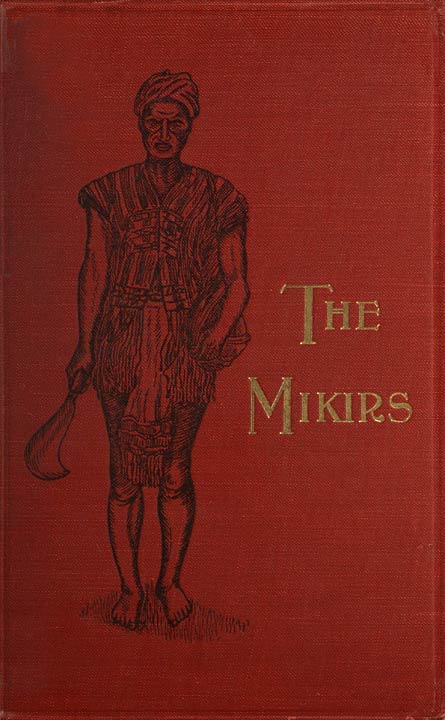
The Project Gutenberg eBook of The Mikirs
Title: The Mikirs
Author: Edward Stack
Editor: Sir Charles James Lyall
Release date: April 14, 2015 [eBook #48706]
Most recently updated: October 24, 2024
Language: English
Credits: Produced by Jeroen Hellingman and the Online Distributed
Proofreading Team at http://www.pgdp.net/ for Project
Gutenberg (This file was produced from images generously
made available by The Internet Archive)
ILLUSTRATED
LONDON
DAVID NUTT
57, 59, LONG ACRE
1908
INTRODUCTORY NOTE.
In 1882 Edward Stack, appointed the first Director of the newly-created Department of Land Records and Agriculture in Assam, entered upon his duties in that province, and applied himself with ardour to the study of its people. He had passed just ten years in the Indian Civil Service, which he joined in 1872 at the head of his year. These ten years had been fruitful in varied interest and activity: the strenuous life of a District and Settlement officer in the North-Western Provinces; secretariat employment in his own province and the Government of India; and, just before his translation to Assam, six months spent in travel in Persia.1 Activity of mind and body, and keen interest in the people and speech of all the countries he lived in, were his strongest characteristics. During the cold season of 1882–83 he spent several months in moving up and down the Brahmaputra Valley, learning, observing, and noting. He acquired a working knowledge of Assamese with surprising rapidity; with this as his foundation and instrument, he attacked the multitude of tribal languages which he found impinging on the Aryan pale. To him more than to any one else, is due the honourable distinction of the Assam Province in the grammars, vocabularies, and phrase-books of nearly all the most important of its multitudinous varieties of Indo-Chinese speech, which have been drawn up by officers and others who have served there. In 1883 the Report on the Census of 1881 in Assam was published; and in this Report, mainly the work of the Chief Commissioner, Sir Charles Elliott, the chapter on Castes and Tribes was written by Edward Stack. Paragraphs 131–136 deal with the Mikirs, and much in these represents the result of his careful personal inquiries among them. His interest in this tribe gradually grew. In 1884 he was called to take up the work of Secretary to the Chief Commissioner, and while thus employed he occupied his leisure in studying Mikir. He became acquainted with a bright young Mikir lad, a convert of the American Baptist Mission at Nowgong, named Sārdokā, to which he was accustomed to add the names of his sponsor at baptism, Perrin Kay. With the help of Mr. Neighbor’s Vocabulary of English and Mikir, with illustrative sentences,2 Stack and Sārdokā worked together at the language, correcting and largely supplementing the material contained in their text-book. From this they went on to folk-tales, which were written down, with a careful attention to systematic orthography, by Stack from Sārdokā’s dictation, each day’s work being provided with a series of notes elucidating every difficulty in it. Thus material gathered; and in the course of 1886 Stack had arranged, when relieved at the end of that year of the duties of Secretary by my return to Assam, to put together a complete account of the Mikirs and their language, fully illustrated (as his wont was) by ample variety of phrase and idiom, and a collection of stories in Mikir with commentary and vocabulary. But during the latter half of 1886 his health failed. Partly the moist climate of Assam, and partly, perhaps, unsuspected flaws of constitution, told upon his strong and active frame; and, after some months of gradually increasing weakness, he died at sea on the 12th January, 1887, aged 37, just before the vessel reached Adelaide, in South Australia, where he had planned to spend his furlough.
A few months after his death his papers were sent to me at Shillong, and for some time I hoped, with Sārdokā’s help, to be able to carry out his purpose. But the steadily increasing pressure of other duties prevented this. I left Shillong on a long tour in November, 1887, and soon after my return in the spring of 1888 I was transferred to the post of Commissioner in the Assam Valley, eventually leaving the province in the autumn of 1889 for engrossing work elsewhere, never to return, except for a brief space as Chief Commissioner in 1894. It had become evident from an examination of the materials that to do what Stack had set before him involved much more labour than I could give. It was necessary to learn the language from the beginning, to construct grammar and dictionary, and to retrace the steps which he had trodden in his progress; and this with an aptitude and power of acquisition far inferior to his. Accordingly, on my departure from Assam, the papers were made over to others, with whom they remained until, on the organization under Dr. G. A. Grierson of the Linguistic Survey of Northern India, they were again inquired for, and utilized, so far as the scope of that work admitted, in preparing an account of the Mikir language for insertion in the Survey.3
In 1904, when Sir Bampfylde Fuller had obtained the sanction of the Government of India to his scheme for the preparation of a series of descriptive monographs on the more important tribes and castes of Assam, he proposed to me to undertake an account of the Mikirs, based on Stack’s materials. There were several reasons why I hesitated to accept the task. It was many years since I had left the province, and official work and other studies claimed time and leisure. The materials were themselves in the rough—mere notes and jottings, sufficient for the man who carried the main part of his knowledge in his head, but by no means easy to interpret or set in order for one who had no such knowledge. They dated, too, from twenty years back, and in the interval great changes had occurred in the material development of the tract where the Mikirs live, which is now traversed by the Assam-Bengal Railway. I decided, nevertheless, to make the attempt, and, however imperfectly, to do something to perpetuate the work of a man to whom I was most intimately bound by affection, and whose great powers and attractive personality were the admiration and delight of all who knew him. The present volume is the result.
In addition to Stack’s notes, I received from Assam three sets of replies to ethnographical questions which had been circulated to persons acquainted with the tribe. These were from Mr. W. C. M. Dundas, Subdivisional Officer of North Cachar, and the Rev. P. E. Moore and Mr. Allen of the American Baptist Mission.4 These replies, which were not very detailed, while quite independent in origin, agreed closely with Stack’s data, and showed that the lapse of years had not made the latter inapplicable to the present time. In the following pages any information drawn from these sources has been duly acknowledged.
It was explained in the Introduction to Major Gurdon’s Monograph on the Khasis (1907) that the order and arrangement of subjects to be treated in dealing with each tribe had been prescribed by authority; and Stack’s notes had to be brought within this framework. As will be seen, under certain heads not much information is forthcoming; and perhaps the more searching standard of inquiry applied by ethnologists in the present day might demand more exhaustive treatment of some points in this presentment of the Mikir people. This, however, must be left for our successors.
Section I has been expanded by adding numerical data from the last Census (1901), and measurements from Lieut.-Colonel L. A. Waddell’s Tribes of the Brahmaputra Valley (1900). Section II (Domestic Life) is entirely due to Stack. The same is the case with Section III (Laws and Customs), except the Appendix. Section IV (Religion) is wholly Stack’s; reading the careful and minute account which it contains of the funeral ceremonies, one is strongly impressed by the thoroughness which he brought to his investigations. Section V (Folk-lore) contains translations of three of the folk-tales written down in Mikir by Stack, of which the original text, with an interlinear rendering, is given in Section VI. These translations, in both Sections, have been made by me. Stack’s manuscript supplied the Mikir text, which has been faithfully copied, and a number of explanatory notes, but no connected rendering. I have therefore had to depend upon my study of the language in the linguistic materials collected by him, and those contained in Mr. Neighbor’s vocabulary and Sārdokā’s dictionary and phrase-book. I had hoped to have the assistance of Sārdokā himself in revising the translations. He served for many years in the Assam Secretariat after Stack’s death, and helped in the preparation of the specimens of Mikir for the Linguistic Survey in 1902; but in September, 1904, he was transferred as mauzadār, or Revenue collector and administrator, to the important mauza or territorial division in the Mikir Hills called Duār Bagurī, now divided between the districts of Nowgong and Sibsagar; and on the 8th March, 1905, he most unhappily died there of cholera. Other help was not forthcoming. I must, therefore, ask for the indulgence of those better acquainted than I with Mikir in regard to these renderings. Probably they contain many errors of detail; but at least they seem to hang together as a whole, and to be consistent with what I could ascertain elsewhere of the fashion of Mikir speech. The notes are chiefly from Stack. The sketch of the Grammar in Section VI is reproduced (in a somewhat abridged form) from that which I contributed to the Linguistic Survey. Stack himself had drawn up no grammar, though he had put together much illustrative material from which the mechanism of the language could be deduced. The main facts are clear and comparatively simple, though there are not a few idiomatic expressions in the texts of which it is difficult to give a satisfactory account.
For the last Section, that dealing with the probable affinities of the Mikir race, I must take the full responsibility. It is the result of the collation and comparison of materials from many sources, and especially those contained in the three volumes of the Linguistic Survey treating of the Tibeto-Burman family of speech. The authorities on which I have relied are indicated in the text.
In the Bibliography I have entered only those works (so far as known to me) which contribute something to our knowledge of the Mikirs. I have not thought it necessary to specify mere casual allusions to the tribe, or to quote imperfect lists of words which have been superseded by more accurate material.
For the coloured illustrations I have to thank Miss Eirene Scott-O’Connor (now Mrs. Philip Rogers), and for the photographs Major Gurdon and Mr. W. C. M. Dundas; the reproductions are by Messrs. W. Griggs and Sons. The map (by Mr. J. G. Bartholomew) showing the localities inhabited by the Mikirs is taken from the new volumes of the Imperial Gazetteer of India. An explanation of the system adopted for rendering Mikir words will be found on p. 74.
C. J. LYALL.
1 The record of these travels, under the name Six Months in Persia (two vols.), was published in 1882; “A really clever and trustworthy, readable, book,” was the judgment on it of the late Sir Frederic Goldsmid—the best of all judges. ↑
4 I must apologize for the misdescription of these gentlemen at pp. 44 and 70, as of the American Presbyterian Mission. ↑
TABLE OF CONTENTS.
PAGES
Introductory Note vii–xiii
Section I.
- Numbers and Distribution 1–2
- Habitat 2–3
- Physical characters 4
- Traditions as to origin 4–5
- Dress 5–6
- Tattooing 6
- Jewellery 6
- Weapons 6
Section II.
- Occupations 7
- Houses 7–9
- Furniture 9–10
- Manufactures 10
- Agriculture and crops 10–11
- Lads’ clubs (rīsō-mār) 11–12
- Hunting and fishing 12
- Food 12–13
- Drink 13
- Luxuries 14
Section III.
- Sections or Divisions 15
- Exogamous groups 15–17
- Personal names 17
- Marriage 17–19
- Female chastity 19
- Polygamy 19–20
- Divorce 20
- Words for relationship by blood or marriage 20–21
- Inheritance 21
- Property in land 21–22
- Mikir mauzas 22
- Decision of disputes: village councils 22
- War 22
- Outsiders admitted to tribe 23
- Appendix: List of exogamous groups as given by other authorities 23–27
Section IV.
- General character of popular belief in ghosts and spirits, and a future life 28–29
- Amulets 30
- The gods and their worship 30–34
- Divination and magic 34–37
- Oaths and imprecations 37
- Funeral ceremonies 37–42
- Festivities 43
- Tabu 43
Section V.
- Character of Mikir Folk-tales 44–46
- Three stories translated:—
- 1. Story of a Frog 46–48
- 2. The Orphan and his Uncles 48–55
- 3. Harata Kuṅwar 55–70
- Appendix: The Legend of Creation 70–72
Section VI.
- Outline of Mikir grammar 73–87
- Mikir text of three stories:—
- 1. Story of a Frog 88–94
- 2. The Orphan and his Uncles 95–112
- 3. Harata Kuṅwar 113–150
Section VII.
- The place of the Mikirs in the Tibeto-Burman Family 151–172
Bibliography 173–177
Index 179–183
LIST OF ILLUSTRATIONS.
- A Mikir Man Frontispiece
- A Group of Mikirs (North Cachar)—1 To face page 5
- A Mikir Girl 6
- Plan of Mikir House Page 8
- Mikir House: Family Group To face page 10
- A Group of Mikirs (North Cachar)—2 23
- A Mikir Boy 56
- An Old Mikir Woman 59
- Women pounding Paddy 132
- Map showing Locality of Mikirs at end of volume