
The Project Gutenberg eBook of The pears of New York
Title: The pears of New York
Author: U. P. Hedrick
Contributor: E. H. Francis
G. H. Howe
O. M. Taylor
H. B. Tukey
Release date: September 29, 2014 [eBook #46994]
Most recently updated: October 24, 2024
Language: English
Credits: Produced by Steven Giacomelli, Mark C. Orton, The Internet
Archive (TIA) and the Online Distributed Proofreading Team
at http://www.pgdp.net (This file was produced from images
produced by Core Historical Literature in Agriculture
(CHLA), Cornell University)
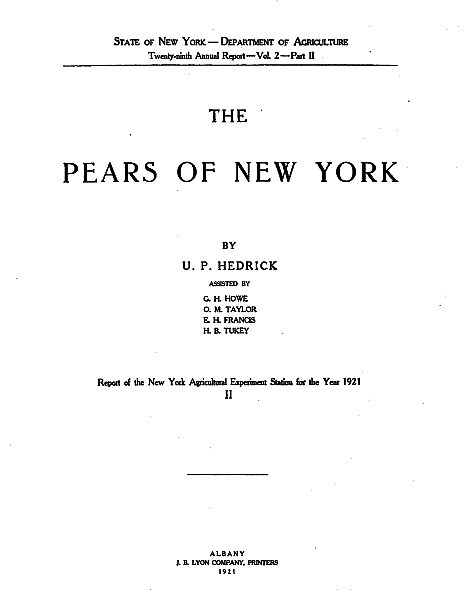
State of New York—Department of Agriculture
Twenty-ninth Annual Report—Vol. 2—Part II
THE
PEARS OF NEW YORK
BY
U. P. HEDRICK
ASSISTED BY
| G. H. HOWE O. M. TAYLOR E. H. FRANCIS H. B. TUKEY |
Report of the New York Agricultural Experiment Station for the Year 1921
II
ALBANY
J. B. LYON COMPANY, PRINTERS
1921
NEW YORK AGRICULTURAL EXPERIMENT STATION,
Geneva, N. Y., October 1, 1921.
To the Honorable Board of Control of the New York Agricultural Experiment Station:
Gentlemen:—I have the honor to transmit herewith the manuscript of the sixth of the series of monographs on fruits, to be entitled “The Pears of New York.” I recommend that, under the authority of chapter 636 of the Laws of 1919, this be submitted for publication as Part II of the report of this Station for 1921.
The wide-spread use of and frequent expressions of appreciation for the preceding books of this series are ample justification for the preparation and publication of this similar treatise on pears. Further, the added years of experience and observation of Dr. Hedrick and his assistants serve to bring each successive monograph to a higher state of excellence and completeness. The present work is a splendid example of painstaking care in the collection and compilation of all available evidence concerning all known varieties of pears.
With the publication of this volume, the series will include books on apples, peaches, plums, cherries and pears, all of our leading tree-fruits of the non-citrus type. The book on grapes and the “Sturtevant’s Notes on Edible Plants” are similar treatises published in uniform style with those dealing with tree-fruits and it is hoped that the series may eventually be extended to include similar discussions of small fruits.
“The Pears of New York” cannot fail to find an extremely useful place in the literature of fruit-growing, and its publication will be welcomed by the fruit growers of the State and by horticulturists the world over.
R. W. THATCHER,
Director
PREFACE
The Pears of New York is sixth in the series of books on hardy fruits being published by the New York Agricultural Experiment Station. The object and scope of these treatises have been given in prefaces of the preceding books, and though this work does not differ from its predecessors, for the convenience of readers the aim and the contents of the book in hand are set forth in this foreword.
Broadly speaking, the aim is to make The Pears of New York a complete record of the development of the pear wherever cultivated up to the present time. With this end in view an attempt is made: To give an account of the history and uses of the pear; to depict the botanical characters of cultivated pears; to describe pear growing in this country and more particularly in New York; and, lastly, to give in full detail the synonymy, bibliography, economic status, and full descriptions of the most important cultivated pears with brief notices of varieties of minor importance.
The reader will want to know what considerations have governed the selection of varieties for color plates and full descriptions. These are several: (1) The value of a variety for home or commercial orchards. (2) Noteworthy new varieties. (3) Varieties desirable in breeding new pears. (4) A few sorts are described and illustrated to show the trend of evolution in the pear.
In the use of horticultural names the rules of the American Pomological Society as adopted at the meeting in Columbus, Ohio, in 1919, have been followed. With a very few varieties these rules have not been followed since the changes required by their strict observance would augment rather than diminish confusion.
The references given are those that have been used in ascertaining the history and economic status or in verifying the description of varieties. The synonyms created by pomologists whose works we have had have been noted, but in no case are synonyms given only when quoted by pomologists from another writer. One of the chief aims of The Pears of New York is to set straight in high degree the names of pears.
Biographical sketches of men who have been most prominent in pear growing in the United States are to be found in the footnotes. These are written to give in some measure the credit and honor due to those who introduced new varieties or improved their culture. A knowledge of the career of these men is indispensable to a full comprehension of the industry of growing pears.
U. P. HEDRICK,
Horticulturist, New York Agricultural Experiment Station
TABLE OF CONTENTS
| PAGE | ||
| Preface | v | |
| Index to Illustrations | ix | |
| Chapter I. | —History of the Pear | 1 |
| Chapter II. | —Species of Pears and Their Characters | 57 |
| Chapter III. | —Pear Culture | 83 |
| Chapter IV. | —Leading Varieties of Pears | 122 |
| Chapter V. | —Minor Varieties of Pears | 236 |
| Bibliography, References, and Abbreviations | 589 | |
| Index | 599 | |
INDEX TO ILLUSTRATIONS
CHAPTER I
HISTORY OF THE PEAR
The pear has no history if history be defined as a record of evolution. Even the annals of the pear, which but state events in chronological order, are a heap of confused facts and dates with important data missing at every turn. The origin of the cultivated pear is so completely hidden in prehistoric darkness that it can never be known precisely from what wild pear it came. The historian must content himself with recording what the pear was when written records began; what the touch of time has done since the first written accounts; and what the events and by whom directed which have aided time in making its impressions since cultivated pears have accompanied its flight.
Happily, it does not matter much what the pear was before husbandmen appeared on the scene. But from the day the pear began to supply the needs of men, and in its turn to require ministration from those it nourished, its history becomes of importance to all mankind. Those whom it helps sustain as well as those who tend the pear, may well ask: What was the raw material when the domestication of the pear began? How has this material been fashioned into the pear of the present? Who began domestication and who has carried it forward? And, gauged by past progress, what further progress is possible? These are questions of prime importance to those who seek to improve the pear; they throw light on the culture of the pear; and they are of general interest to all husbandmen, and to all interested in the world’s food supply. The history of the pear is important, as has been said, only as it is connected with the history of man. Yet, this history must begin with the wild pear.
WILD PEARS
Botanists number from twenty to twenty-five species of pears, all of which are found in the northern hemisphere of the Old World, there being no true pear native to the southern hemisphere or to the New World. Some ten or twelve wild pears are found in China, several of which overrun the limits of China; three or four are natives of Japan; at least one has its habitat in Korea; another is to be found in the western Himalayas; while the remainder, some eight or ten species, are found westward from Turkestan, through Persia and Asia Minor into southern and western Europe and northern Africa. From these statements as to habitats it is seen that pears grow wild over a very extended area and under quite varied conditions; therefore, it would be expected that the several species are quite distinct, differing chiefly, however, from a horticultural point of view, in the fruits.
But three of these wild species are now under common cultivation, though it is possible that through hybridization the blood of one or two more are to be found in cultivated varieties. Several others have horticultural possibilities either for their fruit, as means through which new characters may be introduced into cultivated pears, or as stocks upon which to grow orchard varieties. The three species of chief horticultural importance are Pyrus communis Linn., P. nivalis Jacq., and P. serotina Rehd.
The pear of common cultivation in ancient and modern orchards is Pyrus communis, native of southern Europe and Asia as far east as Kashmir. The species is now to be found naturalized in forests and byways of northern Europe, as it is in parts of America, so that it is impossible to tell precisely what its ancient habitat was. While most often to be found in mountainous regions in the great area which it inhabits, wild pears are common enough in the forests of Europe and western Asia so that it is probable that most of the early inhabitants of this part of the Old World enlivened their fare, obtained with the spear or the bow, with ready-made food from the pear. The species runs into at least three botanical forms, a dozen or more horticultural divisions and between two and three thousand orchard varieties.
Pyrus nivalis, the Snow pear, is a small tree native of southern Europe, more particularly of Austria and northern Italy, from which region it has spread in modern times as an escape from cultivation into neighboring countries. It is called Snow pear because the fruits are not fit to eat until after snow falls. The French call it the “Sage-leaved pear” (Poirier sauger), from the fact that the under side of the leaves is covered with down so that the leaf resembles that of garden sage. The Snow pear is cultivated in southern Europe, particularly in France, for the making of perry for which purpose several varieties are grown. Probably the Greeks and Romans used fruit of this species for perry so that it may be said to have had attention from man, if not care under cultivation, from the earliest times. It is doubtful if it has been hybridized with P. communis, parent of nearly all cultivated pears. The Snow pear is not cultivated in America but is to be found in botanical collections.
From Pyrus serotina came the Japanese, Chinese, or Sand pears of pomologists. The species is a native of central and eastern China and is found wild in Japan, but whether as a native or as an escape from cultivation it is impossible to say. There are three botanical forms of the species and possibly a score of horticultural varieties cultivated for their fruits and as ornamentals. Of all the species of Pyrus found in western Asia, this, in the light of present knowledge, is most closely related to the common pear, with which it hybridizes freely.
We have now discovered in what countries the progenitors of cultivated pears grow spontaneously, and are therefore ready to search for the first landmarks in the domestication of the three cultivated species. What has ancient literature to say on the subject? We turn first to the Bible and find that the pear is not mentioned in sacred literature, and that, according to commentators on the Sanscrit and Hebrew languages, there is no name in the tongues of Biblical lands for the pear. Nor should we expect ancient notices of the pear in north-west India or Persia, for the pear does not flourish in hot countries. The survey next turns to ancient Greece where landmarks are at once sighted which must be put down as the earliest records of the pear, and as such deserve full consideration.
THE PEAR IN ANCIENT GREECE
In ancient Greece we find the first landmarks and begin the history of the pear as a cultivated plant. It is wrong, however, to assume that the beginning of the cultivation of the pear, or of any plant, was contemporaneous with the writing of even the oldest books. Mention of a cultivated plant in a book is proof that its domestication antedates the writing of the book. It is not easy to imagine tribes of semi-civilized men in southern Europe and Asia who did not make use of the apples, pears, quinces, plums, cherries, almonds, olives, figs, pomegranates, and grapes which grew wild in this land of gardens and orchards, and who did not minister to their needs as husbandmen long before men wrote books. Names for orchard operations, as planting, grafting, and pruning, in the simplest dialects of primitive peoples, establish the fact that husbandry long antedates writing, as would be expected from the greater need of the one than of the other.
Plutarch, a Greek writer, A.D. 50-120, enlightens us as to the early use of the pear by the Greeks, and also as to the Grecian name for the fruit and tree. He says in his Greek Questions (51):
“Why do the boys of the Argives playing at a certain festival call themselves Ballachrades? (Ballo, I throw; achras, a wild pear.)
“It is because they say that those who were first brought down by Inachus (founder of Argos) from the rural districts into the plains were nourished on wild pears (achrades). But wild pears (they say) were first seen by the Greeks in Peloponnesus, when that country was still called Apia; whence wild pears were named apioi. (Apios, a pear-tree; apion, a pear.)”
The pear is one of the “gifts of the gods” which Homer tells us grew in the garden of Alcinöus. It is certain, therefore, whether or not this is the earliest mention of the pear in Greek literature, that in Homer’s time, nearly one thousand years before the Christian era, the pear was cultivated in Greece. As this garden of Alcinöus furnishes the earliest noteworthy landmarks of the pear, and is moreover the most renowned of heroic times, an early paradise of trees, vines, and herbs, it is worth while to take a look at it with a view of discovering the status of the pear at this early date. Stripped of the harmonious rhyme and pleasing rhythm of Homer’s poetry, the garden is described in English prose as follows:
“And without the court-yard hard by the door is a great garden, of four plough-gates, and a hedge runs round on either side. And there grow tall trees blossoming, pear-trees and pomegranates, and apple-trees with bright fruit, and sweet figs, and olives in their bloom. The fruit of these trees never perisheth, neither faileth winter or summer, enduring through all the year. Evermore the West Wind blowing brings some fruits to birth and ripens others. Pear upon pear waxes old, and apple on apple, yea, and cluster ripens upon cluster of the grape, and fig upon fig. There too hath he a faithful vineyard planted, whereof the one part is being dried by the heat, a sunny plot on level ground, while other grapes men are gathering, and yet others they are treading in the wine-press. In the foremost row are unripe grapes that cast the blossom, and others there be that are growing black to vintaging. There too, skirting the furthest line, are all manner of garden beds, planted trimly, that are perpetually fresh, and therein are two fountains of water, whereof one scatters his streams all about the garden, and the other runs over against it beneath the threshold of the court-yard, and issues by the lofty house, and thence did the townsfolk draw water.—These were the splendid gifts of the gods in the palace of Alcinöus.[1]”
Divested of the spell with which the poet’s flight of imagination bewitches us, we find that the wonderful garden of Alcinöus is, after all, rather trifling, probably of small extent, and containing an orchard, a vineyard, garden beds and two fountains of water, which brings us to the conclusion that this renowned garden would cut but a sorry figure beside modern gardens; but, on the other hand, we are made sure that certain fruits, among them the pear, were commonly cultivated in Greece a thousand years before Christ’s time. There is no hint in Homer as to whether there were as yet varieties of pears, or as to whether fruits were as yet pruned, grafted, fertilized and otherwise cared for. For indications that these arts of the orchard were under practice, we must pass on to the writings of another great Greek, Theophrastus.
Between Homer and Theophrastus nearly 600 years intervene, in all of which time traces of the pear are few and uncertain. But from Theophrastus, to whom botanists accord the title “Father of Botany,” we know that orcharding had been making progress, and that the pear, among other fruits, must have been as well known and nearly as well cared for in his time, 370-286 B.C., as in this twentieth century. All the expedients we now know to assist nature to bring pears to perfection, save spraying and cross-pollination, were known to Theophrastus, although of course the evolution from the wild state as indicated by number and diversity of kinds had not progressed so far. Out of one of the books of Theophrastus, Enquiry into Plants, a very good treatise on the pear might be compiled and one better worth following than many of his more modern imitators. To quote Theophrastus at length is impossible, but space must be given to a summary of what he says about pears.
Theophrastus distinguishes between wild and cultivated pears and says that the cultivated forms have received names. He speaks of the propagation of pears from seeds, roots, and cuttings and makes plain that plants grown from seed “lose the character of their kind and produce a degenerate kind.” Grafting is described. The nature of the ground is said to regulate the distance for planting pears, and the lower slopes of hills are recommended as the best sites for pear orchards. Root-pruning, girdling the stems, and driving iron pegs in the trunk and other methods of “punishing” trees are said to hasten the bearing time. Even the necessity of cross-pollination is recognized though of course the reasons for it are not known. Thus, Theophrastus says: “Trees which are apt to shed their fruit before ripening it are almond, apple, pomegranate, pear, and, above all, fig and date-palm; and men try to find the suitable remedies for this. This is the reason for the process called ‘caprification’; gall-insects come out of the wild figs which are hanging there, eat the tops of the cultivated figs, and so make them swell.” The growth of the pear on various soils and in diverse situations is compared; he makes mention of a “peculiar, red and hairy worm” which infested the pear of these old Greek orchards. In Pontus, it is stated, “pears and apples are abundant in a great variety of forms and are excellent.” “General diseases” are enumerated as “those of being worm-eaten, sun-scorched, and rot.” Certain affections due to season and situation are mentioned, as freezing, scorching, and injury from winds.
This is but a brief epitome of what Theophrastus writes of the pomology of the Greeks, and only topics in which the pear is specifically mentioned are set down and not all of these. By inference, one who reads Theophrastus might apply much more to the pear. Yet enough has been said to prove the point that pear culture was as well established in Greece 300 years B.C. as in 1900 years A.D. One leaves Theophrastus, satisfied that pear-growers of his day had about the same problems that growers have nowadays and solved them by the same sort of reasoning intelligence.
In crediting Theophrastus as the earliest writer on pomology, we may assume that there were earlier writers from whom he must have received much knowledge. Perhaps greater writers on botany and pomology preceded him, since he cites older authors on the same subjects whose books have been lost. His alone of the books of its kind have come down to us from ancient Greece. Theophrastus was the friend and pupil of Aristotle, another philosopher and prince of science, and both in turn were taught by Plato. Who shall say, then, from whence Theophrastus received his knowledge? Aristotle is said to have written two books on botany antedating the Enquiry into Plants of Theophrastus, neither of which has survived the passing centuries. May not these great minds have been indebted to authors whose books and names have perished? These speculations serve to remind us again that the beginnings of botany and pomology long antedate written records.
There were Greeks who wrote on agriculture after Theophrastus, and before the Roman treatises on farm management, a few of which are to be mentioned in the next topic. Of books, as monuments of vanished minds, however, there are none to indicate the activities of Greek farmers who wrote, but there are citations to show that ancient Greek literature on farming was voluminous. Thus, Marcus Terentius Varro (B.C. 116-28), called “the most learned of the Romans,” in his eightieth year wrote a book on Roman agriculture for the guidance of his wife in the practice of farming. Learned old Varro believed in “book farming,” or science with practice, of which we hear so much nowadays. He begins his treatise by invoking Greek and Roman deities to aid his wife, and names fifty monographs on husbandry written by Greeks, in which, he tells this early farmerette, she will find all of the practical information she needs. This is but one of several sources from which we learn that in the making of books on agriculture there was no end in the heroic days of Greece as in modern times.
THE PEAR IN ANCIENT ROME
Italy, by common consent, is the garden of the world, and it would be strange if the pear had not been taken to this favored land with the earliest tillers of orchards, or if attempts had not been made to domesticate the wild pears found in the northern mountains. And so we may assume, with no very definite proofs, that the pear was cultivated in ancient Rome some hundreds of years before the Christian era. In Cato, the first book written in Latin on agriculture, the pear is discussed, and six varieties are named and described. What had this illustrious Roman, known generally as a statesman and scholar, to do with pomology?
Marcus Portius Cato (B.C. 235-150), called the elder Cato, besides serving Rome in state and army, wrote a treatise on farming, fruit-growing, and gardening, which, first of its kind in Latin literature, may be read with greater profit than the works of most writers of our own day in agriculture. Cato was preeminently the first agricultural philosopher, and no one who has followed him has packed more shrewd agricultural philosophy in a book than he. But it is as a pomologist that Cato concerns us most at this time. Cato describes almost every method of propagating, grafting, caring for, and keeping fruits known to twentieth-century fruit-growers. He describes, also, many varieties of fruits, as well as of vegetables, grains, and breeds of farm animals. Among Cato’s fruits are six varieties of pears. What is of especial interest in this history is that Cato writes as if the practices of agriculture and the plants and animals he described were not only established but ancient in his time.
Varro, whose standing as a Roman writer on agriculture is noted above, says nothing of varieties of pears, but gives directions for grafting pear-trees, among other methods that of inarching of which he seems the first ancient writer to take note, thereby justifying, in small degree, it is true, the appellation often given him, “the most modern of all the ancients.” Varro also tells how pears should be stored. While, therefore, he says nothing that helps in following the evolution of the pear, yet his accounts of grafting and storing make plain the fact that this fruit was a standard product of the times. Were it worth while, still other early Roman treatises on husbandry might be quoted to establish the place of the pear in the agriculture of ancient Rome, but it is chiefly in the evolution of the fruit we are concerned and so pass from Varro to Pliny, who, in his Natural History, adds to Cato’s six varieties thirty-five new sorts, giving a total of forty-one for the generation following Christ.
Pliny, more or less discredited as a scientist because he was a compiler and, as the men of science for science sake never forget to point out, at all times of a utilitarian bent of mind, makes a most important contribution to the history of the pear as a domesticated fruit. Indefatigable compiler as he was, few cultivated pears of his or more ancient times could have escaped his notice, and the thread of the utilitarian running through his Natural History makes all the more important what he has to say in this study of the domestication and improvement of the pear. A good authority says that there are sixty manuscript copies of Pliny and eighty different editions, no two of which are exactly alike. Allowing some latitude, therefore, to the translator, Pliny’s descriptions of pears run as follows: