
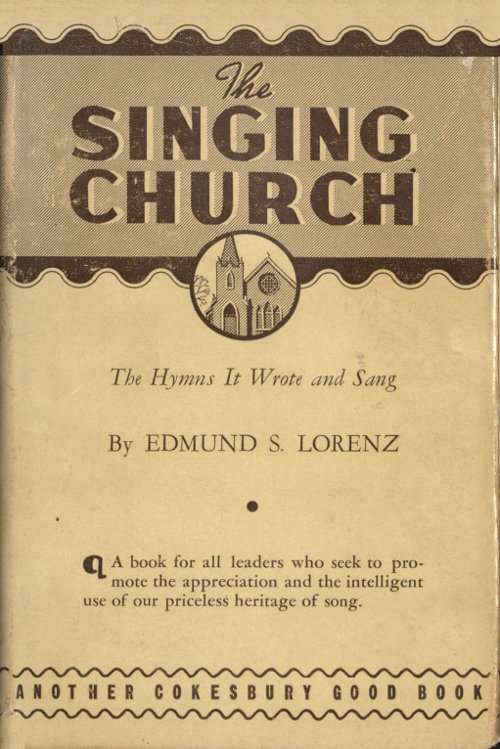
The Project Gutenberg eBook of The Singing Church: The Hymns It Wrote and Sang
Title: The Singing Church: The Hymns It Wrote and Sang
Author: Edmund S. Lorenz
Release date: February 13, 2020 [eBook #61393]
Most recently updated: October 17, 2024
Language: English
Credits: Produced by Stephen Hutcheson and the Online Distributed
Proofreading Team at http://www.pgdp.net
THE
SINGING CHURCH
THE HYMNS IT WROTE AND SANG
By
Edmund S. Lorenz, LL.D., Mus. Doc.
AUTHOR OF
MUSIC IN WORK AND WORSHIP
PRACTICAL HYMN STUDIES
PRACTICAL CHURCH MUSIC
CHURCH MUSIC
COKESBURY PRESS
NASHVILLE
THE SINGING CHURCH
Copyright, MCMXXXVIII
By WHITMORE & SMITH
All rights in this book are reserved. No part of the text may be reproduced in any form without written permission of the publishers, except brief quotations used in connection with reviews in a magazine or newspaper.
Set up, electrotyped, printed, and bound by the Parthenon Press at Nashville Tennessee, United States of America
“Be filled with the Spirit; speaking to yourselves in psalms and hymns and spiritual songs, singing and making melody in your heart to the Lord.” (Eph. 5: 18, 19.)
PREFACE
In preparing this discussion of the Christian hymn, it has been my ambition, not to be pre-eminently scholarly, but rather to be pre-eminently helpful. The current treatment of this phase of church worship is quite sufficiently thorough in its literary analysis and historical research; there is nothing but praise for this aspect of the study of the hymn in the many excellent treatises in America as well as in England.
The fathers of American hymnology, Professors Austin Phelps and Edwards A. Parks and Rev. Daniel L. Furber, set a good example to later hymnologists in their Hymns and Choirs in laying stress on the thought and sentiment of the hymns and in devoting nearly one-third of their study to “The Dignity and the Methods of Worship in Song,” discussing choirs, congregational singing, organs, and many other practical phases in the use of hymns. They gave little consideration to the historicity of individual hymns; that viewpoint had not risen above the horizon.
Later works have given more attention to the historical background. The work of Dr. Louis F. Benson, the greatest hymnologist America has produced, cannot be too highly commended for its scholarly thoroughness and indefatigable research. His The English Hymn and The Hymnody of the Christian Church should be found in the library of every minister. Other valuable American treatises on hymns are Ninde’s Story of the American Hymn, Gilman’s Evolution of the English Hymn, Reeves’ The Hymn as Literature, Marks’ Rise and Growth of English Hymnody, and Tillett’s Our Hymns and Their Authors, all of which are most helpful and illuminating discussions bearing on the literary and historical aspects of Christian hymns. On the other side of the sea are other most valuable studies of the hymn. Horder’s The Hymn Lover is particularly fresh and inspiring. Others are instructive regarding the individual hymns, such as Josiah Miller’s Singers and Songs of the Church, John Telford’s The Methodist Hymn-Book Illustrated and Evenings with the Sacred Poets, and W. T. Stead’s Hymns That Have Helped. Supreme above them all is Julian’s Dictionary of Hymnology, which is a stupendous work of vast comprehensiveness and indefatigable industry, the last word in the history and critical study of Christian hymns of all lands and all Christian ages.
The justification of another survey of the field lies in the fact that all these admirable books confine themselves to the purely literary and historical data regarding each hymn, with side glances in only a few cases at the practical values involved. While the fundamental urge of expressing religious emotions back of Christian hymns is not denied or even deprecated, the emotional values are not developed or stressed.
In order to assure this lacking element of practical helpfulness, this discussion includes four chapters on the purposeful use of hymns in the work of the Church.
It is proper that I should recognize the sympathetic and cordial helpfulness in an advisory way of Professor Herman von Berge, my editorial associate in the musical work to which I have devoted the larger part of my life. His scholarship and wide practical experience, both as pastor and theological seminary professor, have helped me solve some problems that rather daunted me. Acknowledgment is also due to my son, Rev. Edward H. Lorenz, and to Mrs. F. C. Goodlin, my private secretary, in typing and proofreading my longhand manuscript. Last but not least, the co-operation of my brother, Dr. D. E. Lorenz, organizer of the church of the Good Shepherd in New York City and its pastor for thirty-four years, in the indexing and proofreading, calls for grateful recognition. Only an experienced author can fully measure the value of such efficient helpers.
E. S. L.
Dayton Ohio.
CONTENTS
- INTRODUCTION 17
- THE PLACE AND IMPORTANCE OF THE HYMN.
- The Impulse to Sing Is Constitutional in Man.
- Biblical Authority for the Singing of Hymns.
- The Use of Hymns in the Development of the Christian Church.
- Cultural Value of Hymns.
- Spiritual Value of Hymns.
- The Value of Singing Hymns Too Often Overlooked.
- The Need of Emphasis on Efficient Use of Hymns.
- PART I
THE CHARACTER OF THE HYMN - CHAPTER I
- WHAT IS A HYMN? 25
- I DEFINITION OF THE HYMN.
- Importance of Accurate Definition.
- Inadequate Definition.
- Definition Must Be Based on Practical Considerations.
- Types of Hymns.
- Definition of the Congregational Hymn.
- II THE HYMN MUST BE POETRY.
- To Be Poetry, It Must Be Emotional.
- It Must Have Poetical Form.
- It Must Be Poetic in Spirit.
- The Hymn Must Have Unity.
- The Poetical Element Is Contributory Only.
- III THE CHRISTIAN HYMN MUST BE DISTINCTLY RELIGIOUS.
- Poems of Semi-religious Fancy Are No Hymns.
- Mere Moralizing Will Not Serve.
- Special Propaganda Is Not Admissible.
- Christian Hymns Should Be Genuinely Christocentric.
- IV SCRIPTURAL ELEMENTS OF THE HYMN.
- Hymns Based on the Scriptures.
- Use of Scriptural Forms Desirable.
- V THE HYMN MUST BE FITTED FOR MASS SINGING.
- Congregational Singing Is a Pronouncedly Christian Exercise.
- Meter Essential to Mass Singing.
- VI PRACTICABILITY FOR ACTUAL USE.
- Ideas Must Be Plainly Evident.
- Hymns May Not Be Extremely Individualistic.
- Distracting Figures and Forms of Expression.
- Verses Must Be Complete in Themselves.
- Musical Limitations.
- Outworn Hymns.
- Mistaken Objections to Some Hymns.
- CHAPTER II
- THE PURPOSE AND VALUE OF HYMNS 40
- I THE IMPULSE TO WRITE HYMNS.
- II PURPOSE IN WRITING HYMNS.
- The Influence of Purpose.
- The Purpose Must Affect Only the Practical Aspects.
- III PURPOSE OF THE USER OF HYMNS.
- IV PURPOSES SERVED BY SINGING HYMNS.
- Hymns Unite Christians in Worship and Christian Activities.
- Hymns Concentrate Interest and Attention.
- Hymns Afford a Means of Expression for the Congregation.
- Hymns Provide Help and Comfort in Dark Hours.
- Hymns Afford Clear Expression of Christian Truth.
- Hymns Give Opportunity for Active Participation by All.
- Hymns Provide Variety.
- Hymns Create a Religious Atmosphere.
- Hymns in the Home.
- Hymns in Personal Work.
- V REASONS FOR THE MINISTER’S APPRECIATION OF HYMNS.
- Hymns Are Evidence of the Effect of the Bible.
- Hymns and Psalms Affected the Life of Church.
- Hymns in Personal Christian Experience.
- Hymns as Stimulating the Spiritual Life of the Minister.
- Hymns Approved by Paul.
- Hymns in the Early Church.
- Hymns Prepared the Church for Periods of Marked Progress.
- VI STRANGE INDIFFERENCE TO HYMNS.
- The Minister’s Indifference.
- Indifference of the Congregation.
- CHAPTER III
- THE LITERARY ASPECT OF HYMNS 53
- I WHAT MAKES THE HYMN LITERATURE?
- Its Character as a Transcript of Life.
- Its Wide Distribution.
- Its Acceptance Through Many Generations.
- Its Profound Influence.
- II OBJECTIONS TO RECOGNIZING ITS LITERARY CHARACTER.
- Due to Narrow Definition of Literature.
- Due to Failure to Realize Limitations of Hymns.
- Some Critics and Their Criticisms.
- III THE WRITING OF HYMNS.
- The Handicap of Thought and Diction.
- The Handicap of Meter.
- IV LITERARY QUALITY NOT TO BE OVERESTIMATED.
- Literary Quality Not the Supreme Consideration.
- Literary Quality Should Be Subconscious.
- CHAPTER IV
- THE EMENDATION OF HYMNS 63
- I THE CHANGES IN OUR HYMNS.
- Early Changes.
- The Abuse of the Editorial Revision.
- The Return to the Originals.
- II PRINCIPLES OF EQUITY INVOLVED IN THESE CHANGES.
- The Rights of the Original Writer.
- The Limits of the Author’s Rights.
- III EFFECT OF CHANGES ON QUALITY.
- Loss of Original Writer’s Vision.
- Biblical Precedent.
- IV ANALYSIS OF CHANGES MADE.
- The Omission of Verses.
- Reconstructing and Rewriting Faulty Hymns.
- Minor Felicitous Changes.
- CHAPTER V
- THE CONTENT OF THE HYMN 76
- I ITS RELATION TO GOD.
- Thanksgiving.
- Prayer for Future Blessing.
- Adoration.
- The Hymn of Communion.
- II RELATION TO THE SINGER.
- The Hymn of Emotion.
- The Hymn of Inspiration.
- The Hymn of Personal Experience.
- The Hymn of Meditation.
- The Hymn of Exhortation.
- The Didactic Hymn.
- The Doctrinal Hymn.
- The Homiletical Hymn.
- The Hymn of Propaganda.
- Hymns of the Social Gospel.
- Special Hymns.
- The Great Hymnic Themes.
- CHAPTER VI
- THE GOSPEL HYMN 89
- Lack of Discrimination.
- Wrong Assumptions of the Opposition.
- Unfairness in Comparisons Made.
- Criteria for Evaluation.
- Gospel Hymns and the Unsaved.
- Gospel Hymns and the Demands of Worship.
- Gospel Hymns in the Preparatory Service.
- Gospel Hymns in the Laboratory.
- The Advantages of Gospel Hymns.
- Discrimination in the Use of Gospel Songs Needed.
- PART II
HISTORY OF THE DEVELOPMENT OF THE CHRISTIAN HYMN - CHAPTER VII
- APOSTOLIC ORIGIN AND DEVELOPMENT 103
- SACRED SONG IN THE NEW CHRISTIAN CHURCH.
- The Rise of Sacred Song in Apostolic Times.
- Apostolic Emphasis of Sacred Song.
- Traces of Hymns in the Epistles.
- The Hymns of the Apocalypse.
- “The Odes of Solomon.”
- The Failure of Apostolic Spiritual Songs to Survive.
- CHAPTER VIII
- THE POST-APOSTOLIC HYMN 109
- The Post-Apostolic Church a Singing Church.
- The Earliest Surviving Hymns.
- The Relation of Hymns to Psalms and Canticles.
- The Hymn as Propaganda.
- CHAPTER IX
- THE GREEK HYMNODY 114
- Introduction. THE SYRIAC HYMN-WRITERS.
- I EARLY GREEK HYMNS.
- II THE LATER GREEK HYMNS.
- CHAPTER X
- THE LATIN HYMNODY 119
- I THE BEGINNING OF LATIN HYMNODY.
- II EARLY LATIN HYMN-WRITERS.
- III GREAT LATIN HYMNS.
- IV MEDIEVAL DEVOTIONAL POEMS.
- V MEDIEVAL POPULAR HYMNODY.
- CHAPTER XI
- LUTHER AND THE GERMAN HYMN 130
- I PRE-REFORMATION VERNACULAR HYMNS.
- II LUTHER’S RELATION TO GERMAN HYMNODY.
- CHAPTER XII
- THE LATER GERMAN HYMNODY 137
- I THE RISING STANDARD OF LITERARY VALUES.
- II THE GOLDEN AGE OF GERMAN HYMNODY.
- III THE PIETISTIC HYMN-WRITERS.
- IV GERMAN REFORMED HYMNODY.
- V TRANSITION TO RATIONALISTIC HYMNS.
- VI RATIONALISM IN HYMNODY.
- VII HYMNS OF RENEWED RELIGIOUS LIFE.
- VIII HYMNS OF PIETISTIC TYPE.
- CHAPTER XIII
- METRICAL PSALMODY 148
- I CALVIN’S CONCEPTION OF CONGREGATIONAL SINGING.
- II CALVIN’S FOLLOWERS MORE EXTREME.
- III MAROT’S SUCCESSFUL VERSIONS.
- IV DEVELOPMENT OF THE GENEVAN PSALTER.
- V ENGLISH PSALM VERSIONS BEFORE STERNHOLD.
- VI VERSION OF STERNHOLD AND HOPKINS.
- VII THE SCOTCH VERSION.
- VIII ROUS’ VERSION.
- IX TATE AND BRADY’S “NEW VERSION.”
- X AMERICAN PSALMODY.
- XI THE VALUE OF THE PSALM VERSIONS.
- CHAPTER XIV
- THE ENGLISH HYMN BEFORE WATTS 158
- I THE EARLIEST ENGLISH HYMN.
- II ENGLISH HYMNODY SUBMERGED BY REFORMED PSALMODY.
- III ENGLISH LITERARY IDEALS UNFAVORABLE TO HYMN-WRITING.
- IV THE DEVELOPMENT OF THE TECHNIC OF WRITING SINGING HYMNS.
- V THE IDEAL OF THE SINGING HYMN REALIZED.
- CHAPTER XV
- ISAAC WATTS AND HIS PERIOD 168
- I THE HYMNIC NEED OF THE TIME.
- II THE LIFE OF WATTS.
- III WATTS AS A HYMN-WRITER.
- IV WATTS’ ARGUMENT FOR THE HYMN.
- V WATTS’ INSISTENCE ON PRACTICABILITY.
- VI THE INESTIMABLE VALUE OF WATTS’ HYMNS.
- VII CONTEMPORARIES OF WATTS.
- CHAPTER XVI
- THE WESLEYS AND THEIR ERA 180
- I THE INFLUENCE OF WATTS ON THE WESLEYS.
- II THE HOME OF THE WESLEYS.
- III THE MORAVIAN INFLUENCE.
- IV JOHN WESLEY.
- V CHARLES WESLEY.
- VI CHARLES WESLEY’S HYMNS QUITE SUBJECTIVE.
- VII WATTS AND CHARLES WESLEY.
- VIII ISSUES OF THE WESLEYAN HYMNS.
- IX THE METHODIST TUNES.
- X INFLUENCES OPPOSING THE WESLEYAN HYMNS.
- XI OTHER METHODIST HYMN-WRITERS.
- XII CALVINISTIC-METHODIST HYMN-WRITERS.
- XIII BAPTIST HYMN-WRITERS.
- CHAPTER XVII
- HYMNS IN THE CHURCH OF ENGLAND 193
- I RISE OF SPIRITUAL LIFE IN THE ENGLISH CHURCH.
- II EARLY COLLECTIONS OF EVANGELICAL HYMNS.
- III EVANGELICAL HYMN-WRITERS.
- IV HYMN-WRITERS OF THE ROMANTIC SCHOOL.
- V CONTEMPORARY HYMN-WRITERS.
- VI MINOR HYMN-WRITERS.
- VII THE HYMNS OF THE OXFORD MOVEMENT.
- CHAPTER XVIII
- AMERICAN HYMNODY 209
- I THE TRANSITION FROM PSALMODY TO HYMNODY.
- II THE INTRODUCTION OF WATTS’ HYMNS.
- III THE BEGINNINGS OF AMERICAN HYMNODY.
- IV COLLECTIONS OF AMERICAN HYMNS.
- V EPISCOPAL HYMN-WRITERS.
- VI UNITARIAN HYMNODY.
- VII LATER ORTHODOX HYMN-WRITERS.
- PART III
PRACTICAL HYMNOLOGY - CHAPTER XIX
- THE STUDY OF HYMNS 229
- I IMPORTANCE OF THE STUDY OF HYMNS.
- II PERSONAL ADVANTAGES OF SUCH STUDY OF HYMNS.
- Literary Pleasure.
- Literary Culture.
- Development of Emotional Nature.
- III THE PRACTICAL VALUES OF INDIVIDUAL HYMNS.
- Classifying Hymns by Their Nature.
- Classifying Hymns by Their Fitness for Definite Purposes.
- IV THE MINUTE STUDY OF HYMNS.
- Analysis of the Hymn.
- The Background of the Hymn.
- Making a Hymnal of His Own.
- Memorizing Hymns.
- V A STUDY OF METHODS OF USE.
- Using Hymns in Sermons.
- Studying Responsiveness of the Congregation.
- Studying Methods of Announcement and Securing Participation.
- Studying Use of Hymnal for Specific Purposes.
- VI A STUDY OF THE TUNES.
- CHAPTER XX
- THE PRACTICAL USE OF HYMNS 248
- I THE HYMN AS A MEANS TO AN END.
- II ANALYSIS OF PRACTICAL APPLICATION OF HYMNS.
- III THE USE OF HYMNS FOR CREATING RELIGIOUS INTEREST.
- IV THE HYMN AS AN OPPORTUNITY FOR TEACHING TRUTH.
- V HYMN SERMONS AND HYMN SERVICES.
- VI THE USE OF HYMNS IN EMERGENCIES.
- CHAPTER XXI
- THE SELECTION OF HYMNS 256
- I SELECTION SHOULD SECURE UNITY OF SERVICE.
- Narrow Conception of Unity.
- Broader Conception of Unity.
- Unity Based on Purpose.
- II SUGGESTIVE SELECTIONS OF HYMNS.
- Hymns for Service on God’s Omnipotence.
- Hymns for Service on God’s Love.
- Hymns for a Missionary Service.
- III IMPORTANCE OF THE TUNES.
- CHAPTER XXII
- THE ANNOUNCEMENT AND TREATMENT OF HYMNS 266
- I THE ANNOUNCEMENT OF HYMNS.
- II THE TREATMENT OF HYMNS.
- EPILOGUE 274
- REFERENCES AND NOTES 277
- GENERAL INDEX 285
- INDEX OF HYMNS 291
INTRODUCTION
THE PLACE AND IMPORTANCE OF THE HYMN
The Church of God has been and is a singing church. This was true in the antediluvian centuries, which was its seminal period, for some of its canticles have survived. In its pupal stage, the Old Testament church life developed both the form and the content of the future hymnody.
To the solo forms of the preceding period, the Mosaic social and religious organization now adds both the choral and the congregational forms of vocal worship. To the fear and awe of previous generations, the Christian development of the Church of God has added the intimate phases of adoration, of gratitude, of love, based on consciousness of communion with the Triune Deity.
Outside of the Israelitish Church and its Christian consummation, there has been little or no song in religious worship. The heathen deities were honored only with rude vocal and instrumental noises made by temple singers and players. It is the Church of God under all dispensations which was a singing church. To this day the voice of sacred song is practically absent from heathen temple.
The Impulse to Sing Is Constitutional in Man.
In the beginning, song was a spontaneous expression of feeling, being based on man’s original constitution as fully as breathing or speaking. Its exercise did not rise high enough in the consciousness of men, nor so conspicuously affect the current of events, that account should be made of it in the sketchy outlines of the early history of the race. None the less do we hear unrelated echoes from Lamech and Jubal,[1] and from Laban’s complaint that Jacob gave him no opportunity to bid farewell “with songs, with tabret, and with harp.”[2] During the great Exodus, these echoes multiply and become more articulate at the Red Sea,[3] at the digging of the well at Beer,[4] about the walls of Jericho,[5] Deborah,[6] Barak,[7] and Hannah,[8] and the school of the prophets,[9] developing a grand crescendo which culminates in the full-voiced chorus and orchestra of the times of David and Solomon.[10] Undoubtedly all these were surviving manifestations of the unbroken tide of social and religious song that flowed on through the ages. The Hebrew church carried on the model constructed by the organizing instinct of Samuel and the musical and literary genius of David, through the succeeding ages, and passed on the devotional impulse to the Christian Church.
Biblical Authority for the Singing of Hymns.
If any authority for the use of hymns were needed beyond the unfailing urge of a sanctified soul to find expression for its spiritual experiences and to persuade other souls to seek a like blessed privilege, there would be ample provision in the development of religious song in the Jewish church, in the participation of Jesus in such a song at so high a peak of religious solemnity as the institution of “The Lord’s Supper,”[11] in the use of song by the Apostles in their private meetings and in unusual personal experiences from the very beginning,[12] in the exhortations of Paul[13] and James,[14] and in the choral scenes of the great Apocalypse.[15]
The Use of Hymns in the Development of the Christian Church.
But the use God has made of song through the succeeding centuries of the development of the Christian Church, is an even more striking indication of the high importance placed upon sacred song by the divine mind.
The results of the thoughtful use of song, both in ancient times and the recent past, abundantly illustrate its value and are genuine laboratory proof of its power in deepening the spirituality of individuals, of communities, and even of nations. The hymns of Huss and of Luther, the psalmody of Calvin and of Knox, the preparatory effect of the hymns of Watts for the great Second Reformation in England and its intensification by the hymns of the Wesleys, the joyous singing of rudely fashioned psalms and the newly introduced hymns in the Great Awakening in New England, the great evangelistic movement in America and in England with its enthusiastic singing of unpretentious Gospel songs—all establish on unquestionably scientific basis the spiritual value of sacred song.
Cultural Value of Hymns.
Compare the number of people in any given city or community who read poetry in any of its forms with the number of church attendants who read, even when they do not sing, from three to eight hymns every Lord’s Day. In literary influence, unconsciously absorbed, this wide use of hymns is vastly more effective upon the public at large than the more intensive and conscious influence of distinctly literary verse.
Millions of homes in Great Britain and America have copies of the Bible and of some hymnbook, while few of them have books of poetry. Phrases from hymns and psalms are a large part of the religious vocabulary of millions. They are quoted not only in sermons, but in essays and general writings and in the public press, perhaps more generally than are poems.
They have been appreciated by the greatest minds, who found them to be of great comfort and even delight, including such men as Benjamin Franklin (who first issued Watts’ hymns in America), George Washington, John Adams, Thomas Jefferson, and William Ewart Gladstone. They deeply interested the man, Matthew Arnold, although the literary critic, Matthew Arnold, had no use for them.
Spiritual Value of Hymns.
Hymns touch and influence the most intimate life of men, the moral and spiritual, and are always influential for good. They concentrate the comforting truths of the Gospel, make them rememberable; what is even more important, they add the emotional vitality to those truths that make them real and actual.
To leave out the hymns from a single service might be an interesting experiment; but omit them permanently, as was the former custom among the Friends, and note how arid and flat the service becomes.
To some, the hymnbook is simply the Bible in another form, bringing its doctrines, its ideals, its hopes, its promises, its comforts, and its spiritual inspirations in a more apprehensible form. Having passed through the crucible of the actual personal experience of the writers of the hymns, they are more concrete, more appealing, more actual.
The Value of Singing Hymns Too Often Overlooked.
Since the hymn has so high a spiritual value, it is all the more distressing that its possibilities of spiritual helpfulness are so generally overlooked and ignored by our ministers and their people. Even where it seems to be distinctly cultivated and emphasized, it is often the merely physiological effects that are sought. In other apparently earnest endeavors to develop its value, there is the aridity of merely artistic and literary emphasis, or the formal liturgical aspect that is stressed!
There is an absence of clear comprehension of what the hymns are intended to accomplish, of their meaning, of the emotions they are supposed to express, and of the methods to be used to vitalize them and to make them effective. They are used mechanically, in deference to tradition and good ecclesiastical form. Most ministers select hymns to fit the themes of their discourses, fitness depending solely on logical relations.
The spiritual life of the churches is not only the poorer and the shallower because of this loss of the quickening influence of the hymn, but this mechanical attitude is carried over to the other exercises of the divine service. The preacher who sings mechanically will pray mechanically, preach mechanically.
The Need of Emphasis on Efficient Use of Hymns.
The actual fact is that in the hymn the preacher has a most valuable factor in making his service spiritually effective. Even as a perfunctory exercise it has at least a social value; but if its emotional and spiritual possibilities are fully developed and exploited, it becomes one of the most impressive and thrilling means of securing genuinely religious results among his people. It is a tragedy that so many clergymen have such dull and unattractive services when through a proper use of hymns they might be made thrillingly interesting. Professor H. M. Poteat, of Wake Forest College, does not use too severe language in his Practical Hymnology when he says, “As a result of inexcusable ignorance, carelessness, and laziness, the singing of hymns, in all too many churches, instead of being an act of worship, has degenerated into a mere incident of the service, holding its place solely because of immemorial custom.”
It is the purpose of this treatise at least to prevent the ignorance Professor Poteat complains of so bitterly. The other difficulties can be removed only “by fasting and prayer.”