
The Project Gutenberg eBook of The Sunshade, the Glove, the Muff
Title: The Sunshade, the Glove, the Muff
Author: Octave Uzanne
Illustrator: Paul Avril
Release date: January 3, 2014 [eBook #44570]
Most recently updated: October 23, 2024
Language: English
Credits: Produced by Chris Curnow, RichardW and the Online
Distributed Proofreading Team at http://www.pgdp.net
J. C. NIMMO AND BAIN
14, KING WILLIAM STREET, STRAND, W.C.
1883
PREFACE
AFTER the brilliant success which attended, in the spring of last year, our volume on The Fan—a success which was the result, as I cannot conceal from myself, much more of the original conception and decorative execution of that work of luxe than of its literary interest—I have determined to close this series of Woman’s Ornaments by a last little work on the protective adornments of that delicate being, as graceful as she is gracious: The Sunshade, the Glove, the Muff. This collection, therefore, of feminine toys will be limited to two volumes, a collection which at first sight appeared to us so complex and heavy that a dozen volumes at least would have been required to contain its principal elements. This, doubtless, on the one hand, would have tried our own constancy, and on the other, would have failed in fixing more surely the inconstancy of our female readers. The spirit has its freaks of independence, and the unforeseen of life ought to be carefully economised. Moreover, to tell the whole truth, the decorative elegance of a book like the present hides very often beneath its prints the torture of an intellectual thumbscrew. The unhappy author is obliged to confine his exuberant ideas in a sort of strait-jacket in order to slip them more easily through the varied combinations of pictorial design, which here rules, an inexorable Mentor, over the text.
AFTER the brilliant success which attended, in the spring of last year, our volume on The Fan—a success which was the result, as I cannot conceal from myself, much more of the original conception and decorative execution of that work of luxe than of its literary interest—I have determined to close this series of Woman’s Ornaments by a last little work on the protective adornments of that delicate being, as graceful as she is gracious: The Sunshade, the Glove, the Muff. This collection, therefore, of feminine toys will be limited to two volumes, a collection which at first sight appeared to us so complex and heavy that a dozen volumes at least would have been required to contain its principal elements. This, doubtless, on the one hand, would have tried our own constancy, and on the other, would have failed in fixing more surely the inconstancy of our female readers. The spirit has its freaks of independence, and the unforeseen of life ought to be carefully economised. Moreover, to tell the whole truth, the decorative elegance of a book like the present hides very often beneath its prints the torture of an intellectual thumbscrew. The unhappy author is obliged to confine his exuberant ideas in a sort of strait-jacket in order to slip them more easily through the varied combinations of pictorial design, which here rules, an inexorable Mentor, over the text.
In a work printed in this manner, just as in a theatre, the mise en scène is often detrimental to the piece; the one murders the other—it cannot be otherwise—the public applauds, but the writer who has the worship of his art sorrowfully resigns himself, and inwardly protests against the condescension of which he has had experience.
Two volumes, then, under a form which thus imprisons the strolling, sauntering, inventive, and paradoxical spirit, will be sufficient for my lady readers. Very soon we shall meet again in books with vaster horizons, and “ceilings not so low,” to employ an expression which well describes the moral imprisonment in which I am enveloped by the graces and exquisite talent of my collaborateur, Paul Avril.
Let it be understood, then, that I have no personal literary pretensions in this work. As the sage Montaigne says in his Essays, “I have here but collected a heap of foreign flowers, and brought of my own only the string which binds them together.”
Octave Uzanne.

In a work printed in this manner, just as in a theatre, the mise en scène is often detrimental to the piece; the one murders the other—it cannot be otherwise—the public applauds, but the writer who has the worship of his art sorrowfully resigns himself, and inwardly protests against the condescension of which he has had experience.
Two volumes, then, under a form which thus imprisons the strolling, sauntering, inventive, and paradoxical spirit, will be sufficient for my lady readers. Very soon we shall meet again in books with vaster horizons, and “ceilings not so low,” to employ an expression which well describes the moral imprisonment in which I am enveloped by the graces and exquisite talent of my collaborateur, Paul Avril.
Let it be understood, then, that I have no personal literary pretensions in this work. As the sage Montaigne says in his Essays, “I have here but collected a heap of foreign flowers, and brought of my own only the string which binds them together.”
Octave Uzanne.
THE SUNSHADE
THE PARASOL —— THE UMBRELLA
THE author of a Dictionary of Inventions, after having proved the use of the Parasol in France about 1680, openly gives up any attempt to determine its precise original conception, which indeed seems to be completely concealed in the night of time.
It would evidently be childish to attempt to assign a date to the invention of Parasols; it would be better to go back to Genesis at once. A biblical expression, the shelter which defends from the sun, would almost suffice to demonstrate the Oriental origin of the Parasol, if it did not appear everywhere in the most remote antiquity—as well in the Nineveh sculptures, discovered and described by M. Layard; as on the bas-reliefs of the palaces or frescoes of the tombs of Thebes and Memphis.
In China they used the Parasol more than two thousand years before Christ. There is mention of it in the Thong-sou-wen, under the denomination of San-Kaï, in the time of the first dynasties, and a Chinese legend attributes the invention of it to the wife of Lou-pan, a celebrated carpenter of antiquity. “Sir,” said this incomparable spouse to her husband, “you make with extreme cleverness houses for men, but it is impossible to make them move, whilst the object which I am framing for their private use can be carried to any distance, beyond even a thousand leagues.”
And Lou-pan, stupefied by his wife’s genius, then saw the unfolding of the first Parasol.
Interesting as these legends may be, handed down by tradition to the peoples of the East, they have no more historical credit than our delicate fables of mythology: they preserve in themselves less of the poetic quintessence, and above all seem less connected with that mysterious charm with which Greek paganism drowned that charming Olympus wherefrom the very origins of art appear to descend.
Let the three Graces be represented burned by Apollo, tired of flying through the shadows, where Fauns and Ægipans lie in ambush, or let these three fair ones be painted in despair at the fiery sensation of sunburning which brands their epidermis; let them invoke Venus, and let the Loves appear immediately, bearers of unknown instruments, busily occupied in working the little hidden springs, ingeniously showing their different uses and salutary effects; let a poet—a Voltaire, a Dorat, a Meunier de Querlon, or an Imbert of the time—be kind enough to forge some rhymes of gold on this fable; let him, in fine, inspired by these goddesses, compose an incontestable master-piece, and behold the Origin of the Sunshade! graven in pretty legendary letters on the temple of Memory, not to be contradicted by any spectacled savant in the world.
But if no poet, in smart affected style, has told us in rhyme the Story of the Parasol, many poets of all times have recalled the use of it in precious verses, which appear to serve as landmarks for history, and as references to discoveries of archæology. In ancient Greece, in the time of the festivals of Bacchus, it was the custom, not then confounded with fashion, to carry a Sunshade, not so much to extenuate the ardour of the sun, but as a sort of religious ceremonial. Paciaudi, in his treatise De Umbellæ Gestatione, shows us on the carriage on which the statue of Bacchus is placed a youth seated, the bearer of a Sunshade, a sign of divine majesty. Pausanias, in his Arcadics, mentions the Sunshade in describing the festivals of Alea in Argolis, whilst later on, in the Eleutheria, we see the Parasol also. Lastly, after having painted for us, in a marvellous description of Alexandria on a holiday, the hierophants, bearers of emblems and the mystic vase, the Monads covered with ivy, the Bassarids with scattered hair wielding their thyrsus, Athenæus suddenly shows us the magnificent chariot of Bacchus, where the statue of the god, six cubits high, all in gold, with a purple robe falling to his heels, had over his head a Sunshade ornamented with gold. Bacchus alone, of all the gods, had the privilege of the Sunshade, if we rely on the evidence of ancient monuments, earthen vases, and graven stones drawn from the museums of Stosch and other archæologists.
As a result of their frequent relations with the Greeks after the death of Alexander the Great, the Jews appear to have borrowed from the Gentiles, in the celebration of their Feast of Tabernacles, the use of the Sunshade. The subjoined medal of Agrippa the Old, struck by the Hellenised Jews, in some sort supports this, although Spanheim, in a passage relating to this medal, says he has hesitated a long while as to the signification of the symbols which it represents. Do the ears of corn mark the fertility of the governed provinces, or do they refer to the Feast of Tabernacles? As for the tent on the obverse, it is little probable that it represents a tabernacle according to Moses’ rite, since the roofs of these tabernacles, far from being pointed, were flat and cloven in the midst, so as to allow rain, sun, and starlight to pass through. It must then be the Sunshade, the emblem of royalty; this at least seems probable.
The Parasol played among the Greeks a very important part, as well in the sacred and funeral ceremonies as in the great holidays of nature, and even in the private life of the noble ladies of Athens.
The Parasol in its elegant form may be seen drawn on the majority of Greek vases, either painted with straight or arched branches, concave or convex, or in the shape of a hemisphere or a tortoise’s back. But the Sunshade with movable rods, opening or shutting, existed at that time, as is sufficiently indicated by the phrase of Aristophanes in the Knights (Act v. Scene 2)—“His ears opened and shut something like a sunshade.”
An archæologist might amuse himself with writing a special work on the rôle of the Sunshade in Greece; documents would not fail him; nay, the book would soon grow big, and might bristle with notes from all quarters, abounding in the margins, after the example of those good solid volumes of the sixteenth century, which none but a hermit would have the leisure to read conscientiously to-day. Such is not our business in this light chapter.
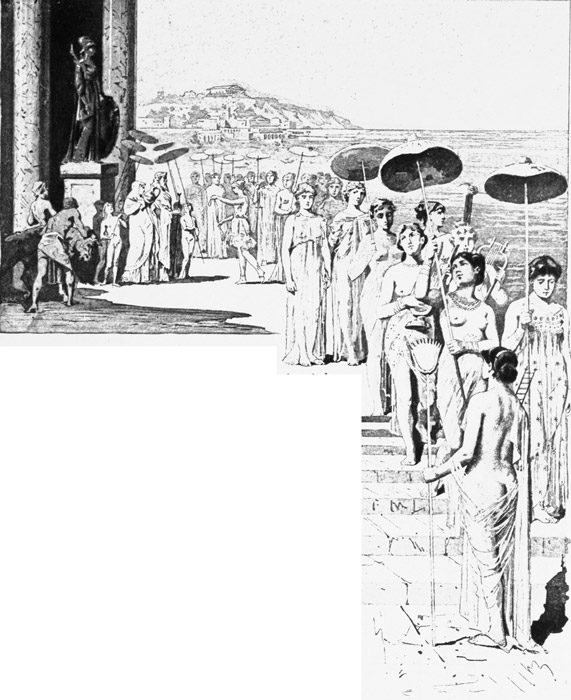
One cannot exactly say for what motive the Sunshade was carried by young virgins in all the processions in the Thesmophoria, the festivals of Eleusis, and the Panathenæa. Aristophanes calls the baskets and the white Sunshades “symbolic instruments, destined to recall to human beings the acts of Ceres and Proserpine.”
An archæologist might amuse himself with writing a special work on the rôle of the Sunshade in Greece; documents would not fail him; nay, the book would soon grow big, and might bristle with notes from all quarters, abounding in the margins, after the example of those good solid volumes of the sixteenth century, which none but a hermit would have the leisure to read conscientiously to-day. Such is not our business in this light chapter.
One cannot exactly say for what motive the Sunshade was carried by young virgins in all the processions in the Thesmophoria, the festivals of Eleusis, and the Panathenæa. Aristophanes calls the baskets and the white Sunshades “symbolic instruments, destined to recall to human beings the acts of Ceres and Proserpine.”
Perhaps it is not necessary to search beyond this Aristophanic definition, which may on the whole entirely satisfy us. Moreover, these Sunshades were white, not, say they, because the statue erected by Theseus to Minerva was of that colour, but because white marked the liveliest joy and pomp according to Ovid, who recommends very carefully in his Fasti the wearing in sign of rejoicings white tunics worthy of pleasing Ceres, in whose cult both the priestesses and the things they used ought to be entirely white.
In a man, according to Anacreon, the carrying a Parasol was the mark of a libertine and effeminate life; one might draw an analogous conclusion from a scene in the Birds of Aristophanes, in which Prometheus, through fear of Jupiter, cries to his slave, before abandoning himself to a sweet passion for Venus only, “Quick, take this sunshade, and hold it over me, in order that the gods may not see me.”
It is also doubtless for the same reason, which virtually interdicted the use of the Parasol to men, that the daughters of the Metœci, or strangers domiciled at Athens, carried, according to Ælian, the sunshade of the Athenian women in the spectacles and public ceremonies, whilst the fathers carried the vases destined for the sacrifices.
The Θολἱα, or “Sunshade Hat,” succeeded the Parasol properly so called. It is of these Θολἱα that Theocritus speaks in several places; it is also this hat, and not a Sunshade, which we must see in the curious medal above, stamped by the Ætolians, which represents Apollo bearing this strange hat, in the style of Yokohama, hanging on his back.
From the most distant epochs the Sunshade has been considered, so far as it is the attribute of gods and sovereigns, as the ensign of omnipotence. We see it playing this supreme rôle, not only by right of an emblem of blazonry, in the curious dissertation of the Chevalier Beatianus On a Sunshade of vermeil on a field argent, symbol of power, sovereign authority and true friendship, but also we see it universally adopted as a sign of the highest distinction by Oriental peoples, to be displayed over the head of the king in time of peace, and occasionally in time of war.
It is thus that it may be contemplated on the sculptures of ancient Egypt, where its usage was not exclusively indeed reserved to the Pharaohs, but sometimes also to the great dignitaries, but to these only. There is to be seen in Wilkinson a strange engraving representing an Æthiopian princess seated on a plaustrum or carriage drawn by oxen, and having behind her a vague personage armed with a large Parasol of an undecided form, something between the screen and the flabellum in the segment of a circle. Is it not also in sign of adoration that it was the custom to put above the heads of divine statues crescents, Sunshades, little spheres, which served not only to guarantee these august heads against the injuries of time and the ordures of birds, but also to set their physiognomy in relief as by a nimbus or crown of paganism?
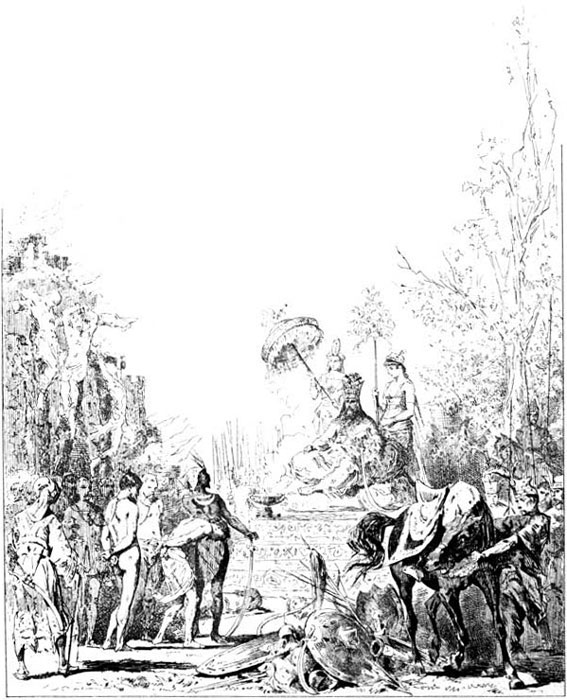
The kings or satraps of Persia of the oldest dynasties were sheltered by the sovereign Parasol. Chardin, in his Voyages, describes bas-reliefs of a time long before that of Alexander the Great, in which the king of Persia is frequently represented sometimes just about to mount his horse, at others surrounded by young slave-girls—beautiful as day, as a poet might write for sake of a simile—among whom one inclines a Sunshade, while another uses a flyflap made of a horse’s silky tail. Other bas-reliefs, again, represent the Persian monarch on a throne, at the conclusion of a victorious battle, whilst the rebels are being crucified, and writhe under the punishment, and prisoners brought up, one after the other, make humble submission. Here the Sunshade has the floating appearance of a glorious standard. It symbolised also the power of life and death, vested in the savage conqueror over the unfortunate conquered, delivered up wholly to his mercy.
The kings or satraps of Persia of the oldest dynasties were sheltered by the sovereign Parasol. Chardin, in his Voyages, describes bas-reliefs of a time long before that of Alexander the Great, in which the king of Persia is frequently represented sometimes just about to mount his horse, at others surrounded by young slave-girls—beautiful as day, as a poet might write for sake of a simile—among whom one inclines a Sunshade, while another uses a flyflap made of a horse’s silky tail. Other bas-reliefs, again, represent the Persian monarch on a throne, at the conclusion of a victorious battle, whilst the rebels are being crucified, and writhe under the punishment, and prisoners brought up, one after the other, make humble submission. Here the Sunshade has the floating appearance of a glorious standard. It symbolised also the power of life and death, vested in the savage conqueror over the unfortunate conquered, delivered up wholly to his mercy.
In ancient India, the cradle of the human race, as it is said, the Parasol in every time, and more than anywhere else, is unfolded in its splendour and the grace of its contexture, as an immutable symbol of royal majesty. It seems really that it was under the deep azure of the admirable Indian sky that the coquettish instrument, of which we are exposing here by literary zigzags the historic summary, was invented. It must have been born there first as a fragile buckler to oppose the ardour of the sun; afterwards, doubtless, it developed, little by little, into a large dome, carried in the arms of slaves, or on the back of an elephant, showing the sparkle of its colours, the originality of its form, the richness of its tissues, all overloaded with fine gold and silver filigree, making its spangles and jewels scintillate in the full leaping light, in the slow oscillation given to it by the march of its bearers, or the swayings of a heavy pachyderm, in the midst of magic powers, of dancers and enchantments without number among the most bizarre palaces of the world.
In Hindostan the large Parasol is commonly called Tch’hâtâ, the small ordinary Parasol Tch’hâtry, and the bearer of the Parasol for dignitaries tch’hâtâ-wâlâ.
The Parasol of seven stages (savetraxat) is the first ensign of royalty: it is found graven on the royal seal. The mythology and literature of the Hindoos are, so to speak, confusedly peopled with Parasols. In his fifth incarnation, Vishnu descends to Hades with a Parasol in his hand. On the other hand, from the seventh century, Hiouen Thsang has remarked, according to the rites of the kingdom of Kapitha, Brâhma and Indra were represented holding in their hand, one a flyflap, the other a Parasol. In the Râmayana (ch. xxvi. scloka 12), Sitâ, speaking of Râma, whose beautiful eyes resemble the petals of the lotus, expresses herself thus—“Covered with the Parasol striped with a hundred rays, and such as the entire orb of the moon, why do I not see thy most charming face shining beneath it?”
We read also in the Mahâbârata (sclokas 4941-4943)—“The litter on which was placed the inanimate body of the monarch Pândou was adorned with a flyflap, a fan, and a white Sunshade; at the sound of all the instruments of music, men by hundreds offered, in honour of the extinguished shoot of Kourou, a crowd of flyflaps, white Sunshades, and splendid robes.”
The Mahratta princes who reigned in Punah and Sattara held the title of Tch’hâtâ pati, “Lord of the Parasol;” and we are told that one of the most esteemed titles of the monarch of Ava was also that of “King of the White Elephant, and Lord of the Four-and-twenty Parasols.”
When, in 1877, the Prince of Wales, future inheritor of the throne of England, undertook his famous voyage into India, it was absolutely necessary—says Dr. W. H. Russell, the scrupulous historian of that princely expedition—in order to make him known to the natives, to set the Prince upon an elephant, and to hold over his head the golden Sunshade, symbol of his sovereignty.
There may be seen to-day in the South Kensington Museum, in the admirable Indian gallery which has just been installed, some score of the Parasols brought back by the Prince from his voyage, of which each particular type deserves a description which cannot, alas! to our sincere regret, find its place here. One may admire there the state Umbrella of Indore, in the form of a mushroom; the Sunshade of the Queen of Lucknow, in blue satin stitched with gold and covered with fine pearls; next the Parasols of gilt paper, others woven of different materials, some entirely covered with ravishing feathers of rare birds, all with long handles in gold or silver, damascened, in painted wood, in carved ivory, of a richness and an execution not to be forgotten.
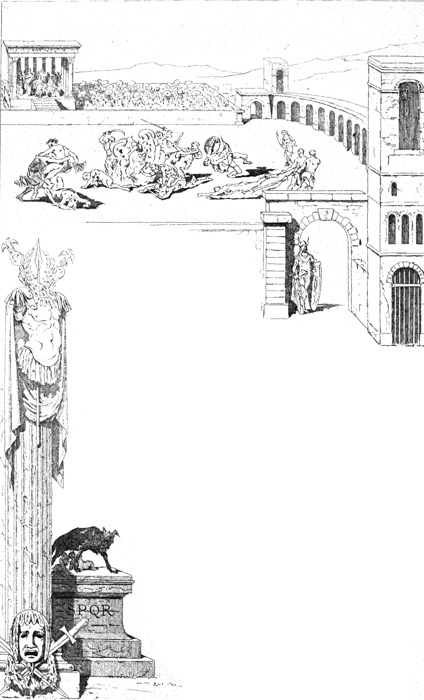
Let us tear ourselves away, as in duty bound, from Hindustan, to meet again with the Parasol on more classic ground in ancient Rome, in the middle of the Forum and of the games of the Circus. The Sunshade is found very frequently in the most ancient paintings, on stones and vases of Etruria, a long while even before the Roman era. According to Pliny and Valerius Maximus, it is from Campania that the Velarium comes, which is destined to defend the spectators from the sun. The use of the private Sunshade for each person established itself by degrees on those days when, on account of the wind, the Velarium could not be used. Martial says in his Epigrams (Book IV.):
There may be seen to-day in the South Kensington Museum, in the admirable Indian gallery which has just been installed, some score of the Parasols brought back by the Prince from his voyage, of which each particular type deserves a description which cannot, alas! to our sincere regret, find its place here. One may admire there the state Umbrella of Indore, in the form of a mushroom; the Sunshade of the Queen of Lucknow, in blue satin stitched with gold and covered with fine pearls; next the Parasols of gilt paper, others woven of different materials, some entirely covered with ravishing feathers of rare birds, all with long handles in gold or silver, damascened, in painted wood, in carved ivory, of a richness and an execution not to be forgotten.
Let us tear ourselves away, as in duty bound, from Hindustan, to meet again with the Parasol on more classic ground in ancient Rome, in the middle of the Forum and of the games of the Circus. The Sunshade is found very frequently in the most ancient paintings, on stones and vases of Etruria, a long while even before the Roman era. According to Pliny and Valerius Maximus, it is from Campania that the Velarium comes, which is destined to defend the spectators from the sun. The use of the private Sunshade for each person established itself by degrees on those days when, on account of the wind, the Velarium could not be used. Martial says in his Epigrams (Book IV.):
Accipe quæ nimios vincant umbracula soles
Sit licet et ventus, te tua vela tegent.
People used the Sunshade not only at theatres, but also at battles, and above all in the promenade. Ovid, in his Fasti, shows us Hercules protecting his well-beloved Omphale by means of a Sunshade from the sun’s rays:
Aurea pellebant tepidos umbracula soles
Quæ tamen Herculeæ sustinuere manus.
This image of Hercules carrying a light Parasol would surely be worthy to replace the used-up theme of the distaff?
The ancient Romans brought to the decoration of their Parasols a magnificence unknown in our days. They borrowed from the East its stuffs, its jewels, its ornamental style, to enrich in the best manner possible these pretty portable tents. When Heliogabalus, forgetting his sex, after the example of the priests of Atys, appeared on his car clothed with the long dress and all the gewgaws that women wear; when he caused himself to be drawn along surrounded by legions of nude slave-girls, he carried a fan in the guise of a sceptre; and not only was there a golden Parasol in the form of a dais stretched over his head, but also at each side two umbelliferæ held light Sunshades of silk, covered with diamonds, mounted on Indian bamboo, or on a stem of gold carved and encrusted with the most wondrous jewels.
In the train which accompanied a matron on the Appian Way, if we can believe the historian of Rome in the age of Augustus, two slaves were obligatory: the fan-bearer (flabellifera) and the follower (pedis sequa). The latter carried an elegant Parasol of linen stretched over light rods at the extremity of a very long reed, so that, at the least sign of her mistress, she might direct over her the shadow of this movable defence.
The Roman Umbrella seems to have been nothing but a simple morsel of leather, according to these verses, which Martial wrote by way of advice:
Ingrediare viam cœlo licet usque sereno;
Ad subitas nunquam scortea desit aquas.
This “leather cloth” was assuredly an Umbrella, which, except perhaps in weight, need have envied nothing of our own.
At Rome, as at Athens, the Sunshade appears to have hidden people from the looks of the gods, for, according to Montfauçon, even the Triclinia were covered with a sort of Sunshade, that folk might deliver themselves more mysteriously to orgies of every kind and to the pleasures of Venus.
The material used in the manufacture of Sunshades was originally, according to Pliny, leaves of palm divided into two, or the tresses of the osier; afterwards they were made in silk, in purple, in Eastern stuffs, in gold, in silver; they were adorned with Indian ivory; they were starred with trinkets and jewels. One author tells us even of Sunshades made out of women’s hair—the hair of women so arranged as to supply the place of a Sunshade.
Singular headdress or singular Parasol!
Juvenal speaks of a green Sunshade sent with some yellow amber to a friend to celebrate her birthday and the return of spring.
En cui tu viridem umbellam, cui succina mittas
Grandia, natalis quoties redit, aut madidum ver Incipit.
And with regard to this green Sunshade, apropos of the viridem, all the commentators enter into the field, and make a deafening noise to explain that the epithet had no reference to the colour of the Sunshade, but to the spring.
Let us, if you please, leave Rome, without entering into these idle dissertations.
It would be difficult for us to find in the Middle Ages numerous manifestations of the Sunshade in private life; it was evidently adopted in the ceremonies of the Christian Church and in the royal entrées; but it was especially the privilege of the great, and never appeared save on solemn days in the processions, as later on the dais, reserved for kings and ecclesiastical nobles.
At Venice the Doge had already his celebrated Sunshade in 1176. The Pope Alexander III. had accorded to the Venetian chiefs the right to carry the Sunshade in the processions. Under the reign of the Doge Giovanni Dandolo (1288) it was ordered that the pretty golden statuette of the Annunciation should be added, which is seen represented at the top of the Sunshade of the Venetian dogate.
One can get some idea of this marvellous Sunshade, all of gold brocade, and of a pompous and original shape, by looking at most of the prints of the time, and particularly at the celebrated engraving of the Procession of the Doge, as well as at the pictures of Canaletto, Francesco Guardi, Tiepolo, and the greater number of the charming Venetian painters of the eighteenth century.
It seems evident that the Roman Gauls knew the use of the Parasol, but it would not be easy to demonstrate its existence logically in the martial and Gothic epochs. One can scarcely imagine these men of arms, these gentle pages, and these noble damsels, with their lofty head-gear and long dress, defended by a frail silken encas (in case). They feared not then assuredly either sun or rain; they dreamed of nought but batailloles (little battles), according to the language of that day; everything was done in honour of the ladies, after the laws of the good King René, and the ladies would certainly never have wished at the hour of the glorious tournaments to shelter themselves at the approaches of the lists, against a sun which sparkled on the breastplate of their brave knights with as much brightness as the hope which shone in their eyes.
Let us come now to China, to find there Parasols and Umbrellas in great honour, since the beginning of the dynasty Tchéou (eleventh century before Christ).
“The Umbrellas of that time,” says M. Natalis Rondot, “resembled ours; the mounting was composed of twenty-eight curved branches, and covered with silken stuff. The Parasols were of feathers.
“After the Thong-ya, it is only under the first Wei (A.D. 220-264) that gentlemen began the use of Parasols; these Parasols were most frequently made of little rods of bamboo and oiled paper; pedestrians never made use of them before the second Wei (386-554). Parasols figure ordinarily in processions and funerals since the seventh century. Thus, in 648, at the time of the inauguration of the Convent of the Grand Beneficence, at Si-ngan-Fou, one counted—says the historian of the Life of Hiouen thsang—only in the procession three hundred Parasols of precious stuffs. The Parasol in China, as in India, has always been a sign of elevated rank, although it has not been exclusively used by emperors and mandarins. Formerly, it seems, four-and-twenty Parasols were carried before the Emperor when his Majesty went to the chase.
“A Chinese of a rank at all elevated, such as a mandarin, a bonze, or a priest, never goes out without a Parasol,” according to M. Marie Cazal, a Sunshade manufacturer, who, about the year 1844, wrote a small Essay on the Umbrella, the Walking-stick, and their Manufacture.—‘Every Chinese of a superior order is followed by his slave, who carries his Parasol extended over him.’
“The Umbrella in China is destined to the same use as the Parasol, says M. Cazal: it belongs to all. Never, when the weather is the least degree doubtful, does a Chinese go out of doors without his Umbrella. Even horses are sheltered, as well as elephants, by Parasols or Umbrellas fastened to branches of bamboo. Their drivers take very good care not to illtreat them; imbued as they are, like every good Chinaman, with the doctrines of metempsychosis, they fear to torture the soul of their father or their grandfather, reduced, in order to expiate his faults, to animate the body of these quadrupeds.”
The Umbrellas and Parasols which are most common in China resemble very much those which are imported into Europe; they are made entirely of stalks of bamboo, disposed with enormous art, and covered with oiled, tarred, or lacquered paper. Some are coloured, and have printed on them religious allegories or sentences of Confucius.
All the voyages in China and around the world are filled with details of the Chinese Parasol. “The Chinese women, whose feet have been compressed from infancy,” remarks M. Charles Lavollée, “can scarcely walk, and are obliged to support themselves on the handle of their Parasol, which serves them for a walking-stick.”
The Parasol and the Fan in China play a rôle so considerable, that it would be necessary to write a special monograph on each of these two objects in order to consider properly their importance in the history of the country and its current manners. In a general and summary sketch like the present, must we not skim through, rather than sew together documents collected with difficulty, or found within reach, and leave aside the more bulky bundles, under pain of foundering in the folio form of heavy dictionaries?
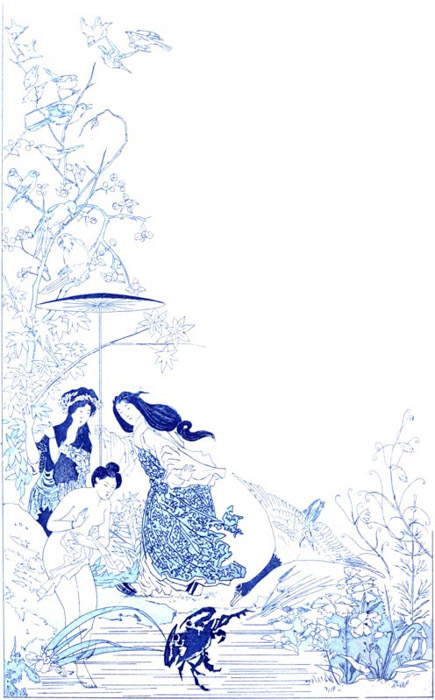
All the voyages in China and around the world are filled with details of the Chinese Parasol. “The Chinese women, whose feet have been compressed from infancy,” remarks M. Charles Lavollée, “can scarcely walk, and are obliged to support themselves on the handle of their Parasol, which serves them for a walking-stick.”
The Parasol and the Fan in China play a rôle so considerable, that it would be necessary to write a special monograph on each of these two objects in order to consider properly their importance in the history of the country and its current manners. In a general and summary sketch like the present, must we not skim through, rather than sew together documents collected with difficulty, or found within reach, and leave aside the more bulky bundles, under pain of foundering in the folio form of heavy dictionaries?
Everywhere on the exquisite decorative combinations of Japan, we see a large Parasol opened amidst delicate peach-blossoms, gracious flights of strange birds, indented leaves, and rosy ibises. Sometimes, on the inimitable paintings of the enamelled vases, the Japanese Sunshade shelters a king’s daughter, escorted by her followers, who makes her chaste preparations for entering the bath; sometimes, on a thin gauze, the Parasol half hides women, promenading on the margin of some vast blue lake, full of ideal dreams. Sometimes, in fine, in a fantastic sketch of an album, which one reads as a riot of the imagination, is perceived some human being excited to a singular degree, with hair tossed by the wind, and haggard eye, floating at the will of the tumultuous waves on a Parasol turned upside down, to the handle of which he clings with the energy of despair. The plates of the Voyage de Ricord, and especially the old Japanese albums, are useful to consult in order to understand better the varieties of forms of the Sunshade in Japan. We gain a bizarre notion of the effects and services which a Japanese can obtain from a common Parasol of his country by looking at the games of the acrobats who come to us occasionally from Tokio, Yedo, or Yokohama. Théophile Gautier, who was highly astonished, and not without reason, at the quickness, grace, and daring of these marvellous equilibrists, has left us on this matter the fairest pages, perhaps, of his Feuilletons de Lundiste. The worthy Théo, that Gallic Rajah borrowed from these clowns, astonishing in their lightness, an enthusiasm which put on his palette as a colourist the most vibrating tones and the finest shades. The Sunshade and the Fan are in fact presented by these magicians of the East with particular graces in the jugglery of the most varied exercises. Here it is a ball of ivory which rolls with the bickering of a babbling stream over the lamels or ribs of the Sunshade; there it is a Parasol held in equilibrium on the blade of a dagger, and a thousand other astonishing inventions. All these fascinating feats of skill cannot be described save in the manner of Gautier, in other words, by veritable pen-pictures. Admirable interpretation of things glimpsed at!
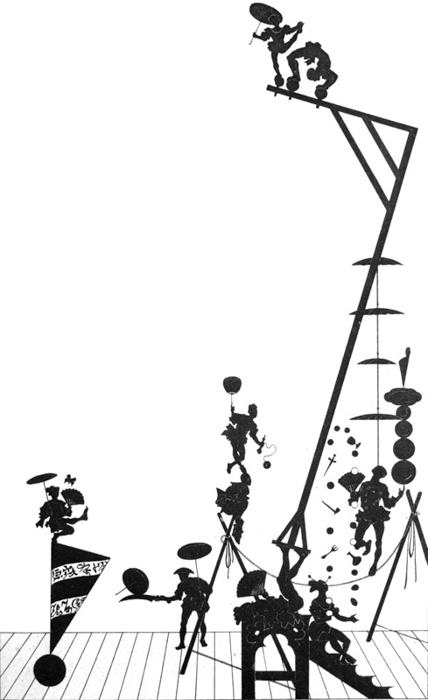
Everywhere on the exquisite decorative combinations of Japan, we see a large Parasol opened amidst delicate peach-blossoms, gracious flights of strange birds, indented leaves, and rosy ibises. Sometimes, on the inimitable paintings of the enamelled vases, the Japanese Sunshade shelters a king’s daughter, escorted by her followers, who makes her chaste preparations for entering the bath; sometimes, on a thin gauze, the Parasol half hides women, promenading on the margin of some vast blue lake, full of ideal dreams. Sometimes, in fine, in a fantastic sketch of an album, which one reads as a riot of the imagination, is perceived some human being excited to a singular degree, with hair tossed by the wind, and haggard eye, floating at the will of the tumultuous waves on a Parasol turned upside down, to the handle of which he clings with the energy of despair. The plates of the Voyage de Ricord, and especially the old Japanese albums, are useful to consult in order to understand better the varieties of forms of the Sunshade in Japan. We gain a bizarre notion of the effects and services which a Japanese can obtain from a common Parasol of his country by looking at the games of the acrobats who come to us occasionally from Tokio, Yedo, or Yokohama. Théophile Gautier, who was highly astonished, and not without reason, at the quickness, grace, and daring of these marvellous equilibrists, has left us on this matter the fairest pages, perhaps, of his Feuilletons de Lundiste. The worthy Théo, that Gallic Rajah borrowed from these clowns, astonishing in their lightness, an enthusiasm which put on his palette as a colourist the most vibrating tones and the finest shades. The Sunshade and the Fan are in fact presented by these magicians of the East with particular graces in the jugglery of the most varied exercises. Here it is a ball of ivory which rolls with the bickering of a babbling stream over the lamels or ribs of the Sunshade; there it is a Parasol held in equilibrium on the blade of a dagger, and a thousand other astonishing inventions. All these fascinating feats of skill cannot be described save in the manner of Gautier, in other words, by veritable pen-pictures. Admirable interpretation of things glimpsed at!
In the tea-houses of Tokio, the pretty Geishas often employ, to mimic an expressive dance, the Fan and the little paper Parasol.
One of the most usual of their dances, managed something like our ballets, is called the Rain-dance. This is the way in which a Globe-trotter gives an account of its leading idea and character:—
“Some young girls prepare to leave their homes, and to pose as beauties in the streets of Yedo. They admire each other in playing their fans, they are dressed in superb toilets—they are sure of turning the heads of all the young samouraï of the town.
“Scarcely have they got out of doors when a thick cloud appears. Great disquietude! They open their Parasol, and make a thousand pretty grimaces, to show how sadly they fear the ruin of their charming dresses. . . . A few drops of rain begin to fall: they quicken their steps on their way home again.
“A burst of thunder occasioned by the Samisen and the drums, is heard, which announces a terrible downpour. Then our four dancers catch their robes with both hands, and throw them with one sweep under their arms, and suddenly turning, take to their heels, showing us a row of little . . . . frightened faces, saving themselves at the full speed of their legs.”
What a series of pantomimes, in which the Sunshade must assume in the hands of the charming Geishas the most seductive positions!