
Much that is fanciful and unreal has been written about the tournament, and it is only in recent times that the knowledge of the subject has been placed on a more scientific basis, through the labours and researches of Querin von Leitner, Cornelius Curlitt, Boeheim, Dillon, Haenel and others, who have built on the valuable foundations laid by earlier writers on the subject. In France the subject has received but scant attention in recent times.
The contemporary literature in France and England concerning the tournament of the sixteenth century is much less voluminous than that written in the fifteenth, and the narrations of chroniclers greatly lack that technical knowledge which characterizes the work of their predecessors, who belonged to a higher class of society. The contrast, indeed, in their treatment of these meetings is very marked, in that comparatively little attention is devoted by the later writers to the martial sports themselves, while the pageantry and dresses closely connected with them absorb most of the matter of their narrations. This is perhaps an indication of a diminished public interest in the tournament in these countries; and but for the fuller and more circumstantial German records it would be difficult to present any comprehensive account of its ramifications during the sixteenth century and to the time when it fell into disuse. There are many records relating to the tournament in the College of Arms, London, and among the Ashmolean, Harleian and Cottonian MSS.[171]; whilst the Chronicles of Hall and Holinshed also afford much information. De Pluvinal, in Maneige Royal, published in 1625, gives some interesting particulars of jousting in its later stages, and Ménestrier, in Traité des Tournois, Jousts, Carrousels, &c., when it had almost ceased being practised.
The institution had attained its highest development in most of the countries of chivalry in the first half of the fifteenth century, and the sixteenth saw its rapid decline. It had become more and more a mere sport and pastime, and had lost much of its former dignity in being so closely associated with mummeries and the pageant. All the safeguards instituted in the fifteenth century had become accentuated in the sixteenth to a degree making serious accidents very rare; and the introduction of barriers in combats on foot, and the employment of lances in these contests, apart from the preliminary casting, so often described in the narrations of such encounters of the fifteenth century, had greatly changed their character, and made them much less dangerous.
In admitting cavaliers to the tournament kings of arms were particular to exclude all who were not of noble birth, with the requisite number of descents. The bâton of illegitimacy, however, was no bar to the admission of the bastards of princely houses, who were generally accepted in society on an apparently equal footing with nobles of the highest rank.
The prizes awarded were often a wreath, a ring, a sword, helmet, jewel or a charger; at a joust held at Weimar in 1534 they consisted of a spur, a sword and a lady’s slipper, all of gold.
Many new forms of jousting were introduced in Germany late in the fifteenth and during the sixteenth centuries, though most of them were derived from three main courses with but trivial differences from them. Some of the variants were conceived with a view to the introduction of some striking or humorous novelty; and, in fact, the passion for theatrical effect then prevailing in Germany, brought about some extraordinary mechanical absurdities as applied to jousting. The intricacies of the various courses would seem to have been somewhat perplexing even to the generations by whom they were practised, and they are, of course, much more difficult to disentangle now.
It was in Germany that the bulk of the jousting harnesses of the sixteenth century were made, and in that country the contemporary literature over the period in question concerning the tournament is most considerable.
The tournament records of the emperor Maximilian I and those of the ruling princes of the German Empire are of the first importance in the history of the tournament of the period, for it was at the courts of these sovereigns that such sports were most practised in their various phases, and when they reached their greatest development. The tournament, with its attendant pageants and mummeries, played a leading part in the weekly routine of the relaxation and amusements of these princes and their chivalry, a part perhaps second only to the chase; and these records bring the actual details of the various courses vividly before us in the many carefully executed drawings representing them which have been preserved. Most of them deal with the tournament of the sixteenth century, though some of the combats of the last quarter of the fifteenth are recorded and illustrated; and while, perhaps, none of the drawings are strictly speaking contemporaneous with the events they depict many of them were copied from older pictures, so that taken as a whole the details given are more reliable than most of the other sources of information.
The most precious among these tourney-books is the Freydal of Maximilian I, a work of the year 1515, in which the emperor’s combats in the lists, with the accompanying mummeries, are pictured.
The allegorical name “Freydal” is one of those assumed by the emperor in his knightly character. Maximilian was born in 1459, elected emperor in 1494, and died in 1520. He began his jousting career when quite a youth, and took a leading and personal part in the compilation of Freydal, dictating some of the text to his secretary Max Trytssaurwein in 1511; and, indeed, he corrected some of the proofs with his own hand. He selected for the book the examples of the various courses in which he was engaged, in almost all of which he appears as the victor. These instructions as to the choice of the subjects of the plates are of great value to the student, and are given in Appendix D. The personal character of the work adds much to its interest and importance in the history of the tournament.
The admirable reproduction of Freydal by Querin von Leitner, issued under the directions of Franz, Grafen Folliot De Grenneville,[172] leaves little to be desired. There are 255 plates arranged in series of Rennen, Stechen, foot combats and a mêlée, all depicting courses in which Maximilian had “gerennt, gestochen und gekämpft.”[173] The work is valuable from many points of view, for it includes a register of the prominent personages of the time, and full particulars of the colours, trappers, arms and crests of the cavaliers taking part, together with the costumes of the mummers and others, besides some genealogical notes.
Freydal is one of a series of chronicles somewhat similar in character, comprising Theuerdank, Weisskünig, Triumph of Maximilian and Ehrenpforte; all were written with a view to the glorification of the emperor and his reign. Freydal is the emperor’s testament to posterity of his career in the tiltyard, and, with the accompanying mummeries he initiated, forms a knightly tribute to the memory of his much lamented consort Mary of Burgundy. A poem in the work follows, which illustrates the spirit of vanity and the somewhat frivolous character of the monarch:—
Theuerdank is a narration of Maximilian’s journey to Ghent to wed the heiress of Charles the Bold, with an account of his adventures by the way, and the story of his courtship. It was written by the emperor for the instruction of Charles V when a youth. There are 117 wood-cuts by Hans Schaufflein.
Weisskünig is the story of his life and government.
The Triumph describes the progress and achievements of his reign, as typified by the picture of the triumphal car running through it. It was written in 1512, greatly at the emperor’s own dictation; and the illustrations depict jousters fully equipped for some of the various courses of the tournament.
The Ehrenpforte is a monument to the glory of the Emperor’s name and house.
In the tourney-book of Maximilian belonging to the Prince of Hohenzollern-Sigmaringen the spirited illustrations are by the hand of Hans Burgmaier, of Augsburg, an able coadjutor of the great armour-smith Koloman Colman of the same city, surnamed Helmschmidt.
Of great interest and importance are the three original tourney books of the Saxon Electors—Johanns des Beständigen, Johann Friedrichs des Grozmüthigen, and August, scoffingly called by Carlyle, if we remember rightly, the physically strong. They are in three volumes, which are preserved in the public library at the Japanese Palace, Dresden. The illustrations, which number over 300, are water-colour drawings on parchment, and they depict the courses of Rennen, Stechen,[175] and a mêlée, as run by those princes during their reigns; they afford characteristic records of these knightly sports from the year 1487 to 1566. The earlier jousts of the Kurfürst Johann begin towards the end of the fifteenth century, the others following in the sixteenth; while the third volume, executed in 1584, includes fifty-five drawings of the courses of Scharfrennen and Gestech run by the Kurfürst August, the last taking place in February, 1566, at Dresden. The drawings are by Heinrich Göding, of Brunswick, the court painter, and many of them would seem to have been copied from an earlier work.
There is also an old copy of one of the books in the royal library at Veste Coburg. Professor Haenel, the Curator of the Johanneum Collection of Arms and Armour at Dresden, has reproduced a selection of the plates in the three volumes of the joustings of the Saxon Kurfürsts, two of them coloured as in the originals, the others plain (published under the auspices of Die Verein für historische Waffenkunde, Dresden, 1910). The book supplies a long-felt want, for the original volumes are not easy of access.
In the Gewehrgalerie at the Johanneum, Dresden,[176] are twenty-nine paintings in oils by the same artist as those in the tourney-books, and they depict courses run in Scharfrennen by the Kurfürsts. These pictures are of even greater value than the drawings in the tourney-books in being painted on a larger scale, and giving more details both of the courses themselves and the general surroundings of the lists. One of them, like the last picture in the tournament-book, Vol. III, depicts the last joust of the Kurfürst August, run against his ennobled master-armourer Hans Dehn, in the year 1566; and it bears the title, “Ein Rennen mit Hannss Dehnen gethan, der ist alleine gefallen. Ao 66 im Februar zu Dressten an der Festnacht.” This oil-painting is hung in a bad light, and is darkened by age, but a close examination reveals the fact that the riders and horses are only models, stuffed with straw, their hoofs attached to low four-wheeled bogies. The figures are impelled to charge by a mechanical apparatus; ropes, running along the bogies and beyond, are visible, but the machinery itself for setting the models in motion is hidden from view. These models, as stated on the picture, formed part of a Carnival mummery, held at court. The painting exhibits the moment when Hans Dehn is in the act of being hurled from his horse by the Kurfürst, his lance falling to the ground; while the prince is holding up his left hand in the manner customary after impact. The Kurfürst wears a jousting-salade, with a crest of plumes; the usual shield; bases and jousting-cuisses. The legs and feet are unarmoured. The lance is stout, rounded, adorned with puffs, and headed with a small conically formed sharp tip; the vamplate is very large. The horse bears an enriched collar and a spiked chamfron, while plumes adorn the head and tail. The saddle is without cantle, the object of the course being unhorsing; the trapper, reaching down to the horse’s houges, is painted with stars, foliations and the arms (viz. a lion rampant).
PLATE III
MAXIMILIAN I ENGAGED IN HOHENZEUGGESTECH
About the end of the seventeenth century the models of horses used for the display of armour in the Tower of London were mounted on casters, and guide books of the period and later state that they had been employed in practising tilting and running at the ring. This could hardly have been the case as regards these particular models, their purpose having been doubtless merely for convenience in moving and cleaning. These statements were, however, founded on the fact that there had been horses fitted with mechanical contrivances for impelling them forward towards one another for the purpose of practising the joust and its kindred military sports. In the years 1672 and 1673 patents were taken out in England for models of horses fitted with mechanical appliances for the purpose in question,[177] and the joust at Dresden on Twelfth-night, 1566, shows that they were not confined to this country.
The subjects of the paintings and embroideries on trappers in the sixteenth century were often humorous, religious, and sometimes even political in character. An example shows a barrel of gunpowder in the act of explosion and a pair of sweethearts standing before it kissing. Another exhibits a man standing in the street, clad only in his shirt, being well soused with water thrown from an open window. A religious example deals with the struggle in progress between the propaganda of reform as against the Church of Rome, wherein a monk and a Lutheran divine are seen fighting for the globe amid lightning and hail; the waves of the sea, peopled by monsters of the deep, advancing menacingly towards them.
The mottoes are often curious and suggestive, for instance:—
Another:—
The humorous devices painted were sometimes groups of owls, hares, mice or foxes. Trappers were usually armoried.
The contract price for a complete harness for the tiltyard in the second half of the sixteenth century was usually from 100 to 200 thalers (£20 to £40), rather a wide margin; though anything extra special in the way of enrichment would often cost much more. August Kurfürst of Saxony ordered from Peffenhaüser of Augsburg in 1582 a “Stechkürass fur die Pallier[180] mit allen Doppelstücken, und alle Stücke zum Freirennen und Fussturnier 200 Thalers,” i.e. a harness for jousting at the tilt with the reinforcing pieces thereto appertaining, together with the additional pieces for Freirennen and Fussturnier. A more ordinary suit “ein anderer, schlichter, gemeiner Kürass” is offered at 100 thalers. Four thalers “Tringeld” for each suit was usually added. A Feldkürass (a hoasting harness) was cheaper, say 60 to 80 thalers according to quality. Prices had advanced since the beginning of the century. In 1511, September 16, “Conrad Seusenhofer receives for two suits of armour for his Imperial Majesty and one for the English Embassy 211 florins.”[181]
1512. Sept 13. “Payments made by Thomas Wuley on the King’s behalf to a certain merchant of Florence for 2000 complete harnesses called Almayne rivets according to pattern in the hands of John Douncy, accounting alway a salet, a gorget, a breastplate, a back-plate and a pair of splints for every complete harness at 16s a set.”[182] Such last-named suits were for the soldiery and without armour for the arms and legs.
Hans Schwenkh’s Wappenmeisterbuch, the tourney-book of Duke William IV of Bavaria, in the Royal Library at Munich, commences in 1510. It was compiled by Frederich von Schlichtegroll in 1807, it exhibits eight separate forms of the tourney, and covers the jousting of the duke in the first quarter of the sixteenth century together with later examples. The illustrations are faithfully reproduced on stone by the brothers Theobald and Clemens Senefeder, with an explanatory text by Schlichtegroll.
The tourney-book of Duke Henry of Braunschweig-Lüneburg is at Berlin; that of the Pole Zuganoviez Stanislaus of the year 1574 in the Dresden Historical Museum.
Several forms of jousting, combats on foot and the tourney prevailing in the fifteenth century have been lightly touched upon, and a more detailed statement of the leading courses now follows, together with an account of their more important variants.
The main courses of the jousts are:—
1. Courses run in the lists with lances rebated or tipped with coronals, without a tilt or barrier between the jousters; the chief object in view being the splintering of lances and unhorsing.
2. Courses of courtesy run in the lists with sharp lances, also without a tilt; the main desideratum being unhorsing.
3. Courses run with lances tipped with coronals, in which the jousters charged along a tilt which was between them. In this course the chief object in view was the splintering of lances.
There are many variants in the first two groups.
These three classes were practised more or less in all the countries of chivalry in the sixteenth century, though outside Germany it was the joust at the tilt which was commonly run. In the Fatherland and Austria these courses were known respectively as the Gestech or Stechen, Scharfrennen or Rennen, and the Welsch Gestech or Italian joust.
The type of joust run in the lists without a barrier or tilt, the lances tipped with coronals, is a very old one, though it had been subjected to a gradual modification and the application of safeguards as the centuries had advanced. The horses were blindfolded, so that they should not flinch or jib at the moment of impact, and so deflect the aim of the rider; and the animals were also sometimes rendered deaf by the stopping of their ears with wool, and they were often muzzled. Except in the case of one German variant of this class, the legs of the riders were without armour, these limbs being sufficiently protected by the saddle-steels. A chamfron, sometimes spiked, covered the face of the horse, and a crinet its neck. A cushion or mattress (Stechkissen or Bourrelet), filled with straw, hung from the saddle-bow, covering the chest of the animal, to act as a buffer when there were collisions, which frequently happened in the absence of a tilt; and, indeed, in such cases one or both chargers, with their riders, often fell. An illustration of this cushion is given in the Tourney Book of René d’Anjou, and another by Boeheim in his Waffenkunde, drawn after an actual example, which is believed to have belonged to Maximilian I, and now forms part of the superb collection of arms and armour at Vienna. The horse was usually barded in leather, which did not extend to the front, and a trapper, painted with various devices, covered its body. The saddle employed in Class 1, which weighs about 10·2 kilos., has a high squared plate in front reaching to the jouster’s breast, and there are short steels, though no cantle; so that unhorsing was of frequent occurrence. The head-piece of this class was the great jousting-helm. This course involved much more skill and initiative in the jouster and a more careful training of the horse than did the joust at the tilt. This class of joust was much practised in Germany under the general name “Gestech” or its abbreviation “Stechen,” and was in three forms:
(a) Das Gestech im hohen Zeug or Hohenzeuggestech, known in France as Joûte à la haute barde.
(b) Das gemeine deutsche Gestech. La Joûte Allemand.
(c) Das Gestech im Beinharnisch. Joûte au harnois de jambe.
The joust in Germany was a ruder sport than that practised in other countries, and unhorsing very frequently took place.
Hohenzeuggestech is an older form of the group, its main object being the splintering of lances. In this course the jouster sat high up on his horse in a saddle formed like a well, and his body being well supported on all sides unhorsing was impossible as long as the animal kept its legs and the girths held. This form of saddle had been employed in the Kolbenturnier or baston course (i.e. a duel on horseback with heavy bastons or maces), which prevailed during the fifteenth century and which has been described. The protection on the saddle front in Hohenzeuggestech rises over the rider’s breast, a broad band of iron encircles his body, and the steels are long and broad. The saddle weighs about 12 kilos. The horse ran blindfolded in a leather bard and trapper of cloth; the rider’s legs and feet were encased in hose and well-padded shoes, no armour being necessary, as the saddle-steels afforded ample protection. The mobility of both man and horse must have been much restricted by the heavy armament and by the blindfolding and the thick cushion over the breast. The heavy Flemish horses “did not vanish from their posts like lightning and close in the centre of the lists like a thunderbolt,” but charged at an amble.
Plate III pictures Maximilian armed for Hohenzeuggestech, as shown in Freydal, Plate 98.
Das gemeinedeutsche Gestech. In this course the object was unhorsing, or at least the splintering of a lance on an opponent’s shield. In Freydal there are eighteen illustrations of this form of joust. The armour for the course underwent a complete change about the beginning of the fifteenth century, a special form of harness having been designed for it. The legs and feet were without armour.
Plate IV illustrates two harnesses for the German joust (Gestech or Stechen). Both date in the last quarter of the fifteenth century, that with tassets being the later of the two. They are now at Paris.
PLATE IV
TWO HARNESSES FOR THE GERMAN JOUST OR GESTECH.
AT PARIS.
Plate IX (1) pictures a suit in the Wallace Collection, London,[183] for the Gestech (Stechen). It is very heavy, weighing about a hundredweight, leaving the wearer with little other mobility than was needed to couch and aim his lance; it had evidently seen some service, and bears the dents of many jousts. It is the only complete armour of this kind that we know of in this country. The great jousting-helm weighs about twenty pounds: it is bucket-formed, and extends down in one piece over the top of the cuirass, to which it is fastened by three strong screws, two in front and one behind—the latter, placed vertically, is adjustable for getting the correct line of vision. The crown-piece curves gently over the wearer’s head, and has a comb along the top pierced with twin holes for attaching the crest and torse or wreath which encircles its base. The eyelets for fastening the lining are bordered with laton, and the rivets are capped with the same metal, a golden looking blend, something between bronze and brass. The oculārium affords but a very limited range of vision, and the front of the head-piece juts out in a sort of beak. The helm is very roomy, so that the wearer could move his head about freely under the cap of felt and leather lining, and small cushions stuffed with hair or feathers were over the temples. The breastplate is globose, and, as usual with armour for Stechen and also for Rennen, is flattened on the right side for better couching and aiming the lance. It is reinforced with a heavy plate over the abdomen, to which the taces, of five heavy lames, are riveted. The back-plate is in three overlapping plates. A garde-rein (Schwänzel) of five lames protects the loins, and the tuilles, garnished with a figure like a horn, are tile-formed. The motons over the armpits, fastened in their places by straps of leather, are plain and very large—9½ inches across; that on the right side is pierced with a bouche, to leave space for the lance-shaft. On the right side is a lance-rest (Rüsthaken), and, as is usual in armour for both Gestech and Scharfrennen, there is a heavy queue, termed in German a Rasthaken, which acted as a counterpoise for holding the heavy lance used in the course in position, and for avoiding much strain on the lance-arm. The lance-shaft lies in the bed of the lance-rest, and is held under the queue behind it on the flattened part of the cuirass, the direction towards impact being guided by the hand. The cuirass is held together by hinged straps or strips of iron, which are pierced for fitting over staples and are secured by nuts. The pauldrons are each in five plates, with wings behind, and the coudes are pointed. On the top of each shoulder is a thin iron peg, which stands up diagonally, fixed to the armour by laton-headed rivets. These projections are roughly about two inches long, and are squared and topped like a nail. They were perhaps intended as winding pegs for the tassels or jagged ends of the mantling which usually streamed out from the jousting-helm. Such pegs are present on two similar harnesses at Paris. The right hand is without a gauntlet; the arm bears the poldermiton or épaule de mouton, stamped with the Augsburg guild badge; and on the bridle forearm and hand is the stiff and heavy mainfere, the jousting gauntlet. The jousting shield is of hard wood, covered with leather and gesso, about 15½ inches broad by 14 inches high: it is formed rectangularly at the top, somewhat rounded at the bottom, and is slightly concave and emblazoned. Pieces of horn are let into it to lend it elasticity and stability. It is fastened by cords to a pierced wooden block fixed on the breastplate and is held in position by a strap which buckles on to the helm. The harness itself bears the Augsburg guild stamp, a fir-cone and the letter “S” with an indistinct bar or bâton running through it. It is dated in the last quarter of the fifteenth century. No leg-armour was worn, so as to give the rider a better grip of his horse; hose covered the shanks, and well-wadded shoes, of cloth or leather, the feet.
There is almost an exact counterpart of this suit in a harness in the fine collection at Nuremberg, also forged at Augsburg, with the year of make, 1498, inscribed on the armour, the only difference between the two suits being that there are here tassets of laminated plates instead of the solid tuilles present on the Wallace suit, the tuilles being an indication of a somewhat earlier date. There are three similar harnesses at Vienna. The weight of the armour with shield is usually about 45·6 kilos. When arming, the different pieces are screwed on one after the other, the jousting-shield being adjusted last.
The lance is of fir or pine and is stouter than that used in Rennen; its greatest diameter is 9 centimetres, length 373 cm., and weight, with vamplate and coronal, about 14·3 kilos. An example may be seen in the writer’s collection of arms and armour at Tynemouth.
Plate 9 in the tourney-book appertaining to the Kurfürst Johann (des Beständigen) pictures a Gestech at Leipsig in 1489, between Duke Hans of Saxony and Von Wunsdorf, in which the latter was unhorsed. The duke wears the jousting-helm, a spiked moton is over the armpit, and his lance is heavy and furnished with the circular form of vamplate, viz. that used in Gestech. The horse wears a collar of bells (grelots or Schellenkette), and a cushion over the breast; the body is covered with a trapper, painted with the royal arms. The equipment corresponds with the date of the armour shown on Plate IX (1).
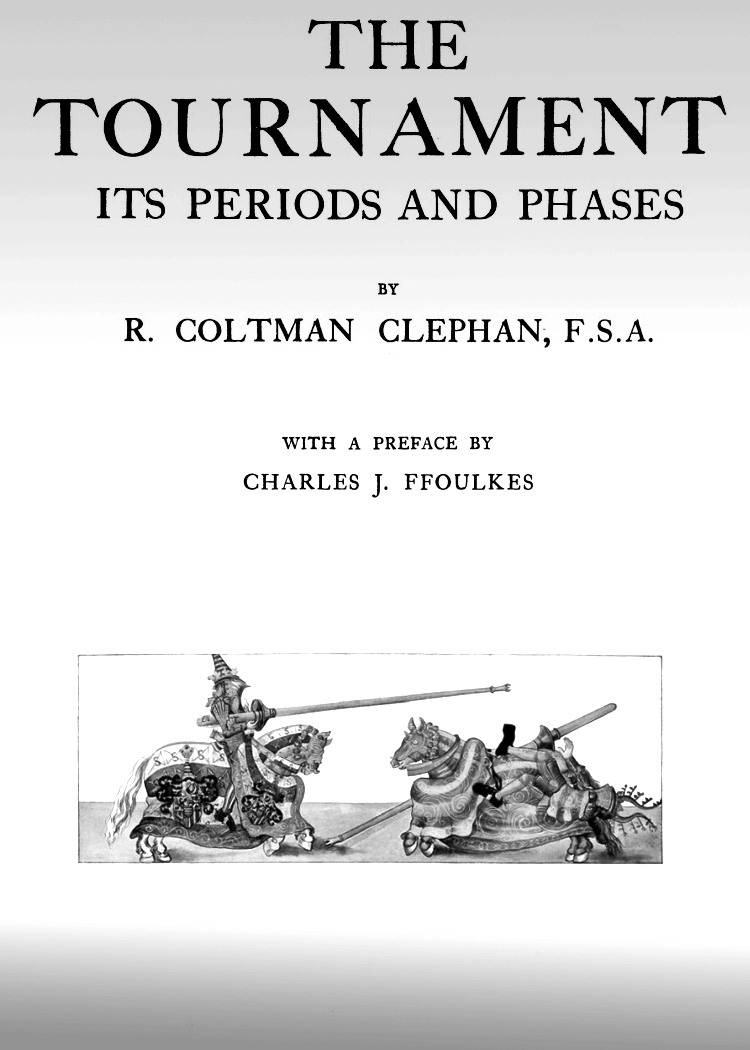
The frontispiece of this work is taken from the tourney-book of the Kurfürst Johann Friedrich (des Groszüthigen), Plate 81. It depicts the Kurfürst running in Gestech at the moment when his adversary is being hurled from his saddle. The victor’s body-armour, vamplate, the chamfron of his horse and the coronal of his mighty lance are all painted the colour of steel. His crest, enriched by a crown at its base, is the Saxon emblem or badge (Kleinod), it is painted in a tawny colour with black stripes. The hose are striped in colours, green, pink, white and black; the shoes are of black felt. The trapper, reaching down to the horse’s houges, is banded in white, blue and two shades of red, and is sprinkled with the ciphers “XS” in gold and silver. It bears, twice repeated, the arms of Meiszen, Thuringen, Pfalz-Sachsen and Landsberg with the crested helm and shield of Saxony. The horses wear necklets of bells (Shellenkette). The trapper of the opposing champion is banded in shades of yellow and red sprinkled with foliations; his crest a pair of silver horns with a coronet encircling the base and silver laterals of linden twigs and leaves. The details of the armour are very clear and the picture a good representative of its class.
Das Gestech im Beinharnisch is a course run with leg-armour, as its name implies. The object is unhorsing and the splintering of lances. The Kuriss saddle was employed. The presence of leg-armour rendered unhorsing much easier of accomplishment than without it, for the belly of the horse could not be so well gripped.
The joust of courtesy with pointed lances, as differentiated from Froissart’s justes mortelles, was, as we have seen, much practised throughout the fifteenth century; and it continued being run in Germany until soon after the middle of the sixteenth, when it became practically displaced by the joust at the tilt. This course was known in Germany as Scharfrennen or Schweifrennen, in France as La Course à la queue; it is illustrated six times in Freydal and many times in the Saxon tourney-books.
The main desideratum of the course was unhorsing, and the form of the saddle had been designed with that object specially in view, though the splintering of lances also counted in the score, in fact, the jouster who sat his horse the longest against the greatest number of splintered lances, or without being unhelmed, was declared the victor. The objective of the lance in this course was either the beaver of an opponent or his jousting-shield on the left side. The first-named mark was more difficult to hit than the other and the lance more liable to glance off, but when fairly struck it proved irresistible. As a rule the effect of impact was that the rider reeled in his saddle as he tried to maintain his seat, though usually one or other of the jousters was unhorsed, and, indeed, sometimes both fell, unless supported at the critical moment by the varlets. The lance was held with the point inclining slightly upwards, and, as in the other courses, the jouster promptly withdrew his hand and arm from the shaft immediately after impact, holding his arm upright, and the broken lance fell to the ground. It was the omission to do this which caused the accident resulting in the death of Henri II of France. The lance was a long, thin, rounded straight pole of soft wood, lighter than was used in Stechen, and was about 373 centimetres long with a largest diameter of about 7 cm., as against 9 cm. in the one for Gestech. The vamplate is in the form of a truncated cone. Rennen (Scharfrennen) was an even hardier course than Stechen, and demanded a still more careful training in man and horse and a surer seat.
The salient features of this form of joust are as follows:—The saddle employed in all its varieties was smaller and lighter than that used in the other courses, the weight being only a little over four kilos.; it had a low pommel and no cantle, and was shaped, in fact, much like the British saddle of to-day. Jousting-cuisses (Dülgen or Dilgen, weighing 12 kilos.) hung from it and protected the lower limbs of the jouster, which were unarmoured. The armour was lighter than that used in Stechen, though somewhat similar in form, and the back-plate was shorter. The helmet was a jousting-salade (Rennhut) forged in one piece, without any movable visor, but with a separate beaver reaching well over the top of the cuirass, to which it was screwed, back and front. It was well lined, and a cap of leather or silk was worn. The parts of the salade extending over the temples of the wearer were strengthened by extra plates (Stirnplätter); and there was a thick reinforcing plate (Magenblech) over the abdomen, and to it the heavy taces and tassets were riveted. The horse was barded as in Stechen, a cushion or mattress protected the breast, and the animal was covered with the trapper. As in Stechen the cuirass was flattened on the right side, and to it the lance-rest (Rüsthaken) and queue (Rasthaken) were screwed. The queue was smaller than that on the harness for Stechen, the lance used in Rennen being lighter. There were no motons over the armpits, these weak places being well protected by the vamplate, which was larger and differently formed from that employed in Stechen. The shape was that of a truncated cone. The large concave shield of wood, covered with leather and plated with iron, was 6 to 8 cm. in breadth, it was screwed on to the beaver, and an armlet encircled the right lower arm.
PLATE V
HARNESS FOR SCHARFRENNEN.
AT DRESDEN.
Suits for both Rennen and Stechen were made so that they could be worn by a man of anything like a medium size; they were costly, and were frequently lent out by princes and the great nobles to their poorer brethren who lacked this equipment. A beautiful harness for Scharfrennen, made for the Kurfürst August of Saxony (1553-1586), by Sigmund Rockenburger, of Wittenberg, in 1554, is in the Dresden Museum. The form of the harness is graceful, and it is richly and tastefully etched with human figures, a double-headed eagle and foliations; in the centre of the breastplate is a spear-like projection—a fashion which did not last very long. The back-plate is unusually short and so is the garde-rein (Schwänzel). This harness is illustrated on Plate V. The weight is about forty kilos. The spurs have long shanks and are of both the rowel and prick kinds.
The store of armours for the tournament kept by the Saxon Kurfürsts at Dresden greatly accounts for the number of historic suits preserved there.
In the Turnierwaffensaal at the Johanneum, Dresden, is a fine realistic representation of a Scharfrennen, the jousters mounted and in complete armour down to the smallest detail. They are facing each other, with lances in rest. The armour is etched and gilt, and every detail is original except the under-garment, the hose and well-wadded shoes. The period is about the middle of the sixteenth century.
Plate VI illustrates Maximilian II, mounted and armed for Scharfrennen in 1564. The armour is in the Collection at the Musée d’Artillerie, Paris.
Plate VIII (1) pictures a Rennen, held at Minden, between the Kurfürst August of Saxony and Johann von Ratzenberg. This particular joust was termed a “Gedritts,” signifying that the victor in the first encounter had still to dispose of a second antagonist in order to gain the prize; three were thus engaged, and hence the name. The Kurfürst’s second adversary was Hans von Sehönfeld. The jousting-salade, large vamplate, jousting-cuisses and other details are clearly shown. Numerous illustrations of Scharfrennen are present in Freydal and in the Saxon tourney-books. There are many variants from the main course, the most important being Geschiftrennen, la course à la targe futée. It is of two kinds, Geschifttartscherennen (tartsche, a shield) and Geschiftscheibenrennen (scheibe, a plate or disk); the wearing of a shield or a large plate or disk of iron over the breastplate being the main distinction between them. In both cases, when the centres of the shields were fairly struck by a lance a mechanism was set in motion by the freeing of a spring, which in Geschifttartscherennen dissolved the shield itself into fragments, the pieces flying over the jouster’s head in wedged-formed particles. In Geschiftscheibenrennen, on the right impact having been attained the iron plate remained in its place and only the wedge in the centre flew out. The mechanism of the first-named was much more complicated than that of the latter.
Unhorsing was another of the objects in view in both cases. Both courses would seem to have had their origin in the game of Running at the Ring. There is an illustration of the mechanism at the back of the shield given in a picture-codex in the Armeria at Madrid, dating about 1544.[184] The general equipment in both cases was the same as in Scharfrennen.
Illustrations of Geschifttartscherennen are given in Freydal, both with leg-armour and without. In plates of that work. Nos. 29 and 45, the shields are seen flying in pieces in the air and both riders are unhorsed; while in Plate 5, here reproduced in our Plate VII, both riders keep their seats, but the shields are seen dissolving into fragments over the heads of the jousters. There is but one illustration of Geschiftscheibenrennen in Freydal, viz. in Plate 41. There are also illustrations in the Triumph of Maximilian.
In Bundrennen, often called Pundtrennen, Course appelée Bund, the jouster here also endeavoured to strike the centre of his opponent’s shield, but the main object was unhorsing. This was the most dangerous of all the courses, in the fact that a disrupting shield was employed, like that used in Geschifttartscherennen, but without any protecting beaver beneath it, so that the sharp lance was apt to glance off into the jouster’s face or a fragment of the disrupted shield fly into it, sometimes injuring the nose or eyes. This course, says the Weisskünig, “was certainly amusing to look upon, though with often sorrowful results to one or other of the combatants.”[185] In one of the plates of Freydal (No. 25), illustrating this course, the emperor and his opponent are both seen as being unhorsed; while in other plates (Nos. 21, 62, 73, 93 and 204) the shields spring disrupted into the air, but the jousters retain their seats.
Anzogenrennen, Course au pavois,[186] is a kind in which a very long shield was employed, which was firmly fixed to the beaver by a large screw with a considerably projecting head. The immediate object was unhorsing, or at least the splintering of lances. A picture in the tourney-book of Duke William IV of Bavaria furnishes a good illustration of the course as run in the year 1512, and there are later examples in the tourney-books of the Saxon Kurfürsts. The arms and lower limbs are unarmoured, the harness the same as that employed in Scharfrennen. The shield is very long, extending from the slit for vision in the salade down to below the abdomen. The part over the breastplate conforms to the contour of that piece, while below it the shield becomes concave in form. There is usually a spike in the centre. There are twenty-five illustrations in Freydal (Plates Nos. 9, 17, 50, 58, 89, 97, 141, 180 and 240), all of which exhibit the opponents of Maximilian as being unhorsed; while in Plate 169 both riders retain their seats. In other plates both jousters are unseated.
Krönlrennen was a freak, probably of Maximilian’s, first run in 1492. It is called “Halbierung” in the tourney-book of Kurfürst August of Saxony, and is a blending together of the courses Scharfrennen and Gestech, in that one jouster wore the armour usually employed in Scharfrennen, but used the lance headed with a coronal appertaining to the Gestech; the other, the harness for the Gestech with the sharp lance. The objects of the course were unhorsing and the splintering of lances. Plate 6 in Freydal illustrates Krönlrennen, and there is an excellent example given in the tourney-book of August of Saxony, Plate I.
In Pfannenrennen the combatants ran without body-armour, except for a square metal shield on the breast, and the horses wore hoods.
Feldrennen closes the list under Scharfrennen. “Hoasting” armour was employed; the saddle was that used in jousting at the tilt. The horses were not always blindfolded, and the immediate object in view was the splintering of lances.
In the tourney proper, or mêlée, field-harness with Kuriss saddles were usually employed. Lances are splintered, and the combat continued with swords.
One of the fifteenth century forms was the Feldturnier, or field course, a combat of groups on horseback. Ordinary field-harness, with or without reinforcing pieces, was usually worn. This form of contest is illustrated in the tourney-book of Duke William IV of Bavaria, showing that each cavalier was always provided with two swords. In what respects it differed from the ordinary mêlée is not apparent. Both swords and lances were employed.
The joust at the tilt has been already referred to more than once, and some account given of its leading features. There is reason to believe that it was practised as early as the first quarter of the fifteenth century, and we have mentioned cases of a toile having been employed at Arras in Burgundy in the year 1430, with some rather later instances. Viscount Dillon, in his paper “Tilting in Tudor Times,” published in the Archæological Journal of the year 1898,[187] gives an extract from the Chronicles of St. Remy to the effect that the toile or tilt probably originated in Portugal. As already stated, the salient feature of this form is that it was run with a barrier between the jousters, along which they rode in opposite directions, their left sides towards it, until impact was effected. The first barrier was a toile, a rope hung with cloth extending along the length of the lists; but as this did not prevent the horses from bumping against one another a tilt of planks, usually about six feet high, was devised, which effectually kept them apart, and collisions were avoided, thus rendering the sport much less dangerous. The use of the tilt made impact more uncertain than when running “at the large,” and there was usually a considerable proportion of non-attaints. The main object of this course was the splintering of lances, though unhorsing was also in contemplation and not unfrequently took place. Unseating was, however, rendered difficult by the form of the saddle employed, the so-called Kuriss saddle, which had a cantle behind and a high pommel in front, thus making it much easier for a rider to keep his seat. The usual weight of this form of saddle was a little over 9 kilos. Jousting at the tilt soon greatly supplanted the earlier form in France, Italy and England; but it took no root in Germany before the sixteenth century, at the commencement of which it is stated to have been introduced into that country and Austria from Italy. The name “Welsch Gestech” (Italian Joust), given it in the Fatherland, tends greatly to confirm this; and, indeed, it was just at this time that Maximilian was introducing a new style of armour from Italy into his dominions. Though frequently practised in Germany during the first half of the sixteenth century, the joust at the tilt by no means displaced running “at the large” there. Several plates in Freydal furnish illustrations.