
The Project Gutenberg eBook of The woman and the car
Title: The woman and the car
a chatty little handbook for all women who motor or who want to motor
Author: Dorothy Levitt
Editor: C. Byng-Hall
Photographer: Horace W. Nicholls
Release date: February 24, 2019 [eBook #58956]
Most recently updated: January 24, 2021
Language: English
Credits: Produced by Chuck Greif and the Online Distributed
Proofreading Team at http://www.pgdp.net (This file was
produced from images available at The Internet Archive)
|
List of Illustrations (etext transcriber's note) |
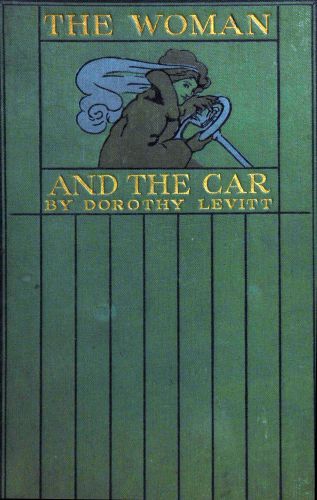
THE WOMAN AND THE CAR
THE WOMAN
AND THE CAR
A CHATTY LITTLE HANDBOOK
FOR ALL WOMEN WHO MOTOR
OR WHO WANT TO MOTOR
BY DOROTHY LEVITT
EDITED WITH INTRODUCTORY
ARTICLES BY C. BYNG-HALL
ILLUSTRATED BY PHOTOGRAPHS
SPECIALLY TAKEN
LONDON: JOHN LANE, THE BODLEY HEAD
NEW YORK: JOHN LANE COMPANY, MCMIX
Printed by Ballantyne & Co. Limited
Tavistock Street, Covent Garden, London
INTRODUCTORY
In presenting this book to the public the publisher is acting largely on the request of some hundreds of ladies, some already motorists, others would-be motorists. Miss Dorothy Levitt, last year, wrote a short series of articles for the Daily Graphic on the subject of Motoring for Women. These articles attracted a great deal of attention and Miss Levitt was inundated with letters from all parts of the United Kingdom and also from abroad, asking her for further information on various points and also begging her to publish the articles and additional information in volume form.
Miss Levitt was also asked to contribute articles on the same lines to many magazines and weekly publications and further received requests from a number of distinguished women to give them personal instruction in the art of driving and managing the mechanism of their cars.
As the simplest way out of answering all these requests Miss Levitt has revised and enlarged her former articles and has added new chapters and a great deal of matter which she believes every woman motorist or beginner will find of use.
There has been no attempt to make this volume a formal text-book on motoring for women but rather a chatty little handbook, containing simple and understandable instructions and hints for all women motorists, whether beginners or experts.
The facts contained in the various chapters are not those gathered from any standard manual of motoring but are from Miss Levitt’s own practical experience of six years’ daily driving, in all sorts of cars, in all sorts of weather and under all sorts of conditions—pleasure trips, long-distance tours at home and abroad and in competitions.
There may be points here and there which she has overlooked. Miss Levitt, however, will answer such questions or furnish such further information as readers may properly desire, either through the medium of his Majesty’s mails or, perhaps, in a later edition of this volume.
The photographs, with which the several chapters are illustrated, were specially taken for the work by Mr. Horace W. Nicholls.
London, February 1909.
CONTENTS
ILLUSTRATIONS
DOROTHY LEVITT: A PERSONAL SKETCH
It is not considered difficult for mere man to write about a pretty, young woman. Yet in the case of Dorothy Levitt it is difficult. There are so many things in her delightful private life which would have a vivid interest for the public. But I am forbidden to tread too deeply in that direction.
Dorothy Levitt is the premier woman motorist and botorist of the world. And she is ready to prove and uphold her title at any time.
In the United Kingdom, in France and in Germany, she has achieved distinctions, won success and carried off trophies such as no woman and few men can claim.
Five years ago Miss Levitt won the Championship of the Seas in the great motor-boat race at Trouville, France, defeating all comers.
Three years ago at Brighton she won a race and created a world’s record for women of 79¾ miles per hour. The following year she broke her own record and created a new world’s record for women of 91 miles an hour.
Looking at Miss Levitt one can hardly imagine that she could drive a car at such terrific speed. The public, in its mind’s eye, no doubt figures this motor champion as a big, strapping Amazon. Dorothy Levitt is exactly, or almost so, the direct opposite of such a picture. She is the most girlish of womanly women. Slight in stature, shy and shrinking, almost timid in her everyday life, it is seeming a marvel that she can really be the woman who has done all that the records show.
And the way in which she came to be a motorist—it is a story in itself. She was from childhood a good cyclist, a good driver of horses, a rider to hounds and an excellent shot with rifle or gun. Fishing was her favourite pastime. She was quick of eye and sure of hand and nerves troubled her not at all.
A friend, owning a motor-car, paid a visit to the family in the West Country. In a very few days Dorothy Levitt had become well acquainted with the intricacies of that motor. She handled the wheel as well as the owner or his chauffeur. She attended, as a spectator, a county competition, driving the car with such skill that the attention was attracted of the manager of a big motor firm. He secured an introduction and asked her to drive one of his cars in a competition. She agreed and thus became the first Englishwoman to drive a motor-car in a public competition.
Her first prize was won a month later, and since then she has steadily mounted the tree of her chosen profession. Yet she has remained an amateur, accepting no money prizes, only medals and cups and such like trophies.
In hill climbs, endurance and speed trials she is alike invincible. At the first aerial hare-and-hounds race of balloons this year she was selected as the umpire. The most careful, as well as intrepid and fast-driving motorist, was wanted. Miss Levitt unerringly followed the hare from London to near Arundel, Sussex, and was on the spot when the first balloon among the hounds descended near the hare.
Miss Levitt has been offered many enticing professional engagements on the Continent and in the United States but prefers to remain at home and an amateur.
In appearance Dorothy Levitt looks partly French, partly Irish, with a soupçon of American. Yet she is wholly English. Of medium height, her figure is slim and very graceful. She has a very girlish but expressive face, large eyes that are brown and grey and green in varying lights, brown hair that curls, a straight nose that has the bare inclination of a saucy upward tip and a mouth which is too large. It is a charming, winning face.
The one fault of Dorothy Levitt is her modesty, almost amounting to bashfulness. One cannot get her to tell much of her many exciting adventures, particularly those of which she is the heroine. She is immensely popular, has been toasted by Royalty at German motor banquets, elected honorary member of many of the first automobile clubs in this country and on the Continent, and has a host of friends, some in the sacred circles of society, others distinguished men and women of the more Bohemian circles of art and literature, music and the drama. She is an inveterate first-nighter, wears simple but ravishing clothes and, to those who do not know her, passes as a bright butterfly of fashion.
In a flat in a quiet but fashionable neighbourhood in the West-end of London, Miss Levitt lives the life of a bachelor girl. There she has a housekeeper and maid and a tiny Pomeranian, one “Dodo,” to keep her company. The flat contains, as its feature rooms, a Louis XIV. drawing-room and a Flemish dining-room, the latter the scene of many little luncheon parties for which Miss Levitt is also famous.
Hers is a busy life, involving many thousands of miles of travel in the year. She is to be seen at Ascot, Goodwood, Cowes, at Henley, at Ranelagh. To-day she may be in London. Next week you may hear of her as in France or Germany taking part in a motor competition; the week following she may be in Scotland or of a house-party in the Shires or botoring in the blue waters off the Riviera coast.
It is little wonder that her ambition is to leave the gay whirl and to settle down quietly in the country, with her motor, her dogs and a fishing-rod and a gun.
Of her public records I can do no better than quote extracts from her diary, for Miss Levitt, unlike the generality of women, is most careful in keeping a very businesslike diary. Here are the extracts:
April 1903.—First Englishwoman to take part in public motor-car competition. Did not win. Will do better next time.
May 13, 1903.—Glasgow to London Non-stop Run. Drove 16 horse-power Gladiator. Gained 994 marks out of possible 1000. Marks deducted for tyre troubles.
August 1903.—Won Gaston Menier Cup at Trouville, France. Value of cup, 350 guineas.
August 8, 1903.—Drove motor-boat Napier at Cowes. Won the race. Afterwards commanded to go over to Royal yacht by the King as his Majesty wanted to see me put boat through its paces. King thinks such boats may be useful for despatch work.
September 1903.—One thousand miles Reliability Trials. Sixteen horse-power Gladiator. Won. Did fastest time in class.
October 2, 1903.—Southport Speed Trials. Drove 16 horse-power Gladiator. Won silver cup for speed.
Won Championship of the Seas, Trouville. Napier motor-boat. Boat afterwards bought by French Government for £1000.
September 1904.—Light Car Trials. Successful. Drove small De Dion, 8 horse-power. Entirely alone. No mechanic attended to car. Did everything myself. Had non-stop for five days but small difficulties on sixth and last day.
October 1904.—Southport Speed Trials. Drove 50 horse-power Napier. Won two medals.
February 1905.—Did Liverpool and back to London in two days, averaging a level 20 miles per hour throughout for the entire 411 miles. Unaccompanied by mechanic. Eight horse-power De Dion.
May 1905.—Won Non-stop Certificate at Scottish Trials. Ran over very rough and hilly roads in the Highlands. Eight horse-power De Dion.
July 1905.—Won Brighton Sweepstakes on 80 horse-power Napier, at rate of 79¾ miles per hour, constituting the woman’s world record. Beat a great many professional drivers. Drove at rate of 77¾ miles in Daily Mail Cup.
June 1906.—Shelsley Walsh Hill Climb. Was only sixth at finish. Fifty horse-power Napier. Mine was only car competing which was not fitted with non-skids. Car nearly went over embankment owing to this and greasy state of roads.
June 1906.—South Harting Hill Climb. Won medal on 50 horse-power Napier. Also presented with silver casket for winning private match on same hill.
July 1906.—Aston Hill Climb (Tring). Third on 50 horse-power Napier.
October 1906.—Broke my own record and created new world’s record for women at Blackpool. Ninety horse-power six-cylinder Napier. Racing car. Drove at rate of 91 miles per hour. Had near escape as front part of bonnet worked loose and, had I not pulled up in time, might have blown back and beheaded me. Was presented with a cup by the Blackpool Automobile Club and also a cup by S. F. Edge, Limited.
May 1907.—Bexhill, Second Prize, Appearance Competition. Eight horse-power De Dion.
June 1907.—Germany. Won Gold Medal Herkomer Trophy Race (1818 kilometres). Fourth out of 172 competitors. In hill climb, fifth, and tenth in Forstenrieder Park Speed Trial out of 172 competitors. Was first of all women in all competitions. Sixty horse-power six-cylinder Napier. There were 42 cars with much larger engines than I had.
October 1907.—France, Gaillon Hill Climb. Forty horse-power six-cylinder Napier. Won in my class by 20 seconds. Gradient of hill 1 in 10 average.
June 1908.—Prinz Heinrich Trophy, Germany. Made absolute non-stop run on 45 horse-power Napier. Won large silver placque.
July 1908.—Aston Hill Climb, Aston Clinton. Made second fastest time of over 50 competitors on 60 horse-power Napier.
August 1908.—France. Trouville, La Côte du Calvaire.
THE WOMAN AND THE CAR
CHAPTER I
THE CAR—ITS COST, UP-KEEP AND ACCESSORIES
Motoring as a Pastime for Women—Patience of more Value than Nerve—Selection of a Car—Single-cylinder the best for Women who are going to drive themselves and attend to the Mechanism—Cost of a Small Car—Necessary Accessories and their Cost—Expense of Up-keep—The necessary Licences and the Cost.
Patience, the capacity for taking pains, is of more value than the most ponderous nerve. You may be afraid, as I am, of driving in a hansom through the crowded streets of town—you may be afraid of a mouse, or so nervous that you are startled at the slightest of sudden sounds—yet you can be a skilful motorist, and enjoy to the full the delights of this greatest of out-door pastimes, if you possess patience—the capacity for taking pains.
Motoring is a pastime for women: young, middle-aged, and—if there are any—old. There may be pleasure in being whirled around the country by your friends and relatives, or in a car driven by your chauffeur; but the real, the intense pleasure, the actual realisation of the pastime comes only when you drive your own car.
I have hunted—and was one with those who declare that the most glorious of all out-door life is in the saddle, on a fast, clean-jumping hunter; but when, by accident, I took up motoring I found the exhilaration, the delights of the gallop doubled. It fascinated me, and it will fascinate any woman who tries it.
I am writing this little book not so much for those women who have already taken up motoring, but for those who would like to, but either dare not because of nervousness, or who imagine it is too difficult to understand the many necessary details.
In the following chapters I will endeavour to explain everything in the simplest possible manner, without lapsing into confusing technicalities.
The first thing to discuss is the car. There are scores of makes, good, bad and indifferent. I have tried many different makes and have come to the conclusion that the De Dion is an ideal single-cylinder car for a woman to drive. It combines simplicity with reliability—two very important items to the automobiliste.
For your own driving, if you are going to attend to the mechanism yourself, you should purchase a single-cylinder car—more cylinders mean more work, and also more expense as regards tyres, petrol, oil, &c. The single-cylinder car is the most economical to run. Being constructed in a much lighter manner the weight on the tyres is less, consequently the tyre bill is smaller, a matter of great importance in the upkeep of a car.
The horse-power of a single-cylinder car is usually 8 h.p. or less. As regards carriage work, of course the purchaser can suit herself, but the “Victoria” type of body has the most graceful lines. Colour, also, is a matter of one’s own selection. Dark blue, brown, green, red or cream, they all look well, and can be picked out with lines to match the upholstery, or further embellished with a top panel of basket-work, as is the car in the photograph.
Such a car as I have described will cost, new, from £230. This price, however, is for the car itself, upholstered and complete as to seats and side lamps. It is the accessories that bring up the cost. It adds greatly to one’s comfort to have a hood, made of either black leather or khaki-coloured canvas, with nickel or brass mountings to match the finish of your car. Such a hood will cost, in leather, about £20, and in canvas £18. I am quoting for the best quality in every instance, for with motoring it is quality that counts in the long run. A folding glass screen, with nickel or brass fittings, framed in stained wood, will cost £10. The front lamps will cost about £6 per pair, and the rear lamp £1 to £1 5s. A waterproof rug can be bought for £1 to £2.
The car will, of course, seat two, but it is often advisable to have a third seat. This should be constructed so as to fold down when not in use, and would cost £15. You can have a stationary seat fitted for £10, but these do not look so nice (though quite as comfortable)
as those that fold down. In addition to these things it is necessary to carry a tyre repair outfit, which will cost about £1, also the following tools and spares:
Ammeter, jack, pliers, spanners, carburetter jet key, large and small screw-drivers, hammer, oil-can, grease injector, tyre-pump, sparking-plug, inlet and exhaust valves, trembler blade and screw, some washers, split pins, file, very fine file for platinum points, emery-powder, insulated tape, and some waste or swabs.
In buying your car you will probably find that the last car you were on is “the best.” It is liable to become somewhat confusing if you go for many trial runs; but one thing to bear in mind is that the car that will do five miles an hour faster than the one you previously tried is not necessarily the best car—it may be faster while it is running, but it may not run for long—therefore take my advice and pin your faith on the car with the reputation for reliability, the one that will not entail a big expenditure every few months for repairs. Nearly all of us, nowadays, have some motoring friends, who have probably had experience with different makes of cars: their experience should benefit you in your choice. There are some very inexpensive cars on the market, but inexpensive only as to initial outlay—they are likely to prove themselves sorry bargains before many months have passed. One of the chief joys of motoring is to feel that you can rely upon your car.
In regard to housing the car, if you are not fortunate enough to possess a stable or garage of your own, one of the following courses is open to you: Hire a stable, or garage, and a man to attend to the cleaning of the car; place it at one of the many garages, public and semi-private, now in existence—or you can stable it at the nearest mews and arrange with the ostler to do the washing. I cannot give the exact cost of the first and last of these, as they would naturally vary, but if placed at a regular garage the cost would be from 8s. 6d. to 12s. 6d. per week.
Another outlay is to be found in “tips.” The men at a garage are always hungry for “tips,” and your car will be polished with greater zest if the “tips” are frequent or generous. The advertisement of the “no tip” garage is a fallacy. The proprietor may consider this principle the right one, but if you act according to his ideas your car will probably suffer.
Petrol varies slightly in price, but is usually from 1s. to 1s. 4d. per gallon. As, with the car illustrated, you are able to run 28 to 32 miles on one gallon, you will see that petrol is not a great item.
The next duty that devolves on you after becoming the owner of a car is to procure your licences. There are two—one a licence for the car (the same as a carriage licence), the cost of which is governed according to the weight of the car, probably near two guineas; the other a driving licence, costing 5s. Both of these are to be obtained from the London County Council offices in Spring Gardens, London, S.W., or in the country at the various County Council headquarters—though the carriage licence can be obtained, after due application, at almost any post office. Your driving licence is an official printed paper with your name and address written in.
To obtain a number for the car it is necessary to apply to Spring Gardens, or any of the Registration and Licensing authorities in the United Kingdom. If one writes to a County Council, the letter should be addressed: “Clerk to the County Council of ——, County Council Offices, ——,” and if to a county borough, to “The Town Clerk, Town Hall, ——.” The registration fee is 20s. You will have to fill up a form and will then have a number registered.
This number you must have painted on two tin plates, white on a black ground. The figures must be 3½ in. deep. These number-plates must be affixed to the back and front of your car. The back one must be so placed that the light from the back lamp is thrown on it and thus the number distinctly seen at night. It is also necessary for part of the rear lamp to show a red light.
You should never go in your car without this licence—your driving licence, for you must produce it when asked by the proper authorities or pay the penalty of £5. But more of this later.