
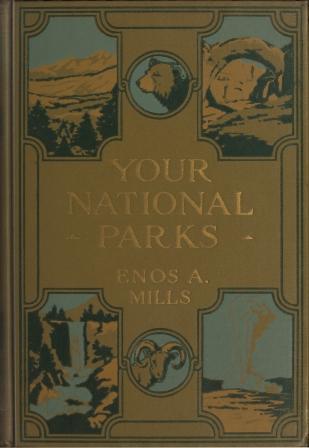
The Project Gutenberg eBook of Your National Parks, with Detailed Information for Tourists
Title: Your National Parks, with Detailed Information for Tourists
Author: Enos A. Mills
Laurence Frederick Schmeckebier
Release date: March 3, 2013 [eBook #42248]
Most recently updated: October 23, 2024
Language: English
Credits: Produced by Greg Bergquist and the Online Distributed
Proofreading Team at http://www.pgdp.net (This file was
produced from images generously made available by The
Internet Archive/American Libraries.)
By Enos A. Mills
YOUR NATIONAL PARKS. Illustrated. THE STORY OF SCOTCH. Illustrated. THE ROCKY MOUNTAIN WONDERLAND. Illustrated. THE STORY OF A THOUSAND-YEAR PINE. Illustrated. IN BEAVER WORLD. Illustrated. THE SPELL OF THE ROCKIES. Illustrated. WILD LIFE ON THE ROCKIES. Illustrated. |
HOUGHTON MIFFLIN COMPANY
Boston and New York
YOUR NATIONAL PARKS
A Guide to the National Parks
YOUR
NATIONAL PARKS
BY
ENOS A. MILLS
WITH DETAILED INFORMATION
FOR TOURISTS
BY
LAURENCE F. SCHMECKEBIER
And with Illustrations and Maps
BOSTON AND NEW YORK
HOUGHTON MIFFLIN COMPANY
The Riverside Press Cambridge
1917
COPYRIGHT, 1917, BY ENOS A. MILLS
ALL RIGHTS RESERVED
Published June 1917
TO
GEORGE W. PERKINS
AND
WILLIAM A. WELCH
WHOSE STATESMANSHIP, ENERGY, IDEALS, AND COURAGE
ARE MAKING THE PALISADES INTER-STATE PARK
"THE GREATEST PARK IN THE WORLD"
PREFACE
St. Louis had a memorable "flag day" a little more than a century ago. Within twenty-four hours the yellow and red flag of Spain was run down and the tricolor run up; this hauled down and the Stars and Stripes run up. The Louisiana Territory thus became a part of the United States. In a flash, the western boundary of this country was changed from the Mississippi River to the Rocky Mountains.
Scarcely were the Stars and Stripes flying, before Lewis and Clark were on their way to explore the vast and mysterious Louisiana Territory—the West. Theirs was one of the most comprehensive and successful exploring expeditions on record—one of the greatest of outdoor expeditions. There were adventures and hardships, but after two years the party returned to civilization with the loss of only one man. The resources of the great West were definitely placed before the world.
This expedition revealed the extraordinary resourcefulness of Lewis and Clark and brought out also two other characters who are worthy of a place in American literature and whose achievements might well be a source of inspiration in American life. These are John Colter, who afterwards discovered the Yellowstone, and Sacagawea, the "bird woman." Sacagawea was the one woman of the Lewis and Clark expedition. She rendered remarkable service, and her name will be forever associated with exploration, with woodcraft, and with the National-Park wildernesses.
Just before the returning Lewis and Clark expedition reached St. Louis, it met trappers starting up the river—going into the great West. This was the real beginning of the trapping industry, which for nearly two generations was the dominating influence of the West.
The West was thoroughly explored by the trappers. In a number of States they formed the first permanent settlement. The trappers harvested the furs of lakes and streams throughout the mountains and built up the "Commerce of the Prairies." We are indebted to them for the Oregon and Santa Fé trails. All history shows no more picturesque or resourceful character than the trapper. Among them were such great men as John Colter, James Bridger, and Kit Carson.
The trapper was followed by the prospector. The trapper did not search for gold. The prospector did not look for furs or fertile lands. In a different way the prospector exploited the same territory as the trapper and thus placed the resources and the romance of the West before the public.
Closely following the trapper and prospector was that rugged and aggressive character, the cowboy. He had a definite part in the forward movement of the frontier. The cowboy cared nothing for furs, or gold, or fertile lands. He was interested in the rich grasses for his cattle. He, too, had his short day. These characters—the cowboy, the prospector, and the trapper—tarried for a brief moment on the frontier when the farmer, the first lasting settler, arrived. All these armed and vigorous people, the wearers of buckskin, were people of individuality and power. They made great changes throughout the West, and hastened its final development.
Pioneer men and women are among the great and influential figures in history. They were human, they were honorable, and we do honor them. They did not want or need sympathy. They were getting much, perhaps the most, from life; they were happy. We think of theirs as being a life of sacrifice, but it really was a life of selection. They were away from the crowd—from the enemies of sincerity and individuality. Of all people they were most nearly free. But the pioneers are gone.
The frontier no longer exists, and the days of the wilderness are gone forever. Yet, in our magnificent National Parks we still have a bit of the primeval world and the spirit of the vigorous frontier. In these wild parks we may rebuild the past, and in them the trapper, the prospector, the cowboy, and the pioneer may act once more their part in the scenes that knew them.
These wilderness empires of our National Parks have been snatched from leveling forces of development. They are likely to prove the richest, noblest heritage of the nation. Here the world is at play, here are scenes ever new and that will greatly help to keep the nation young.
In the words of John Dickinson Sherman: "It is as if Nature in these places had in self-defense devoted all her energies to scenery, proclaiming to the nation, 'Here I will make playgrounds for the people. Here is nothing for commerce or industry. Here is natural beauty at its wildest and best. Elsewhere man must live by the sweat of his brow. Here let him rest and play. Here I will rule supreme for all time.'"
There are seventeen National Parks. New ones will early be made and there are at least twenty other scenic regions which should at once be added. No nation has ever fallen for having too much scenery. Scenery is, indeed, one of our most valuable resources, and these Parks will enable us to build up a scenic industry of magnitude. Already they are being developed with roads and trails, and before long there will be in all of them hotels and camps for visitors of every taste, together with special camps and provision for school-children.
I have tried to describe a few of the wonders of the Parks and to suggest the larger, fuller use of them. Through most of the Parks described I have had happy excursions afoot, alone and unarmed. Not only do the Parks contain some of the world's sublimest and most beautiful scenes, but each Park is a wild-life reservation, a place where guns are forbidden. Thus protected, these wildernesses will remain forever wild, forever mysterious and primeval, holding for the visitor the spell of the outdoors, exciting the spirit of exploration. Within them will survive that poetic million-year-old highway, the trail. Among their pathless scenes wild life will be perpetuated. Chains of mountain-peaks will ever stand—"the silent caravan that never passes by, the caravan whose camel backs are laden with the sky"—with purple forests, mountain-high waterfalls, vast and broken cañons, wind-swept plateaus, splendid lakes, and peaks and glaciers often touched with cloud and sunshine.
Our National Parks will continue for generations to come to be the No Man's Land, the Undiscovered Country, the Mysterious Old West, the Land of Romance and Adventure. My great hope and belief is that they will become a marked factor in public education. Surely, these wonderlands mean much for the general welfare, and will help to develop greater men and women—to arouse enthusiasm for our native land, and for nature everywhere.
E. A. M.
CONTENTS
| I. | The Yellowstone National Park | 3 |
| 1. A Camp-Fire that made History | 3 | |
| 2. The Discovery of the Yellowstone | 10 | |
| 3. The Geysers, Lakes, and Streams | 28 | |
| 4. Ages of Fire and Ice | 38 | |
| 5. The Petrified Forests | 45 | |
| 6. Area; Trees, Flowers, and Animals | 51 | |
| 7. Entrances | 53 | |
| 8. Administrative History | 54 | |
| 9. Lost in the Wilderness | 58 | |
| II. | The Yosemite National Park | 65 |
| 1. Ice-King Topography | 70 | |
| 2. Trees and Forests | 76 | |
| 3. Plant Life | 79 | |
| 4. The Realm of Falling Water | 83 | |
| 5. Seeing Yosemite | 88 | |
| 6. History of Yosemite | 93 | |
| III. | The Sequoia and the General Grant National Parks | 99 |
| The Big Trees | 104 | |
| IV. | Mount Rainier National Park | 116 |
| 1. The Splendid Wild-Flower Garden | 122 | |
| 2. Glaciers of Mount Rainier | 130 | |
| V. | Crater Lake National Park | 137 |
| VI. | Glacier National Park | 148 |
| History of Glacier National Park | 157 | |
| VII. | Mesa Verde National Park | 161 |
| VIII. | Rocky Mountain National Park | 175 |
| IX. | The Grand Cañon | 190 |
| X. | Lassen Volcanic National Park | 211 |
| XI. | Hawaii National Park | 221 |
| XII. | Three National Monuments | |
| 1. The Olympic National Monuments | 230 | |
| 2. The Natural Bridges and Rainbow Bridge National Monuments | 236 | |
| 3. Mukuntuweap National Monument | 239 | |
| XIII. | Other National Parks | 242 |
| 1. Wind Cave National Park | 242 | |
| 2. Sully's Hill Park | 244 | |
| 3. Casa Grande Ruin Reservation | 245 | |
| 4. Hot Springs Reservation | 246 | |
| 5. Platt National Park | 248 | |
| 6. Mount McKinley National Park | 248 | |
| XIV. | Canadian National Parks | 251 |
| 1. Jasper Park | 252 | |
| 2. Rocky Mountains Park | 254 | |
| 3. Yoho Park | 256 | |
| 4. Waterton Lakes Park | 258 | |
| 5. Revelstoke Park | 260 | |
| 6. The Animal Parks | 260 | |
| 7. St. Lawrence Islands Park | 261 | |
| 8. Fort Howe Park | 262 | |
| XV. | Park-Development and New Parks | 264 |
| XVI. | The Spirit of the Forest | 282 |
| XVII. | Wild Life in National Parks | 296 |
| XVIII. | In All Weathers | 317 |
| XIX. | The Scenery in the Sky | 340 |
| 1. Timber-Line | 340 | |
| 2. Above the Timber-Line | 345 | |
| 3. The Work of the Ice King | 351 | |
| 4. High Peaks | 356 | |
| XX. | John Muir | 360 |
| XXI. | National Parks the School of Nature | 366 |
| XXII. | Why We need National Parks | 378 |
| XXIII. | The Trail | 388 |
| APPENDIX | ||
| A. Act of Dedication of the Yellowstone National Park | 397 | |
| B. The National Parks at a Glance | 400 | |
| C. Proposed National Parks | 403 | |
| D. National Monuments | 405 | |
| E. Dominion National Parks of Canada | 412 | |
| BIBLIOGRAPHY | 415 | |
| GUIDE TO THE NATIONAL PARKS | ||
| Introduction | 425 | |
| Yellowstone National Park | 433 | |
| Yosemite National Park | 444 | |
| Sequoia National Park | 455 | |
| General Grant National Park | 459 | |
| Mount Rainier National Park | 460 | |
| Crater Lake National Park | 470 | |
| Glacier National Park | 475 | |
| Mesa Verde National Park | 488 | |
| Rocky Mountain National Park | 491 | |
| The Grand Cañon | 495 | |
| Lassen Volcanic National Park | 500 | |
| Hawaii National Park | 502 | |
| Mount McKinley National Park | 505 | |
| Hot Springs of Arkansas | 506 | |
| Minor National Parks | ||
| Casa Grande Ruin | 508 | |
| Wind Cave National Park | 508 | |
| Platt National Park | 509 | |
| Sully's Hill Park | 509 | |
| National Monuments | 510 | |
| Canadian Parks | ||
| Rocky Mountains Park | 515 | |
| Yoho Park | 516 | |
| Glacier Park | 517 | |
| Jasper Park | 518 | |
| Revelstoke Park | 518 | |
| Waterton Lakes Park | 519 | |
| Buffalo Park | 519 | |
| Elk Island Park | 520 | |
| St. Lawrence Islands Park | 520 | |
| Fort Howe Park | 520 | |
| INDEX | 521 | |
ILLUSTRATIONS
| John Colter, the Discoverer of Yellowstone Park | Frontispiece |
| From a drawing by E. S. Paxson | |
| Map showing Location of the National Parks and National Monuments | 1 |
| Mammoth Hot Springs, Yellowstone National Park | 30 |
| From a photograph by George R. King | |
| Old Faithful Geyser, Yellowstone National Park | 34 |
| From a photograph by Haynes, St. Paul, Minn. | |
| Grand Cañon from Artist Point, Yellowstone National Park | 42 |
| From a copyright photograph by Haynes, St. Paul | |
| Petrified Forests in Amethyst Mountain, Yellowstone National Park | 46 |
| Adapted from an illustration of the United States Geological Survey | |
| Bird's-Eye View of Yosemite Valley | 66 |
| Half Dome, Yosemite | 70 |
| From a photograph by George R. King | |
| Upper and Lower Yosemite Falls | 84 |
| From a photograph by the Pillsbury Picture Company | |
| Lake Tenaya, Yosemite National Park | 88 |
| From a photograph by the Desmond Company | |
| The Four Brothers, Sequoia National Park | 104 |
| From a photograph by Lindley Eddy, Ranger, Cal. | |
| Stage Road, Mount Rainier National Park | 118 |
| From a photograph by Curtis & Miller, Seattle, Wash. | |
| Mount Rainier from Paradise Valley | 124 |
| From a photograph by Curtis & Miller | |
| Crater Lake and Wizard Island | 138 |
| From a photograph by the Kiser Studio | |
| Phantom Ship, Crater Lake | 144 |
| By permission of the National Park Service | |
| McDermott Falls and Grinnell Mountain, Glacier National Park | 150 |
| From a photograph by Haynes, St. Paul | |
| Spruce Tree House, Mesa Verde National Park | 166 |
| From a photograph by Arthur Chapman | |
| Estes Park and Rocky Mountain National Park | 176 |
| From a photograph by Enos A. Mills. | |
| Loch Vale, Rocky Mountain National Park | 180 |
| From a photograph by W. T. Parke, Estes Park, Colo. | |
| Fern Lake, Rocky Mountain National Park | 188 |
| From a photograph by H. T. Cowling | |
| Looking West from North Side of Grand Cañon, showing Point Sublime and Isis Temple | 192 |
| By permission of the Department of the Interior | |
| Lassen Peak in Eruption | 214 |
| From a copyright photograph by B. F. Loomis | |
| Mount St. Helens from the Timber-Line Trail on Mount Rainier | 234 |
| From a photograph by A. H. Barnes | |
| Rainbow Natural Bridge, Rainbow National Monument | 238 |
| From a photograph by the Geological Survey | |
| Illecillewaet Valley, with Mount Sir Donald in the Distance, Glacier Park, Canada | 252 |
| From a photograph taken for the Commissioner of Dominion Parks | |
| Teton Mountain Region: Proposed Addition to Yellowstone Park | 266 |
| From a photograph by J. E. Stimson | |
| Mount Baker from the West | 270 |
| From a copyright photograph by W. H. Wilcox, Port Townsend, Wash. | |
| Mount St. Elias from East Side of Agassiz Glacier, Alaska | 274 |
| From a photograph by J. C. Russell | |
| On the Road to Sherman Tree, Giant Forest, Sequoia National Park | 282 |
| From a photograph by George F. Belden | |
| Elk in Jackson Hole | 296 |
| From a photograph by S. N. Leek | |
| Black Bear Cubs, Sequoia National Park | 304 |
| From a photograph by Lindley Eddy | |
| Long's Peak, from Chasm Lake, Rocky Mountain National Park | 320 |
| From a photograph by Enos A. Mills | |
| Above the Timber-Line in the Rocky Mountain National Park, showing Long's Peak | 346 |
| From a photograph by H. T. Cowling | |
| John Muir in Muir Woods | 360 |
| From a photograph by Herbert W. Gleason | |
| Trail near Timber-Line, Indian Henry's Park, Mount Rainier | 388 |
| From a photograph by Curtis & Miller | |
| Map of Yellowstone National Park | 436 |
| Map of Yosemite National Park | 446 |
| Map of Glacier National Park | 476 |
| Map of Rocky Mountain National Park | 492 |
The maps and bird's-eye view are used by permission of the National
Park Service, Department of the Interior.
Click on the map to enlarge it
By permission of the National Park Service, Department of the Interior
YOUR NATIONAL PARKS
YOUR NATIONAL
PARKS
I
THE YELLOWSTONE NATIONAL PARK
1. A CAMP-FIRE THAT MADE HISTORY
On September 19, 1870, a number of men were chatting around a camp-fire in the wilds of northwestern Wyoming. They had been exploring the Yellowstone wonderland. They had seen the geysers,—little hot-water volcanoes,—the pools of boiling colored mud, the great petrified forest, and the golden cañon of the Yellowstone, into whose colored depths the snowy river leaps. The exploration was over, and the men were about to start for their homes.
A group were discussing how they might secure the ownership of this scenic empire. A monopoly of this wonderland would mean a fortune. The discussion was interrupted. Cornelius Hedges arose before the camp-fire. He said that private ownership ought never to be considered. This region, he thought, should be set aside by the Government and forever held for the unrestricted use of the people. The magnificent National-Park idea was thus born by a camp-fire in the wilds. The views of this statesman prevailed, and it was agreed that the park project be launched at once and vigorously pushed. And this was done. A few enterprising, aggressive men championed the measure so earnestly that the Park became a reality in less than two years after the idea originated.
This celebrated camp was near the junction of the Gibbon and Firehole Rivers, at the foot of what now is National Park Mountain. In 1891 I made a reverent pilgrimage to this historic spot. I am grateful to every one who helped establish the Yellowstone Park. I am glad that the idea of a National Park was a camp-fire thought.
The Helena (Montana) "Herald" of November 9, 1870, had an article by Cornelius Hedges, containing what is probably the first published reference to the park project. Honor must be given to David E. Folsom and a number of other individuals for publicly suggesting, independently, a similar idea. These suggestions, however, were barren of results.
In the course of that autumn a bold park campaign was begun by Nathaniel P. Langford, Cornelius Hedges, and William H. Claggett, who had just been elected Delegate to Congress from Montana. Langford lectured in behalf of the project before interested audiences in Minneapolis, Washington, New York, and elsewhere; and he and Walter Trumbull published magazine articles on the subject. Copies of Langford's article in "Scribner's Magazine" were placed in the hands of every Member of Congress.
Dr. Ferdinand V. Hayden, of the United States Geological Survey of the Territories, became interested in the cause, and rendered invaluable service. During the summer of 1871 he explored the Yellowstone region and took scores of photographs. In coöperation with others, he drew the bill for Congressional enactment, and marked the boundary lines of the Park. This bill was introduced in the House by William H. Claggett, December 18, 1871. Senator Pomeroy, of Kansas, immediately introduced the identical measure in the Senate. Claggett, Hayden, Langford, and others made a thorough canvass. Each Member of Congress was personally interviewed. The enthusiasm, intelligence, and sincerity of these advocates produced winning results. The question came to a successful vote in the Senate, January 30, 1872. Senator Cole, of California, opposed.
In the House, the Committee on Public Lands reported the bill favorably. Henry L. Dawes, of Massachusetts, championed the measure. It reached a vote, February 27, 1872, with the following result: yeas, 115; nays, 65; not voting, 60. The bill was signed by President Grant, March 1, 1872.
It is a remarkable fact that Congress should have thus created the Yellowstone National Park. Through the ages the privileged classes have had almost exclusive enjoyment of scenic empires. The campaign which brought about the creation of this Park was brief, intense, and unique. It was a genuine and epoch-marking achievement.
The National-Park idea has gone round the world. All leading nations now have national parks and are planning more. Time is likely to stamp our original legislation as one of the important acts of statesmanship. A few public-spirited men of vision began a revolution and triumphed. The anniversary of this event may some day be observed with world-wide celebration. People progress in the improvement of their playgrounds no less than in the ordering of their workshops.
Concerning this National-Park legislation, General Hiram M. Chittenden, author of "The Yellowstone National Park," makes the following comment:—