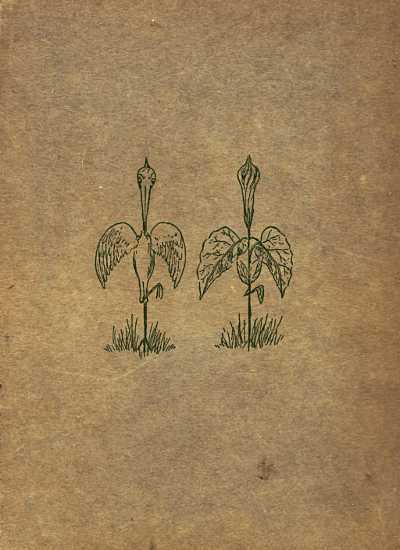
The superficial naturalists have often been misled,
By failing to discriminate between the tail and head:
It really is unfortunate such carelessness prevails,
Because the Bunnies have their heads where Tunnies have their tails.
The Octopus or Cuttle-fish!
I'm sure that none of us would wish
To have him scuttle 'round the house,
Like Puss, when she espies a mouse:
When you secure your house-hold pet,
Be very sure you do not get
The Octopus, or there may be
Domestic in-felis-ity.
The marked aversion which we feel,
When in the presence of the Eel,
Makes many view with consternation,
The Elephant's front ele-vation.
Such folly must be clearly due
To their peculiar point of view.
The ant is known by his ant-ennae,
Where-as the pheas-ant has'nt any,
And that is why he wears instead,
A small red cap upon his head:
Without his Fez, indeed the pheasant,
Would be quite bald and quite un-pleasant.
The Harrier, harassed by the Hare,
Presents a picture of despair;
Although as far as I'm concerned,
I love to see the tables turned.
The Harrier flies with all his might,
It is a harum-scare'm flight:
I'm not surprised he does not care
To meet the fierce pursuing Hare.
We have for many years been bored
By that old saw about the sword
And pen, and now we all rejoice,
To see how Nature made her choice:
She made, regardless of offendin',
The Sword-fish mightier than the Penguin.
The Gnu conspicuously wears
His coat of gnumerous bristling hairs,
While, as we see, the modest Newt
Of such a coat is destitute.
(I'm only telling this to you,
And it is strictly "entre gnu")
In point of fact the Newt is nude,
And therefore he does not obtrude,
But hides in some secluded gnook,
Beneath the surface of the brook.
It's almost more than he can bear,
To issue slyly from his lair,
And snatch a hasty breath of air,
His need of which is absolute,
Because, you see, he is a pneu-t. *
I always sing the hymn of hate,
When I perceive the Ray (or skate)
His ugly mouth I can't abide,
His eyes are on the other side,
His features are all out of place
He hasn't even any face.
I do not mind the Raven, though
Maligned by Edgar Allan Poe:
By his fun-er-ial array
We recognize him from the Ray,
Whose epiderm is white as snow,
Not black as night, like Mr Crow.
Though black, morose, and quite unshaven
I'm sure we all prefer the Raven.
The Apes, from whom we are descended,
Hang ape-x down from trees suspended,
And since we find them in the trees,
We term them arbor-ig-i-nes.
This quite explains the monkey-shines
Cut up by those who pluck from vines
The Grape, and then subject its juices,
To Bacchanalian abuses.
The Doe and her phonetic double,
No longer are a source of trouble,
Because the Dodo, it appears,
Has been extinct for many years:
She was too haughty to embark,
With total strangers in Noah's ark,
And we rejoice because her pride,
Our nature book has simplified.
To smoke a herring is to make
A most lam-en-table mistake,
Particularly since there are
The pipe-fish and the long Sea-gar.
Bear this in mind when next you wish
To smoke your after-dinner fish.
A roar of welkome through the welkin
Is certain proof you'll find the Elk in;
But if you listen to the shell,
In which the Whelk is said to dwell,
And hear a roar, beyond a doubt
It indicates the Whelk is out.
The striking similarity of this P-Q-liar pair,
No longer need en-cumber us, or fill us with despair:
The P-Cock and the Q-Cumber you never need confuse,
If you pay attention to the Eyes and mind your P's and Q's.
See what a fix the Sloth is in,
He has been captured by the gin:
This gin is not the same gin though,
In which we sometimes find the Sloe.
This shows how careful one must be,
To treat the gin most gingerly.
The Cowry seems to be, somehow,
A sort of mouth-piece for the Cow:
A speaking likeness one might say,
Which I've endeavored to portray.
If you will tap the Cantelope reposing on the ground
It will not move, but just emit a melon-choly sound
But if you try this method on the antlered antelope,
His departure will convince you that he is a mis-an-thrope.
Observe how Nature's necromancies
Have clearly painted on the Pansies,
These almost human counten-ances,
In yellow, blue and black nu-ances.
The face however seems to me
To be that of the Chim-pan-zee:
A fact that makes the gentle Pansy,
Appeal no longer to my fancy.
The Argo-naut or Nautilus,
With habits quite adventurous,
A com-bin-a-tion of a snail,
A jelly-fish and paper sail.
The parts of him that did not jell,
Are packed securely in his shell.
It is not strange that when I sought
To find his double, I found Naught.