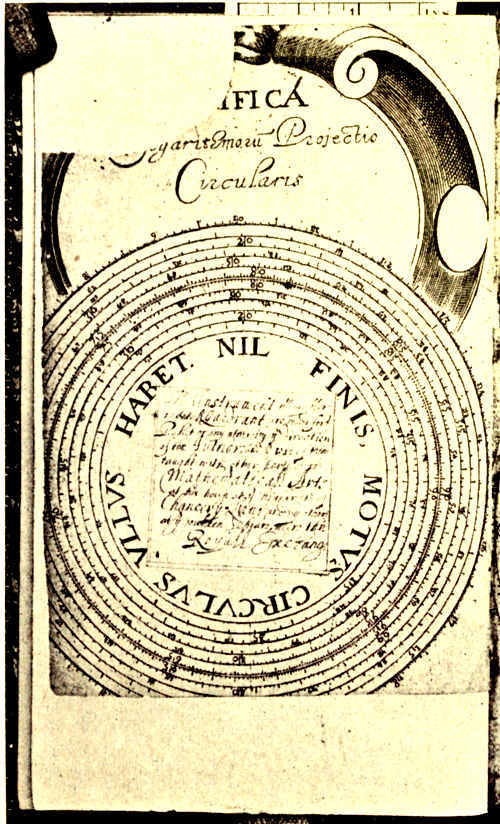
Title: On the History of Gunter's Scale and the Slide Rule During the Seventeenth Century
Author: Florian Cajori
Release date: February 26, 2013 [eBook #42216]
Language: English
Credits: Produced by Brenda Lewis, Stephen Hutcheson and the Online
Distributed Proofreading Canada Team at
http://www.pgdpcanada.net (This file was produced from
images generously made available by The Internet
Archive/American Libraries.)
UNIVERSITY OF CALIFORNIA PUBLICATIONS
IN
MATHEMATICS
Vol. 1, No. 9, pp. 187-209 February 17, 1920
BY
FLORIAN CAJORI
UNIVERSITY OF CALIFORNIA PRESS
BERKELEY
In my history of the slide rule[1], and my article on its invention[2] it is shewn that William Oughtred and not Edmund Wingate is the inventor, that Oughtred’s circular rule was described in print in 1632, his rectilinear rule in 1633. Richard Delamain is referred to as having tried to appropriate the invention to himself[3] and as having written a scurrilous pamphlet against Oughtred. All our information about Delamain was taken from De Morgan,[4] who, however, gives no evidence of having read any of Delamain’s writings on the slide rule. Through Dr. Arthur Hutchinson of Pembroke College, Cambridge, I learned that Delamain’s writings on the slide rule were available. In this article will be given: First, some details of the changes introduced during the seventeenth century in the design of Gunter’s scale by Edmund Wingate, Milbourn, Thomas Brown, John Brown and William Leybourn; second, an account of Delamain’s book of 1630 on the slide rule which antedates Oughtred’s first publication (though Oughtred’s date of invention is earlier than the date of Delamain’s alleged invention) and of Delamain’s later designs of slide rules; third, an account of the controversy between Delamain and Oughtred; fourth, an account of a later book on the slide rule written by William Oughtred, and of other seventeenth century books on the slide rule.
We begin with Anthony Wood’s account of Wingate’s introduction of Gunter’s scale into France.[5]
In 1624 he transported into France the rule of proportion, having a little before been invented by Edm. Gunter of Gresham Coll. and communicated it to most of the chiefest mathematicians then residing in Paris: who apprehending the great benefit that might accrue thereby, importun’d him to express the use thereof in the French tongue. Which being performed accordingly, he was advised by monsieur Alleawne the King’s chief engineer to dedicate his book to monsieur the King’s only brother, since duke of Orleans. Nevertheless the said work coming forth as an abortive (the publishing thereof being somewhat hastened, by reason an advocate of Dijon in Burgundy began to print some uses thereof, which Wingate had in a friendly way communicated to him) especially in regard Gunter himself had learnedly explained its use in a far larger volume.[6]
Gunter’s scale, which Wingate calls the “rule of proportion,” contained, as described in the French edition of 1624, four lines: (1) A single line of numbers; (2) a line of tangents; (3) a line of sines; (4) a line, one foot in length, divided into 12 inches and tenths of inches, also a line, one foot in length, divided into tenths and hundredths.
The English editions of this book which appeared in 1623 and 1628 are devoid of interest. The editions of 1645 and 1658 contain an important innovation.[7] In the preface the reasons why this instrument has not been used more are stated to be: (1) the difficulty of drawing the lines with exactness, (2) the trouble of working thereupon by reason (sometimes) of too large an extent of the compasses, (3) the fact that the instrument is not readily portable. The drawing of Wingate’s arrangement of the scale in the editions of 1645 and 1658 is about 66 cm. (26.5 in.) long. It contains five parallel lines, about 66 cm. long, each having the divisions of one line marked on one side and of another line on the other side. Thus each line carries two graduations: (1) A single logarithmic line of numbers; (2) a logarithmic line of numbers thrice repeated; (3) the first scale repeated, but beginning with the graduations which are near the middle of the first scale, so that its graduation reads 4, 5, 6, 7, 8, 9, 1, 2, 3; (4) a logarithmic line of numbers twice repeated; (5) a logarithmic line of tangents; (6) a logarithmic line of sines; (7) the rule divided into 1000 equal parts; (8) the scale of latitudes; (9) a line of inches and tenths of inches; (10) a scale consisting of three kinds, viz., a gauge line, a line of chords, and a foot measure, divided into 1000 equal parts.
Important are the first and second scales, by which cube root extraction was possible “by inspection only, without the aid of pen or compass;” similarly the third and fourth scales, for square roots. This innovation is due to Wingate. The 1645 edition announces that the instrument was made in brass by Elias Allen, and in wood by John Thompson and Anthony Thompson in Hosier Lane.
William Leybourn, in his The Line of Proportion or Numbers, Commonly called Gunter’s Line, Made Easie, London, 1673, says in his preface “To the Reader:”
The Line of Proportion or Numbers, commonly called (by Artificers) Gunter’s Line, hath been discoursed of by several persons, and variously applied to divers uses; for when Mr. Gunter had brought it from the Tables to a Line, and written some Uses thereof, Mr. Wingate added divers Lines of several lengths, thereby to extract the Square or Cube Roots, without doubling or trebling the distance of the Compasses: After him Mr. Milbourn, a Yorkshire Gentleman, disposed it in a Serpentine or Spiral Line, thereby enlarging the divisions of the Line.
On pages 127 and 128 Leybourn adds:
Again, One T. Browne, a Maker of Mathematical Instruments, made it in a Serpentine or Spiral Line, composed of divers Concentrick Circles, thereby to enlarg the divisions, which was the contrivance of one Mr. Milburn a Yorkshire Gentleman, who writ thereof, and communicated his Uses to the aforesaid Brown, who (since his death) attributed it to himself: But whoever was the contriver of it, it is not without inconvenience; for it can in no wise be made portable; and besides (instead of compasses) an opening Joynt with thirds [threads] must be placed to move upon the Centre of the Instrument, without which no proportion can be wrought.
This Mr. Milburn is probably the person named in the diary of the antiquarian, Elias Ashmole, on August 13 [1646?]; “I bought of Mr. Milbourn all his Books and Mathematical Instruments.”[8] Charles Hutton[9] says that Milburne of Yorkshire designed the spiral form about 1650. This date is doubtless wrong, for Thomas Browne who, according to Leybourn, got the spiral form of line from Milbourn, is repeatedly mentioned by William Oughtred in his Epistle[10] printed some time in 1632 or 1633. Oughtred does not mention Milbourn, and says (page 4) that the spiral form “was first hit upon by one Thomas Browne a Joyner, . . . the serpentine revolution being but two true semicircles described on severall centers.”[11]
Thomas Brown did not publish any description of his instrument, but his son, John Brown, published in 1661 a small book,[12] in which he says (preface) that he had done “as Mr. Oughtred with Gunter’s Rule, to a sliding and circular form; and as my father Thomas Brown into a Serpentine form; or as Mr. Windgate in his Rule of Proportion.” He says also that “this brief touch of the Serpentine-line I made bold to assert, to see if I could draw out a performance of that promise, that hath been so long unperformed by the promisers thereof.” Accordingly in Chapter XX he gives a description of the serpentine line, “contrived in five (or rather 15) turn.” Whether this description, printed in 1661, exactly fits the instrument as it was developed in 1632, we have no means of knowing. John Brown says:
1. First next the center is two circles divided one into 60, the other into 100 parts, for the reducing of minutes to 100 parts, and the contrary.
2. You have in seven turnes two inpricks, and five in divisions, the first Radius of the sines (or Tangents being neer the matter, alike to the first three degrees,) ending at 5 degrees and 44 minutes.
3. Thirdly, you have in 5 turns the lines of numbers, sines, Tangents, in three margents in divisions, and the line of versed sines in pricks, under the line of Tangents, according to Mr. Gunter’s cross-staff: the sines and Tangents beginning at 5 degrees, and 44 minutes where the other ended, and proceeding to 90 in the sines, and 45 in the Tangents. And the line of numbers beginning at 10, and proceeding to 100, being one entire Radius, and graduated into as many divisions as the largeness of the instrument will admit, being 10 to 10 50 into 50 parts, and from 50 to 100 into 20 parts in one unit of increase, but the Tangents are divided into single minutes from the beginning to the end, both in the first, second and third Radiusses, and the sines into minutes; also from 30 minutes to 40 degrees, and from 40 to 60, into every two minutes, and from 60 to 80 in every 5th minute, and from 80 to 85 every 10th, and the rest as many as can be well discovered.
The versed sines are set after the manner of Mr. Gunter’s Cross-staff, and divided into every 10th minutes beginning at 0, and proceeding to 156 going backwards under the line of Tangents.
4. Fourthly, beyond the Tangent of 45 in one single line, for one Turn is the secants to 51 degrees, being nothing else but the sines reitterated beyond 90.
5. Fifthly, you have the line of Tangents beyond 45, in 5 turnes to 85 degrees, whereby all trouble of backward working is avoided.
6. Sixthly, you have in one circle the 180 degrees of a Semicircle, and also a line of natural sines, for finding of differences in sines, for finding hour and Azimuth.
7. Seventhly, next the verge or outermost edge is a line of equal parts to get the Logarithm of any number, or the Logarithm sine and Tangent of any ark or angle to four figures besides the carracteristick.
8. Eightly and lastly, in the space place between the ending of the middle five turnes, and one half of the circle are three prickt lines fitted for reduction. The uppermost being for shillings, pence and farthings. The next for pounds, and ounces, and quarters of small Averdupoies weight. The last for pounds, shillings and pence, and to be used thus: If you would reduce 16s. 3d. 2q. to a decimal fraction, lay the hair or edge of one of the legs of the index on 16. 3½ in the line of 1. s. d. and the hair shall cut on the equal parts 81 16; and the contrary, if you have a decimal fraction, and would reduce it to a proper fraction, the like may you do for shillings, and pence, and pounds, and ounces.
The uses of the lines follow.
As to the use of these lines, I shall in this place say but little, and that for two reasons. First, because this instrument is so contrived, that the use is sooner learned then any other, I speak as to the manner, and way of using it, because by means of first second and third radiusses, in sines and Tangents, the work is always right on, one way or other, according to the Canon whatsoever it be, in any book that treats of the Logarithms, as Gunter, Wells, Oughtred, Norwood, or others, as in Oughtred from page 64 to 107.
Secondly, and more especially, because the more accurate, and large handling thereof is more then promised, if not already performed by more abler pens, and a large manuscript thereof by my Sires meanes, provided many years ago, though to this day not extant in print; so for his sake I claiming my interest therein, make bold to present you with these few lines, in order to the use of them: And first note,
1. Which soever of the two legs is set to the first term in the question, that I call the first leg always, and the other being set to the second term, I call the second leg . . .
The exact nature of the contrivance with the “two legs” is not described, but it was probably a flat pair of compasses, attached to the metallic surface on which the serpentine line was drawn. In that case the instrument was a slide rule, rather than a form of Gunter’s line. In his publication of 1661, as also in later publications,[13] John Brown devoted more space to Gunter’s scales, requiring the use of a separate pair of compasses, than to slide rules.
The same remark applies to William Leybourn who, after speaking of Seth Partridge’s slide rule, returns to forms of Gunter’s scale, saying:[14]
There is yet another way of disposing of this Line of Proportion, by having one Line of the full length of the Ruler, and another Line of the same Radius broken in two parts between 3 and 4; so that in working your Compasses never go off of the Line: This is one of the best contrivances, but here Compasses must be used. These are all the Contrivances that I have hitherto seen of these Lines: That which I here speak of, and will shew how to use, is only two Lines of one and the same Radius, being set upon a plain Ruler of any length (the larger the better) having the beginning of one Line, at the end of the other, the divisions of each Line being set so close together, that if you find any number upon one of the Lines, you may easily see what number stands against it on the other Line. This is all the Variation. . . .
Example 1. If a Board be 1 Foot 64 parts broad, how much in length of that Board will make a Foot Square? Look upon one of your Lines (it matters not which) for 1 Foot 64 parts, and right against it on the other Line you shall find 61; and so many parts of a Foot will make a Foot square of that Board.
This contrivance solves the equation 1.64x=1, yielding centesimal parts of a foot.
James Atkinson[15] speaks of “Gunter’s scale” as “usually of Boxwood . . . commonly 2 ft. long, 1½ inch broad” and “of two kinds: long Gunter or single Gunter, and the sliding Gunter. It appears that during the seventeenth century (and long after) the Gunter’s scale was a rival of the slide rule.
We begin with a brief statement of the relations between Oughtred and Delamain. At one time Delamain, a teacher of mathematics in London, was assisted by Oughtred in his mathematical studies. In 1630 Delamain published the Grammelogia, a pamphlet describing a circular slide rule and its use. In 1631 he published another tract, on the Horizontall Quadrant.[16] In 1632 appeared Oughtred’s Circles of Proportion[17] translated into English from Oughtred’s Latin manuscript by another pupil, William Forster, in the preface of which Forster makes the charge (without naming Delamain) that “another . . . went about to pre-ocupate” the new invention. This led to verbal disputes and to the publication by Delamain of several additions to the Grammelogia, describing further designs of circular slide rules and also stating his side of the bitter controversy, but without giving the name of his antagonist. Oughtred’s Epistle was published as a reply. Each combatant accuses the other of stealing the invention of the circular slide rule and the horizontal quadrant.
The two title-pages of the edition of the Grammelogia in the British Museum in London which we have called “Grammelogia IV.”
There are at least five different editions, or impressions, of the Grammelogia which we designate, for convenience, as follows:
Grammelogia I, 1630. One copy in the Cambridge University Library.[18]
Grammelogia II, I have not seen a copy of this.
Grammelogia III, One copy in the Cambridge University Library.[19]
Grammelogia IV, One copy in the British Museum, another in the Bodleian Library, Oxford.[20]
Grammelogia V, One copy in the British Museum.
In Grammelogia I the first three leaves and the last leaf are without pagination. The first leaf contains the title-page; the second leaf, the dedication to the King and the preface “To the Reader;” the third leaf, the description of the Mathematical Ring. Then follow 22 numbered pages. Counting the unnumbered pages, there are altogether 30 pages in the pamphlet. Only the first three leaves of this pamphlet are omitted in Grammelogia IV and V.
In Grammelogia III the Appendix begins with a page numbered 52 and bears the heading “Conclusion;” it ends with page 68, which contains the same two poems on the mathematical ring that are given on the last page of Grammelogia I but differs slightly in the spelling of some of the words. The 51 pages which must originally have preceded page 52, we have not seen. The edition containing these we have designated Grammelogia II. The reason for the omission of these 51 pages can only be conjectured. In Oughtred’s Epistle (p. 24), it is stated that Delamain had given a copy of the Grammelogia to Thomas Brown, and that two days later Delamain asked for the return of the copy, “because he had found some things to be altered therein” and “rent out all the middle part.” Delamain labored “to recall all the bookes he had given forth, (which were many) before the sight of Brownes Lines.” These spiral lines Oughtred claimed that Delamain had stolen from Brown. The title-page and page 52 are the only parts of the Appendix, as given in Grammelogia III, that are missing in the Grammelogia IV and V.
Grammelogia IV answers fully to the description of Delamain’s pamphlet contained in Oughtred’s Epistle. It was brought out in 1632 or 1633, for what appears to be the latest part of it contains a reference (page 99) to the Grammelogia I (1630) as “being now more then two yeares past.” Moreover, it refers to Oughtred’s Circles of Proportion, 1632, and Oughtred’s reply in the Epistle was bound in the Circles of Proportion having the Addition of 1633. For convenience of reference we number the two title-pages of Grammelogia IV, “page (1)” and “page (2),” as is done by Oughtred in his Epistle. Grammelogia IV contains, then, 113 pages. The page numbers which we assign will be placed in parentheses, to distinguish them from the page numbers which are printed in Grammelogia IV. The pages (44)-(65) are the same as the pages 1-22, and the pages (68)-(83) are the same as the pages 53-68. Thus only thirty-eight pages have page numbers printed on them. The pages (67) and (83) are identical in wording, except for some printer’s errors; they contain verses in praise of the Ring, and have near the bottom the word “Finis.” Also, pages (22) and (23) are together identical in wording with page (113), which is set up in finer type, containing an advertisement of a part of Grammelogia IV explaining the mode of graduating the circular rules. There are altogether six parts of Grammelogia IV which begin or end by an address to the reader, thus: “To the Reader,” “Courteous Reader,” or “To the courteous and benevolent Reader . . .,” namely the pages (8), (22), (68), (89), (90), (108). In his Epistle (page 2), Oughtred characterizes the make up of the book in the following terms:
In reading it . . . I met with such a patchery and confusion of disjoynted stuffe, that I was striken with a new wonder, that any man should be so simple, as to shame himselfe to the world with such a hotch-potch.
Grammelogia V differs from Grammelogia IV in having only the second title-page. The first title-page may have been torn off from the copy I have seen. A second difference is that the page with the printed numeral 22 in Grammelogia IV has after the word “Finis” the following notice:
This instrument is made in Silver, or Brasse for the Pocket, or at any other bignesse, over against Saint Clements Church without Temple Barre, by Elias Allen.
This notice occurs also on page 22 of Grammelogia I and III, but is omitted from page 22 of Grammelogia V.
In his address to King Charles I, in his Grammelogia I, Delamain emphasizes the ease of operating with his slide rule by stating that it is “fit for use . . . as well on Horse backe as on Foot.” Speaking “To the Reader,” he states that he has “for many yeares taught the Mathematicks in this Towne,” and made efforts to improve Gunter’s scale “by some Motion, so that the whole body of Logarithmes might move proportionally the one to the other, as occasion required. This conceit in February last [1629] I struke upon, and so composed my Grammelogia or Mathematicall Ring; by which only with an ocular inspection, there is had at one instant all proportionalls through the said body of Numbers.” He dates his preface “first of January, 1630.” The fifth and sixth pages contain his “Description of the Grammelogia,” the term Grammelogia being applied to the instrument, as well as to the book. His description is as follows:
The parts of the Instrument are two Circles, the one moveable, and the other fixed; The moveable is that unto which is fastened a small pin to move it by; the other Circle may be conceived to be fixed; The circumference of the moveable Circle is divided into unequall parts, charactered with figures thus, 1. 2. 3. 4. 5. 6. 7. 8. 9. these figures doe represent themselves, or such numbers unto which a Cipher or Ciphers are added, and are varied as the occasion falls out in the speech of Numbers, so 1. stands for 1. or 10. or 100., &c. the 2. stands for 2. or 20. or 200. or 2000., &c. the 3. stands for 30. or 300. or 3000., &c.
After elaborating this last point and explaining the decimal subdivisions on the scales of the movable circle, he says that “the numbers and divisions on the fixed Circle, are the very same that the moveable are, . .” There is no drawing of the slide rule in this publication. The twenty-two numbered pages give explanations of the various uses to which the instrument can be put: “How to performe the Golden Rule” (pp. 1-3), “Further uses of the Golden Rule” (pp. 4-6), “Notions or Principles touching the disposing or ordering of the Numbers in the Golden Rule in their true places upon the Grammelogia” (pp. 7-11), “How to divide one number by another” (pp. 12, 13), “to multiply one Number by another” (pp. 14, 15), “To find Numbers in continuall proportion” (pp. 16, 17), “How to extract the Square Root,” “How to extract the Cubicke Root” (pp. 18-21), “How to performe the Golden Rule” (the rule of proportion) is explained thus:
Seeke the first number in the moveable, and bring it to the second number in the fixed, so right against the third number in the moveable, is the answer in the fixed.
If the Interest of 100. li. be 8. li. in the yeare, what is the Interest of 65. li. for the same time.
Bring 100. in the moveable to 8. in the fixed, so right against 65. in the moveable is 5.2. in the fixed, and so much is the Interest of 65. li. for the yeare at 8. li. for 100. li. per annum.
The Instrument not removed, you may at one instant right against any summe of money in the moveable, see the Interest thereof in the fixed: the reason of this is from the Definition of Logarithmes.
These are the earliest known printed instructions on the use of a slide rule. It will be noticed that the description of the instrument at the opening makes no references to logarithmic lines for the trigonometric functions; only the line of numbers is given. Yet the title-page promised the “resolution of Plaine and Sphericall Triangles.” Page 22 throws light upon this matter:
If there be composed three Circles of equal thicknesse, A.B.C. so that the inner edge of D [should be B] and the outward edge of A bee answerably graduated with Logarithmall signes [sines], and the outward edge of B and the inner edge of A with Logarithmes; and then on the backside be graduated the Logarithmall Tangents, and againe the Logarithmall signes oppositly to the former graduations, it shall be fitted for the resolution of Plaine and Sphericall Triangles.
After twelve lines of further remarks on this point he adds:
Hence from the forme, I have called it a Ring, and Grammelogia by annoligie of a Lineary speech; which Ring, if it were projected in the convex unto two yards Diameter, or thereabouts, and the line Decupled, it would worke Trigonometrie unto seconds, and give proportionall numbers unto six places only by an ocular inspection, which would compendiate Astronomicall calculations, and be sufficient for the Prosthaphaeresis of the Motions: But of this as God shall give life and ability to health and time.
The unnumbered page following page 22 contains the patent and copyright on the instrument and book:
Whereas Richard Delamain, Teacher of Mathematicks, hath presented vnto Vs an Instrument called Grammelogia, or The Mathematicall Ring, together with a Booke so intituled, expressing the use thereof, being his owne Invention; we of our Gracious and Princely favour have granted unto the said Richard Delamain and his Assignes, Privilege, Licence, and Authority, for the sole Making, Printing and Selling of the said Instrument and Booke: straightly forbidding any other to Make, Imprint, or Sell, or cause to be Made, or Imprinted, or Sold, the said Instrument or Booke within any our Dominions, during the space of ten yeares next ensuing the date hereof, upon paine of Our high displeasure. Given under our hand and Signet at our Palace of Westminster, the fourth day of January, in the sixth yeare of our Raigne.
In the Appendix of Grammelogia III, on page 52 is given a description of an instrument promised near the end of Grammelogia I:
That which I have formerly delivered hath been onely upon one of the Circles of my Ring, simply concerning Arithmeticall Proportions, I will by way of Conclusion touch upon some uses of the Circles, of Logarithmall Sines, and Tangents, which are placed on the edge of both the moveable and fixed Circles of the Ring in respect of Geometricall Proportions, but first of the description of these Circles.
First, upon the side that the Circle of Numbers is one, are graduated on the edge of the moveable, and also on the edge of the fixed the Logarithmall Sines, for if you bring 1. in the moveable amongst the Numbers to 1. in the fixed, you may on the other edge of the moveable and fixed see the sines noted thus 90. 90. 80. 80. 70. 70. 60. 60. &c. unto 6.6. and each degree subdivided, and then over the former divisions and figures 90. 90. 80. 80. 70. 70. &c. you have the other degrees, viz. 5. 4. 3. 2. 1. each of those divided by small points.
Secondly, (if the Ring is great) neere the outward edge of this side of the fixed against the Numbers, are the usuall divisions of a Circle, and the points of the Compasse: serving for observation in Astronomy, or Geometry, and the sights belonging to those divisions, may be placed on the moveable Circle.
Thirdly, opposite to those Sines on the other side are the Logarithmall Tangents, noted alike both in the moveable and fixed thus 6.6.7.7.8.8.9.9.10.10.15.15.20.20. &c. unto 45.45. which numbers or divisions serve also for their Complements to 90. so 40 gr. stands for 50. gr. 30. gr. for 60 gr. 20. gr. for 70. gr. &c. each degree here both in the moveable and fixed is also divided into parts. As for the degrees which are under 6. viz. 5.4.3.2.1. they are noted with small figures over this divided Circle from 45.40.35.30.25. &c. and each of those degrees divided into parts by small points both in the moveable and fixed.
Fourthly, on the other edge of the moveable on the same side is another graduation of Tangents, like that formerly described. And opposite unto it, in the fixed is a Graduation of Logarithmall sines in every thing answerable to the first descrition of Sines on the other side.
Fifthly, on the edge of the Ring is graduated a parte of the Æquator, numbered thus 10 20. 30. unto 100. and there unto is adjoyned the degrees of the Meridian inlarged, and numbered thus 10 20.30 unto 70. each degree both of the Æquator, and Meridian are subdivided into parts; these two graduated Circles serve to resolve such Questions which concerne Latitude, Longitude, Rumb, and Distance, in Nauticall operations.
Sixthly, to the concave of the Ring may be added a Circle to be elevated or depressed for any Latitude, representing the Æquator, and so divided into houres and parts with an Axis, to shew both the houre, and Azimuth, and within this Circle may be hanged a Box, and Needle with a Socket for a staffe to slide into it, and this accommodated with scrue pines to fasten it to the Ring and staffe, or to take it off at pleasure.
The pages bearing the printed numbers 53-68 in the Grammelogia III, IV and V make no reference to the dispute with Oughtred and may, therefore, be assumed to have been published before the appearance of Oughtred’s Circles of Proportion. On page 53, “To the Reader,” he says:
. . . you may make use of the Projection of the Circles of the Ring upon a Plaine, having the feet of a paire of compasses (but so that they be flat) to move on the Center of that Plaine, and those feet to open and shut as a paire of Compasses . . . now if the feet bee opened to any two termes or numbers in that Projection, then may you move the first foot to the third number, and the other foot shall give the Answer; . . . it hath pleased some to make use of this way. But in this there is a double labour in respect to that of the Ring, the one in fitting those feet unto the numbers assigned, and the other by moving them about, in which a man can hardly accommodate the Instrument with one hand, and expresse the Proportionals in writing with the other. By the Ring you need not but bring one number to another, and right against any other number is the Answer without any such motion. . . . upon that [the Ring] I write, shewing some uses of those Circles amongst themselves, and conjoyned with others . . . in Astronomy, Horolographie, in plaine Triangles applyed to Dimensions, Navigation, Fortification, etc. . . . But before I come to Construction, I have thought it convenient by way introduction, to examine the truth of the graduation of those Circles . . .
These are the words of a practical man, interested in the mechanical development of his instrument. He considers not only questions of convenience but also of accuracy. The instrument has, or may have now, also lines of sines and tangents. To test the accuracy of the circles of Numbers, “bring any number in the moveable to halfe of that number in the fixed: so any number or part in the fixed shall give his double in the moveable, and so may you trie of the thirds, fourths &c. of numbers, vel contra,” (p. 54). On page 55 are given two small drawings, labelled, “A Type of the Ringe and Scheme of this Logarithmicall projection, the use followeth. These Instruments are made in Silver or Brasse by John Allen neare the Sauoy in the Strand.”
Delamain’s publication of 1630 on the ‘Mathematicall Ring’ does not appear at that time to have caused a rupture between him and Oughtred. When in 1631 Delamain brought out his Horizontall Quadrant, the invention of which Delamain was afterwards charged to have stolen from Oughtred, Delamain was still in close touch with Oughtred and was sending Oughtred in the Arundell House, London, the sheets as they were printed. Oughtred’s reference to this in his Epistle (p. 20) written after the friendship was broken, is as follows:
While he was printing his tractate of the Horizontall quadrant, although he could not but know that it was injurious to me in respect of my free gift to Master Allen, and of William Forster, whose translation of my rules was then about to come forth: yet such was my good nature, and his shamelessnesse, that every day, as any sheet was printed, hee sent, or brought the same to mee at my chamber in Arundell house to peruse which I lovingly and ingenuously did, and gave him my judgment of it.
Even after Forster’s publication of Oughtred’s Circles of Proportion, 1632, Oughtred had a book, A canon of Sines Tangents and Secants, which he had borrowed from Delamain and was then returning (Epistle, page (5)). The attacks which Forster, in the preface to the Circles of Proportion, made upon Delamain (though not naming Delamain) started the quarrel. Except for Forster and other pupils of Oughtred who urged him on to castigate Delamain, the controversy might never have arisen. Forster expressed himself in part as follows:
. . . being in the time of the long vacation 1630, in the Country, at the house of the Reverend, and my most worthy friend, and Teacher, Mr. William Oughtred (to whose instruction I owe both my initiation, and whole progresse in these Sciences.) I vpon occasion of speech told him of a Ruler of Numbers, Sines, & Tangents, which one had be-spoken to be made (such as it vsually called Mr. Gunter’s Ruler) 6 feet long, to be vsed with a payre of beame-compasses. “He answered that was a poore invention, and the performance very troublesome: But, said he, seeing you are taken with such mechanicall wayes of Instruments, I will shew you what deuises I have had by mee these many yeares.” And first, hee brought to mee two Rulers of that sort, to be vsed by applying one to the other, without any compasses: and after that hee shewed mee those lines cast into a circle or Ring, with another moueable circle vpon it. I seeing the great expeditenesse of both those wayes; but especially, of the latter, wherein it farre excelleth any other Instrument which hath bin knowne; told him, I wondered that hee could so many yeares conceale such vseful inuentions, not onely from the world, but from my selfe, to whom in other parts and mysteries of Art, he had bin so liberall. He answered, “That the true way of Art is not by Instruments, but by Demonstration: and that it is a preposterous course of vulgar Teachers, to begin with Instruments, and not with the Sciences, and so in-stead of Artists, to make their Schollers only doers of tricks, and as it were Iuglers: to the despite of Art, losse of precious time, and betraying of willing and industrious wits, vnto ignorance and idlenesse. That the vse of Instruments is indeed excellent, if a man be an Artist: but contemptible, being set and opposed to Art. And lastly, that he meant to commend to me, the skill of Instruments, but first he would haue me well instructed in the Sciences. He also shewed me many notes, and Rules for the vse of those circles, and of his Horizontall Instrument, (which he had proiected about 30 yeares before) the most part written in Latine. All which I obtained of him leaue to translate into English, and make publique, for the vse, and benefit of such as were studious, and louers of these excellent Sciences.
Which thing while I with mature, and diligent care (as my occasions would give me leaue) went about to doe: another to whom the Author in a louing confidence discouered this intent, using more hast then good speed, went about to preocupate; of which vntimely birth, and preuenting (if not circumuenting) forwardnesse, I say no more: but aduise the studious Reader, onely so farre to trust, as he shal be sure doth agree to truth & Art.
While in this dedication reference is made to a slide rule or “ring” with a “moveable circle,” the instrument actually described in the Circles of Proportion consists of fixed circles “with an index to be opened after the manner of a paire of Compasses.” Delamain, as we have seen, had decided preference for the moveable circle. To Oughtred, on the other hand, one design was about as good as the other; he was more of a theorist and repeatedly expressed his contempt for mathematical instruments. In his Epistle (page (25)), he says he had not “the one halfe of my intentions upon it” (the rule in his book), nor one with a “moveable circle and a thread, but with an opening Index at the centre (if so be that bee cause enough to make it to bee not the same, but another Instrument) for my part I disclaime it: it may go seeke another Master: which for ought I know, will prove to be Elias Allen himselfe: for at his request only I altered a little my rules from the use of the moveable circle and the thread, to the two armes of an Index.”
All parts of Delamain’s Grammelogia IV, except pages 1-22 and 53-68 considered above, were published after the Circles of Proportion, for they contain references to the ill treatment that Delamain felt or made believe that he felt, that he had received in the book published by Oughtred and Forster. Oughtred’s reference to teachers whose scholars are “doers of tricks,” “Iuglers,” and Forster’s allusion to “another to whom the Author in a loving confidence” explained the instrument and who “went about to preocupate” it, are repeatedly mentioned. Delamain says, (page (89)) that at first he did not intend to express himself in print, “but sought peace and my right by a private and friendly way.” Oughtred’s account of Delamain’s course is that of an “ill-natured man” with a “virulent tongue,” “sardonical laughter” and “malapert sawsiness.” Contrasting Forster and Delamain, he says that, of the former he “had the very first moulding” and made him feel that “the way of Art” is “by demonstration.” But Delamain was “already corrupted with doing upon Instruments, and quite lost from ever being made an Artist.” (Epistle page (27)). Repeatedly does Oughtred assert Delamain’s ignorance of mathematics. The two men were evidently of wholly different intellectual predilections. That Delamain loved instruments is quite evident, and we proceed to describe his efforts to improve the circular slide rule.