By E. P. ALEXANDER.
Relations of Railway Management to all Other Pursuits—Developed by the Necessities of
a Complex Industrial Life—How a Continuous Life is Given to a Corporation—Its Artificial
Memory—Main Divisions of Railway Management—The Executive and Legislative
Powers—The Purchasing and Supply Departments—Importance of the Legal
Department—How the Roadway is Kept in Repair—The Maintenance of Rolling
Stock—Schedule-making—The Handling of Extra Trains—Duties of the Train-despatcher—Accidents
in Spite of Precautions—Daily Distribution of Cars—How Business
is Secured and Rates are Fixed—The Interstate Commerce Law—The Questions
of "Long and Short Hauls" and "Differentials"—Classification of Freight—Regulation
of Passenger-rates—Work of Soliciting Agents—The Collection of Revenue
and Statistics—What is a Way-bill—How Disbursements are Made—The Social
and Industrial Problem which Confronts Railway Corporations.
The world was born again with the building of
the first locomotive and the laying of the first
level iron roadway. The energies and activities,
the powers and possibilities then developed have
acted and reacted in every sphere of life—social,
industrial, and political—until human progress,
after smouldering like a spark for a thousand
years, has burst into a conflagration which will
soon leave small trace of the life and customs, or even the modes of
thought, which our fathers knew. But, in it all, the railroad remains
the most potent factor in every development. By bringing men
more and more closely together, and supplying them more and
more abundantly and cheaply with all the varied treasures of the
earth, stored up for millions of years for the coming of this generation,
it adds continually more fuel to the flame it originated. And
as it is necessarily reacted upon equally by every new invention or
discovery, and by all progress in other departments of human activity,
the demands upon it, and its points of contact with everyday
life, are still increasing in geometrical progression.
Hence, in the practical management of railroad affairs, problems
are of constant occurrence which touch almost every pursuit
to which men give themselves, whether of finance, agriculture,
commerce, manufactures, science, or politics; and the methods,
forms, and principles under which current railroad management
is being developed (for it is by no means at a stand-still) are
the result of the necessities imposed by these multiplying problems
acting within the constraints of corporate existences.
For while the life of a corporation is perpetual, its powers are
constrained, and the individuals exercising them are constantly
changing. It is but an artificial individual existing for certain purposes
only, and, as it lacks some human qualities, all its methods
of doing business are influenced thereby. The business affairs
of an individual, for instance, are greatly simplified by his memory
of his transactions from day to day and from year to year.
But a corporation having no natural memory, all of its transactions
and relations must be minutely and systematically noted in its
archives. Every contract and obligation must be of record, all
property bought or constructed must go upon the books, and,
when expended or used up, must go off in due form; and especially
must an accurate system of checks guard all earnings and
expenditures, and a comprehensive system of book-keeping consolidate
innumerable transactions into the great variety of boiled-down
figures and statistics necessary for officers and stockholders
to fully understand what the property is doing.
Under such circumstances, then, our railroads and their systems
of organization and management, like the Darwinian Topsy, have
not "been made" but have "growed."
Naturally, both the direction and extent of the development have
varied in different localities and under different conditions. Within
the limits of this article it would be impossible to give anything
like an exhaustive or complete account of the organization, distribution
of duties, systems of working, and of checks in the various
departments of even a single road. Most roads publish more or
less elaborate small volumes of regulations on such subjects for the
use of their various employees. The task would also be endless
to describe technically the variations of practice and of nomenclature
in different sections and on different systems. The shades of
difference, too, between managers, superintendents, or masters;
comptrollers, auditors, book-keepers, and accountants; secretaries,
cashiers, treasurers, and paymasters in different localities would
be tedious to draw. A technical account of them would be almost
a reproduction of the volumes above-mentioned. I can only
attempt to outline and illustrate very briefly the general principles
which underlie the present practice, and are more or less elaborated
as circumstances may require.
The principal duties connected with the management of a railroad
may be classified as follows:
1. The physical care of the property.
2. The handling of the trains.
3. The making rates and soliciting business.
4. The collection of revenue and keeping statistics.
5. The custody and disbursement of revenue.
The president is, of course, the executive head of the company,
but in important matters he acts only with the consent and approval
of the Board of Directors, or of an executive committee
clothed with authority of the board, which may be called the legislative
branch of the management. More or less of the executive
power and supervision of the president may be delegated to one or
more vice-presidents. Often all of it but that relating to financial
matters is so delegated, but, as their functions are subdivisions of
those of the president, they have no essential part in a general
scheme of authority.
Of the five subdivisions of duties indicated above, the first four
are usually confided to a general manager, who may also be a vice-president,
and the fifth is in charge of a treasurer, reporting directly
to the president.
The special departments under charge of the general manager
are each officered by trained experts:
A superintendent of roadway or chief engineer has charge of
the maintenance of the track, bridges, and buildings.
A superintendent of machinery has charge of the construction
and maintenance of all rolling stock.
A superintendent of transportation makes all schedules, and has
charge of all movements of trains.
A car accountant keeps record of the location, whereabout, and
movements of all cars.
A traffic manager has charge of passenger and freight rates, and
all advertising and soliciting for business.
A comptroller has charge of all the book-keeping by which the
revenue of the company is collected and accounted for. All statistics
are generally prepared in his office.
A paymaster receives money from the treasurer and disburses,
under the direction of the comptroller, for all expenses of operation.
All dividend and interest payments are made by the treasurer,
under direction of the president and board.
There are, besides the above, two general departments with
which all the rest have to do, to a greater or less extent—the legal
department and the purchasing department. The quantity and
variety of articles used and consumed in the operation of a railroad
are so great that it is a measure of much economy to concentrate
all purchases into the hands of a single purchasing agent, rather
than to allow each department to purchase for itself. This agent
has nothing to do but to study prices and markets. His pride is
enlisted in getting the lowest figures for his road, and the large
amount of his purchases enables him to secure the best rates. And
last, but not least, in matters where dishonesty would find so great
opportunities, it is safer to concentrate responsibility than to diffuse
it.
As I shall not again refer to this department, what remains of
interest for me to say about it will be said here. As an adjunct to
it, storehouses are established at central points in which stocks of
articles in ordinary use are kept on hand. Whenever supplies are
wanted in any other department—as, for instance, a bell-cord and
lantern by a conductor—requisitions are presented, approved by a
designated superior. These requisitions state whether the articles
are to be charged to legitimate wear and tear, and if so,
whether to the passenger or the freight service, and of which subdivision
of the road; or whether they are to be charged to the
conductor for other articles not properly accounted for. Without
going into further detail, it can be readily seen how the comptroller's
office can, at the end of each month, from these requisitions,
have a complete check upon all persons responsible for the care of
property. The purchasing agent, too, from his familiarity with
prices, is usually charged with the sale of all condemned and worn-out
material.[14]
Before returning to a more detailed review of the operating departments
of a railroad, its legal department requires a few words.
Not only is a railroad corporation, being itself a creation of the law,
peculiarly bound to conform all its actions to legal forms and tenets,
but it is also a favorite target for litigation. The popular prejudice
against corporations, it may be said in passing, is utterly illogical.
The corporation is the poor man's opportunity. Without it he
could never share in the gains and advantages open to capital in
large sums. With it a thousand men, contributing a thousand dollars
each, compete on equal terms with the millionaire. Its doors
are always open to any who may wish to share its privileges or its
prosperity, and no man is denied equal participation according to
his means and inclinations. It is the greatest "anti-poverty" invention
which has ever been produced, and the most democratic.
But, for all that, instead of possessing the unbounded power usually
ascribed to it, no creature of God or man is so helpless as a corporation
before the so-called great tribunal of justice, the American
jury. It may not be literally true that a Texas jury gave damages to
a tramp against a certain railroad because a section-master's wife
gave him a meal which disagreed with him, but the story can be
nearly paralleled from the experience of many railroads. Hence
settlements outside of the law are always preferred where they are
at all possible, and an essential part of an efficient legal organization
is a suitable man always ready to repair promptly to the scene of
any loss or accident, to examine the circumstances with the eye of
a legal expert on liabilities.
But the management of claims, and of loss and damage suits,
though a large part, is by no means all of the legal business connected
with a railroad. Every contract or agreement should pass
under scrutiny of counsel, and in the preparation of the various
forms of bonds, mortgages, debentures, preferred stocks, etc.,
which the wants of the day have brought forth, the highest legal
talent finds employment. For, as development has multiplied the
types of cars
and engines to
meet special
wants, so have
a great variety
of securities
been developed
to meet the
taste and prejudices
of investors of all nations.
There is, in fact, a certain
fashion in the forms of
bonds, and the conditions incorporated
in mortgages,
which has to be observed to
adapt any bond to its proposed
market.
We shall now return to the
operating departments under
their respective heads, and
glance briefly at the methods
and detail pursued in each.
On roads of large mileage the general manager is assisted by general
or division superintendents in charge of roadway, motive
power, and trains of one or more separate divisions; but for our
purposes we may consider the different departments without reference
to these superintendents.
The superintendent of roadway or chief engineer comes first,
having charge of track, bridges, and buildings. In his office are
collected maps of all important stations and junction points, kept
up to date with changes and additions; scale drawings of all
bridges and trestles, of all standard depots, tanks, switches, rails,
fastenings, signals, and everything necessary to secure uniformity
of patterns and practice over the entire road. Under him are
supervisors of bridges and supervisors of road, each assigned to a
certain territory. The supervisors of bridges make frequent and
minute examinations of every piece or member of every bridge and
trestle, report in advance all the repairs that become necessary,
and make requisition for the material needed.
The superintendent of roadway or chief engineer comes first,
having charge of track, bridges, and buildings. In his office are
collected maps of all important stations and junction points, kept
up to date with changes and additions; scale drawings of all
bridges and trestles, of all standard depots, tanks, switches, rails,
fastenings, signals, and everything necessary to secure uniformity
of patterns and practice over the entire road. Under him are
supervisors of bridges and supervisors of road, each assigned to a
certain territory. The supervisors of bridges make frequent and
minute examinations of every piece or member of every bridge and
trestle, report in advance all the repairs that become necessary,
and make requisition for the material needed.
Under the bridge supervisor are organized "bridge gangs,"
each consisting of a competent foreman with carpenters and laborers
skilled in bridge work and living in "house" or "boarding"
cars, and provided with pile-drivers, derricks, and all appliances
for handling heavy timbers and erecting, tearing down, and repairing
bridges. These cars form a movable camp, going from place
to place as needed, and being side-tracked as near as possible to
the work of the gang. Long experience begets great skill in their
special duties, and the feats which these gangs will perform are
often more wonderful than many of the more showy performances
of railroad engineering. It is an every-day thing with such gangs
to take down an old wooden structure, and erect in its place an
iron one, perhaps with the track raised several feet above the level
of the original, while fifty trains pass every day, not one of which
will be delayed for a moment.
A Rotary Steam Snow-shovel in Operation.
(From an instantaneous photograph.)
Each of the supervisors of road has his assigned territory divided
into "sections," from five to eight miles in
length. At a suitable place on each section are erected houses
for a resident section-master and from six to twelve hands. These
are provided with hand- and push-cars, and spend their whole
time in keeping their sections in good condition. Upon many
roads annual inspections are made and prizes offered for the best
sections. At least twice a day track-walkers from the section-gangs
pass over the entire line of road. To simplify reports and
instructions, frequently every bridge or opening in the track is
numbered, and the number displayed upon it; and every curve is
also posted with its degree of curvature and the proper elevation
to be given to the outer rail.
The work of the section-men is all done under regular system.
In the spring construction-trains deliver and distribute ties and
rails on each section, upon requisitions from supervisors. Then
the section-force goes over its line from end to end, putting in first
the new ties and then the new rails needed. Next the track is
gone over with minute care and re-lined, re-surfaced, and re-ballasted,
to repair the damages of frost and wet, the great enemies
of a road-bed. Then ditches, grass, and the right-of-way have attention.
These processes are continually repeated, and especially
in the fall in preparation for winter. During the winter as little
disturbance of track is made as possible, but ditches are kept
clean, and low joints are raised by "shims" on top of joint ties. Essential
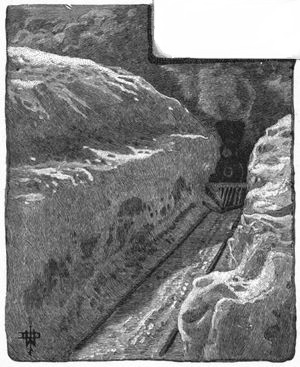
parts of the equipment of any large road are snow-ploughs
(pp. 154–5–6) and wrecking cars, with powerful derricks and
other appliances for clearing obstructions. When wrecks or blockades
occur these cars, with extra engines, section-hands, bridge
gangs, and construction-trains, are rushed to the spot, and everything
yields to the
work of getting the
road clear.
We come next
to the superintendent
of machinery,
whose duty it is to
provide and maintain
locomotives
and cars of all
kinds to handle the
company's traffic.
His department is
subdivided between
a master mechanic,
in charge of
locomotives and
machine-shops,
and a master car-builder,
in charge
of car-shops.
The master
mechanic selects and immediately controls all engine-runners and
firemen, and keeps performance sheets of all locomotives, showing
miles run, cars hauled, wages paid, coal and oil consumed, and
other details giving results accomplished by different runners and
firemen, and by different types of engine, or on different divisions
or roads. Premiums are often paid the runners and firemen accomplishing
the best results.
Report of Performance of Engines, Repairs, and all other Costs
Incident thereto, for the fiscal year ending June 30th, 1888.
[Key for column headings. Column A has been repeated in each Part.]
A. Number of Engine.
B. Passenger
C. Freight.
D. Gravel or Construction.
E. Switching.
F. Total.
G. Eighth Cords of wood.
H. Bushels Coal.
I. Cost of Fuel.
[Table—Part 1 of 4]
| | |
| Miles Run. | Fuel. |
| | |
| A. | B. | C. | D. | E. | F. | G. | H. | I. |
| | | | | | | | |
| 1 | — | 12,084 | 4,253 | 64 | 16,401 | 118 | 10,699 | $1,090.25 |
| 2 | — | 2,672 | 11,779 | 954 | 15,405 | 193 | 10,913 | 1,131.77 |
| 3 | 5,402 | 14,471 | 408 | 120 | 20,407 | 189 | 10,590 | 1,101.08 |
| 4 | 28,643 | 4,168 | — | — | 32,811 | 297 | 11,875 | 1,212.20 |
| 5 | 28,275 | 4,490 | — | 72 | 32,837 | 301 | 12,961 | 1,335.31 |
| 6 | — | — | — | 32,370 | 32,370 | 33 | 10,360 | 1,042.26 |
| 8 | 3,229 | 11,799 | 4,779 | — | 19,807 | 150 | 13,233 | 1,356.30 |
| 9 | 1,050 | 23,203 | — | — | 24,253 | 155 | 16,344 | 1,663.41 |
| 10 | 874 | 24,729 | — | 96 | 25,699 | 158 | 17,039 | 1,741.67 |
| 11 | — | — | — | 23,609 | 23,609 | 205 | 7,661 | 811.00 |
| 12 | 1,527 | — | 4,369 | 12,060 | 17,956 | 142 | 8,875 | 918.75 |
| 30 | 41,345 | — | — | — | 41,345 | 237 | 17,702 | 1,821.37 |
| 31 | 37,450 | — | — | — | 37,450 | 215 | 16,695 | 1,716.56 |
| 32 | 4,233 | 13,516 | — | 120 | 17,869 | 115 | 10,918 | 1,117.10 |
| 34 | 13,742 | 5,217 | — | 1,224 | 20,183 | 149 | 6,691 | 704.07 |
| | | | | | | | |
| 165,770 | 116,349 | 25,588 | 70,695 | 378,402 | 2657 | 182,556 | $18,768.13 |
| | | | | | | | |
A. Number of Engine.
J. Gallons of Engine Oil.
K. Signal Oil.
L. Head-Light Oil.
M. Lbs. of Cyl. Oil.
N. Car Grease.
O. Waste.
P. Packing.
Q. Gallons Kerosene.
[Table—Part 2 of 4]
| |
| Oil, Waste and Other Stores. |
| |
| A. | J. | K. | L. | M. | N. | O. | P. | Q. |
| | | | | | | | |
| 1 | 124 | 10 | 29 | 59½ | 45 | 347 | 72 | – |
| 2 | 121½ | 13½ | 35½ | 69½ | 69 | 466 | 102 | 2 |
| 3 | 132½ | 10½ | 38 | 74½ | 69 | 350 | 61 | – |
| 4 | 258 | 14 | 49 | 125 | 106 | 659 | 76 | – |
| 5 | 256 | 12 | 39 | 99½ | 75 | 622 | 82½ | – |
| 6 | 30½ | 12½ | 188½ | 111¼ | — | 298 | 160½ | – |
| 8 | 134 | 10½ | 41 | 65¼ | 60 | 327 | 98 | – |
| 9 | 135 | 12½ | 45½ | 73 | 70 | 374 | 87 | – |
| 10 | 131½ | 13½ | 63 | 69 | 70 | 372 | 96 | – |
| 11 | 136 | 1¾ | 96 | 81 | 40 | 354 | 81 | 2 |
| 12 | 105 | 9¼ | 58 | 95½ | 20 | 360 | 75 | – |
| 30 | 223 | 23¾ | 44½ | 69 | 106 | 726 | 51 | – |
| 31 | 243 | 15¼ | 46 | 92 | 110 | 660 | 68 | 1 |
| 32 | 138 | 10½ | 41 | 71½ | 130 | 361 | 63 | 7 |
| 34 | 186 | 10 | 32 | 71 | 75 | 409 | 43 | 2 |
| | | | | | | | |
| 2,554 | 179½ | 846 | 1,226½ | 1045 | 6685 | 1214 | 14 |
| | | | | | | | |
A. Number of Engine.
R. Cost of Stores.
S. Wages of Engineer and Fireman.
T. Cost of Cleaning.
U. Labor.
V. Material.
W. Total Cost of Repairs.
X. Total Expenses and Repairs.
[Table—Part 3 of 4]
| | | | | |
| | | | Cost of Repairs. | |
| | | | | | | |
| A. | R. | S. | T. | U. | V. | W. | X. |
| | | | | | | |
| 1 | $ 87.64 | $ 1,293.80 | $ 115.00 | $ 223.40 | $ 66.32 | $ 289.72 | $ 2,876.41 |
| 2 | 106.85 | 1,646.90 | 82.50 | 69.65 | 75.14 | 144.79 | 3,112.81 |
| 3 | 93.85 | 1,489.65 | 187.50 | 178.25 | 63.61 | 241.86 | 3,113.94 |
| 4 | 171.85 | 1,719.55 | 212.50 | 203.95 | 100.13 | 304.08 | 3,620.18 |
| 5 | 144.86 | 1,628.80 | 202.00 | 240.55 | 114.98 | 355.53 | 3,666.50 |
| 6 | 173.92 | 1,884.50 | 10.00 | 172.35 | 63.65 | 236.00 | 3,346.68 |
| 8 | 97.34 | 1,593.05 | 150.00 | 110.75 | 106.69 | 217.44 | 3,414.13 |
| 9 | 108.53 | 1,625.80 | 200.00 | 139.80 | 175.48 | 315.28 | 3,918.02 |
| 10 | 108.38 | 1,669.55 | 205.00 | 207.55 | 109.78 | 317.33 | 4,041.93 |
| 11 | 111.83 | 1,126.75 | 5.00 | 413.95 | 89.76 | 503.71 | 2,558.29 |
| 12 | 106.31 | 1,405.10 | 25.00 | 37.45 | 27.17 | 64.62 | 2,519.78 |
| 30 | 142.71 | 1,719.56 | 212.50 | 144.50 | 77.52 | 222.02 | 4,118.15 |
| 31 | 152.16 | 1,554.55 | 205.00 | 642.50 | 432.86 | 1,075.36 | 4,703.66 |
| 32 | 108.40 | 1,186.40 | 172.00 | 1,729.70 | 438.40 | 2,168.10 | 4,752.00 |
| 34 | 108.40 | 1,186.40 | 137.00 | 1,522.10 | 781.64 | 2,303.74 | 4,313.48 |
| | | | | | | |
| 1,823.80 | 22,603.45 | 2,121.00 | 6,036.45 | 2,723.13 | 8,759.58 | 54,075.96 |
| | | | | | | |
A. Number of Engine.
Y. Bushel Coal.
Z. Gal. Engine Oil.
AA. Pound of Tallow.
BB. Repairs.
CC. Fuel.
DD. Stores.
EE. Wages E. and F.
FF. Cleaning.
GG. Total.
HH. Car Mileage.
[Table—Part 4 of 4]
| | | |
| M'ls run to one. | Cost per Mile Run For. | |
| | | | | | | | | | |
| A. | Y. | Z. | AA. | BB. | CC. | DD. | EE. | FF. | GG. | HH. |
| | | | | | | | | | |
| 1 | 1.5 | 122.3 | 34.5 | 01.76 | 06.64 | 00.53 | 07.89 | 00.61 | 17.43 | 177,659 |
| 2 | 1.1 | 126.8 | 27.7 | 00.94 | 07.34 | 00.69 | 10.69 | 00.53 | 20.19 | 197,203 |
| 3 | 0.9 | 77.7 | 17.4 | 02.32 | 10.58 | 00.90 | 14.31 | 02.04 | 30.15 | 182,402 |
| 4 | 2.7 | 127.2 | 32.8 | 00.92 | 03.69 | 05.23 | 05.24 | 00.64 | 15.72 | 139,422 |
| 5 | 2.5 | 128.2 | 41.2 | 01.08 | 04.06 | 00.44 | 04.96 | 00.61 | 11.15 | 135,780 |
| 6 | 3.1 | 140.4 | 36.3 | 00.72 | 03.22 | 00.53 | 05.82 | 00.03 | 10.32 | — |
| 8 | 1.5 | 147.8 | 37.9 | 01.09 | 06.84 | 00.49 | 08.04 | 00.76 | 17.22 | 305,024 |
| 9 | 1.4 | 150.0 | 48.5 | 01.30 | 06.88 | 00.40 | 06.70 | 00.82 | 16.10 | 383,682 |
| 10 | 1.5 | 195.4 | 46.5 | 01.23 | 06.77 | 00.31 | 06.49 | 00.79 | 15.59 | 409,035 |
| 11 | 3.0 | 173.6 | 36.4 | 02.13 | 03.43 | 00.47 | 04.77 | 00.02 | 10.82 | — |
| 12 | 2.0 | 171.0 | 23.5 | 00.36 | 05.11 | 00.59 | 07.82 | 00.14 | 14.02 | 66,834 |
| 30 | 2.3 | 185.4 | 74.9 | 00.53 | 04.40 | 00.34 | 04.15 | 00.51 | 09.93 | 231,554 |
| 31 | 2.2 | 154.1 | 50.8 | 02.87 | 04.58 | 00.40 | 04.15 | 00.54 | 12.54 | 202,289 |
| 32 | 1.6 | 129.5 | 31.2 | 12.11 | 06.25 | 00.60 | 06.64 | 00.96 | 26.56 | 184,083 |
| 34 | 3.2 | 108.5 | 35.5 | 11.41 | 03.48 | 00.54 | 05.29 | 00.67 | 21.39 | 107,060 |
| | | | | | | | | | |
| 2.5 | 148.1 | 38.5 | 02.31 | 04.98 | 00.48 | 05.97 | 00.55 | 14.29 | 2,722,027 |
| | | | | | | | | | |
The master car-builder has charge of the shops where cars are
built and repaired, and of the car-inspectors who are stationed at
central and junction points to prevent defective cars being put into
the trains.
Formerly each railroad used its own cars exclusively, and
through freights were transferred at every junction point. This involved
such delay and expense that railroads now generally permit
all loaded cars to go through to destination without transfer,
and allow each other a certain sum for the use of cars. Usually
this is about three-quarters of a cent for each mile which the car
travels on a foreign road. This involves a great scattering of cars,
and an extensive organization to keep record of their whereabouts
and of the accounts between the companies for mileage.[15] This organization
will be referred to more fully in connection with the department
of transportation. But the joint use of each other's cars
makes it necessary that there should be at least enough similarity
in their construction and their coupling appliances to permit their
indiscriminate use upon all roads. And conventions of master car-builders
have recommended certain forms and dimensions as standards,
which are now in general use.
There is much convenience in this, but one disadvantage. It
requires almost unanimous action to introduce any change of form
or of construction, however advantageous it may be. And to secure
unanimous action in such matters is almost as hard as it would
be to secure unanimity in a change in the spelling of English words.
Still there is progress, though slow, toward several desirable reforms,
the most important of which is the adoption of a standard
automatic coupler (see p. 142).
Having shown how the property of all kinds is kept in efficient
condition, we next come to its operation. This is called "conducting
transportation," and the officer in charge is usually called
the superintendent of transportation. All train-despatchers, conductors,
train-men, and telegraph operators are under his immediate
control. He makes all schedules and provides all extra and
irregular service that the traffic department makes requisition for,
himself calling upon the superintendent of machinery for the necessary
locomotives, switching engines, and cars. It is his especial
province to handle all trains as swiftly as possible, and to see that
there are no collisions. It is impossible to detail fully the safeguards
and precautions used to this end, but the general principles
observed are as follows:
First, a general time-table or schedule is carefully made out for
all regular trains upon each division, showing on one sheet the
time of each train at each station.
This schedule is all that is needed so long as all trains are able
to keep on time, and there are no extras. Trouble begins when
regular trains cannot keep on schedule, or when extra trains have
to be sent out, not provided for on the schedule. A diagram,
or graphic representation of this schedule, upon a board or large
sheet of paper, is an important feature of the office regulating
train-movements. Twenty-four vertical lines divide the board into
equal spaces representing the twenty-four hours of the day, numbered
from midnight to midnight. Horizontal lines at proportionate
distances from the top represent the stations in their order between
the termini, represented by the top and bottom lines of the
diagram. The course of every train can now be plotted on this
diagram in an oblique line joining the points on each station line
corresponding to the time the train arrives at and leaves that station.
The cut on the opposite page will illustrate. It represents a
road 130 miles long from A to N, with intermediate stations B, C,
D, etc., at different distances from each other, and six trains are
shown as follows:
A passenger train, No. 1, leaving A at 12 midnight and arriving
at N at 4.05 A.M. A fast express, No. 2, leaving N at 12.45
and arriving at A at 3.30. A local passenger train, No. 4, which
leaves N at 1.15, runs to E by 4 A.M., stops there until 4.10, and
returns to N by 7 A.M.; being called No. 3 on the return, as the
direction is always indicated by the train-number's being odd or
even. No. 5 is a way freight, leaving A at 12.05 and making long
stops at each station. No. 6 is an opposing train of the same
character.