
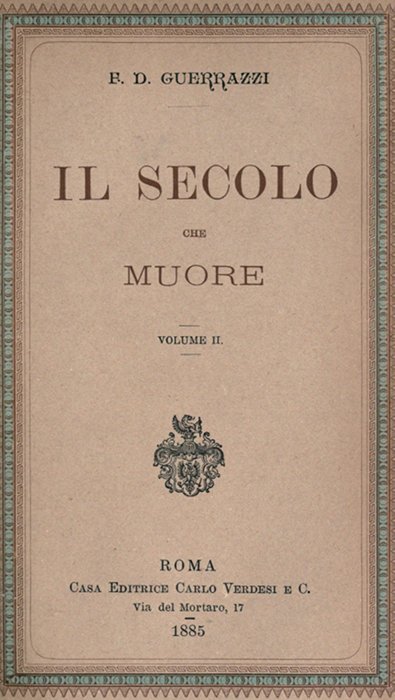
About This Book
L'autore ripercorre eventi e riflessioni sulla lotta per l'unità e la libertà italiana, celebrando la figura di Garibaldi come esempio di virtù popolare e memoria morale. Alternando ritratti di battaglie e meditazioni politiche, critica i regimi monarchici e l'ingerenza clericale, racconta i sacrifici dei patrioti e la tensione fra repubblicanesimo e tirannide, e denuncia la corruzione che tradisce le speranze di libertà. Il testo combina accenti appassionati e giudizi storici, esplorando il prezzo umano della rivoluzione, la perseveranza civile e la necessità di onorare i martiri del risveglio nazionale.
About the Author

More Books by This Author
6 picks
 Amelia Calani ed altri scritti
by Francesco Domenico Guerrazzi
Amelia Calani ed altri scritti
by Francesco Domenico Guerrazzi
 Apologia della vita politica di F.-D. Guerrazzi
by Francesco Domenico Guerrazzi
Apologia della vita politica di F.-D. Guerrazzi
by Francesco Domenico Guerrazzi
 Beatrice Cenci: Storia del secolo XVI
by Francesco Domenico Guerrazzi
Beatrice Cenci: Storia del secolo XVI
by Francesco Domenico Guerrazzi
 I Bianchi e i Neri: Dramma
by Francesco Domenico Guerrazzi
I Bianchi e i Neri: Dramma
by Francesco Domenico Guerrazzi
 I nuovi tartufi
by Francesco Domenico Guerrazzi
I nuovi tartufi
by Francesco Domenico Guerrazzi
 Il buco nel muro
by Francesco Domenico Guerrazzi
Il buco nel muro
by Francesco Domenico Guerrazzi
You May Also Like
6 picks
 "1683-1920" / The Fourteen Points and What Became of Them—Foreign Propaganda in the Public Schools—Rewriting the History of the United States—The Espionage Act and How It Worked—"Illegal and Indefensible Blockade" of the Central Powers—1,000,000 Victims of Starvation—Our Debt to France and to Germany—The War Vote in Congress—Truth About the Belgian Atrocities—Our Treaty with Germany and How Observed—The Alien Property Custodianship—Secret Will of Cecil Rhodes—Racial Strains in American Life—Germantown Settlement of 1683 and a Thousand Other Topics
by Frederick Franklin Schrader
"1683-1920" / The Fourteen Points and What Became of Them—Foreign Propaganda in the Public Schools—Rewriting the History of the United States—The Espionage Act and How It Worked—"Illegal and Indefensible Blockade" of the Central Powers—1,000,000 Victims of Starvation—Our Debt to France and to Germany—The War Vote in Congress—Truth About the Belgian Atrocities—Our Treaty with Germany and How Observed—The Alien Property Custodianship—Secret Will of Cecil Rhodes—Racial Strains in American Life—Germantown Settlement of 1683 and a Thousand Other Topics
by Frederick Franklin Schrader
 "1812"
by Vasilïĭ Vasilʹevich Vereshchagin
"1812"
by Vasilïĭ Vasilʹevich Vereshchagin
 "Barbarous Soviet Russia"
by Isaac McBride
"Barbarous Soviet Russia"
by Isaac McBride
 "Brother Bosch", an Airman's Escape from Germany
by Gerald Featherstone Knight
"Brother Bosch", an Airman's Escape from Germany
by Gerald Featherstone Knight
 "Monsieur Henri": A Foot-Note to French History
by Louise Imogen Guiney
"Monsieur Henri": A Foot-Note to French History
by Louise Imogen Guiney
 "My country, 'tis of thee!" / Or, the United States of America; past, present and future. A philosophic view of American history and of our present status, to be seen in the Columbian exhibition.
by Willis Fletcher Johnson
"My country, 'tis of thee!" / Or, the United States of America; past, present and future. A philosophic view of American history and of our present status, to be seen in the Columbian exhibition.
by Willis Fletcher Johnson