
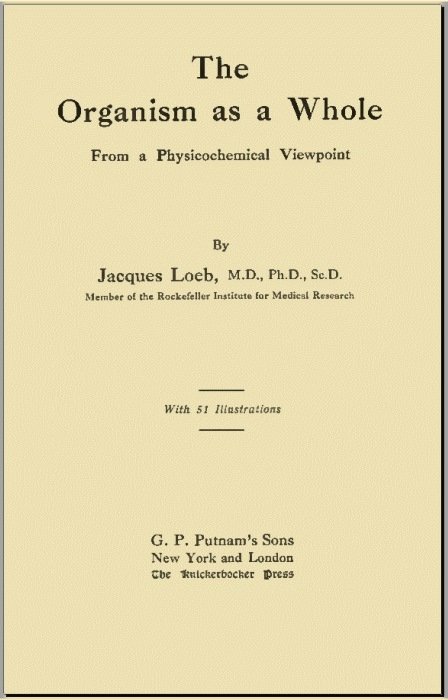
The Organism as a Whole, from a Physicochemical Viewpoint
Explore more books like this:
About This Book
The work presents a physicochemical account of living systems, arguing that physico-chemical processes underlie physiological functions and that egg cytoplasm largely determines species identity and organismal unity while chromosomal Mendelian factors contribute individual traits, probably through hormones and enzymes. It surveys species specificity and fertilization, artificial parthenogenesis, embryonic determinism, regeneration, sex determination, instincts and tropisms, environmental influence and adaptation, heredity mechanisms, and the problems of evolution and death. Experimental and theoretical discussions stress specific proteins, enzymes, and physico-chemical reactions as the basis for biological specificity and coordinated development.
About the Author
You May Also Like
 A bacteriological study of ham souring
by Charles Neil McBryde
A bacteriological study of ham souring
by Charles Neil McBryde
 A Bilateral Division of the Parietal Bone in a Chimpanzee; with a Special Reference to the Oblique Sutures in the Parietal
by Aleš Hrdlička
A Bilateral Division of the Parietal Bone in a Chimpanzee; with a Special Reference to the Oblique Sutures in the Parietal
by Aleš Hrdlička
 A Check-List of the Birds of Idaho
by M. Dale Arvey
A Check-List of the Birds of Idaho
by M. Dale Arvey
 A Civic Biology, Presented in Problems
by George W. Hunter
A Civic Biology, Presented in Problems
by George W. Hunter
 A conchological manual
by G. B. Sowerby
A conchological manual
by G. B. Sowerby
 A Critical Examination of the Position of Mr. Darwin's Work, "On the Origin of Species," in Relation to the Complete Theory of the Causes of the Phenomena of Organic Nature / Lecture VI. (of VI.), "Lectures to Working Men", at the Museum of Practical Geology, 1863, on Darwin's Work: "Origin of Species"
by Thomas Henry Huxley
A Critical Examination of the Position of Mr. Darwin's Work, "On the Origin of Species," in Relation to the Complete Theory of the Causes of the Phenomena of Organic Nature / Lecture VI. (of VI.), "Lectures to Working Men", at the Museum of Practical Geology, 1863, on Darwin's Work: "Origin of Species"
by Thomas Henry Huxley