
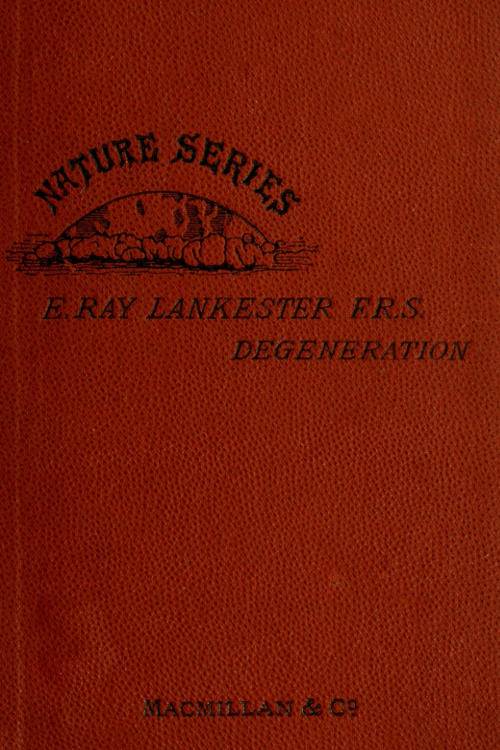
About This Book
The author examines degeneration as an evolutionary process whereby organisms lose structures and complexity in response to parasitism, sessile habits, or specialized lifestyles. He combines theoretical discussion about the role of hypothesis and the aims of science with comparative anatomical examples—parasites and reduced arthropods, barnacles, ascidians, and skin mites—to show how reduced organs, simplified physiologies, and altered life histories can be adaptive outcomes. The book surveys causes, varieties, and evidential patterns of regression, arguing that degeneration complements progressive evolution and must be interpreted within a causal, Darwinian framework.
About the Author

More Books by This Author
6 picks

You May Also Like
6 picks
 A bacteriological study of ham souring
by Charles Neil McBryde
A bacteriological study of ham souring
by Charles Neil McBryde
 A Bilateral Division of the Parietal Bone in a Chimpanzee; with a Special Reference to the Oblique Sutures in the Parietal
by Aleš Hrdlička
A Bilateral Division of the Parietal Bone in a Chimpanzee; with a Special Reference to the Oblique Sutures in the Parietal
by Aleš Hrdlička
 A Check-List of the Birds of Idaho
by M. Dale Arvey
A Check-List of the Birds of Idaho
by M. Dale Arvey
 A Civic Biology, Presented in Problems
by George W. Hunter
A Civic Biology, Presented in Problems
by George W. Hunter
 A conchological manual
by G. B. Sowerby
A conchological manual
by G. B. Sowerby
 A Critical Examination of the Position of Mr. Darwin's Work, "On the Origin of Species," in Relation to the Complete Theory of the Causes of the Phenomena of Organic Nature / Lecture VI. (of VI.), "Lectures to Working Men", at the Museum of Practical Geology, 1863, on Darwin's Work: "Origin of Species"
by Thomas Henry Huxley
A Critical Examination of the Position of Mr. Darwin's Work, "On the Origin of Species," in Relation to the Complete Theory of the Causes of the Phenomena of Organic Nature / Lecture VI. (of VI.), "Lectures to Working Men", at the Museum of Practical Geology, 1863, on Darwin's Work: "Origin of Species"
by Thomas Henry Huxley