
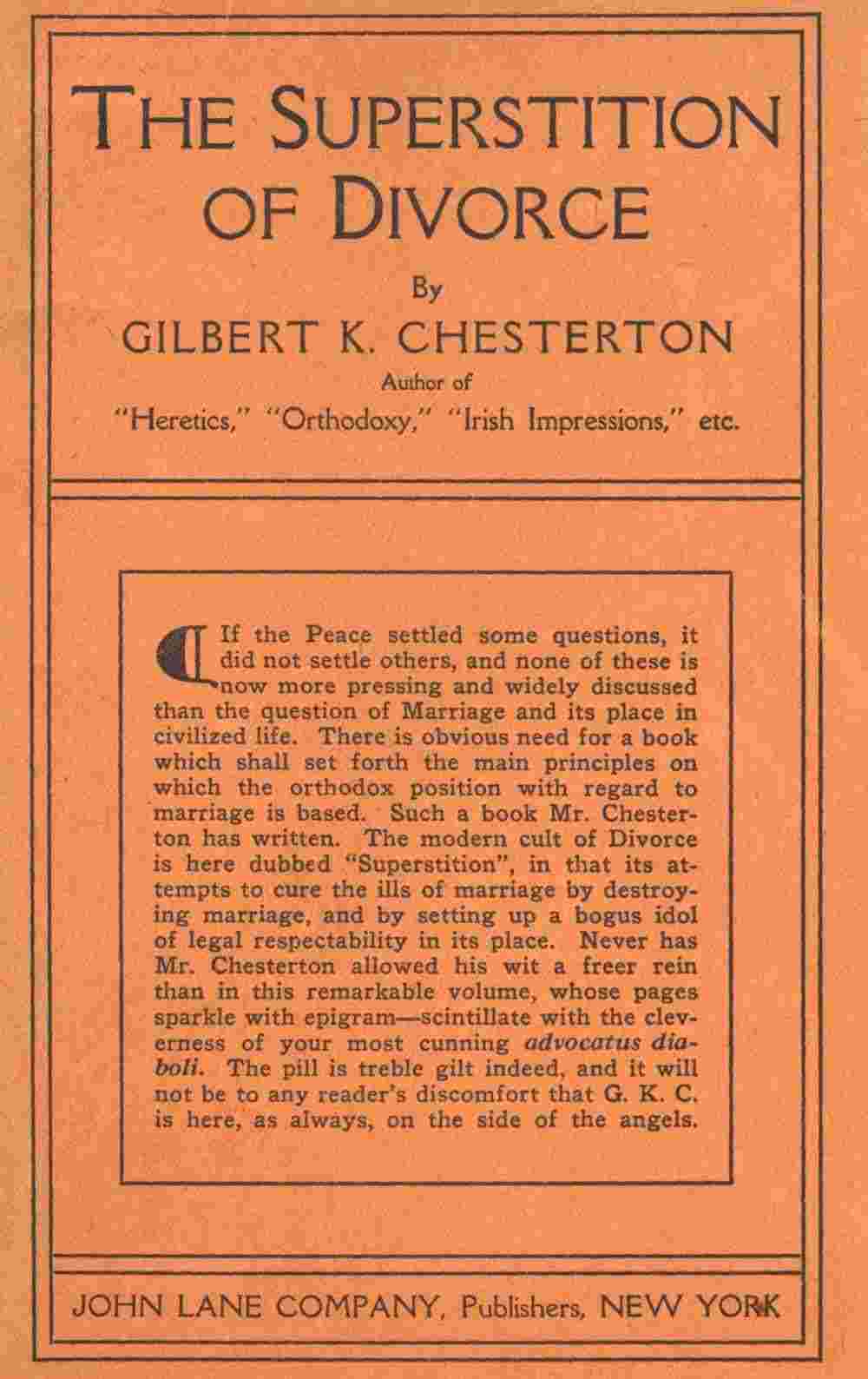
About This Book
A series of essays argues that divorce cannot be treated as a simple remedy because marriage is an organic institution rooted in vows, family structure, and social obligations. The author critiques reformers who pursue piecemeal legal changes without understanding marriage's purpose, warns that opportunistic fixes undermine the household and wider social fabric, and contends that religious and moral traditions embody a broader philosophy rather than mere literal texts. He examines the family, the nature of the marital vow, common marital tragedies, and possible consequences of liberalized divorce laws, combining polemic, social observation, and moral reasoning to defend durable marital commitments against what he sees as destructive modern forces.
About the Author

More Books by This Author
 A Chesterton Calendar / Compiled from the writings of 'G.K.C.' both in verse and in prose. With a section apart for the moveable feasts.
by G. K. Chesterton
A Chesterton Calendar / Compiled from the writings of 'G.K.C.' both in verse and in prose. With a section apart for the moveable feasts.
by G. K. Chesterton
 A Miscellany of Men
by G. K. Chesterton
A Miscellany of Men
by G. K. Chesterton
 A Short History of England
by G. K. Chesterton
A Short History of England
by G. K. Chesterton
 Alarms and Discursions
by G. K. Chesterton
Alarms and Discursions
by G. K. Chesterton
 All Things Considered
by G. K. Chesterton
All Things Considered
by G. K. Chesterton
 Appreciations and Criticisms of the Works of Charles Dickens
by G. K. Chesterton
Appreciations and Criticisms of the Works of Charles Dickens
by G. K. Chesterton
You May Also Like
 "'Tis Sixty Years Since" / Address of Charles Francis Adams; Founders' Day, January 16, 1913
by Charles Francis Adams
"'Tis Sixty Years Since" / Address of Charles Francis Adams; Founders' Day, January 16, 1913
by Charles Francis Adams
 "... és a felelősségtől való rettegés"
by Émile Faguet
"... és a felelősségtől való rettegés"
by Émile Faguet
 "A Most Unholy Trade," Being Letters on the Drama by Henry James
by Henry James
"A Most Unholy Trade," Being Letters on the Drama by Henry James
by Henry James
 "About My Father's Business": Work Amidst the Sick, the Sad, and the Sorrowing
by Thomas Archer
"About My Father's Business": Work Amidst the Sick, the Sad, and the Sorrowing
by Thomas Archer
 "America for Americans!" / The Typical American, Thanksgiving Sermon
by John Philip Newman
"America for Americans!" / The Typical American, Thanksgiving Sermon
by John Philip Newman
 "Bethink Yourselves!"
by graf Leo Tolstoy
"Bethink Yourselves!"
by graf Leo Tolstoy