

T. R. Malthus
6 books
Thomas Robert Malthus (1766-1834) was an English cleric and scholar, best known for his influential theories on population growth and its implications for society. His seminal work, "An Essay on the Principle of Population," published in 1798, argued that population growth would inevitably outpace food production, leading to widespread famine and societal challenges. Malthus's ideas sparked significant debate and laid the groundwork for modern demography and economics. He also contributed to political economy with works such as "An Inquiry into the Nature and Progress of Rent" and "Definitions in Political Economy." His insights continue to resonate in discussions about sustainability and resource management.
Books by This Author
6 titles
 An Essay on the Principle of Population
T. R. Malthus
An Essay on the Principle of Population
T. R. Malthus
 An Inquiry into the Nature and Progress of Rent, and the Principles by Which It is Regulated
T. R. Malthus
An Inquiry into the Nature and Progress of Rent, and the Principles by Which It is Regulated
T. R. Malthus
 Definitions in Political Economy, / Preceded by an Inquiry Into the Rules which Ought to Guide Political Economists in the Definition and Use of Their Terms; with Remarks on the Deviation from These Rules in Their Writings
T. R. Malthus
Definitions in Political Economy, / Preceded by an Inquiry Into the Rules which Ought to Guide Political Economists in the Definition and Use of Their Terms; with Remarks on the Deviation from These Rules in Their Writings
T. R. Malthus
 Observations on the Effects of the Corn Laws, and of a Rise or Fall in the Price of Corn on the Agriculture and General Wealth of the Country
T. R. Malthus
Observations on the Effects of the Corn Laws, and of a Rise or Fall in the Price of Corn on the Agriculture and General Wealth of the Country
T. R. Malthus
 The Grounds of an Opinion on the Policy of Restricting the Importation of Foreign Corn / Intended as an appendix to "Observations on the corn laws"
T. R. Malthus
The Grounds of an Opinion on the Policy of Restricting the Importation of Foreign Corn / Intended as an appendix to "Observations on the corn laws"
T. R. Malthus
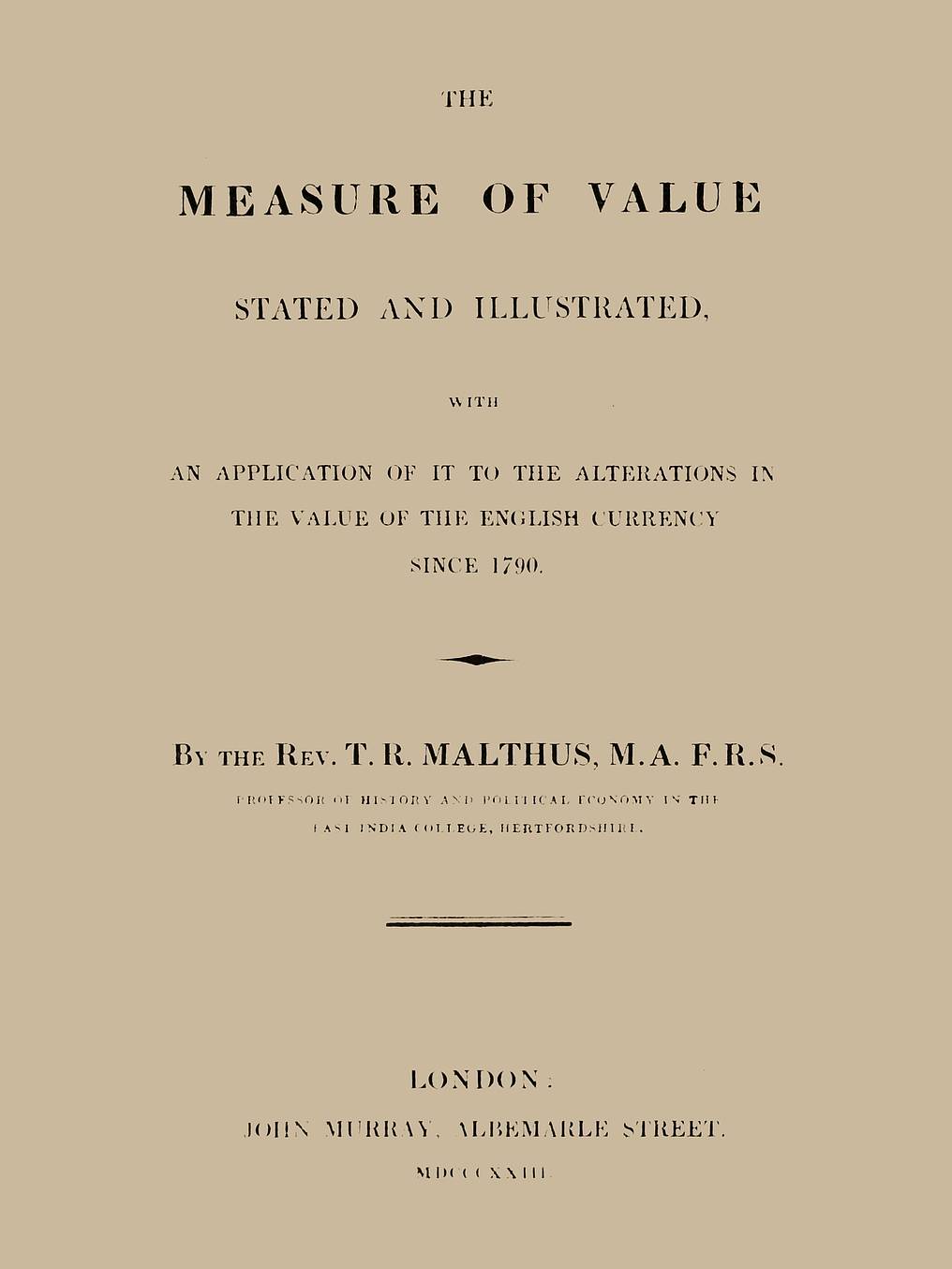 The Measure of Value Stated and Illustrated / With an Application of it to the Alterations in the Value of the English Currency since 1790
T. R. Malthus
The Measure of Value Stated and Illustrated / With an Application of it to the Alterations in the Value of the English Currency since 1790
T. R. Malthus