
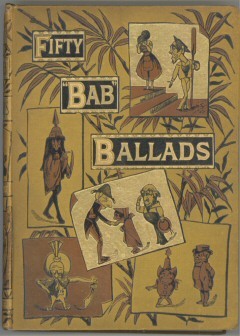
The Project Gutenberg eBook of Fifty "Bab" Ballads: Much Sound and Little Sense
Title: Fifty "Bab" Ballads: Much Sound and Little Sense
Author: W. S. Gilbert
Release date: December 1, 1996 [eBook #757]
Most recently updated: August 19, 2019
Language: English
Credits: Transcribed from the 1884 George Routledge and Sons editions by David Price
Transcribed from the 1884 George Routledge and Sons editions by David Price, email ccx074@pglaf.org
FIFTY “BAB” BALLADS
Much Sound and Little Sense
BY
W. S. GILBERT
WITH ILLUSTRATIONS BY THE AUTHOR [1]
LONDON
GEORGE ROUTLEDGE AND SONS
BROADWAY, LUDGATE HILL
NEW YORK: 9 LAFAYETTE PLACE
1884
PREFACE.
The “Bab Ballads” appeared originally in the columns of “Fun,” when that periodical was under the editorship of the late Tom Hood. They were subsequently republished in two volumes, one called “The Bab Ballads,” the other “More Bab Ballads.” The period during which they were written extended over some three or four years; many, however, were composed hastily, and under the discomforting necessity of having to turn out a quantity of lively verse by a certain day in every week. As it seemed to me (and to others) that the volumes were disfigured by the presence of these hastily written impostors, I thought it better to withdraw from both volumes such Ballads as seemed to show evidence of carelessness or undue haste, and to publish the remainder in the compact form under which they are now presented to the reader.
It may interest some to know that the first of the series, “The Yarn of the Nancy Bell,” was originally offered to “Punch,”—to which I was, at that time, an occasional contributor. It was, however, declined by the then Editor, on the ground that it was “too cannibalistic for his readers’ tastes.”
W. S. GILBERT.
24 The Boltons, South Kensington,
August,
1876.
CONTENTS.
|
PAGE |
Captain Reece |
|
The Rival Curates |
|
Only a Dancing Girl |
|
To a Little Maid |
|
The Troubadour |
|
Ferdinando and Elvira; or, the Gentle Pieman |
|
To my Bride |
|
Sir Macklin |
|
The Yarn of the “Nancy Bell” |
|
The Bishop of Rum-Ti-Foo |
|
The Precocious Baby |
|
To Phœbe |
|
Baines Carew, Gentleman |
|
Thomas Winterbottom Hance |
|
A Discontented Sugar Broker |
|
The Pantomime “Super” to his Mask |
|
The Ghost, the Gallant, the Gael, and the Goblin |
|
The Phantom Curate |
|
King Borria Bungalee Boo |
|
The Story of Prince Agib |
|
Ellen McJones Aberdeen |
|
Peter the Wag |
|
To the Terrestrial Globe |
|
Gentle Alice Brown |
|
Mister William |
|
The Bumboat Woman’s Story |
|
Lost Mr. Blake |
|
The Baby’s Vengeance |
|
The Captain and the Mermaids |
|
Annie Protheroe. A Legend of Stratford-le-Bow |
|
An Unfortunate Likeness |
|
The King of Canoodle-dum |
|
The Martinet |
|
The Sailor Boy to his Lass |
|
The Reverend Simon Magus |
|
My Dream |
|
The Bishop of Rum-Ti-Foo again |
|
The Haughty Actor |
|
The Two Majors |
|
Emily, John, James, and I. A Derby Legend |
|
The Perils of Invisibility |
|
Phrenology |
|
The Fairy Curate |
|
The Way of Wooing |
|
Hongree and Mahry. A Recollection of a Surrey Melodrama |
|
Etiquette |
|
At a Pantomime |
|
Haunted |
CAPTAIN REECE.
Of all the ships
upon the blue,
No ship contained a better crew
Than that of worthy Captain Reece,
Commanding of The Mantelpiece.
He was adored by all his men,
For worthy Captain Reece, R.N.,
Did all that lay within him to
Promote the comfort of his crew.
If ever they were dull or sad,
Their captain danced to them like mad,
Or told, to make the time pass by,
Droll legends of his infancy.
A feather bed had every man,
Warm slippers and hot-water can,
Brown windsor from the captain’s store,
A valet, too, to every four.
Did they with thirst in summer burn,
Lo, seltzogenes at every turn,
And on all very sultry days
Cream ices handed round on trays.
Then currant wine and ginger pops
Stood handily on all the “tops;”
And also, with amusement rife,
A “Zoetrope, or Wheel of Life.”
New volumes came across the sea
From Mister Mudie’s libraree;
The Times and Saturday Review
Beguiled the leisure of the crew.
Kind-hearted Captain
Reece, R.N.,
Was quite devoted to his men;
In point of fact, good Captain
Reece
Beatified The Mantelpiece.
One summer eve, at half-past ten,
He said (addressing all his men):
“Come, tell me, please, what I can do
To please and gratify my crew.
“By any reasonable plan
I’ll make you happy if I can;
My own convenience count as nil:
It is my duty, and I will.”
Then up and answered William Lee
(The kindly captain’s coxswain he,
A nervous, shy, low-spoken man),
He cleared his throat and thus began:
“You have a daughter, Captain Reece,
Ten female cousins and a niece,
A Ma, if what I’m told is true,
Six sisters, and an aunt or two.
“Now, somehow, sir, it seems to me,
More friendly-like we all should be,
If you united of ’em to
Unmarried members of the crew.
“If you’d ameliorate our life,
Let each select from them a wife;
And as for nervous me, old pal,
Give me your own enchanting gal!”
Good Captain Reece,
that worthy man,
Debated on his coxswain’s plan:
“I quite agree,” he said, “O Bill;
It is my duty, and I will.
“My daughter, that enchanting gurl,
Has just been promised to an Earl,
And all my other familee
To peers of various degree.
“But what are dukes and viscounts to
The happiness of all my crew?
The word I gave you I’ll fulfil;
It is my duty, and I will.
“As you desire it shall befall,
I’ll settle thousands on you all,
And I shall be, despite my hoard,
The only bachelor on board.”
The boatswain of The Mantelpiece,
He blushed and spoke to Captain
Reece:
“I beg your honour’s leave,” he said;
“If you would wish to go and wed,
“I have a widowed mother who
Would be the very thing for you—
She long has loved you from afar:
She washes for you, Captain
R.”
The Captain saw the dame that day—
Addressed her in his playful way—
“And did it want a wedding ring?
It was a tempting ickle sing!
“Well, well, the chaplain I will seek,
We’ll all be married this day week
At yonder church upon the hill;
It is my duty, and I will!”
The sisters, cousins, aunts, and niece,
And widowed Ma of Captain Reece,
Attended there as they were bid;
It was their duty, and they did.
THE RIVAL CURATES.
List while the poet
trolls
Of Mr. Clayton Hooper,
Who had a cure of souls
At Spiffton-extra-Sooper.
He lived on curds and whey,
And daily sang their praises,
And then he’d go and play
With buttercups and daisies.
Wild croquêt Hooper banned,
And all the sports of Mammon,
He warred with cribbage, and
He exorcised backgammon.
His helmet was a glance
That spoke of holy gladness;
A saintly smile his lance;
His shield a tear of sadness.
His Vicar smiled to see
This armour on him buckled:
With pardonable glee
He blessed himself and chuckled.
“In mildness to abound
My curate’s sole design is;
In all the country round
There’s none so mild as mine is!”
And Hooper,
disinclined
His trumpet to be blowing,
Yet didn’t think you’d find
A milder curate going.
A friend arrived one day
At Spiffton-extra-Sooper,
And in this shameful way
He spoke to Mr. Hooper:
“You think your famous name
For mildness can’t be shaken,
That none can blot your fame—
But, Hooper, you’re
mistaken!
“Your mind is not as blank
As that of Hopley
Porter,
Who holds a curate’s rank
At Assesmilk-cum-Worter.
“He plays the airy flute,
And looks depressed and blighted,
Doves round about him ‘toot,’
And lambkins dance delighted.
“He labours more than you
At worsted work, and frames it;
In old maids’ albums, too,
Sticks seaweed—yes, and names it!”
The tempter said his say,
Which pierced him like a needle—
He summoned straight away
His sexton and his beadle.
(These men were men who could
Hold liberal opinions:
On Sundays they were good—
On week-days they were minions.)
“To Hopley
Porter go,
Your fare I will afford you—
Deal him a deadly blow,
And blessings shall reward you.
“But stay—I do not like
Undue assassination,
And so before you strike,
Make this communication:
“I’ll give him this one
chance—
If he’ll more gaily bear him,
Play croquêt, smoke, and dance,
I willingly will spare him.”
They went, those minions true,
To Assesmilk-cum-Worter,
And told their errand to
The Reverend Hopley
Porter.
“What?” said that reverend gent,
“Dance through my hours of leisure?
Smoke?—bathe myself with scent?—
Play croquêt? Oh, with pleasure!
“Wear all my hair in curl?
Stand at my door and wink—so—
At every passing girl?
My brothers, I should think so!
“For years I’ve longed for some
Excuse for this revulsion:
Now that excuse has come—
I do it on compulsion!!!”
He smoked and winked away—
This Reverend Hopley
Porter—
The deuce there was to pay
At Assesmilk-cum-Worter.
And Hooper holds his
ground,
In mildness daily growing—
They think him, all around,
The mildest curate going.
ONLY A DANCING GIRL.
Only a dancing
girl,
With an unromantic style,
With borrowed colour and curl,
With fixed mechanical smile,
With many a hackneyed wile,
With ungrammatical lips,
And corns that mar her trips.
Hung from the “flies” in air,
She acts a palpable lie,
She’s as little a fairy there
As unpoetical I!
I hear you asking, Why—
Why in the world I sing
This tawdry, tinselled thing?
No airy fairy she,
As she hangs in arsenic green
From a highly impossible tree
In a highly impossible scene
(Herself not over-clean).
For fays don’t suffer, I’m told,
From bunions, coughs, or cold.
And stately dames that bring
Their daughters there to see,
Pronounce the “dancing thing”
No better than she should be,
With her skirt at her shameful knee,
And her painted, tainted phiz:
Ah, matron, which of us is?
(And, in sooth, it oft occurs
That while these matrons sigh,
Their dresses are lower than hers,
And sometimes half as high;
And their hair is hair they buy,
And they use their glasses, too,
In a way she’d blush to do.)
But change her gold and green
For a coarse merino gown,
And see her upon the scene
Of her home, when coaxing down
Her drunken father’s frown,
In his squalid cheerless den:
She’s a fairy truly, then!
TO A
LITTLE MAID
By a Policeman.
Come with me, little
maid,
Nay, shrink not, thus afraid—
I’ll harm thee not!
Fly not, my love, from me—
I have a home for thee—
A fairy grot,
Where mortal
eye
Can rarely
pry,
There shall thy dwelling be!
List to me, while I tell
The pleasures of that cell,
Oh, little maid!
What though its couch be rude,
Homely the only food
Within its shade?
No thought of
care
Can enter
there,
No vulgar swain intrude!
Come with me, little maid,
Come to the rocky shade
I love to sing;
Live with us, maiden rare—
Come, for we “want” thee there,
Thou elfin thing,
To work thy
spell,
In some cool
cell
In stately Pentonville!
THE TROUBADOUR.
A troubadour he
played
Without a castle wall,
Within, a hapless maid
Responded to his call.
“Oh, willow, woe is me!
Alack and well-a-day!
If I were only free
I’d hie me far away!”
Unknown her face and name,
But this he knew right well,
The maiden’s wailing came
From out a dungeon cell.
A hapless woman lay
Within that dungeon grim—
That fact, I’ve heard him say,
Was quite enough for him.
“I will not sit or lie,
Or eat or drink, I vow,
Till thou art free as I,
Or I as pent as thou.”
Her tears then ceased to flow,
Her wails no longer rang,
And tuneful in her woe
The prisoned maiden sang:
“Oh, stranger, as you play,
I recognize your touch;
And all that I can say
Is, thank you very much.”
He seized his clarion straight,
And blew thereat, until
A warden oped the gate.
“Oh, what might be your will?”
“I’ve come, Sir Knave, to see
The master of these halls:
A maid unwillingly
Lies prisoned in their walls.”’
With barely stifled sigh
That porter drooped his head,
With teardrops in his eye,
“A many, sir,” he said.
He stayed to hear no more,
But pushed that porter by,
And shortly stood before
Sir Hugh de Peckham
Rye.
Sir Hugh he darkly
frowned,
“What would you, sir, with me?”
The troubadour he downed
Upon his bended knee.
“I’ve come, de
Peckham Rye,
To do a Christian task;
You ask me what would I?
It is not much I ask.
“Release these maidens, sir,
Whom you dominion o’er—
Particularly her
Upon the second floor.
“And if you don’t, my lord”—
He here stood bolt upright,
And tapped a tailor’s sword—
“Come out, you cad, and fight!”
Sir Hugh he
called—and ran
The warden from the gate:
“Go, show this gentleman
The maid in Forty-eight.”
By many a cell they past,
And stopped at length before
A portal, bolted fast:
The man unlocked the door.
He called inside the gate
With coarse and brutal shout,
“Come, step it, Forty-eight!”
And Forty-eight stepped out.
“They gets it pretty hot,
The maidens what we cotch—
Two years this lady’s got
For collaring a wotch.”
“Oh, ah!—indeed—I
see,”
The troubadour exclaimed—
“If I may make so free,
How is this castle named?”
The warden’s eyelids fill,
And sighing, he replied,
“Of gloomy Pentonville
This is the female side!”
The minstrel did not wait
The Warden stout to thank,
But recollected straight
He’d business at the Bank.
FERDINANDO AND ELVIRA;
Or, the Gentle
Pieman.
PART I.
At a pleasant
evening party I had taken down to supper
One whom I will call Elvira, and we
talked of love and Tupper,
Mr. Tupper and the
Poets, very lightly with them dealing,
For I’ve always been distinguished for a strong poetic
feeling.
Then we let off paper crackers, each of which
contained a motto,
And she listened while I read them, till her mother told her not
to.
Then she whispered, “To the ball-room we
had better, dear, be walking;
If we stop down here much longer, really people will be
talking.”
There were noblemen in coronets, and military
cousins,
There were captains by the hundred, there were baronets by
dozens.
Yet she heeded not their offers, but dismissed
them with a blessing,
Then she let down all her back hair, which had taken long in
dressing.
Then she had convulsive sobbings in her
agitated throttle,
Then she wiped her pretty eyes and smelt her pretty
smelling-bottle.
So I whispered, “Dear Elvira, say,—what can the matter be
with you?
Does anything you’ve eaten, darling Popsy, disagree with you?”
But spite of all I said, her sobs grew more and
more distressing,
And she tore her pretty back hair, which had taken long in
dressing.
Then she gazed upon the carpet, at the ceiling,
then above me,
And she whispered, “Ferdinando,
do you really, really love me?”
“Love you?” said I, then I sighed,
and then I gazed upon her sweetly—
For I think I do this sort of thing particularly neatly.
“Send me to the Arctic regions, or
illimitable azure,
On a scientific goose-chase, with my Coxwell or my Glaisher!
“Tell me whither I may hie me—tell
me, dear one, that I may know—
Is it up the highest Andes? down a horrible volcano?”
But she said, “It isn’t polar
bears, or hot volcanic grottoes:
Only find out who it is that writes those lovely cracker
mottoes!”
PART II.
“Tell me, Henry
Wadsworth, Alfred Poet Close,
or Mister Tupper,
Do you write the bon bon mottoes my Elvira pulls at supper?”
But Henry Wadsworth
smiled, and said he had not had that honour;
And Alfred, too, disclaimed the words
that told so much upon her.
“Mister Martin Tupper,
Poet Close, I beg of you inform
us;”
But my question seemed to throw them both into a rage
enormous.
Mister Close
expressed a wish that he could only get anigh to me;
And Mister Martin Tupper sent the
following reply to me:
“A fool is bent upon a twig, but wise men
dread a bandit,”—
Which I know was very clever; but I didn’t understand
it.
Seven weary years I wandered—Patagonia,
China, Norway,
Till at last I sank exhausted at a pastrycook his doorway.
There were fuchsias and geraniums, and
daffodils and myrtle,
So I entered, and I ordered half a basin of mock turtle.
He was plump and he was chubby, he was smooth
and he was rosy,
And his little wife was pretty and particularly cosy.
And he chirped and sang, and skipped about, and
laughed with laughter hearty—
He was wonderfully active for so very stout a party.
And I said, “O gentle pieman, why so
very, very merry?
Is it purity of conscience, or your one-and-seven
sherry?”
But he answered, “I’m so
happy—no profession could be dearer—
If I am not humming ‘Tra! la! la!’ I’m singing
‘Tirer, lirer!’
“First I go and make the patties, and the
puddings, and the jellies,
Then I make a sugar bird-cage, which upon a table swell is;
“Then I polish all the silver, which a
supper-table lacquers;
Then I write the pretty mottoes which you find inside the
crackers.”—
“Found at last!” I madly shouted.
“Gentle pieman, you astound me!”
Then I waved the turtle soup enthusiastically round me.
And I shouted and I danced until he’d
quite a crowd around him—
And I rushed away exclaiming, “I have found him! I
have found him!”
And I heard the gentle pieman in the road
behind me trilling,
“‘Tira, lira!’ stop him, stop him!
‘Tra! la! la!’ the soup’s a
shilling!”
But until I reached Elvira’s home, I never, never
waited,
And Elvira to her Ferdinand’s irrevocably mated!
TO MY
BRIDE
(WHOEVER SHE MAY BE.)
Oh! little
maid!—(I do not know your name
Or who you are, so, as a safe precaution
I’ll add)—Oh, buxom widow! married dame!
(As one of these must be your present portion)
Listen, while I unveil prophetic
lore for you,
And sing the fate that Fortune has
in store for you.
You’ll marry soon—within a year or
twain—
A bachelor of circa two and thirty:
Tall, gentlemanly, but extremely plain,
And when you’re intimate, you’ll call
him “Bertie.”
Neat—dresses well; his
temper has been classified
As hasty; but he’s very
quickly pacified.
You’ll find him working mildly at the
Bar,
After a touch at two or three professions,
From easy affluence extremely far,
A brief or two on Circuit—“soup”
at Sessions;
A pound or two from whist and
backing horses,
And, say three hundred from his
own resources.
Quiet in harness; free from serious vice,
His faults are not particularly shady,
You’ll never find him “shy”—for,
once or twice
Already, he’s been driven by a lady,
Who parts with him—perhaps a
poor excuse for him—
Because she hasn’t any
further use for him.
Oh! bride of mine—tall, dumpy, dark, or
fair!
Oh! widow—wife, maybe, or blushing maiden,
I’ve told your fortune; solved the gravest care
With which your mind has hitherto been laden.
I’ve prophesied correctly,
never doubt it;
Now tell me mine—and please
be quick about it!
You—only you—can tell me, an’
you will,
To whom I’m destined shortly to be mated,
Will she run up a heavy modiste’s bill?
If so, I want to hear her income stated
(This is a point which interests
me greatly).
To quote the bard, “Oh! have
I seen her lately?”
Say, must I wait till husband number one
Is comfortably stowed away at Woking?
How is her hair most usually done?
And tell me, please, will she object to smoking?
The colour of her eyes, too, you
may mention:
Come, Sibyl,
prophesy—I’m all attention.
SIR MACKLIN.
Of all the youths I
ever saw
None were so wicked, vain, or silly,
So lost to shame and Sabbath law,
As worldly Tom, and Bob, and Billy.
For every Sabbath day they walked
(Such was their gay and thoughtless natur)
In parks or gardens, where they talked
From three to six, or even later.
Sir Macklin was a
priest severe
In conduct and in conversation,
It did a sinner good to hear
Him deal in ratiocination.
He could in every action show
Some sin, and nobody could doubt him.
He argued high, he argued low,
He also argued round about him.
He wept to think each thoughtless youth
Contained of wickedness a skinful,
And burnt to teach the awful truth,
That walking out on Sunday’s sinful.
“Oh, youths,” said he, “I
grieve to find
The course of life you’ve been and hit
on—
Sit down,” said he, “and never mind
The pennies for the chairs you sit on.
“My opening head is
‘Kensington,’
How walking there the sinner hardens,
Which when I have enlarged upon,
I go to ‘Secondly’—its
‘Gardens.’
“My ‘Thirdly’ comprehendeth
‘Hyde,’
Of Secresy the guilts and shameses;
My ‘Fourthly’—‘Park’—its
verdure wide—
My ‘Fifthly’ comprehends ‘St.
James’s.’
“That matter settled, I shall reach
The ‘Sixthly’ in my solemn tether,
And show that what is true of each,
Is also true of all, together.
“Then I shall demonstrate to you,
According to the rules of Whately,
That what is true of all, is true
Of each, considered separately.”
In lavish stream his accents flow,
Tom, Bob, and Billy
dare not flout him;
He argued high, he argued low,
He also argued round about him.
“Ha, ha!” he said, “you
loathe your ways,
You writhe at these my words of warning,
In agony your hands you raise.”
(And so they did, for they were yawning.)
To “Twenty-firstly” on they go,
The lads do not attempt to scout him;
He argued high, he argued low,
He also argued round about him.
“Ho, ho!” he cries, “you bow
your crests—
My eloquence has set you weeping;
In shame you bend upon your breasts!”
(And so they did, for they were sleeping.)
He proved them this—he proved them
that—
This good but wearisome ascetic;
He jumped and thumped upon his hat,
He was so very energetic.
His Bishop at this moment chanced
To pass, and found the road encumbered;
He noticed how the Churchman danced,
And how his congregation slumbered.
The hundred and eleventh head
The priest completed of his stricture;
“Oh, bosh!” the worthy Bishop said,
And walked him off as in the picture.
THE YARN OF THE “NANCY BELL.” [44]
’Twas on the
shores that round our coast
From Deal to Ramsgate span,
That I found alone on a piece of stone
An elderly naval man.
His hair was weedy, his beard was long,
And weedy and long was he,
And I heard this wight on the shore recite,
In a singular minor key:
“Oh, I am a cook and a captain bold,
And the mate of the Nancy brig,
And a bo’sun tight, and a midshipmite,
And the crew of the captain’s gig.”
And he shook his fists and he tore his hair,
Till I really felt afraid,
For I couldn’t help thinking the man had been drinking,
And so I simply said:
“Oh, elderly man, it’s little I know
Of the duties of men of the sea,
And I’ll eat my hand if I understand
However you can be
“At once a cook, and a captain bold,
And the mate of the Nancy brig,
And a bo’sun tight, and a midshipmite,
And the crew of the captain’s gig.”
Then he gave a hitch to his trousers, which
Is a trick all seamen larn,
And having got rid of a thumping quid,
He spun this painful yarn:
“’Twas in the good ship Nancy
Bell
That we sailed to the Indian Sea,
And there on a reef we come to grief,
Which has often occurred to me.
“And pretty nigh all the crew was
drowned
(There was seventy-seven o’ soul),
And only ten of the Nancy’s men
Said ‘Here!’ to the muster-roll.
“There was me and the cook and the
captain bold,
And the mate of the Nancy brig,
And the bo’sun tight, and a midshipmite,
And the crew of the captain’s gig.
“For a month we’d neither wittles
nor drink,
Till a-hungry we did feel,
So we drawed a lot, and, accordin’ shot
The captain for our meal.
“The next lot fell to the Nancy’s
mate,
And a delicate dish he made;
Then our appetite with the midshipmite
We seven survivors stayed.
“And then we murdered the bo’sun
tight,
And he much resembled pig;
Then we wittled free, did the cook and me,
On the crew of the captain’s gig.
“Then only the cook and me was left,
And the delicate question, ‘Which
Of us two goes to the kettle?’ arose,
And we argued it out as sich.
“For I loved that cook as a brother, I
did,
And the cook he worshipped me;
But we’d both be blowed if we’d either be stowed
In the other chap’s hold, you see.
“‘I’ll be eat if you dines
off me,’ says Tom;
‘Yes, that,’ says I, ‘you’ll
be,—
‘I’m boiled if I die, my friend,’ quoth I;
And ‘Exactly so,’ quoth he.
“Says he, ‘Dear James, to murder me
Were a foolish thing to do,
For don’t you see that you can’t cook me,
While I can—and will—cook
you!’
“So he boils the water, and takes the
salt
And the pepper in portions true
(Which he never forgot), and some chopped shalot.
And some sage and parsley too.
“‘Come here,’ says he, with a proper
pride,
Which his smiling features tell,
‘’T will soothing be if I let you see
How extremely nice you’ll smell.’
“And he stirred it round and round and
round,
And he sniffed at the foaming froth;
When I ups with his heels, and smothers his squeals
In the scum of the boiling broth.
“And I eat that cook in a week or
less,
And—as I eating be
The last of his chops, why, I almost drops,
For a wessel in sight I see!
* * * *
“And I never larf, and I never smile,
And I never lark nor play,
But sit and croak, and a single joke
I have—which is to say:
“Oh, I am a cook and a captain bold,
And the mate of the Nancy brig,
And a bo’sun tight, and a midshipmite,
And the crew of the captain’s
gig!’”
THE BISHOP OF RUM-TI-FOO.
From east and south
the holy clan
Of Bishops gathered to a man;
To Synod, called Pan-Anglican,
In flocking crowds they came.
Among them was a Bishop, who
Had lately been appointed to
The balmy isle of Rum-ti-Foo,
And Peter was his
name.
His people—twenty-three in sum—
They played the eloquent tum-tum,
And lived on scalps served up, in rum—
The only sauce they knew.
When first
good Bishop Peter came
(For Peter was that Bishop’s
name),
To humour them, he did the same
As they of Rum-ti-Foo.
His flock, I’ve often heard him tell,
(His name was Peter) loved him
well,
And, summoned by the sound of bell,
In crowds together came.
“Oh, massa, why you go away?
Oh, Massa Peter, please to
stay.”
(They called him Peter, people say,
Because it was his name.)
He told them all good boys to be,
And sailed away across the sea,
At London Bridge that Bishop he
Arrived one Tuesday night;
And as that night he homeward strode
To his Pan-Anglican abode,
He passed along the Borough Road,
And saw a gruesome sight.
He saw a crowd assembled round
A person dancing on the ground,
Who straight began to leap and bound
With all his might and main.
To see that dancing man he stopped,
Who twirled and wriggled, skipped and hopped,
Then down incontinently dropped,
And then sprang up again.
The Bishop chuckled at the sight.
“This style of dancing would delight
A simple Rum-ti-Foozleite.
I’ll learn it if I can,
To please the tribe when I get back.”
He begged the man to teach his knack.
“Right Reverend Sir, in half a crack!”
Replied that dancing man.
The dancing man he worked away,
And taught the Bishop every day—
The dancer skipped like any fay—
Good Peter did the
same.
The Bishop buckled to his task,
With battements, and pas de basque.
(I’ll tell you, if you care to ask,
That Peter was his
name.)
“Come, walk like this,” the dancer said,
“Stick out your toes—stick in your head,
Stalk on with quick, galvanic tread—
Your fingers thus extend;
The attitude’s considered quaint.”
The weary Bishop, feeling faint,
Replied, “I do not say it ain’t,
But ‘Time!’ my Christian
friend!”
“We now proceed to something
new—
Dance as the Paynes and Lauris do,
Like this—one, two—one, two—one, two.”
The Bishop, never proud,
But in an overwhelming heat
(His name was Peter, I repeat)
Performed the Payne and Lauri feat,
And puffed his thanks aloud.
Another game the dancer planned—
“Just take your ankle in your hand,
And try, my lord, if you can stand—
Your body stiff and stark.
If, when revisiting your see,
You learnt to hop on shore—like me—
The novelty would striking be,
And must attract remark.”
“No,” said the worthy Bishop,
“no;
That is a length to which, I trow,
Colonial Bishops cannot go.
You may express surprise
At finding Bishops deal in pride—
But if that trick I ever tried,
I should appear undignified
In Rum-ti-Foozle’s eyes.
“The islanders of Rum-ti-Foo
Are well-conducted persons, who
Approve a joke as much as you,
And laugh at it as such;
But if they saw their Bishop land,
His leg supported in his hand,
The joke they wouldn’t understand—
’T would pain them very much!”
THE
PRECOCIOUS BABY.
A VERY TRUE TALE.
(To be sung to the Air of the “Whistling Oyster.”)
An elderly
person—a prophet by trade—
With his quips
and tips
On withered old
lips,
He married a young and a beautiful maid;
The cunning old
blade!
Though rather
decayed,
He married a beautiful, beautiful maid.
She was only eighteen, and as fair as could be,
With her
tempting smiles
And maidenly
wiles,
And he was a trifle past seventy-three:
Now what she
could see
Is a puzzle to
me,
In a prophet of seventy—seventy-three!
Of all their acquaintances bidden (or bad)
With their loud
high jinks
And underbred
winks,
None thought they’d a family have—but they had;
A dear little
lad
Who drove
’em half mad,
For he turned out a horribly fast little cad.
For when he was born he astonished all by,
With their
“Law, dear me!”
“Did ever
you see?”
He’d a pipe in his mouth and a glass in his eye,
A hat all
awry—
An octagon
tie—
And a miniature—miniature glass in his eye.
He grumbled at wearing a frock and a cap,
With his
“Oh, dear, oh!”
And his
“Hang it! ’oo know!”
And he turned up his nose at his excellent pap—
“My
friends, it’s a tap
Dat is not worf
a rap.”
(Now this was remarkably excellent pap.)
He’d chuck his nurse under the chin, and
he’d say,
With his
“Fal, lal, lal”—
“’Oo
doosed fine gal!”
This shocking precocity drove ’em away:
“A month
from to-day
Is as long as
I’ll stay—
Then I’d wish, if you please, for to toddle
away.”
His father, a simple old gentleman, he
With nursery
rhyme
And “Once
on a time,”
Would tell him the story of “Little Bo-P,”
“So pretty
was she,
So pretty and
wee,
As pretty, as pretty, as pretty could be.”
But the babe, with a dig that would startle an ox,
With his
“C’ck! Oh, my!—
Go along wiz
’oo, fie!”
Would exclaim, “I’m afraid ’oo a socking ole
fox.”
Now a father it
shocks,
And it whitens
his locks,
When his little babe calls him a shocking old fox.
The name of his father he’d couple and
pair
(With his
ill-bred laugh,
And insolent
chaff)
With those of the nursery heroines rare—
Virginia the
Fair,
Or Good
Goldenhair,
Till the nuisance was more than a prophet could bear.
“There’s Jill and White Cat”
(said the bold little brat,
With his loud,
“Ha, ha!”)
“’Oo
sly ickle Pa!
Wiz ’oo Beauty, Bo-Peep, and ’oo Mrs. Jack Sprat!
I’ve
noticed ’oo pat
My pretty
White Cat—
I sink dear mamma ought to know about dat!”
He early determined to marry and wive,
For better or
worse
With his elderly
nurse—
Which the poor little boy didn’t live to contrive:
His hearth
didn’t thrive—
No longer
alive,
He died an enfeebled old dotard at five!
Now, elderly men of the bachelor crew,
With wrinkled
hose
And spectacled
nose,
Don’t marry at all—you may take it as true
If ever you
do
The step you
will rue,
For your babes will be elderly—elderly too.
TO PHŒBE. [59]
“Gentle,
modest little flower,
Sweet epitome of May,
Love me but for half an hour,
Love me, love me, little fay.”
Sentences so fiercely flaming
In your tiny shell-like ear,
I should always be exclaiming
If I loved you, Phœbe dear.
“Smiles that thrill from any distance
Shed upon me while I sing!
Please ecstaticize existence,
Love me, oh, thou fairy thing!”
Words like these, outpouring sadly
You’d perpetually hear,
If I loved you fondly, madly;—
But I do not, Phœbe
dear.