
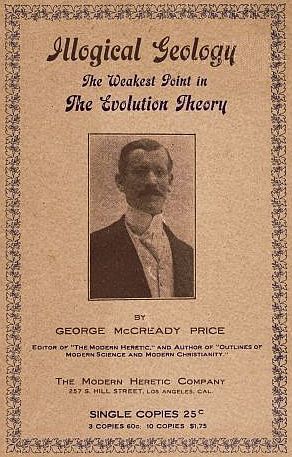
The Project Gutenberg eBook of Illogical Geology, the Weakest Point in the Evolution Theory
Title: Illogical Geology, the Weakest Point in the Evolution Theory
Author: George McCready Price
Release date: February 7, 2013 [eBook #42043]
Most recently updated: October 23, 2024
Language: English
Credits: Produced by Heiko Evermann, Ayeshah Ali and the Online
Distributed Proofreading Team at http://www.pgdp.net (This
book was produced from scanned images of public domain
material from the Google Print project.)
TRANSCRIBER'S NOTE: Scroll the mouse over a word and the original text will appear. A list of corrections is at the end of the text.
Illogical Geology
The Weakest Point in
The Evolution Theory
BY
GEORGE McCREADY PRICE
Editor of "The Modern Heretic," and Author of "Outlines of Modern Science" and "Modern Christianity."
The Modern Heretic Company
Illogical Geology
The Weakest Point in
The Evolution Theory
BY
GEORGE McCREADY PRICE
Editor of "The Modern Heretic," and Author of "Outlines of Modern Science and Modern Christianity."
The Modern Heretic Company
257 S. HILL STREET, LOS ANGELES, CAL.
SINGLE COPIES 25c
3 COPIES 60c: 10 COPIES $1.75
ILLOGICAL GEOLOGY
THE WEAKEST POINT IN THE EVOLUTION THEORY
To the Reader.
This Advance Edition has been issued by the Publishers in this cheap form to enable them to get out several thousand copies for critical review at comparatively small expense. Succeeding editions will be in regular book form, and will be sold at the usual rates for bound volumes.
"It is a singular and a notable fact, that while most other branches of science have emancipated themselves from the trammels of metaphysical reasoning, the science of geology still remains imprisoned in 'a priori' theories."—Sir Henry Howorth: "The Glacial Nightmare and the Flood." Preface. VII.
THE MODERN HERETIC COMPANY
257 S. Hill St., Los Angeles, California
1906
COPYRIGHT 1906
BY
GEORGE McCREADY PRICE
LOS ANGELES, CAL.
PART I
PREFACE
This book is not written especially for geologists or other scientists as such, though it deals with the question which it discusses from a purely scientific standpoint, and presupposes a good general knowledge of the rocks and of current theories. It is addressed rather to that large class of readers to whom geology is only an incident in larger problems, and who are not quite wholly satisfied with those explanations of the universe which are now commonly accepted on the testimony of biological science. I am free to say that my own conviction of the higher value and surer truth of other data outside of the biological sciences have always been given formative power in my own private opinions, and that in this way I have long held that there must be something wrong with the Evolution Theory, and also that there must be a surer way of gauging the value of that Theory, even from the scientific standpoint, than the long devious processes connected with Darwinism and biology. Some years ago, when compelled to investigate the subject more fully than I had hitherto done, I discovered, somewhat to my own surprise, the phenomenal weakness of the geological argument. The results of that investigation have grown into the present work.
Though mostly critical and analytic, it is not wholly so. But so far as it is constructive there is one virtue which can rightly be claimed for it. It is at least an honest effort to study the foundation facts of geology from the inductive may be standpoint, and whether or not I have succeeded in this, it is, so far as I know, the only work published in the English or any other language which does not treat the science of geology more or less as a cosmogony.
That such a statement is possible is, I think, my chief justification in giving it to the public. It would seem as if the twentieth century could afford at least one book built up from the present, instead of being postulated from the past.
GEORGE McCREADY PRICE.
257 South Hill Street,
Los Angeles, California,
June, 1906.
CONTENTS
| PART I | ||
| I | The Abstract Idea | 11 |
| II | History of The Idea | 14 |
| III | Fact Number One | 20 |
| IV | Fact Number Two | 24 |
| V | Turned Upside Down | 27 |
| VI | Fact Number Four | 31 |
| VII | Extinct Species | 34 |
| VIII | Skipping | 42 |
| PART II | ||
| IX | Graveyards | 53 |
| X | Change of Climate | 64 |
| XI | Degeneration | 70 |
| XII | Fossil Men | 74 |
| XIII | Inductive Methods | 81 |
| Appendix | 89 |
INTRODUCTION
A brief outline of the argument which I have used in the following pages will be in order here.
Darwinism, as a part, the chief part, of the general Evolution Theory, rests logically and historically on the succession of life idea as taught by geology. If there has actually been this succession of life on the globe, then some form of genetic connection between these successive types is the intuitive conclusion of every thinking mind. But if there is no positive evidence that certain types are essentially older than others, if this succession of life is not an actual scientific fact, then Darwinism or any other form of evolution has no more scientific value than the vagaries of the old Greeks—in short, from the standpoint of true inductive science it is a most gigantic hoax, historically scarce second to the Ptolemaic astronomy.
In Part One I have examined critically this succession of life theory. It is improper to speak of my argument as destructive, for there never was any real constructive argument to be thus destroyed. It is essentially an exposure, and I am willing to give a thousand dollars to any one who will, in the face of the facts here presented, show me how to prove that one kind of fossil is older than another.
In Part Two I have attempted to build up a true, safe induction in the candid, unprejudiced spirit of a coroner called upon to hold a post mortem. The abnormal character of most of the fossiliferous deposits, the sudden world-wide change of climate they record, the marked degeneration in all organic forms in passing from the older to the modern world, together with the great outstanding fact that human beings, with thousands of other living species of animals and plants have at this great world-crisis left their fossils in the rocks all over the world, prove beyond a possible doubt that our once magnificently stocked world met with a tremendous catastrophe some thousands of years ago, before the dawn of history. As for the origin of the living beings that existed before that event, we can only suppose a direct creation, since modern science knows nothing of the spontaneous generation of life, or of certain types of life having originated before other types, and thus being able to serve as the source of origin of other alleged succeeding types.
With the myth of a life succession dissipated once and for ever, the world stands face to face with creation as the direct act of the Infinite God.
CHAPTER I
THE ABSTRACT IDEA
How many of us have ever tried to think out a statement of just how we would prove that there has been a succession of life on the globe in a particular order?
Herbert Spencer did[1] and he did not seem to think the way in which it is usually attempted a very praiseworthy example of the methods to be pursued in natural science.
He starts out with Werner, of Neptunian fame, and shows that the latter's main idea of the rocks always succeeding one another over the whole globe like the coats of an onion was "untenable if analyzed," and "physically absurd," for among other things it is incomprehensible that these very different kinds of rocks could have been precipitated one after another by the same "chaotic menstrum."
But he then proceeds to show that the science is "still swayed by the crude hypotheses it set out with; so that even now, old doctrines that are abandoned as untenable in theory, continue in practice to mould the ideas of geologists, and to foster sundry beliefs that are logically indefensible."
Werner had taken for his data the way in which the rocks happened to occur in "a narrow district of Germany," and had at once jumped to the conclusion that they must always occur in this relative order over the entire globe. "Thus on a very incomplete acquaintance with a thousandth part of the earth's crust, he based a sweeping generalization applying to the whole of it."
Werner classified the rocks according to their mineral characters, but when the fossils were taken as the prime test of age, the "original nomenclature of periods and formations" kept alive the original idea of complete envelopes encircling the whole globe one outside each other like the coats of an onion. So that now, instead of Werner's successive ages of sandstone making or limestone making, and successive suites of these rocks, we have successive ages of various types of life, with successive systems or "groups of formations which everywhere succeed each other in a given order; and are severally everywhere of the same age. Though it may not be asserted that these successive systems are universal, yet it seems to be tacitly assumed that they are so.... Though, probably, no competent geologist would contend that the European classification of strata is applicable to the globe as a whole; yet most, if not all geologists, write as though it were so."
Spencer then goes on to show how dogmatic and unscientific it is to say that when the Carboniferous flora, for example, existed in some localities, this type of life and this only must have enveloped the world.
"Now this belief," he says, "that geologic 'systems' are universal, is quite as untenable as the other. It is just as absurd when considered a priori: and it is equally inconsistent with the facts," for all such systems of similar life-forms must in olden time have been of merely "local origin," just as they are now. In other words, we have no scientific knowledge of a time in the past when there were not zoological provinces and zones as there are to-day, one type of life existing in one locality, while another and totally different type existed somewhere else.
Then, after quoting from Lyell a strong protest against the old fancy that only certain types of sandstone and marls were made at certain epochs, he proceeds:
"Nevertheless, while in this and numerous passages of like implication, Sir C. Lyell protests against the bias here illustrated, he seems himself not completely free from it. Though he utterly rejects the old hypothesis that all over the earth the same continuous strata lie upon each other in regular order, like the coats of an onion, he still writes as though geologic 'systems' do thus succeed each other. A reader of his 'Manual' would certainly suppose him to believe, that the Primary epoch ended, and the Secondary epoch commenced, all over the world at the same time.... Must we not say that though the onion-coat hypothesis is dead, its spirit is tractable, under a transcendental form, even in the conclusions of its antagonists."
Spencer then examines at considerable length the kindred idea that the same or similar species "lived in all parts of the earth at the same time." "This theory," he says, "is scarcely more tenable than the other."
He then shows how in some localities there are now forming coral deposits, in some places chalk, and in others beds of Molluscs; while in still other places entirely different forms of life are existing. In fact, each zone or depth of the ocean has its particular type of life, just as successive altitudes do on the sides of a mountain; and it is a dogmatic and arbitrary assumption to say that such conditions have not existed in the past.
"On our own coasts, the marine remains found a few miles from shore, in banks where fish congregate, are different from those found close to the shore, where only littoral species flourish. A large proportion of aquatic creatures have structures that do not admit of fossilization; while of the rest, the great majority are destroyed, when dead, by the various kinds of scavengers that creep among the rocks and weeds. So that no one deposit near our shores can contain anything like a true representation of the fauna of the surrounding sea; much less of the co-existing faunas of other seas in the same latitude; and still less of the faunas of seas in distant latitudes. Were it not that the assertion seems needful, it would be almost absurd to say that the organic remains now being buried in the Dogger Bank can tell us next to nothing about the fish, crustaceans, mollusks, and corals that are now being buried in the Bay of Bengal."
This author evidently found it difficult to keep within the bounds of parliamentary language when speaking of the absurd and vicious reasoning at the very basis of the whole current geological theory; for, unlike the other physical sciences, the great leading ideas of geology are not generalisations framed from the whole series or group of observed facts, but are really abstract statements supposed to be reasonable in themselves, or at the most very hasty conclusions based on wholly insufficient data, like that of Werner in his "narrow district of Germany." Sir Henry Howorth[2] has well expressed the urgent need that there is of a complete reconstruction of geological theory:
"It is a singular and a notable fact, that while most other branches of science have emancipated themselves from the trammels of metaphysical reasoning, the science of geology still remains imprisoned in a priori theories."
But Huxley[3] also has left us some remarks along the same line which are almost equally helpful in showing the essential absurdity of the assumption that when one type of life was living and being buried in one locality another and very diverse type could not have been doing the same things in other distant localities.
This is how he expresses it:
"All competent authorities will probably assent to the proposition that physical geology does not enable us in any way to reply to this question—Were the British Cretaceous rocks deposited at the same time as those of India, or were they a million of years younger, or a million of years older?"
This phase of the idea, however, is not so bad, for the human mind refuses to believe that distant and disconnected groups of similar forms were not connected in time and genetic relationship. It is really the reverse of this proposition that contains the most essential absurdity, and this is the very phase that is most essential to the whole succession of life idea. Huxley, indeed, seems to have caught a glimpse of this truth, for he says:
"A Devonian fauna and flora in the British Islands may have been contemporaneous with Silurian life in North America, and with a Carboniferous fauna and flora in Africa. Geographical provinces and zones may have been as distinctly marked in the Palaeozoic epoch as at present."
Certainly; but if this be true, it is equally certain that the Carboniferous flora of Pennsylvania may have been contemporaneous alike with the Cretaceous flora of British Columbia and the Tertiary flora of Germany and Australia. But in that case what becomes of this succession of life which for nearly a century has been the pole star of all the other biological sciences—I might almost say of the historical and theological as well?
Must it not be admitted that in any system of clear thinking this whole idea of there having really been a succession of life on the globe is not only not proved by scientific methods, but that it is essentially unprovable and absurd?
Huxley, in point of fact, admits this, though he goes right on with his scheme of evolution, just as if he never thought of the logical consequences involved. His words are:
"In the present condition of our knowledge and of our methods (sic) one verdict—'not proven and not provable'—must be recorded against all grand hypotheses of the palaeontologist respecting the general succession of life on the globe."
In view of these startling facts, is it not amazing to see the supernatural knowledge of the past continually and quietly assumed in every geological vision of the earth's history?
CHAPTER II
HISTORY OF THE IDEA
Among the few stray principles that the future will probably be able to save from the wreck of Spencer's philosophy, is the advisability of looking into the genealogy of an idea. What has been its surroundings? What is its family history? Does it come of good stock, or is its family low and not very respectable?
This is especially true in the case of a scientific idea, which above all others needs to have a clean bill of health and a good family record. But, unfortunately, the idea we are here considering has a bad record, very bad in fact; for the whole family of Cosmogonies, of which this notion is the only surviving representative, were supposed to have been banished from the land of science long ago, and were all reported dead. Some of them had to be executed by popular ridicule, but most of them died natural deaths, the result of inherited taint, in the latter part of the eighteenth and early nineteenth centuries. It is perfectly astonishing how any of the family could have survived over into the twentieth century, in the face of such an antecedent record.
For one of the chief traits of the family as a whole is that of mental disorder of various stages and degrees. Some of them were raving crazy; others were mild and comparatively harmless, except that their drivel had such a disturbing effect on scientific investigations that they had to be put out of the way. It seems such a pity that when this last fellow, early in life, was up before Doctors Huxley and Spencer for examination, he was not locked up or put in limbo forthwith. This is especially unfortunate, because this survivor of an otherwise extinct race has since then produced a large family, some of which it is true have already expired, while the eldest son, Darwinism, was reported in 1901 to be "at its last gasp,"[4] and was even said last year to have had its "tombstone inscription" written by von Hartmann of Germany. But the succession of life idea itself, the father of all this brood, is still certified by those in authority to be healthy and compos mentis.
The Cosmogony Family is a very ancient one, running back to the time of Plato and Thales of Miletus. Indeed the cuneiform inscriptions of Babylonia seem to indicate that a tribe with very similar characteristics existed several millenniums before the Christian era. But discarding all these, the first men that we need to mention are perhaps Burnet and Whiston, who knew no other way of arriving at geological truth than to spin a yarn about how the world was made. Woodward seems to have had a little better sense, and is named along with Hooke and John Ray as one of the real founders of the science.
Unfortunately the brood of Cosmogonists was not dead, for Moro and De Maillet were at this same period spinning their fantastic theories about the origin of things; or as Zittel puts it, "accepted the risks of error, and set about explaining the past and present from the subjective standpoint."[5] This tendency we will find to be a birthmark in the family, and will serve to invariably identify any of them wherever found. We must remember this, and apply the test to the modern survivors.
Buffon seems to have been really the founder of the family in the modern form. He is credited with the sarcastic remark that "geologists must feel like the ancient Roman augurs who could not meet each other without laughing;" though in view of his fantastic scheme of seven "epochs," in which he endeavors to portray "the beginning, the past, and the future (sic) of our planet,"[6] one is reminded of the common symptom which manifests itself in thinking all the rest of the world crazy.
The "Heroic Age of Geology" succeeded this period, and was characterized largely by a determination to discard speculation, and to seek to build up a true science of actual fact and truth.
We have already seen from Spencer's remarks that A. G. Werner, who was, however, one of the leaders in Germany at this time, was very far from following true inductive methods. And the following language of Sir Arch. Geikie shows that in him the family characteristics were decidedly prominent:
"But never in the history of science did a stranger hallucination arise than that of Werner and his school, when they supposed themselves to discard theory and build on a foundation of accurately-ascertained fact. Never was a system devised in which theory was more rampant; theory, too, unsupported by observation, and, as we now know, utterly erroneous. From beginning to end of Werner's method and its applications, assumptions were made for which there was no ground, and these assumptions were treated as demonstrable facts. The very point to be proved was taken for granted, and the geognosts, who boasted of their avoidance of speculation, were in reality among the most hopelessly speculative of all the generations that had tried to solve the problem of the theory of the earth."[7]
In fact this author says that:
"The Wernerians were as certain of the origin and sequence of the rocks as if they had been present at the formation of the earth's crust." (pp. 288-9.)
Here we see the family characteristics very strongly developed.
In speaking of Werner's five successive "suites" or onion-coats in which he wrapped his embryo world, Zittel complains:
"Unfortunately, Werner's field observations were limited to a small district, the Erz mountains and the neighboring parts of Saxony and Bohemia. And his chronological scheme of formations was founded upon the mode of occurrence of the rocks within these narrow confines." (p. 59.)
And yet, as we have seen, it is precisely such a charge as this that Spencer and Huxley bring against the modern phase of the doctrine of successive ages based on the succession of life idea. Werner, from observations "limited to a small district," constructed his scheme of exact chronological sequence, basing it entirely upon the mineral or mechanical character of his "suites." And hundreds of enthusiastic followers long declared that the rocks everywhere conformed to this classification, even so great an observer as von Humboldt thinking that the rocks which he examined in Central and South America fully confirmed Werner's chronological arrangement.
But such notions to-day only cause a smile of pity, for it is now well known that, take the world over, the rocks do not occur as Werner imagined, though, as Geikie says, he and his disciples were as certain of the matter "as if they had been present at the formation of the earth's crust." Besides, as already pointed out, we moderns ought now to have pretty well assimilated the idea that while one kind of mineral or rock was forming in one locality, a totally different kind of deposit may have been in process of formation in another spot some distance off at the very same time, and we cannot imagine a time in the past when this principle would not hold good. But in a precisely similar way the idea of a time value was, as we shall see, transferred from the mechanical and mineral character of the rocks to their fossil contents; and from observations again "limited to a small district," William Smith and Cuvier conceived the idea that the fossils occurred only in a certain order; that only certain fossils lived at a certain time; that, for example, while Trilobites were living and dying in one locality, Nummulites or Mammals positively were not living and dying in another locality, though in any system of clear thinking this latter notion is just as irrational as that of Werner. Hence Spencer is compelled to say, "though the onion-coat hypothesis is dead, its spirit is still traceable, under a transcendental form, even in the conclusions of its antagonists."
The two cases are exactly parallel; only it has taken us nearly a hundred years, it seems, to find out that the fossils do not follow the prearranged order of Smith and Cuvier any better than the rocks and minerals do the scheme of Werner. If hundreds of geologists still seem to think that the fossils in general agree with the standard order, we must remember how many sharp observers said the same thing for decades about Werner's scheme. The taint of heredity will always come out sooner or later; and both of these schemes exhibit very strongly the family history of the whole tribe of Cosmogonies, viz., the facts refuse to certify that they are of sound mind.
It was William Smith, an English land surveyor, who first conceived the idea of fixing the relative ages of strata by their fossils. Just how far he carried this idea it seems difficult to determine exactly. Lyell[8] says nothing along this line about him, save that he followed the leading divisions of the Secondary strata as outlined by Werner, though he claims "independently" of the latter. Whewell[9] remarks rather pityingly on his having had "no literary cultivation" in his youth, but has nothing about the degree in which he is responsible for the modern scheme of life succession of which many modern geologists have made him the "father". Geikie and Zittel are much more explicit. The former[10] says that "he had reached early in life the conclusions on which his fame rests, and he never advanced beyond them." "His plain, solid, matter-of-fact intellect never branched into theory or speculation, but occupied itself wholly in the observation of facts." Zittel[11] says pretty much the same thing, remarking that "Smith confined himself to the empirical investigation of his country, and was never tempted into general speculations about the history of the formation of the earth"—words which to my mind are the very highest praise, for they seem to indicate that he was only in a very limited way responsible for the unscientific and illogical scheme of a "phylogenic series" or complete "life-history of the earth," which now passes as the science of geology. Doubtless like his little bright-eyed German contemporary, A. G. Werner, he had not had his imagination sufficiently cultivated in his youth to be able to appreciate the beauty of first assuming your premises and then proving them by means of your conclusion, i.e., first assuming that there has been a gradual development on the earth from the lowest to the highest, and then arranging the fossils from scattered localities over the earth in such a way that they cannot fail to testify to the fact.
The following may be taken as a fair statement of what he actually accomplished and taught:
"After his long period of field observations, William Smith came to the conclusion that one and the same succession of strata stretched through England from the south coast to the east, and that each individual horizon could be recognized by its particular fossils, that certain forms reappear in the same beds in the different localities, and that each fossil species belongs to a definite horizon of rock."[12]
But even granting the perfect accuracy of this generalization of Smith's for the rocks which he examined, I fail to see how it is any better than Werner's scheme, which Zittel characterizes as "weak" and premature, and of which Whewell (p. 521) says that "he promulgated, as respecting the world, a scheme collected from a province, and even too hastily gathered from that narrow field."
Quoting again from Zittel's criticism of Werner's work ("Hist. of Geology," p. 59), we must admit that Smith's observations also were "limited to a small district," and "his chronological scheme of formations was founded upon the mode of occurrence of the rocks (fossils) within these narrow confines." There is, as we have shown, a monstrous jump from this to the conclusion that even these particular fossils must always occur in this particular relative order over the whole earth. How can any one deny that if we had a complete collection of all the fossils laid down during the last thousand years—when all admit that the so-called "phylogenic series" is complete—particular fossils would in many cases be found to occur only in particular rocks, and we could still arrange them in this same order from the lowest to the highest forms of life, while we might even happen to find "small districts" where the "mode of occurrence of the rocks within these narrow confines" would have all the appearance of showing a true "phylogenic" order. This of itself ought to be sufficient to show us the weakness of this subjective method of study, and the purely hypothetical and imaginary value of the fossils in determining the real age of a rock deposit.
The name of Baron Cuvier is the next that we have to consider. An examination of part of his teaching will come naturally a little later when considering "extinct species." That part of his work which related to the doctrine of Catastrophism is somewhat aside from the subject of our study; while with regard to his influence on the succession of life idea per se there is not very much that need be said. And yet Cuvier is the real founder of modern cosmological geology, and thus in a certain sense the father of biological evolution.
But if the absence of the architectonic mania for building a cosmogony will serve to remove in a great measure any suspicions with regard to William Smith's results, we cannot say the same for those of Cuvier. In his scheme the hereditary Cosmological taint, which is such an invariable characteristic of the family, is very strong, though disguised and almost transfigured by learning and genius. It is doubtless these latter qualities which have secured for the theory such a phenomenal length of life, though of course we know that nothing born of this whole brood can ever secure a permanent home in the kingdom of science.
"How glorious," wrote this otherwise truly great man in his famous "Preliminary Discourse," "it would be if we could arrange the organized products of the universe in their chronological order, as we can already (Werner's onion-coats) do with the more important mineral substances!"
His work (with that of his co-laborer Brongniart) on the fossils of the Paris basin was probably accurate and logical enough for that limited locality. It was only when he quietly assumed as Werner had done, that the rocks must always occur in this particular order all over the world, or as Whewell expresses it, "promulgated as respecting the world, a scheme collected from a province, and (perhaps) even too hastily gathered from that narrow field"—it was only, I say, when this monstrous assumption was incorporated into his scheme, and he began to call into being his vision of organic creation on the instalment plan, as Werner had done with the minerals, that his great and valuable work for science became tainted with the deadly Cosmological virus, dooming it to death sooner or later. Sherlock Holmes might attempt to diagnose a disease by a mere glance at his patient's boots, but even this gave him more data and was a more logical proceeding than the facts and methods of Cuvier supplied for constructing a scheme of organic creation.
It will not be necessary to detail the manner in which the modern "phylogenic series" was gradually pieced together from the scattered fragments here and there all over the globe; but it should be noted here that the whole chain of life was practically complete before any serious attempt was made to study the rocks on the top of the ground, and to find out how this marvellous record of the past joined on to the modern period, thus reversing completely the true inductive method, and leaving the most important of all, viz., the rocks containing human remains and other living species, over till the last, with the result that we have for over half a century been laboring under a "Glacial Nightmare," and these deposits on the top of the ground "still remain in many respects the despair of geology."
Then came Lyell, Agassiz, and Darwin; and now in the light of the keen discussions instituted by Weismann in the later eighties of the last century, the modern world is pretty well agreed on two results, viz., that so far from natural selection being able to originate a species, it can't possibly originate anything at all, and also that no individual can transmit to his descendants what he has himself acquired in his lifetime, and hence it is hard to see how he can transmit what he has not got himself and what none of his ancestors ever had.
I have not the space to show how Agassiz further complicated the problem immensely by his absurdly illogical use of his three "laws" of comparison, when the prime fact of there ever having been a succession of life on the globe in any order whatever had never been proved; but I am free to say that if Cuvier's system of creation on the instalment plan had been fact instead of fancy, some scheme of evolution would undoubtedly be implied in this general fact. It is this instinctive feeling on the part of modern scientists which makes them to-day, while confessing the failure of Darwinism, still cling to the general idea of evolution somehow. Hence it seems quite evident that, having deviated from strict inductive methods by pursuing this ignis fatuus of a cosmological history of creation, it was essential in the interests of true science to go the whole journey and make a complete investigation of the biological side of the question, in order to complete the demonstration that science was on a wrong tack entirely. Darwin and Weismann were inevitable in view of the wholly unscientific course on which biology entered under the guidance of Buffon and Cuvier.
What then can we take as the general lesson to be learned from the stubborn way in which, for over a hundred years, the world has followed this hypnotic suggestion of folly, that we might explain our genesis and being from the scientific standpoint? One of the lessons—there may be others—is that science knows nothing about origins, and that, in speculating along these lines, the cosmological taint will always vitiate the accuracy of our conclusions and debauch the true spirit of induction. A hundred years ago, they thought they knew all about how the world was made. The keen investigations inspired by Darwinism were necessary to convince us that we know nothing at all about it. Modern biology has simply developed a gigantic reductio ad absurdum argument against the easy assumptions of the earlier geologists that it occurred by a progression from the low to the high. A hundred years—nay fifty years ago—this assumption did not appear so unscientific, for we did not then have the biological evidence to refute such an idea. Now, however, in the light of the modern progress of science, this awful mystery of our existence, of our creation and destiny, is borne in upon us from every dividing cell, from every sprouting seed, from countless millions of the eloquent voices of nature, which our forefathers were too blind to see, too deaf to understand; and with weary, reluctant sadness does science confess that about it all she knows absolutely nothing.
CHAPTER III
FACT NUMBER ONE
Hitherto we have been dealing only with the a priori aspects of the succession of life idea. We have seen that it is really based on two primary assumptions, viz.:
(1) That over all the earth the fossils must always occur in the particular order in which they were found to occur in a few corners of Western Europe; and also—
(2) That in the long ago there were no such things as zoological provinces and zones, and totally different types of fossils from separated localities could not possibly have been contemporaneous with one another as we know they are to-day in "recent" deposits.[13]
On the blending of these two assumptions, the latter essentially absurd, and the former long ago disproved by the facts of the rocks, has been built up the towering structure of a complete "phylogenic series" from the Cambrian to the Pleistocene. The way in which, as we have been, Spencer and Huxley treated this subject, reminds us very much of the old advice, "When you meet with an insuperable difficulty, look it steadfastly in the face—and pass on." For neither they nor any of their thousands of followers have ever, so far as I know, pointed out the horrible logic in taking this immense complex of guesses and assumptions as the starting-point for new departures, the solid foundation for detailed "investigations" as to just how this wonderful phenomenon of development has occurred. For after Agassiz and his contemporaries had built on these large assumptions of Cuvier, and had arranged the details and the exact order of these successive forms by comparison with the embryonic life of the modern individual, the evolutionists of our time, led by such men as Spencer and Haeckel, with their "philogenetic principle," prove their theory of evolution by showing that the embryonic life of the individual is only "a brief recapitulation, as it were from memory," of the geological succession in time. There would really seem to be little hope of reaching with any arguments a generation of scientists who can elaborate genealogical trees of descent for the different families and genera of the animal kingdom, based wholly on such a series of assumptions and blind guesses, and then palm off their work on a credulous world as the proved results of inductive science.
And yet I am tempted to make some effort in this direction. And since we have now examined the a priori aspects of the question, it remains to test the two above mentioned assumptions by the facts of the rocks. The second, indeed, involving as it does a profound supernatural knowledge of the past, and being so positively contrary to all that we know of the modern world as to seem essentially absurd, is yet by its very nature beyond the reach of any tests that we can bring to bear upon it. Hence it remains to test by the facts of the rocks the assumption that all over the earth the fossils invariably occur in the particular order in which they were first found in a few corners of Western Europe by the founders of the science. Have we already a sufficiently broad knowledge of the rocks of the world to decide such a question? I think we have.
To begin then at the beginning, let us try to find out how we can fix on the rocks which are absolutely the oldest on the globe. We would expect to find a good many patches of them here and there, but there must be some common characteristic by which they may be distinguished wherever found. Of course, when I say "rocks" here I mean fossils, for as has long been agreed upon by geologists, mineral and mechanical characters are of practically no use in determining the age of deposits, and we are here dealing only with life and the order in which it has occurred on the globe. Accordingly our problem is really to find that typical group of fossils which is essentially older than all dissimilar groups of fossils.
In most localities we do not have to go very far down[14] into the earth to find granite or other so-called igneous rocks, which not only do not contain any traces of fossils, but which we have no proper reason for supposing ever contained any. These Azoic or Archaean rocks constitute practically all the earth's crust, there being only a thin skim of fossiliferous strata on the outside somewhat like the skin on an apple. Now it would be natural enough to suppose that those fossils which occur at the bottom, or next to the Archaean, are the oldest. This is doubtless what the earlier geologists had in mind, or at least ought to have had, for it is not quite certain that they had any clear thoughts on the matter whatever. They did not really begin at the bottom, but half way up, so to speak, at the Mesozoic and Tertiary rocks, and Sedgwick and Murchison, who undertook to find bottom, got too excited over their Cambro-Silurian controversy to attend to such an insignificant detail as the logical proof that any type of fossils was really older than all others. If they had really stopped to consider that some type of fossil might occur next to the Archaean in Wales, and another type occur thus in Scotland, while still another type altogether might be found in this position in some other locality, and so on over the world, leading us to the very natural conclusion that in the olden times as now there were zoological provinces and districts, the history of science during the nineteenth century might have been very different, and this chapter might never have been written. But this commonplace of modern geology, that any type of fossil whatever, even the very "youngest," may occur next to the Archaean, was not then considered or understood; and when about 1830 it came to be recognized, other things were allowed to obscure its significance, and the habit of arranging the rocks in chronological order according to their fossils was too firmly established to be disturbed by such an idea.
But the Fact Number One, which I have chosen as the subject of this chapter, is the now well established principle that any kind of fossil whatever, even "young" Tertiary rocks, may rest upon the Archaean or Azoic series, or may themselves be almost wholly metamorphosed or crystalline, thus resembling in position and outward appearance the so-called "oldest" rocks.
The first part of this proposition, about any rocks occurring next to the Archaean, is covered by the following quotation from Dana:[15]
"A stratum of one era may rest upon any stratum in the whole of the series below it,—the Coal-measures on either the Archaean, Silurian, or Devonian strata; and the Jurassic, Cretaceous, or Tertiary on any one of the earlier rocks, the intermediate being wanting. The Quaternary in America in some cases rests on Archaean rocks, in others on Silurian or Devonian, in others on Cretaceous or Tertiary."
It would be tedious to multiply testimony on a point so universally understood.
As for the other half of this fact, that even the so-called "youngest" rocks may be metamorphic and crystalline just as well as the "oldest," it also is now a recognized commonplace of science. Dana[16] says that as early as 1833 Lyell taught this as a general truth applicable to "all the formations from the earliest to the latest."
The first reference I can find to any disproof of this old fable of Werner's, that only certain kinds of rock are to be found next to the "Primitive" or Archaean, is in the observations of Studer and Beaumont in the Alps, (1826-28), who found "relatively young" fossils in crystalline schists, which, as Zittel says, "was a very great blow to the geologists who upheld the hypothesis of the Archaean or pre-Cambrian age of all gneisses and schists."
James Geikie, doubtless referring to the same series of rocks, tells us that:—
"In the central Alps of Switzerland, some of the Eocene strata are so highly metamorphosed that they closely resemble some of the most ancient deposits of the globe, consisting, as they do, of crystalline rocks, marble, quartz-rock, mica schist, and gneiss."[17]
Hence we need not be surprised at the following statement of the situation by Zittel.[18]
"The last fifteen years of the nineteenth century witnessed very great advances in our knowledge of rock-deformation and metamorphism. It has been found that there is no geological epoch whose sedimentary deposits have been wholly safeguarded from metamorphic changes, and, as this broad fact has come to be realized, it has proved most unsettling, and has necessitated a revision of the stratigraphy of many districts in the light of new possibilities. The newer researches scarcely recognize any theory; they are directed rather to the empirical method of obtaining all possible information regarding microscopic and field evidences of the passage from metamorphic to igneous rocks, and from metamorphic to sedimentary rocks."
But in addition to what Zittel means by recognizing "no theory" as to the origin of the various sorts of "igneous" rocks, it seems to me that this "broad fact" ought surely to prove "most unsettling," to the traditional theories about certain fossils being intrinsically older than others. With our minds divested of all prejudice, and this "broad" Fact Number One well comprehended, that any kind of fossil whatever may occur next to the Archaean, and the rocky strata containing it may in texture and appearance "closely resemble some of the most ancient deposits on the globe," where on this broad earth shall we look for the place to start our life-succession That is, where can we now go to find those kinds of fossils which we can prove, by independent arguments, to be absolutely older than all others? It may seem very difficult for some of us to discard a theory so long an integral part of all geology; but until it can be proved that this "broad fact" as stated by Zittel and Dana is no fact at all, I see no escape from the acknowledgment that the doctrine of any particular fossils being essentially older than others is a pure invention, with absolutely nothing in nature to support it.
Or, to state the matter in another way, since the life succession theory rests logically and historically on Werner's notion that only certain kinds of rocks (fossils) are to be found at the "bottom" or next to the Archaean, and it is now acknowledged everywhere that any kind of rocks whatever may be thus situated, it is as clear as sunlight that the life succession theory rests logically and historically on a myth, and that there is no way of proving what kind of fossil was buried first.
Of course, the reason the followers of Cuvier and his life succession now find themselves in such a fix as this is because they have not been following true inductive methods. Theirs has been a geology by hypothesis instead of by observed fact. They started out with a pretty scheme ready-made about the origin and formation of the world, perfectly innocent of any evil intent in such a method of procedure, and unconscious of its speculative character; and for nearly a hundred years they have supposed that they were following inductive methods in Geology. But in view of what we have now learned I think we are perfectly justified in adapting and applying to Cuvier and the modern school of geologists what Geikie[19] says about Werner and his school:
"But never in the history of science did a stranger hallucination arise than that of Cuvier and the modern school, when they supposed themselves to discard theory and build on a foundation of accurately ascertained fact. Never was a system devised in which theory was more rampant; theory, too, unsupported by observation, and, as we now know, utterly erroneous. From beginning to end of Cuvier's method and its applications, assumptions were made for which there was no ground, and these assumptions were treated as demonstrable facts. The very point to be proved was taken for granted, and the evolutionary geologists who boasted of their avoidance of speculation, were in reality among the most hopelessly speculative of all the generations that had tried to solve the problem of the theory of the earth."
CHAPTER IV
FACT NUMBER TWO
If we had ample evidence that a certain man was personally acquainted with Julius Caesar, that they were born in the same town, went to school together, served in the same wars, and later carried on an extensive mutual correspondence, would we not conclude that they must have lived in the same age of the world's history? I confess that the conclusion seems quite unavoidable. Who would dream that eighteen centuries or more had separated the two lives, and that while one was an old Roman the other was an American of the latter nineteenth century?
Some such a puzzle as this is presented in geology under the general subject of conformability. Let me define this term.
Strata laid down by water are in the first place in a horizontal position. Some subsequent force may have disturbed them, so that we may now find them standing up on edge like books in a library. But all human experience goes to show that they were not deposited in this position. Some disturbing cause must have taken hold of them since they were laid down, for the water in which they were made must have spread them out smooth and horizontal, each subsequent layer or stratum fitting "like a glove" on the preceding. Thus when we find two successive layers agreeing with one another in their planes of bedding, with every indication that the lower one was not disturbed in any way before the upper one was spread out upon it, the two are said to be conformable. But if the lower bed has evidently been upturned or disturbed before the other was laid down, or if its surface has even been partly eroded or washed away by the water, the strata are said to be unconformable, or they show unconformability in bedding.
Of course, in all this we are dealing only with relative time. When we find one bed or stratum lying above another in their natural position, the lower one is of course the older of the two; but whether laid down ten minutes earlier, or ten million years earlier, how are we to determine? Ignoring the matter of the fossils they contain, must we not own that, though there is no way of telling just how much longer the lower one was deposited before the next succeeding, yet if the two are conformable to one another, and the bottom one shows no evidence of disturbance or erosion before the other was fitted upon it, the strong presumption would seem to be that no great length of time could have elapsed between the laying down of the two layers. To say that we have here a geological example similar to that of a modern American having been personally acquainted with Julius Caesar, would seem to be quite "inexplicable," as Herbert Spencer used to say.
But if the life succession theory be true, we have just such a conundrum in our Fact Number Two, which is that any formation whatever may rest conformably upon any other "older" formation.
The lower may be Devonian, Silurian, or Cambrian, and the upper one Cretaceous or Tertiary, and thus according to the theory millions on millions of years must have elapsed after the first, and before the following bed was laid down, but the conformability is perfect, and the beds have all the appearance of having followed in quick succession. Sometimes, too, though less frequently, these age-separated formations are lithologically the same, and can only be separated by their fossils!
But before going into the minute description of any of these cases, we must notice some general statements. Thus as long ago as the date of the publication of "The Origin of Species," Darwin, in speaking of the "Imperfection of the Geological Record," could speak of "The many cases on record of a formation conformably covered, after an immense interval of time, by another and later formation, without the underlying bed having suffered in the interval by any wear and tear."[20]
Also Geikie,[21] in speaking of how "fossil evidence may be made to prove the existence of gaps which are not otherwise apparent," says that "It is not so easy to give a satisfactory account of those which occur where the strata are strictly conformable, and where no evidence can be observed of any considerable change of physical conditions at the time of deposit. A group of quite conformable strata having the same general lithological characters throughout, may be marked by a great discrepance between the fossils of the upper and the lower part." In many cases he says these conditions are "not merely local, but persistent over wide areas.... They occur abundantly among the European Palaeozoic and Secondary rocks," and are "traceable over wide regions."
We have seen how Dana admits that "A stratum of one era may rest upon any stratum in the whole series below it, ... the intermediate being wanting." He classes this under the head of the "Difficulties" of the science, quite naturally as it would seem, though he does not expressly assert that these age-separated formations are often conformable to one another, as Geikie and Darwin have said in the above given quotations.
The literature really teems with illustrations of these facts, and the more detailed accounts contained in the various Geological Reports are often quite charmingly naive in their description of the conditions. Two examples, however, must suffice, both from the Canadian North West.
The first is from the Report on the region about Banff, in Alberta, near the line of the Canadian Pacific Railway, and just east of the Rockies.
"East of the main divide the Lower Carboniferous is overlaid in places by beds of Lower Cretaceous age, and here again, although the two formations differ so widely in respect to age, one overlies the other without any perceptible break, and the separation of one from the other is rendered more difficult by the fact that the upper beds of the Carboniferous are lithologically almost precisely like those of the Cretaceous (above them.) Were it not for fossil evidence, one would naturally suppose that a single formation was being dealt with."[22]
The other example is from the District of Athabasca.
"The Devonian limestone is apparently succeeded conformably by the Cretaceous, and with the possible exception of a thin bed of conglomerate of limited extent, which occurs below Crooked Rapid on the Athabasca, the age of which is doubtful, the vast interval of time which separated the two formations, is, so far as observed, unrepresented either by deposition or erosion."[23]
Of course, some geological writers labor to explain this thundering rebuke of their theory, just as the Ptolemaic astronomers had their "deterrents" and "epicycles" for every new difficulty. But surely the detailed records of such observations as these are fearful examples of the power of tradition to blind the minds of investigators to the meaning of the very plainest facts.
On a previous page (Id. p. 51,) the author last quoted gives us some idea of the "remarkable persistence" of this instructive case of conformability, which extends from the Athabasca "in a broad band around the southern end of Birch Mountains, and across Lake Claire to Peace River, and up the latter stream to a point two miles above Vermillion Falls."
The distance, as I judge from the map, can not be less than 150 miles in a straight direction, thus making a district of probably several thousand square miles in extent where, according to the theory of a life succession, nature must have put an injunction on the action of the elements, and they had to continue in the status quo for millions of ages, or from the Devonian to the Cretaceous "age," the water neither wearing away nor building up over any part of this consecrated ground during all this time.
Nor is this all, for from Part E, Report (p. 209) of this same volume, we are told of strata near Lake Manitoba, over 500 miles away, in almost the same wonderful relationship,—"Devonian rocks very similar in character" to those in Athabasca still overlaid directly by the Cretaceous, though in this case as it happens "unconformably." It would almost seem to be a bona fide case of Werner's onion coats cropping out.
And all this incredible picture of nature's inconsistent behaviour in past ages is necessitated solely by the loving allegiance with which the infallibility of the life succession theory is regarded by modern geologists.
CHAPTER V
TURNED UPSIDE DOWN
How many of us have ever seen a mountain fall? Not very many. And yet events even more wonderful than this have frequently occurred in the past, as we are confidently assured by the leaders in geological science. Thus, in speaking of a certain region in the Alps, Dana[24] says that "one of the overthrust folds has put the beds upside down over an area of 450 square miles."
It is well worth our while to try to understand this statement. Our first and most natural inquiry is, What is it that leads scientists to think so? The details of this particular case are not very accessible, and so we are driven to reasoning from analogy from the known methods and constructions employed in this science. We must agree that none of the authorities who report this circumstance can testify as eye-witnesses of this marvellous event: they were not there on the spot when old Mother Earth turned this huge calcareous and silicious pancake. And yet there must be some kind of evidence by which these eminent men have arrived at this conclusion. What kind of evidence can it be?
We cannot imagine any physical evidence which could even remotely suggest such an idea. In fact from the universal custom of making the contained fossils the supreme test of the age of a rock deposit, we are perfectly safe in concluding that it is solely because the fossils occur here in the reverse of the accepted order, that we have this astounding picture of an immense mountain mass having been put "upside down over an area of 450 square miles." The "older" fossils are evidently here on top, while the "younger" ones are underneath, and of course some explanation must be given of this flat contradiction of the life succession theory.
But let us retrace our steps somewhat, and pick up the thread of our argument. We have already found quite serious reason to question the accuracy of this life succession theory: but there is still another way of testing its rationality. If certain fossils are not necessarily older than certain others, it might reasonably be expected that we would now and then find them reversed as to position, i.e., with the "younger" below and the "older" above. Accordingly we have the following very necessary caution from Prof. Nicholson:[25]
"It may even be said that in any case where there should appear to be a clear and decisive discordance between the physical and the palaeontological (fossil) evidence as to the age of a given series of beds, it is the former that is to be distrusted rather than the latter."
To meet all ordinary cases of this character, where the differences involve only a few formations representing a few "ages" or a few million years, the theory of pioneer "colonies" was invented by Barrande in 1852.
But for extreme cases, say where Silurian or Cambrian fossils occur above Jurassic, Cretaceous or Tertiary, there is in such a predicament always an anxious search made for faults and displacements; or gigantic "thrust-faults" or "overthrust folds," like the example already quoted from Dana, are described in picturesque language, many miles in extent—inventions which, as I have already suggested of a similar expedient to explain away evidence, deserve to rank with the famous "epicycles" of Ptolemy, and will do so some day.
Here is Geikie's highly instructive statement regarding the same conditions:—
"We may even demonstrate that in some mountainous ground, the strata have been turned completely upside down, if we can show that the fossils in what are now the uppermost layers ought properly to lie underneath those in the beds below them."[26]
Some day, I fancy, a statement like this will be regarded as a literary curiosity.
There are plenty of examples under this head, though two or three ought to be as good as a dozen. In the part of Alberta east of the Rockies already referred to, is a section of country of about fourteen square miles at least—and we know not how much more—where Cambrian fossils are found above Cretaceous, and the inevitable "thrust fault" is thus described by one of the officers of the Canadian Geological Survey. He has just been speaking of "a series" of these "gigantic thrust faults":—
"One of the largest and most important of these occurs along the eastern base of the chain, and brings the Cambrian limestones of the Castle Mountain group over the Cretaceous of the foot hills. This fault has a vertical displacement of more than 15,000 feet (? three miles), and an estimated horizontal displacement of the Cambrian beds of about seven miles in an easterly section. The actually observed overlap amounts to nearly two miles. The angle of inclination of its plane to the horizon is very low, and in consequence of this its outcrop follows a very sinuous line along the base of the mountains, and acts exactly like the line of contact of two nearly horizontal formations.
"The best places for examining this fault are at the gaps of the Bow and of the south fork of the Ghost River. At the former place the Cretaceous shales form the floor of the bay which the Bow has cut in the eastern wall of the range, and rise to a considerable height in the surrounding slopes. Their line of contact with the massive gray limestones of the overlying Castle Mountain group is well seen near the entrance of the gap in the hills to the north. The fault plane here is nearly horizontal, and the two formations, viewed from the valley, appear to succeed one another conformably."[27]