
FOOTNOTES CHAPTER 3
1 (return)
[ A marvellous account is
given in the Historisch moralischen Belustigungen des Geistes (Hamb.,
1765), Stüclc VII. Aristide ou le Citoyen, XVI. discours du 11 Octobre,
1766 (Lausanne). Hiller wöch. Nachr., 1766,1., p. 174.]
2 (return)
[ Those who please can
make an approximate calculation from L. Mozart's different entries, of the
whole sum received and expended on the tour. The children received so many
presents in jewellery and trinkets that they might have set up a shop with
them.]
3 (return)
[ So says Marianne Mozart
(A. M. Z., II., p. 300).]
4 (return)
[ L. Mozart, who was well
versed in theoretical literature, possessed the original edition in Latin.
(Vienna, 1725.)]
5 (return)
[ According to Kochel's
probable conjecture, Joh. Adam Wieland was born 1710; Curate in 1734;
Vicar of Gotting and Anthering, 1766; Pastor of Friedorfing, 1767; and
died, 1774.]
6 (return)
[ The autograph was found
by F. Pohl, in the Royal Library at Windsor, A. M. Z., 1865, p. 225.]
7 (return)
[ The Agnus of L. Mozart's
Lauretanian Litany in E flat major is a solo, with obbligato alto
trombones.]
8 (return)
[ These traditions,
resting on the authority of Max Keller, the Hofkapell-organist at
Altötting, are alluded to by Prof Schafhutl in his preface to the
Offertorium, published at Munich, 1851.]
9 (return)
[ Hist. Univ. Salisb., p.
110.]
10 (return)
[ A list of the pieces
produced from 1621 to 1727 is given in Hist. Univ. Salisb., p. 112.]
=
FOOTNOTES CHAPTER 4
1 (return)
[ The extracts from L.
Mozart's letters given by Nissen are almost our only sources of
information for this journey.]
2 (return)
[ G. Forster, Schriften
VII., p. 270.]
3 (return)
[ A.M. Z., II., p. 301.]
4 (return)
[ Burney, Reise, II., p.
182. Duten's Mém., I., p. 353.]
5 (return)
[ Garat. Mém. sur Suard,
II., p. 218. Duten's Mém., I., p. 347.]
6 (return)
[ Zimmermann, Briefe, p.
96.]
7 (return)
[ Burney, Reise, II., p.
189.]
8 (return)
[ Gervinus, Gesch. der
poet. National-Litteratur, IV., p. 384. Devrient, Gesch. der deutschen
Schauspielkunst, II., p. 191; and see also how Sonnenfels expresses
himself (Ges. Schr., V., pp. 157, 191, or in a letter to Klotz, I., p. 2)
in the same year, 1768.]
9 (return)
[ Sonnenfels gives a
detailed description of the company (Ges. Schr., V., p. 290).]
10 (return)
[ Metastatio, Opp.
post., II., pp. 278, 290, cf. Arteaga, Le rivoluzioni del teatro musicale
Italiano, III., p. 126 (II., p. 397).]
11 (return)
[ Cramer, Magasin d.
Mus., I., p. 365. Metastatio, Lettere ined. (Nirza, 1796), p. 46.]
12 (return)
[ Burney, Reise, II., p.
188.]
13 (return)
[ Mane ini, Rifless.
prat, sul canto fig., p. 30.]
14 (return)
[ Burney, Reise, II., p.
172.]
15 (return)
[ Dittersdorff,
Selbstbiographie, p. 7.]
16 (return)
[ Muller, Ab8chied v. d.
Bühne, p. 72.]
17 (return)
[ Müller, zuverl.
Nachr., I., p. 13.]
18 (return)
[ Carpani, Le Haydine,
p. 82. Kelly, Remin., I., p. 103.]
19 (return)
[ It is mentioned only,
so far as I am aware, by Biedenfeld. Die Komische Oper., p. 69.]
20 (return)
[ Nicolai, Reise, IV.,
p. 574.]
21 (return)
[ Sonnenfels, Ges.
Schr., V., p. 296. He reappeared in Rome in 1780, a toothless old man.
(Teutsch. Merc., 1789, III., p. 210.)]
22 (return)
[ Sonnenfeu, Ges. Schr.,
V., p. 300.]
23 (return)
[ Sonnenfels, Ges.
Schr., V., p. 291. Burney, Reise, I., p. 63. Müller zuverl. Nachr., I., p.
73. He died at Vienna in 1772, at the age of sixty-seven. (Ibid. II., p.
132.)]
24 (return)
[Sonnenfels, Ges. Schr.,
V., p. 301.]
25 (return)
[ Sonnenfels, Ges.
Schr., V., p. 293.]
26 (return)
[ Sonnenfels, Ges.
Schr., V., p. 293. Müller, zuverl. Nachr., I., p. 73. Kelly, Remin., I.,
p. 66.]
27 (return)
[ Sonnenfels, Ges.
Schr., V., p. 299.]
28 (return)
[ One of Fracasso's
songs was twice composed, so was the middle movement of another, and an
inserted song for Ninetta.]
29 (return)
[ In the beautiful aria
for Polidoro, before described, a tedious passage was afterwards
judiciously struck out by Mozart.]
30 (return)
[ Nissen has incorrectly
given the idea that "the well-known Dr. Messmer, the friend of the
Mozarts," was the celebrated magnetiser of that name. Helfert (Die österr.
Volkschule, I., p. 132.) identifies Mozart's Messmer, who became a member
of the medical faculty in 1767. In 1773 his wife inherited a half share in
a house on the Landstrasse, consistently with which L. Mozart writes to
his wife from Vienna (August) that Fr. v. Messmer has come into
considerable property since the death of her mother. A "young Herr. v.
Messmer," a cousin, was director of the Normal School in 1773.]
31 (return)
[ E. Schelle, Berl. Mus.
Ztg. Echo, 1864, No. 38.]
32 (return)
[ "'Le Devin du Village'
est un intermède charmant dont les paroles et la musique sont de M.
Rousseau," writes Grimm (June 23, 1753) to Gottsched (Danzel, Gottsched,
p. 351). He speaks of it again on December 15, 1753 (Corr. Litt., I., p.
92), as an "intermède agréable, qui a eu très-grand succès à Fontainebleau
et à Paris;" and again, in February, 1754, as an "intermède français
très-joli et très-agréable" (Ibid.,p. 112). He passes it over, however, in
his account at a later date of Rousseau's musical works, and mentions only
his unsuccessful opera, "Les Muses Galantes."]
33 (return)
[La Harpe. Corr. Litt.,
II., p. 59.]
34 (return)
[ A. M. Z., XXI., p.
841. XXIII., p. 141. Berlioz, Voy. Mus., I., p. 389.]
35 (return)
[ Adam (Souv. d'un
Music., p. 198), suggests that Rousseau's score may have been revised by
Francoeur.]
36 (return)
[ On the subject of
recitative, Rousseau speaks exhaustively and to the point, both in his
Dictionnaire de Musique, and in the Lettre sur la Musique Française.
(Ouvres, XI., p. 296.)]
37 (return)
[ It was maintained by
some that Rousseau only wrote the words, and intrusted the composition to
a musician in Lyons (A. M. Z., XIV., p. 469; Castil-Blaze; Molière
Musicien, II., p. 409), an accusation which Grétry contradicted. Rousseau
tried to refute it by a second opera, which, however, did not succeed. (La
Harpe, Corr. Litt., II., p. 370. Adam, Souv. d'un Mus., p. 202.)]
38 (return)
[ An English adaptation
by Burney failed in London in 1766 (Parke, Mus. Mém., II., p. 93). German
versions were produced by Leon (Teutsch. Merc., 1787, II., p. 193) and C.
Dielitz (Berlin, 1820).]
39 (return)
[ Théätre du Favart, V.,
1 (Paris, 1763). A book of the words, printed at Amsterdam in 1758, has
the remark: "Représenté à Bruxelles, Nov., 1753, par les Comédiens
François sous les ordres de S. Alt. Roy."]
40 (return)
[ Grimm, Corr. Litt.,
IV., pp. 400, 417.]
41 (return)
[ Dictionn. d. Théätre,
VI., p. 228; Theaterkal. 1776.]
42 (return)
[ "Bastienne, eine
französische opéra-comique. Auf Befehl in einer freien Uebersetzung
nachgeahmt von Fr. W. Weiskern. Wien, 1764." The French melodies were
retained for some of the songs, and new ones composed for others. The
piece was produced at Vienna (Müller, Zuverl. Nachr., I., p. 31), also in
1770 at Brünn (Ibid., II., p. 213), in 177a at Prague (Ibid., II., p.
163), and in 1776 at Hildesheim (Müller, Abschied v. d. Bühne, p. 137).]
43 (return)
[ Nissen gives
Schachtner as the librettist. His co-operation was probably confined to
the versification of the prose dialogue, a few scenes of which Mozart
afterwards composed in recitative; a useless labour, never completed.]
44 (return)
[ A comparison of the
examples which Hiller (über Metastasio, p. 17) quotes from a translation
of Metastasio, which appeared in Vienna in 1769, will show some
similarity.]
45 (return)
[ A similar instance may
be found in Weber's composition of Voss's songs
46 (return)
[ This is noticed also
by Hiller as especially characteristic in style (Wöehentl. Nachr., I., p.
376; II., p. 118).]
47 (return)
[ Neue Sammlung zum
Vergnügen und Unterrich (Wien, R. Graffer, 1768), IV., pp. 80, 140.]
48 (return)
[ Nicolai, Reisc, IV.,
p. 648.]
49 (return)
[ Nicolai, Reise, III.,
p. 228.]
50 (return)
[ Burney, Reise, II., p.
107.]
51 (return)
[ Müller, Abschied v. d.
Bühne, p. 237.]
52 (return)
[ "Wien. Diarium," 1768,
10 Christmon. No. 99.]
FOOTNOTES CHAPTER 5
1 (return)
[ A. M. Z., 1864, p. 495.
"La Finta Semplice," dramma giocoso per musica, da rappresentarsi in corte
per ordine di S. A. Rev. Monsigr. Sigismondo Conte di
Schrattenbach,Arcivescovo di Salisburgo, &c. Salisb., 1769.]
2 (return)
[ Metastasio speaks of the
different ways of delivering these. (Opp. post, I., p. 300.)]
3 (return)
[ Communicated to me by
Köchel, from the autograph in the possession of R. v. Pfuesterschmied, at
Vienna.]
4 (return)
[ Dominicus Hagenauer
became "Prälat des St. Peterstifts," in 1786. [Footnote Koch-Sternfeld.]
Die letzten dreiss. Jahre., pp. 78, 299, 326.]
5 (return)
[ Burney, Reise, I., p.
101. Cf. the extracts from Th. Fr. Maier's description of Venice. I.,
1787, in the Musik. Realzeitung, 1788, p. 108.]
6 (return)
[ Zelter Briefw. mit
Goethe, II., p. 177.]
7 (return)
[ A remarkable exception,
and a fortunate one for the development of German music, was Joseph Haydn,
although even he was initiated into the Italian school through his lessons
from Porpora, and his intercourse with Metastasio. But his numerous
Italian operas, which he himself considered as equal to the works of any
of his contemporaries, brought him no renown. His fame always rested on
his instrumental compositions, which were thoroughly German; and his two
great oratorios were composed at a time when Italian music was on the
decline.]
8 (return)
[ L. Mozart's letters
during the tour, of which Nissen gives extracts, are almost all in the
Mozarteum. at Salzburg.]
9 (return)
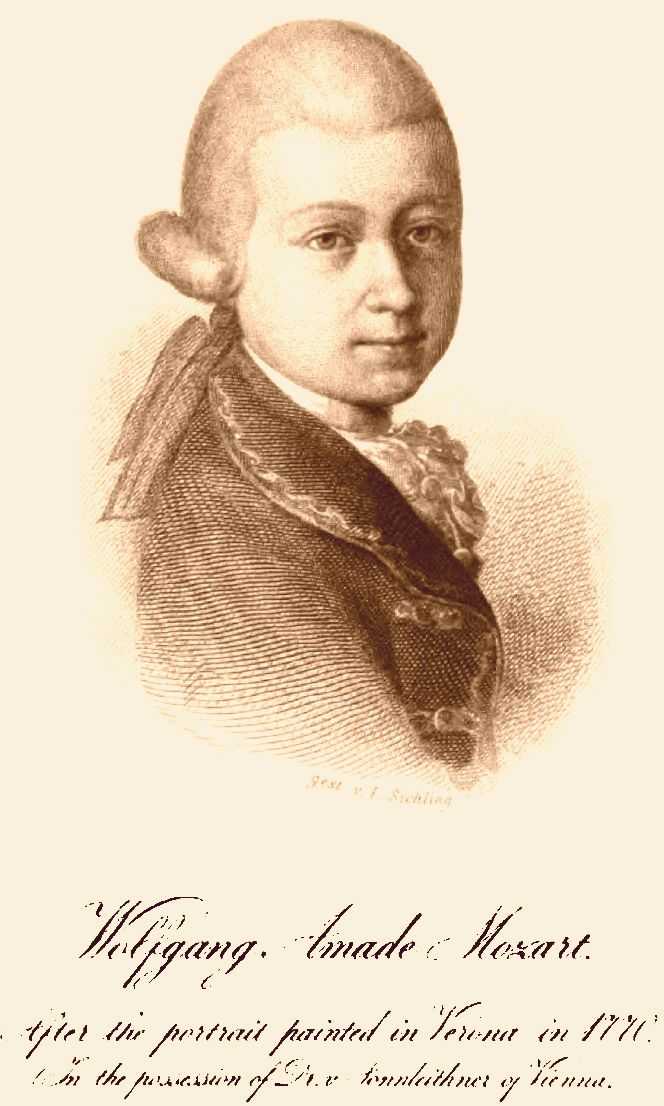
[ The portrait has been
recovered by Sonnleithner's exertions, and in now in his possession.]
10 (return)
[ S. Mayr, Die ehem.
Univ. Salzburg, p. 12.]
11 (return)
[ Winckelmann, Briefe,
pp. 271,279, 324; II., p. 48.]
12 (return)
[ Schlozer's Life, I.,
pp. 96, 276, 313. Cf. Duten's Mém., I., p. 327. Teutsch. Mercur, 1789,
III., p. 301.]
13 (return)
[ Teutsch. Mercur, 1775,
III., p. 247.]
14 (return)
[ Griesinger, Biogr.
Not., p. 15. Carpani, Haydine, p. 56.]
15 (return)
[ The song "Misero tu
non sei" (Anh. 2 K.), which Wolfgang composed in Milan, is from
Metastasio's "Demetrio" (Act i, sc. 4), which he had heard shortly before
in Mantua; it has not been preserved.]
16 (return)
[ A gigliato, Florentine
goldgulden, was about equal to a ducat.]
17 (return)
[ Cf. Kelly's Remin.,
I., p. 74.]
18 (return)
[ G. Gaspari, La Musica
in Bologna, p. 19.]
19 (return)
[ Esemplare osia saggio
fondamentale pratico di contrappunto. Bol., 1774-75.]
20 (return)
[ Burney, Reise, I., p.
144.]
21 (return)
[ This was shown in his
conduct to Grétry (Mém., I., p. 91), Naumann (Meissner, Biogr., I., p.
150), and Burney (Reise, I., p. 142).]
22 (return)
[ Chrysander, Handel,
II., p. 378.]
23 (return)
[ Burney, Reise, I., p.
150.]
24 (return)
[ Mancini, Rifless. sul
Canto Figurato, p. 152.]
25 (return)
[ Dittersdorfs account
in his Autobiography of his stay at Bologna in 1762, and his intercourse
with P. Martini and Farinelli, will be found interesting (p. 110).]
26 (return)
[ Burney, Reise, I., p.
149.]
27 (return)
[ A short Osanna in four
parts, with accompaniment for strings, in complicated canon form (223 K.)
shows the same tendency.]
28 (return)
[ Cf. for the mottoes of
these, Padre Martini, Esemplare, II., p. xxv.]
29 (return)
[ Cf. Barthold, Die
geschichtl. Persdnl., in Casanova's Memoiren, II., p. 177.]
30 (return)
[ Cf. Schubart, Deutsche
Chron., 1776, pp. 499, 554, 613.]
31 (return)
[ Barney, Reise, I., p.
185.]
32 (return)
[ Kelly, Remin., I., p.
225.]
33 (return)
[ He was drowned at a
water party (Parke, Mus. Mem., I., p. 204). Holmes says that his brother
Ozias Linley preserved an Italian letter from Mozart to Thomas Linley.]
34 (return)
[ Rochlitz (Für Freunde
d. Tonk., II., p. 284), highly coloured as usual.]
35 (return)
[ On Holy Thursday, the
Misereres of Anerio, Naldini, and Scarlatti were performed in turns, until
in 1714 Bai's Miserere displaced them. Since 1821 Allegri's Miserere has
only been sung once. Baini, Mem. Stor. Crit., II., p. 195. Kandler, G.
Pierluigi da Palestrina, p. 96.]
36 (return)
[ Cf. Burney's more
critical account (Reise, I., p. 203) and Mendelssohn's (Reise-briefe, pp.
122, 163).]
37 (return)
[ So at least it was
said; but Burney says that the Pope had copies made for the Emperor
Leopold, the King of Portugal, and Padre Martini, and that the Papal
kapellmeister, Santarelli, gave him a copy, which he had printed in
London, 1771 (Reise, I., pp. 202, 208): he heard it again in Florence, and
was offered a copy. In face of these statements, Baini's assurance
(Cäcilia, II., p. 69) that no copy or score of the Miserere had ever been
made, must be held to be exaggerated.]
38 (return)
[ Metastasio declares
(Lett., I., p. 99) that the Miserere, which had thrown him into ecstasies
in Rome, made no impression at all in Vienna, performed by singers who
were secondo il corrente stilo eccellentissimi.]
39 (return)
[ Metastasio, Opp.
post., III., p. 258.]
40 (return)
[ Burney, Reise, I., p.
241. Cramer, Magaz. d. Mus., I., p. 341. Kelly, Remin., I., p. 29.]
41 (return)
[ Burney, Reise, I., p.
252. L. Mozart writes (December 22, 1770) from Milan, "Jomelli's opera has
so completely fallen to the ground, that it is to be withdrawn. This is
the celebrated maestro about whom the Italians make such an astounding
fuss. But he was a little foolish to undertake to write two operas in the
year for the same theatre, particularly as he might have seen that the
first was no great success."]
42 (return)
[ Dittersdorf,
Selbstbiographie, p. 84: "The order is bestowed in Rome, and the members
bear the title of 'Comités Palatina Romani.' They receive a diploma
written on parchment, and authenticated by a great seal. They enjoy all
the rights of the nobility in Rome and the Papal States, have free entry
into the Papal palace, and hold the same position there as the
kammerherren of other reigning courts. Their insignia is a yellow
enamelled gold Maltese cross. They wear it round the neck with a purple
ribbon, and sometimes a smaller one of plain gold, with a red ribbon on
the breast."]
43 (return)
[ Three short movements
in counterpoint for four voices, with a figured bass. "Adoramus" (327 K.),
"Justum deduxit Dominus," and "0 sancte fac nos captare" (326 K.), are
preserved among Wolfgang's sketches in L. Mozart's handwriting. They may
be examples, perhaps by Padre Martini, copied for study. Not even a
conjecture can be made concerning two four-part movements, "Salus
infirmorum," and "Sancta Maria" (324, 325, K.), of which only the
commencing bars are preserved by André.]
44 (return)
[ Burney, Reise, I., p.
166: "I must not neglect to inform my musical readers that I recognise in
the son of Mozart the musician, that little German, whose precocious and
supernatural talent amazed us all in London some years ago, when he was a
mere child. He has been much admired, both in Rome and Naples."]
45 (return)
[ Grétry, Mém., I., p.
91. Kandler, G. A. Hasse, p. 21.]
46 (return)
[ Statuti ovyero
costituzioni de' Signori Accademici Filarmonici di Bologna. Bologna,
1721.]
47 (return)
[ Gaspari, La Musica in
Bologna, p. 27.]
48 (return)
[ Gaspari, p. 28. Fétis,
Biogr. Univ., VI., p. 226. Köchel, A.M.Z., 1864, P- 495.]
49 (return)
[ Nissen, p. 226. A. M.
Z.. XXII., Beil. I.]
50 (return)
[ Rudhart, Gesch. d.
Oper zu München, I., p. 138.]
51 (return)
[ Burney, Reise, I., p.
96.]
52 (return)
[ It consisted,
according to L. Mozart, of 14 first and as many second violins, 2
claviers, 2 double-basses, 6 violoncelli, 2 bassoons, 6 viols, 2 oboes,
and 2 "flautraversen," "which always play with 4 oboes when there are no
flutes," 4 corni di caccia, and 2 clarini, in all, 60 performers.]
53 (return)
[ A Bolognese exclaimed
of Dittersdorf's playing, "Come è mai possibile, che una tartaruga tedesca
possa arrivare a tale perfezione!" (Selbstbiogr., p. III.)]
54 (return)
[ The score remained in
Milan after their departure, for the copyist had orders for five complete
copies, besides single songs.]
55 (return)
[ L. Mozart here relates
a musical event that seemed to him hardly credible in the Italy of that
day: "We heard two beggars, man and wife, singing in the street, and they
sang in fifths without missing one note. I never heard the like in
Germany. In the distance I thought it was two persons, each singing a
song; but as we came nearer we found it was a duet in exact fifths."]
56 (return)
[ L. Mozart here relates
a musical event that seemed to him hardly credible in the Italy of that
day: "We heard two beggars, man and wife, singing in the street, and they
sang in fifths without missing one note. I never heard the like in
Germany. In the distance I thought it was two persons, each singing a
song; but as we came nearer we found it was a duet in exact fifths."]
57 (return)
[ Burney, Reise, I., p.
94.]
58 (return)
[ Meissner, Biographie
Naumanns, I., p. in.]
59 (return)
[ Hasse declared that
six months were necessary for a good opera (Man-fredini reg. armon., p.
134), that was plenty of time; Naumann writes, that in Venice an opera had
to be written, learnt, and produced within a month.]
60 (return)
[ Metastasio, Opp.
post., III., pp. 116, 164.]
61 (return)
[ Orelli, Beitr. z.
Gesch. der Ital. Poesie, II., p. 3.]
62 (return)
[ Carpani, Le Haydine,
p. 83. Kandler, Cenni int. alia vita del G. A. Hasse, p. 27: "Questo
ragazzo ci farà dimenticar tutti"]
63 (return)
[ Marpurg, Krit. Beitr.,
I., p. 227.]
64 (return)
[ Meissner, Biogr.
Naumanns, I., pp. 120, 227, 283.]
65 (return)
[ Cf. Betrachtungen d.
Mannh. Tonsch, I., p. 307.]
66 (return)
[ Parini's Descrizione
delle feste celebrate in Milano per le nozze delle L.L.A.A.R.R. l'arcid.
Ferdinando e l'arcid. Maria Beatrice. Milan, 1825.]
67 (return)
[ Mozart bequeathed this
watch to Joseph Strebl, a Vienna merchant, with whom he used to play
bowls.]
68 (return)
[ Teutsch. Mercur, 1775,
III., p. 240.]
69 (return)
[ L. Mozart writes to
Breitkopf (February 7, 1772): "We arrived at home from Milan on the 15th
of December, and my son, having gained great credit by the composition of
his dramatic serenata, has been commissioned to write the first Carnival
Opera for Milan next year, and the second opera for the same Carnival at
the Theatre of S. Benedetto, in Venice. We shall, therefore, remain in
Salzburg until the end of next September, and then for the third time
repair to Italy."]
70 (return)
[ Meissner, Biographie
Naumanns, I., p. 279.]
71 (return)
[ This is inferred from
a statement made by his sister to Regierungsrath Sonnleithner (Salzburg,
July 2, 1819) about a portrait of Mozart, that "it was painted when he
returned from the Italian tour, at sixteen years of age; but as he was
just recovering from severe illness, the picture is sickly and yellow."]
72 (return)
[ [Koch-Sternfeldj Die
letzten dreissig Jahre des Hochstifts und Erzbisthums Salzburg (1816), p.
36.]
73 (return)
[ Leopold Mozart had
ordered new oboes and bassoons from Dresden in a great hurry, when the
election of an archbishop was imminent.]
74 (return)
[ It would almost appear
that it was performed a second time later on, at least the songs of the
"Licenza" occur in a second composition, which may be referred to a later
period, and is far superior to the first; but it might be that they were
used for an altogether different composition.]
75 (return)
[ Burney, Reise, III.,
p. 263.]
76 (return)
[ Burney, Reise, II.,
pp. 93, no.]
77 (return)
[ Naumann, also, in
whose "Armida" he appeared in Padua, says of him, "he has every good
quality, sings like an angel, and is an excellent actor." From the year
1778 he lived in England as a singer, and then as a teacher till 1810.
Kelly, Remin., I., p. 10. Parke, Mus. Mem., II., p. 51. Rudhart, Gesch. d.
Oper. zu München, I., p. 149.]
78 (return)
[ Afterwards she sang
only in private society. Berl. Musik. Wochenblatt, p. 4.]
79 (return)
[ The Abbé Cardanelli, a
contemporary of Mozart, relates that de Amicis required Wolfgang to submit
the sketches of his songs for her approval, but that he brought her a
finished song, which she found excellent; and he then composed the same
words again twice over, and placed them at her disposal (Folchino, Elogio
Stor. di W. A. Mozart. Cremona, 1817, p. 26). A. M. Z., XX., p. 93. Not
very likely!]
80 (return)
[ The result of the
opera appears to have been the subject of great anxiety. Naomann notes in
his Diary for January 2, 1773: "I went to Colloredo, to hear the news of
the Milan opera."]