
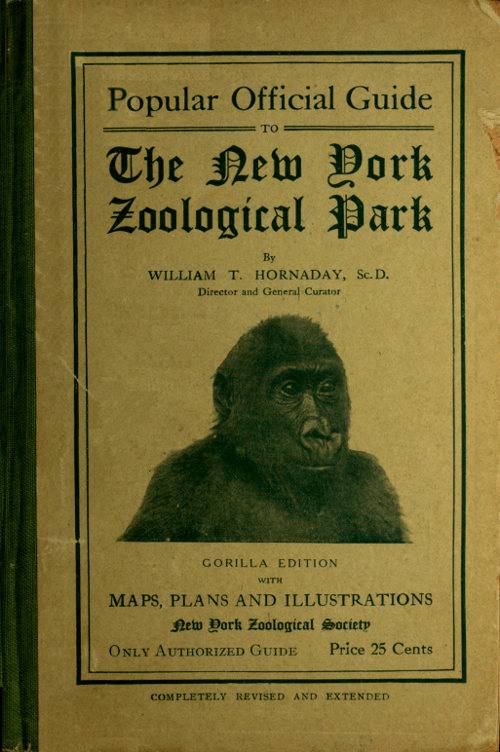
The Project Gutenberg eBook of Popular Official Guide to the New York Zoological Park (September 1915)
Title: Popular Official Guide to the New York Zoological Park (September 1915)
Author: William T. Hornaday
Release date: September 24, 2016 [eBook #53141]
Most recently updated: October 23, 2024
Language: English
Credits: Produced by Stephen Hutcheson, Dave Morgan and the Online
Distributed Proofreading Team at http://www.pgdp.net
NEW YORK ZOOLOGICAL PARK
High-resolution Map
| Administration Bldg., 8 | D 4 |
| Alaskan House, 32 | H 3 |
| Alligator Pool, 36 | H 4 |
| Antelope House, 50 | J 3 |
| Bear Dens, 37 | H 5 |
| Beaver Pond, 29 | G 5 |
| Biological Laboratory, 28 A | G 4 |
| Bird House, Aquatic, 5 | D 2 |
| Bird House, Large, 7 | D 3 |
| Bison, 51 | J 5 |
| Boat House, 54 | M 6 |
| Buffalo Herd, 52 | J 6 |
| Burrowing Animals, 42 | I 3 |
| Cage, Flying, 4 | C 3 |
| Camel House, 39 | I 2 |
| Deer House, Small, 49 | I 2 |
| Deer, American, 30 | H 2 |
| Deer, Asiatic, 1 | C-D 2 |
| Deer, Axis and Sika, 2 | C 2 |
| Deer, Fallow, 53 | K 4 |
| Deer, Red, 10 | D 2 |
| Duck Aviary, 3 | C 3 |
| Eagle and Vulture Aviary, 11 | E 2 |
| Elephant House, 20 | F 3 |
| Elk Range, 21 | G 2 |
| Feed Barn, 27 | G 3 |
| Flying Cage, 4 | C 3 |
| Fountain, Rockefeller, 13 | D 4 |
| Fountains, Drinking, | D 2, H 2, M 7 |
| Fox Dens, 23 | G 2 |
| Lion House, 15 | E 3 |
| Llama House, 38 | I 2 |
| Lydig Arch, 47 | I 5 |
| Mammal House, Small, 35 | H 3 |
| Mountain Sheep Hill, 44 | I 4 |
| Musk Oxen, 48 | I 2 |
| Nursery, 18 | E 9 |
| Ostrich House, 43 | I 3 |
| Otter Pools, 31 | H 2 |
| Pavilion, Shelter, 26 | G 3 |
| Pheasant Aviary, 40 | I 2 |
| Polar Bear Den, 37 | H 5 |
| Prairie Dogs, 41 | I 3 |
| Primate House, 17 | E 4 |
| Puma and Lynx House, 33 A | H 3 |
| Raccoon’s Tree, 44 A | I 5 |
| Reptile House, 34 | H 4 |
| Restaurant, 46 | I 5 |
| Riding Animals, 6 | D 3 |
| Rocking Stone, 45 | I 5 |
| Sea Lion Pool, 12 | D 3 |
| Service Bldg., 28 | H 4 |
| Soda Fount’s. | *D 2, G 3, H 4 |
| Subway Station | O 6 |
| Toilets, W. M., | C 3, E 3, G 3, I 5, L 6, M 8 |
| Tortoise Yards | H 4 |
| Totem Pole, 32 | H 3 |
| Turkeys, Wild, 33 | H 3 |
| Wolf Dens, 22 | G 3 |
| Yak House, 55 | K 4 |
| Zebra Houses, 14 | E 2 |
PENINSULA BEAR: IVAN
POPULAR OFFICIAL GUIDE
TO THE
New York Zoological Park
By WILLIAM T. HORNADAY, Sc.D.
Director and General Curator
ILLUSTRATED BY ELWIN R. SANBORN
GORILLA EDITION
WITH MAPS, PLANS AND ILLUSTRATIONS
THIRTEENTH EDITION—SEPTEMBER, 1915
PUBLISHED BY THE
NEW YORK ZOOLOGICAL SOCIETY
11 WALL STREET, NEW YORK
Only Authorized Guide Price 25 Cents
COMPLETELY REVISED AND EXTENDED
| 1st | Edition, | October, | 1899— | 5000 |
| 2d | “ | May, | 1900— | 5000 |
| 3d | “ | December, | 1900— | 5000 |
| 4th | “ | October, | 1901— | 3000 |
| 5th | “ | June, | 1902— | 10000 |
| 6th | “ | “ | 1903— | 10000 |
| 7th | “ | “ | 1904— | 15000 |
| 8th | “ | “ | 1906— | 7000 |
| 9th | “ | “ | 1907— | 30000 |
| 10th | “ | October, | 1909— | 30000 |
| 11th | “ | June, | 1911— | 30000 |
| 12th | “ | “ | 1913— | 40000 |
| 13th | “ | September, | 1915— | 20000 |
Copyright, 1899, 1900, 1901, 1902, 1903, 1904, 1906, 1907, 1909, 1911, 1913 and 1915.
NEW YORK ZOOLOGICAL SOCIETY
PREFACE
The publication of this revised and extended edition of the Guide to the Zoological Park is necessary in order to bring our most important collections down to date. With the completion of the Zebra House and Eagle Aviary, we are now able to offer a Guide Book to the Zoological Park as practically finished.
The visitor is not to understand, however, that with the completion of the features named above nothing more will remain to be done. An institution of this kind never reaches a state of absolute completion, with no further possibilities of improvement. But the building of boundary walls, and the rebuilding of temporary entrances, are matters of small moment in comparison with the completion of a grand series of installations for animals, and buildings for public comfort.
Few indeed are the persons who know, or who ever will know, the extent to which both the general design and the details of the Zoological Park have been originated, and hammered out of the raw materials. From the inception of the undertaking, the work of development has involved a continuous struggle to meet new conditions. Although precedents and models for things to be done were sought far and wide, in all save a very few instances, our needs were so peculiar, and so different from those of other zoological gardens and parks, we have found really very little that we could copy. The abundant-room idea on which the Zoological Park was founded, and our desire for the full utilization of the works of nature, have from the first taxed the creative faculties of the Society to the utmost.
It has been gratifying to find in other zoological establishments a number of features which we could utilize here, thereby saving ourselves something in the eternal grind of invention and experiment, and we have gladly made prominent mention of such cases.
While it is possible to complete the equipment of animal installations for a Zoological Park, and fill them with fine collections, the demand for more animals is continuous. Our wild creatures are not immortal; and, like human beings, they live out their allotted lives and pass away. The great majority do not perpetuate themselves in captivity, and the depleted ranks must be filled by new gifts and new purchases. Gifts of specimens, and funds for purchases, must constantly be forthcoming.
In the acquisition of certain representative species of great variety but particular desirability, the Society has been much favored by its friends, both at home and abroad. Frequently it happens that the greatest zoological rarities are obtainable only through the good will and tireless industry of friends who travel into the most remote and inaccessible regions of the earth. It is to such sources that we owe our musk-ox herd, walrus, mountain goat herd, spectacled bear and many other species.
The Executive Committee makes grateful acknowledgment of the loyal and generous support it has constantly received from the Board of Managers, the members of the Zoological Society, and from the Government of the City of New York. Thanks to a judicious union of these forces, the development of the Zoological Park has gone forward rapidly and satisfactorily. Although the actual period of construction has been remarkably short for so vast an undertaking, everything constructed is of the most permanent character. It is only just to note the fact that while the Zoological Park is an institution of national interest and importance, and free to all the world, with the exception of a few gifts of animals it has been created and is maintained wholly by the citizens of the City of New York. The State has contributed nothing.
The Executive Committee.
JUNE 1, 1913.
CONTENTS.
- Page
- Statistics of the Zoological Park 10
- Officers of the Society 11
- Origin 13
- Means of Access 16
- Admission 17
- Physical Aspect of the Grounds 21
- MAMMALS.
- Bison Ranges 26
- Mountain Sheep Hill 29
- Antelope House 35
- Small-Deer House 42
- Miscellaneous Mammals 49
- White Mountain Goat 50
- Prong-Horned Antelope 51
- Camel House 53
- Llama House 55
- North American Deer 57
- Zebra House 63
- Asiatic and European Deer 66
- Lion House 71
- Sea-Lions 78
- Primate House 80
- Elephant House 89
- Wolf Dens 98
- Fox Dens 101
- Otter Pools 103
- Small-Mammal House 104
- Puma and Lynx House 115
- Burrowing Mammals 116
- Prairie-Dog Village 118
- Bear Dens 119
- Raccoon Tree 128
- Beaver Pond 128
- Economic Rodent-Reptile Collection 130
- BIRDS.
- Goose Aviary 133
- Flying Cage 135
- Aquatic-Bird House 141
- Eagle and Vulture Aviary 143
- Wild Turkey Enclosure 146
- Large-Bird House 146
- Wild Fowl Pond 153
- Pheasant and Pigeon Aviary 155
- Ostrich House 162
- Cranes 167
- REPTILES.
- Reptile House 171
- Turtles and Tortoises 172
- Crocodiles and Alligators 175
- Lizards 177
- Serpents 179
- Batrachians or Amphibians 182
- INSECTS.
- Insect Collection 185
- Index 188
- MAPS.
- Map of Zoological Park Second page of cover
- Sketch Map, New York 14
- Sketch Map, Vicinity of Park 16
ILLUSTRATIONS.
- PAGE
- Peninsula Bear: Ivan Frontispiece
- Baird Court and Concourse 12
- The Boat House 18
- Boating on Bronx Lake 20
- White-Tailed Deer 24
- American Bison 26
- European Bison 27
- White-Fronted Musk-Ox 30
- Big-Horn Mountain Sheep 30
- Mouflon 32
- Arcal Sheep 32
- Himalayan Tahr 32
- Burrhel 32
- Chamois 33
- Markhor 33
- Aoudad 33
- Persian Wild Goat 33
- Nilgai: Indian Antelope 36
- Nubian Giraffes 38
- Beatrix Antelope 40
- Blessbok 40
- Leucoryx Antelope 41
- White-Tailed Gnu 41
- Eland 42
- Sable Antelope 43
- Redunca Antelope 44
- Sasin Antelope 46
- Great Gray Kangaroo 48
- Rocky Mountain Goat 49
- American Prong-Horned Antelope 52
- Bactrian Camel 53
- Alpaca 54
- Vicunia 55
- American Elk 58
- European Red Deer 58
- Development of Antlers 61
- Grant Zebra 64
- Prjevalsky Horses 65
- Axis Deer 68
- Burmese Deer 69
- Jaguar 72
- Cheetah 73
- Barbary Lion 74
- Snow Leopard 75
- Atlantic Walrus 79
- Chimpanzee, “Baldy” 82
- Orang-Utan 84
- Humboldt Woolly Monkey 85
- Japanese Red-Faced Monkey 88
- Pig-Tailed Macaque 88
- Slow Lemur 89
- Siamang 89
- Elephant House 90
- Indian Elephant 92
- African Elephants 93
- African Two-Horned Rhinoceros 94
- Indian Rhinoceros 95
- Pygmy Hippopotami 96
- Timber Wolf 99
- Coyote: Prairie Wolf 100
- Swift or Kit Fox 102
- Red Fox 103
- Ocelot 106
- Common Genet 107
- African Porcupine 111
- Tamandua 112
- Great Ant-Eater 113
- Six-Banded Armadillo 114
- Two-Toed Sloth 115
- Polar Bear Den 120
- Polar Bear “Silver King” 122
- Syrian Bear 123
- Spectacled Bear 126
- European Brown Bear 127
- Brazilian Tree Porcupine 131
- Mute and Trumpeter Swans 133
- Cereopsis Geese 136
- White-Faced Glossy Ibis 137
- Roseate Spoonbill 137
- Brown and White Pelicans 140
- Great Horned Owl 142
- Spectacled Owl 142
- Eared Vulture 143
- Lammergeyer 143
- King Vulture 145
- Black Vulture 145
- Harpy Eagle 145
- Griffon Vulture 145
- Wild Turkey 147
- Seriema 148
- Secretary Bird 148
- Great Crowned Pigeon 150
- Sulphur Crested Cockatoo 151
- Toco Toucan 151
- Ducks Feeding 154
- Pheasant Aviary 156
- Manchurian Eared Pheasant 158
- Indian Peacock 159
- North African Ostrich 163
- Rhea 164
- Cassowary 164
- Emeus 165
- Little Brown Crane 167
- Demoiselle Crane 167
- Asiatic White Crane 168
- Paradise Crane 168
- Whooping Crane 169
- Crowned Crane 169
- Adjutant 169
- Jabiru 169
- Mastigure 170
- Horned Rattlesnake 170
- Hog-Nosed Snake 170
- Gecko 170
- Tree Frog 170
- Giant Tortoise 173
- Alligator Pool 176
- Venezuelan Boa 177
- Rhinoceros Viper 180
- Cobra-De-Capello 181
- Metamorphosis of the Leopard Frog 184
- Giant Centipede 186
- Tarantula 187
- Red-Winged Locust 187
- Hercules Beetle 187
STATISTICS OF THE ZOOLOGICAL PARK.
| January, 1915. | |
|---|---|
| Final plan of the Zoological Park approved by Park Board, November 22, 1897. | |
| Zoological Society assumed control of grounds, July 1, 1898. | |
| First building begun, August 11, 1898. | |
| Park formally opened to the public, November 9, 1899. | |
| Administration and Service Buildings | 2 |
| Large Animal Buildings (all heated) | 14 |
| Small Animal Buildings (4 heated) | 10 |
| Large Groups of Outdoor Dens, Aviaries and Corrals | 13 |
| Animal Storehouses, for winter use | 3 |
| Restaurants | 2 |
| Public-Comfort Buildings | 6 |
| Entrances | 7 |
| Area of Park Land and Water | 264 acres |
| Area of Water | 30 acres |
| Walks and Roads | 7.78 miles |
| Fences | 10.55 miles |
| LIVE ANIMALS IN THE COLLECTIONS. | ||||
|---|---|---|---|---|
| January, 1915. | ||||
| Mammals | 204 | species, | 586 | specimens. |
| Birds | 811 | “ | 2,753 | “ |
| Reptiles | 164 | “ | 1,014 | “ |
| Total | 1,179 | 4,353 | ||
| Attendance of visitors in 1914 | 2,020,433 |
| Total attendance of visitors from 1899 to Jan., 1915 | 19,325,590 |
NEW YORK ZOOLOGICAL SOCIETY
President,
HENRY FAIRFIELD OSBORN.
MADISON GRANT, Secretary, 11 Wall Street.
PERCY R. PYNE, Treasurer, 30 Pine Street.
Executive Committee
MADISON GRANT, Chairman.
PERCY R. PYNE,
WATSON B. DICKERMAN,
SAMUEL THORNE,
WM. PIERSON HAMILTON,
WILLIAM WHITE NILES,
FRANK K. STURGIS,
LISPENARD STEWART,
HENRY FAIRFIELD OSBORN, ex-officio.
| General Officers | |
| WILLIAM T. HORNADAY, Director | |
| H. J. SHORTER | Assistant Secretary |
| R. L. CERERO | Assistant to Treasurer |
| DR. GEORGE S. HUNTINGTON | Prosector |
| C. GRANT LA FARGE | Architect |
| H. DeB. PARSONS | Consulting Engineer |
| Officers of the Zoological Park. | |
| WILLIAM T. HORNADAY, Sc.D. | |
| Director and General Curator. | |
| H. R. MITCHELL | Chief Clerk and Disbursing Officer |
| R. L. DITMARS | Curator of Reptiles, Asst. Curator of Mammals |
| C. WILLIAM BEEBE | Curator of Birds |
| LEE S. CRANDALL | Assistant Curator of Birds |
| W. REID BLAIR, D.V.S. | Veterinarian |
| H. W. MERKEL | Chief Forester and Constructor |
| ELWIN R. SANBORN | Editor and Photographer |
| GEORGE M. BEERBOWER | Civil Engineer |
| WILLIAM MITCHELL | Cashier |
ITALIAN GARDEN, BAIRD COURT,
The structure on the right is the Large Bird-House, and in the distance, the Lion House.
GENERAL STATUS
OF THE ZOOLOGICAL PARK.
Origin.—The New York Zoological Park originated with the New York Zoological Society, a scientific body incorporated in 1895, under a special charter granted by the Legislature of the State of New York. The declared objects of the Society are three in number—“A public Zoological Park; the preservation of our native animals; the promotion of zoology.” The Society has enrolled among its various classes over 2,000 members.
Henry Fairfield Osborn is the President of the Society. The affairs of the Society are managed by a Board of Managers of thirty-six persons, which meets three times each year. The planning and general development of the Zoological Society is in the hands of an Executive Committee of eight members, as follows: Madison Grant, Chairman; Percy R. Pyne, Samuel Thorne, William White Niles, Watson B. Dickerman, Wm. Pierson Hamilton, Frank K. Sturgis, Lispenard Stewart and Henry Fairfield Osborn, ex-officio. Madison Grant, the Chairman of the Executive Committee, is also Secretary of the Society, and his office is at No. 11 Wall Street. Dr. William T. Hornaday is the Director and General Curator of the Zoological Park, and his office is now located in the Administration Building on Baird Court. The address is 185th Street and Southern Boulevard. The Society assumed control of the grounds on July 1, 1898, and began the first excavation, for the Bird House, on August 11th. The Park Department began work, on the Wild-Fowl Pond, on August 29, 1898.
Sources of Income.—The funds devoted to the development of the Zoological Park have been derived from the following sources:
1. From the Zoological Society, obtained by subscriptions from private citizens—funds for plans, for the erection of buildings, aviaries, dens and other accommodations for animals; and for the purchase of animals.
2. From the City of New York—by vote of the Board of Estimate and Apportionment—funds for the construction of walks, roads, sewers and drainage, water supply, public comfort buildings, entrances, grading, excavating of large ponds and lakes, annual maintenance, and also for animal buildings.
SKETCH MAP SHOWING LOCATION OF ZOOLOGICAL PARK.
The Zoological Society has expended, of its own funds, for plans, construction and live animals, over $641,000. This sum has been derived from its special subscription fund, and from the annual dues and fees of its members.
Privileges.—Because of the fact that the Zoological Society has undertaken to furnish all the animals for the Zoological Park, the City of New York has agreed that all the revenue-producing privileges of the Park shall be controlled by the Society. All net profits derived from the restaurants, boats, refreshments, riding animals, the sale of photographs, books, etc., and all admission fees, are expended by the Society in the purchase of animals for the Park. It is well that visitors should know that all net profits realized in the Park go directly toward the increase of the animal collections.
The Society maintains a supply of boats for hire, and riding animals of various kinds for the amusement of children.
Location.—The Zoological Park is the geographical center of that portion of Greater New York now known as Bronx County. From east to west it is half-way between the Hudson River and Long Island Sound, and from north to south it is midway between the mouth of the Harlem River and Mount Vernon. From the City Hall to the Reptile House the distance is eleven miles. The distance by automobile from the Central Park Plaza to the Concourse Entrance is 9½ miles. The Northwest Entrance is about half a mile from Fordham station on the Harlem Railway.
The area of the Park is 264 acres, divided as follows:
| Land area west of the Boston Road | 150 | acres. |
| Land area east of the Boston Road | 80 | “ |
| Bronx Lake | 25 | “ |
| Lake Agassiz | 5½ | “ |
| Aquatic Mammals’ Pond, Cope Lake and Beaver Pond | 3½ | “ |
| Total area | 264 | acres. |
SKETCH MAP OF THE ZOOLOGICAL PARK AND VICINITY.
MEANS OF ACCESS.
Via the Subway, to the Boston Road Entrance.—The terminus of the eastern branch of the Subway, at “180th St., Zoological Park,” lands visitors at the southeastern entrances to the Zoological Park, at West Farms. Visitors from points below 96th Street must be careful to board the “Bronx Park” trains, and not the “Broadway” trains.
Routes for Automobiles or Carriages.—Via Central Park, Lenox Avenue, Macomb’s Dam Bridge and Jerome Avenue or Grand Concourse to Pelham Avenue, thence eastward to the Concourse Entrance, where motor cars and carriages are admitted to the Park.
Via the Third Avenue Elevated.—The Third Avenue Elevated Railway has been extended to Bedford Park, and visitors coming to the Zoological Park on it or on the Harlem Railroad should alight at Fordham Station, from which the northwest entrance is half a mile distant, due eastward, on Pelham Avenue, via the Union Railway surface cars.
Surface Cars.—The Southern Boulevard and the Zoological Park Cars of the Union Railway now run to both the Crotona (Southwest) Entrance and the Fordham Entrance. The Crosstown cars of the same line intersect the Southern Boulevard three blocks south of the Crotona Entrance.