
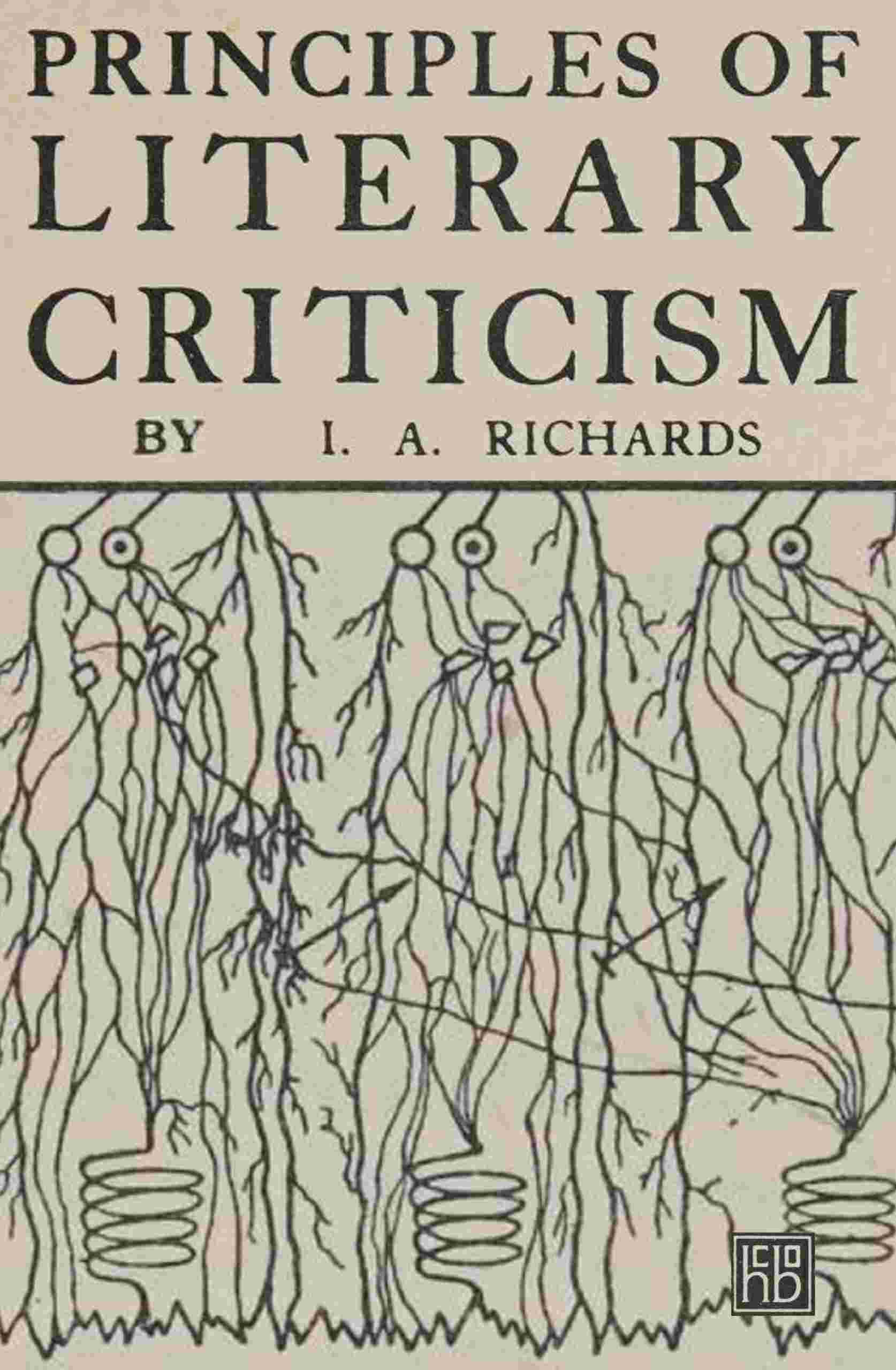
The Project Gutenberg eBook of Principles of literary criticism
Title: Principles of literary criticism
Author: I. A. Richards
Release date: June 14, 2024 [eBook #73827]
Language: English
Original publication: United States: Harcourt, Brace and Company, 1928
Credits: Lauren Prichard
“Extraordinarily interesting. . . . He is erudite and he is intelligent; he makes the courageous attempt to be at the same time scientific and psychological; and he has the great advantage of having at his disposal a knowledge of semantics. His terms are clear, useful, and conveniently few.”—The Nation.
“What he has done is to make thinking about art clearer, and about life, too. This is precisely the merit of Richards’ remarkable volume.”—Christian Science Monitor.
“The book is compact with stimulating criticism of the great critics of the ages, and with numberless original suggestions on all phases of the creation and appreciation of art.”—Springfield Republican.
“An important contribution to the rehabilitation of English criticism—perhaps, because of its sustained scientific nature, the most important yet made. . . . The principles enunciated are pursued in more particular aspects of literary criticism, always with a clear rest and consequent elucidation. Parallel applications to the arts of painting, sculpture, and music form the subjects of three chapters. Another important chapter deals with the availability of the poet’s experience.”—The Criterion, London.
“Mr. Richards is an entertaining writer, whose work avoids easily the tedium of a technical treatise.”—The British Journal of Psychology.
International Library of Psychology
Philosophy and Scientific Method
Transcriber’s Note:
This eBook was created from a 1928 edition, scans of which are available from the Internet Archive, principlesoflite0000rich_b0n0. Footnotes have been converted to endnotes, with note numbering changed to a dagger (†) for citations and an asterisk (*) for additional commentary. Tildes (~) indicate words that were set in Fraktur script in the original text.
New original cover art included with this eBook is granted to the public domain.
PRINCIPLES OF
LITERARY
CRITICISM
BY
I. A. RICHARDS
FELLOW OF
MAGDALENE COLLEGE, CAMBRIDGE
NEW YORK
HARCOURT, BRACE AND COMPANY
LONDON: KEGAN PAUL, TRENCH, TRUBNER & CO. LTD.
PRINTED IN GREAT BRITAIN BY
LUND HUMPHRIES
LONDON * BRADFORD