
The Project Gutenberg eBook of The Poetical Works of William Wordsworth — Volume 8 (of 8)
Title: The Poetical Works of William Wordsworth — Volume 8 (of 8)
Author: William Wordsworth
Editor: William Angus Knight
Release date: August 18, 2016 [eBook #52836]
Most recently updated: October 23, 2024
Language: English
Credits: Produced by Jonathan Ingram and the Online Distributed
Proofreading Team at http://www.pgdp.net
THE POETICAL WORKS
OF
WILLIAM WORDSWORTH
VOL. VIII
William Wordsworth
after Thomas Woolner
Printed by Ch Wittmann Paris
THE POETICAL WORKS
OF
WILLIAM WORDSWORTH
EDITED BY
WILLIAM KNIGHT
VOL. VIII
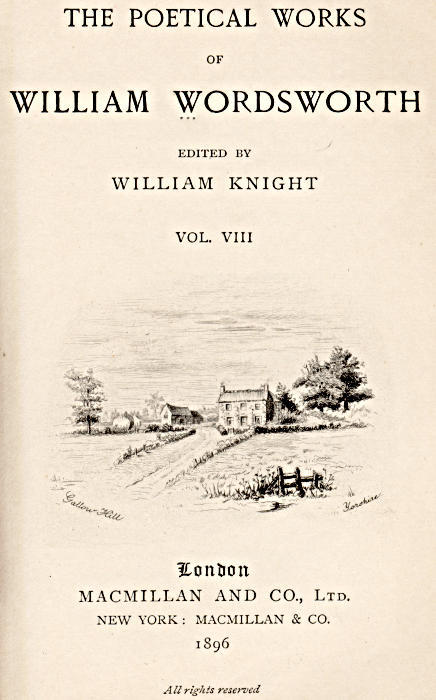
Gallow Hill
Yorkshire
London
MACMILLAN AND CO., Ltd.
New York: Macmillan & Co.
1896
All rights reserved.
CONTENTS
| PAGE | |
| 1834 | |
| Lines suggested by a Portrait from the Pencil of F. Stone | 1 |
| The foregoing Subject resumed | 6 |
| To a Child | 7 |
| Lines written in the Album of the Countess of Lonsdale, Nov. 5, 1834 | 8 |
| 1835 | |
| “Why art thou silent? Is thy love a plant” | 12 |
| To the Moon | 13 |
| To the Moon | 15 |
| Written after the Death of Charles Lamb | 17 |
| Extempore Effusion upon the Death of James Hogg | 24 |
| Upon seeing a Coloured Drawing of the Bird of Paradise in an Album | 29 |
| “Desponding Father! mark this altered bough” | 31 |
| “Four fiery steeds impatient of the rein” | 31 |
| To —— | 32 |
| Roman Antiquities discovered at Bishopstone, Herefordshire | 33 |
| St. Catherine of Ledbury | 34 |
| “By a blest Husband guided, Mary came” | 35 |
| “Oh what a Wreck! how changed in mien and speech!” | 36 |
| 1836 | |
| November 1836 | 37 |
| To a Redbreast—(In Sickness) | 38 |
| 1837 | |
| “Six months to six years added he remained” | 39 |
| Memorials of a Tour in Italy, 1837—To Henry Crabb Robinson | 41 |
| I. Musings near Aquapendente, April, 1837 | 42 |
| II. The Pine of Monte Mario at Rome | 58 |
| III. At Rome | 59 |
| IV. At Rome—Regrets—in Allusion to Niebuhr and other Modern Historians | 60 |
| V. Continued | 61 |
| VI. Plea for the Historian | 61 |
| VII. At Rome | 62 |
| VIII. Near Rome, in Sight of St. Peter’s | 63 |
| IX. At Albano | 64 |
| X. “Near Anio’s stream, I spied a gentle Dove” | 65 |
| XI. From the Alban Hills, looking towards Rome | 65 |
| XII. Near the Lake of Thrasymene | 66 |
| XIII. Near the same Lake | 67 |
| XIV. The Cuckoo at Laverna | 67 |
| XV. At the Convent of Camaldoli | 72 |
| XVI. Continued | 73 |
| XVII. At the Eremite or Upper Convent of Camaldoli | 74 |
| XVIII. At Vallombrosa | 75 |
| XIX. At Florence | 78 |
| XX. Before the Picture of the Baptist, by Raphael, in the Gallery at Florence | 79 |
| XXI. At Florence—From Michael Angelo | 80 |
| XXII. At Florence—From Michael Angelo | 81 |
| XXIII. Among the Ruins of a Convent in the Apennines | 82 |
| XXIV. In Lombardy | 83 |
| XXV. After leaving Italy | 84 |
| XXVI. Continued | 85 |
| At Bologna, in Remembrance of the late Insurrections, 1837.—I. | 86 |
| II. Continued | 86 |
| III. Concluded | 87 |
| “What if our numbers barely could defy” | 87 |
| A Night Thought | 88 |
| The Widow on Windermere Side | 89 |
| 1838 | |
| To the Planet Venus | 92 |
| “Hark! ’tis the Thrush, undaunted, undeprest” | 93 |
| “’Tis He whose yester-evening’s high disdain” | 94 |
| Composed at Rydal on May Morning, 1838 | 94 |
| Composed on a May Morning, 1838 | 97 |
| A Plea for Authors, May 1838 | 99 |
| “Blest Statesman He, whose Mind’s unselfish will” | 101 |
| Valedictory Sonnet | 102 |
| 1839 | |
| Sonnets upon the Punishment of Death— | |
| I. Suggested by the View of Lancaster Castle (on the Road from the South) | 103 |
| II. “Tenderly do we feel by Nature’s law” | 104 |
| III. “The Roman Consul doomed his sons to die” | 105 |
| IV. “Is Death, when evil against good has fought” | 106 |
| V. “Not to the object specially designed” | 106 |
| VI. “Ye brood of conscience—Spectres! that frequent” | 107 |
| VII. “Before the world had past her time of youth” | 107 |
| VIII. “Fit retribution, by the moral code” | 108 |
| IX. “Though to give timely warning and deter” | 109 |
| X. “Our bodily life, some plead, that life the shrine” | 109 |
| XI. “Ah, think how one compelled for life to abide” | 110 |
| XII. “See the Condemned alone within his cell” | 110 |
| XIII. Conclusion | 111 |
| XIV. Apology | 112 |
| “Men of the Western World! in Fate’s dark book” | 112 |
| 1840 | |
| To a Painter | 114 |
| On the same Subject | 115 |
| Poor Robin | 116 |
| On a Portrait of the Duke of Wellington upon the Field of Waterloo, by Haydon | 118 |
| 1841 | |
| Epitaph in the Chapel-Yard of Langdale, Westmoreland | 120 |
| 1842 | |
| “Intent on gathering wool from hedge and brake” | 122 |
| Prelude, prefixed to the Volume entitled “Poems chiefly of Early and Late Years” | 123 |
| Floating Island | 125 |
| “The Crescent-moon, the Star of Love” | 127 |
| “A Poet!—He hath put his heart to school” | 127 |
| “The most alluring clouds that mount the sky” | 128 |
| “Feel for the wrongs to universal ken” | 129 |
| In Allusion to various Recent Histories and Notices of the French Revolution | 130 |
| Continued | 131 |
| Concluded | 131 |
| “Lo! where she stands fixed in a saint-like trance” | 132 |
| The Norman Boy | 132 |
| The Poet’s Dream | 135 |
| Suggested by a Picture of the Bird of Paradise | 140 |
| To the Clouds | 142 |
| Airey-Force Valley | 146 |
| “Lyre! though such power do in thy magic live” | 147 |
| Love lies Bleeding | 148 |
| “They call it Love lies bleeding! rather say” | 150 |
| Companion to the Foregoing | 150 |
| The Cuckoo-Clock | 151 |
| “Wansfell! this Household has a favoured lot” | 153 |
| “Though the bold wings of Poesy affect” | 154 |
| “Glad sight wherever new with old” | 154 |
| 1843 | |
| “While beams of orient light shoot wide and high” | 156 |
| Inscription for a Monument in Crosthwaite Church, in the Vale of Keswick | 157 |
| To the Rev. Christopher Wordsworth, D.D., Master of Harrow School | 162 |
| 1844 | |
| “So fair, so sweet, withal so sensitive” | 164 |
| On the projected Kendal and Windermere Railway | 166 |
| “Proud were ye, Mountains, when, in times of old” | 167 |
| At Furness Abbey | 168 |
| 1845 | |
| “Forth from a jutting ridge, around whose base” | 170 |
| The Westmoreland Girl | 172 |
| At Furness Abbey | 176 |
| “Yes! thou art fair, yet be not moved” | 176 |
| “What heavenly smiles! O Lady mine” | 177 |
| To a Lady | 177 |
| To the Pennsylvanians | 179 |
| “Young England—what is then become of Old” | 180 |
| 1846 | |
| Sonnet | 181 |
| “Where lies the truth? has Man, in wisdom’s creed” | 182 |
| To Lucca Giordano | 183 |
| “Who but is pleased to watch the moon on high” | 184 |
| Illustrated Books and Newspapers | 184 |
| Sonnet. To an Octogenarian | 185 |
| “I know an aged Man constrained to dwell” | 186 |
| “The unremitting voice of nightly streams” | 187 |
| “How beautiful the Queen of Night, on high” | 188 |
| On the Banks of a Rocky Stream | 188 |
| Ode. Intimations of Immortality from Recollections of Early Childhood | 189 |
| POEMS BY WILLIAM WORDSWORTH AND BY DOROTHY WORDSWORTH NOT INCLUDED IN THE EDITION OF 1849-50 |
|
| 1787 | |
| Sonnet, on seeing Miss Helen Maria Williams weep at a Tale of Distress | 209 |
| Lines written by William Wordsworth as a School Exercise at Hawkshead, Anno Ætatis 14 | 211 |
| 1792 (or earlier) | |
| “Sweet was the walk along the narrow lane” | 214 |
| “When Love was born of heavenly line” | 215 |
| The Convict | 217 |
| 1798 | |
| “The snow-tracks of my friends I see” | 219 |
| The Old Cumberland Beggar (MS. Variants, not inserted in Vol. I.) | 220 |
| 1800 | |
| Andrew Jones | 221 |
| “There is a shapeless crowd of unhewn stones” | 223 |
| 1802 | |
| “Among all lovely things my Love had been” | 231 |
| “Along the mazes of this song I go” | 233 |
| “The rains at length have ceas’d, the winds are still’d” | 233 |
| “Witness thou” | 234 |
| Wild-Fowl | 234 |
| Written in a Grotto | 234 |
| Home at Grasmere | 235 |
| “Shall he who gives his days to low pursuits” | 257 |
| 1803 | |
| “I find it written of Simonides” | 258 |
| 1804 | |
| “No whimsey of the purse is here” | 258 |
| 1805 | |
| “Peaceful our valley, fair and green” | 259 |
| “Ah! if I were a lady gay” | 262 |
| 1806 | |
| To the Evening Star over Grasmere Water, July 1806 | 263 |
| Michael Angelo in Reply to the Passage upon his Statue of Night sleeping | 263 |
| “Come, gentle Sleep, Death’s image tho’ thou art” | 264 |
| “Brook, that hast been my solace days and week” | 265 |
| Translation from Michael Angelo | 265 |
| 1808 | |
| George and Sarah Green | 266 |
| 1818 | |
| “The Scottish Broom on Bird-nest brae” | 270 |
| Placard for a Poll bearing an old Shirt | 271 |
| “Critics, right honourable Bard, decree” | 271 |
| 1819 | |
| “Through Cumbrian wilds, in many a mountain cove” | 272 |
| “My Son! behold the tide already spent” | 273 |
| 1820 | |
| Author’s Voyage down the Rhine | 273 |
| 1822 | |
| “These vales were saddened with no common gloom” | 275 |
| Translation of Part of the First Book of the Æneid | 276 |
| 1823 | |
| “Arms and the Man I sing, the first who bore” | 281 |
| 1826 | |
| Lines addressed to Joanna H. from Gwerndwffnant in June 1826 | 282 |
| Holiday at Gwerndwffnant, May 1826 | 284 |
| Composed when a Probability existed of our being obliged to quit Rydal Mount as a Residence | 289 |
| “I, whose pretty Voice you hear” | 295 |
| 1827 | |
| To my Niece Dora | 297 |
| 1829 | |
| “My Lord and Lady Darlington” | 298 |
| 1833 | |
| To the Utilitarians | 299 |
| 1835 | |
| “Throned in the Sun’s descending car” | 300 |
| “And oh! dear soother of the pensive breast” | 301 |
| 1836 | |
| “Said red-ribboned Evans” | 301 |
| 1837 | |
| On an Event in Col. Evans’s Redoubted Performances in Spain | 303 |
| 1838 | |
| “Wouldst thou be gathered to Christ’s chosen flock” | 303 |
| Protest against the Ballot, 1838 | 304 |
| “Said Secrecy to Cowardice and Fraud” | 304 |
| A Poet to his Grandchild | 305 |
| 1840 | |
| On a Portrait of I.F., painted by Margaret Gillies | 306 |
| To I.F. | 307 |
| “Oh Bounty without measure, while the Grace” | 308 |
| 1842 | |
| The Eagle and the Dove | 309 |
| Grace Darling | 310 |
| “When Severn’s sweeping flood had overthrown” | 314 |
| The Pillar of Trajan | 314 |
| 1846 | |
| “Deign, Sovereign Mistress! to accept a lay” | 319 |
| 1847 | |
| Ode, performed in the Senate-House, Cambridge, on the 6th of July 1847, at the First Commencement after the Installation of His Royal Highness the Prince Albert, Chancellor of the University | 320 |
| To Miss Sellon | 325 |
| “The worship of this Sabbath morn” | 325 |
| Bibliographies— | |
| I. Great Britain | 329 |
| II. America | 380 |
| III. France | 421 |
| Errata and Addenda List | 431 |
| Index to the Poems | 433 |
| Index to the First Lines | 451 |
PREFATORY NOTE
The American Bibliography is almost entirely the work of Mrs. St. John of Ithaca, and is the result of laborious and careful critical research on her part. The French Bibliography is not so full. I have been assisted in it mainly by M. Legouis at Lyons, and by workers at the British Museum. I have also collected a German Bibliography, but it is in too incomplete a state for publication in its present form.
The English Bibliography is fuller than any of its predecessors; but there is no such thing as finality in such work, especially when an addition to the literature of the subject is made nearly every week. Many kind friends, and coadjutors, have assisted me in it, amongst whom I may mention Dr. Garnett of the British Museum, and very specially Mr. Tutin, of Hull, and also Mr. John J. Smith, St. Andrews, and Mr. Maclauchlan, Dundee. If I omit, either here or elsewhere, to record the assistance which I have received from any one, in my efforts to make this edition of Wordsworth as perfect as is possible at this stage of literary criticism and editorship, I sincerely regret it; but many of my correspondents have specially requested that no mention should be made of their names or their services.
In the Preface to the first volume of this edition there was an unfortunate omission. In returning the final proofs to press, I accidentally transmitted an uncorrected one, in which two names did not appear. They were those of Mr. Thomas Hutchinson, Dublin, and Mr. S. C. Hill, of Hughli College, Bengal. The former kindly revised most of the sheets of Volumes I. and II., and corrected errors, besides making other valuable suggestions and additions. When his own Clarendon Press edition of Wordsworth was being prepared for press, Mr. Hutchinson asked permission to incorporate in it materials which were not afterwards inserted. This I granted cordially, as a similar permission had been given to Professor Dowden for his Aldine edition. The unfortunate omission of Mr. Hutchinson’s name was not discovered by me till after the issue of volumes I. and II. (which appeared simultaneously), and it was first brought under my notice by Mr. Hutchinson’s own letters to the newspapers. My debt to Mr. Hutchinson is great; and, although I have already thanked him for the services which he has rendered to the world in connection with Wordsworthian literature, I may perhaps be allowed to repeat the acknowledgment now. The revised sheets of Vols. I. and II. of this edition were, however, submitted to others at the same time that they were sent to Mr. Hutchinson; more especially to the late Mr. Dykes Campbell, and on his death to Mr. Belinfante, and then to the late Mr. Kinghorn, all of whom were engaged by my publishers to assist in the work entrusted to me. They “turned on the microscope” on my own work, and Mr. Hutchinson’s; and to them I have been indebted in many ways.
Mr. Hill’s services, in tracing the sources of numerous quotations from other poets which occur in Wordsworth’s text, have been great. He sent me his discoveries, unsolicited, and I wish to express very cordially my indebtedness to him. To discover some of these quotations—there are several hundreds of them—cost me much labour, before I had the pleasure of hearing from, or knowing, Mr. Hill; and his assistance in this matter has been greater than that of any other person. It will be seen that I have failed—after much study and extensive correspondence—to discover them all.
In addition to actual quotations—indicated by Wordsworth by inverted commas in his poems—to trace parallel passages from other poets, or phrases which may have suggested to him what he recast and glorified, has seemed to me work not unworthy of accomplishment. At the same time, and in the same connection, to discover the somewhat similar debts of later poets to Wordsworth, and to indicate this here and there in footnotes, may not be wholly useless to posterity.
My obligations to my friend, Mr. Dykes Campbell, are greater than I can adequately express. He supplied me with much material, drawn from many quarters; and, although he did not always mention his sources, I had implicit confidence in him, both as a literary man and a friend. After his death, through the kindness of Mrs. Campbell, I examined some MS. volumes of Wordsworthiana written by him, which were of much use to me.
Some of these were from unknown sources, which I should perhaps have traced out before making use of them, but, in all my Wordsworth work, I have acted from first to last on the legal opinion of a distinguished Judge, that the heir of the writer of literary work could alone authorise its subsequent publication; and, since the heirs of the Poet had kindly given me permission to collect and publish his works, I did so, with a view to the benefit of posterity.
Some of Mr. Campbell’s material was derived from MSS. now in the possession of Mr. T. Norton Longman, and I have to express my sincere regret that in the earlier volumes I copied from Mr. Campbell’s transcripts of these MSS.—which were lent to him on the condition that no public use should be made of them without Mr. Longman’s permission—some variations of the text, without mentioning the source whence they were derived.
I was unaware that these MSS. were lent to Mr. Campbell with the condition attached, and regret very much that I am unable to trust my memory to indicate now what variations of text I have quoted from them. But I may add that Mr. Longman is about to publish a work which will enable Wordsworth students to become practically acquainted with the contents of his MSS.
In reference to the poems not published by Wordsworth or his sister during their lifetime, I have included in this volume not only fugitive pieces printed in Magazines and elsewhere, but also those which have been since recovered from numerous manuscript sources. They are of varying merit. It would be interesting to know, and to record in every instance, where these manuscripts now are; but this is impossible. In many cases the manuscripts have recently changed ownership. I have obtained a sight of many of them, and have been granted permission to transcribe them, from the fortunate possessors of large autograph collections, and also from dealers in autographs; but, after the sale of manuscripts at public auction-rooms, it is, as a rule, impossible to trace them.
In many cases the MS. variants which have been published in previous volumes occur in copies of the poems, transcribed by the Wordsworth household in private letters to friends. I have occasionally indicated this in footnotes; but, to have done so always would have disfigured the pages, and frequently the notes would have been longer than the text. To trace the present possessors of the MSS. would be well-nigh impossible. It is perhaps worth mentioning that in several cases Wordsworth entered as “misprints” in future editions, what some of his editors have considered “new readings.” E.g. in The Excursion, book ix. l. 679, “wild” demeanour, instead of “mild” demeanour.
On Nov. 4, 1893, Mr. Aubrey de Vere wrote to me—