
- Abel, Ch. Fred., musician, 288
- Adair, Mr., 331
- Addington, Mr., 214
- Aiguillon, Duke d’, Minister for Foreign Affairs, hostility to D’Eon, 219, 224
- Angelo, Mr., at Carlton House, 308;
- friendship for D’Eon, 310;
- lines on D’Eon, 346
- Angelo, Henry, at Carlton House, 308;
- on D’Eon’s fencing, 310
- Apraxin, Marshal the Count, at Gross Jägersdorff, 22;
- retreat, 22, 36;
- character, 22 note
- Arden, R. N., Captain, 324
- Argental, Count d’, designs on D’Eon’s life, 164-166, 194;
- letter from Voltaire, 300
- Aubaret, Marquis d’, 225
- Augusta, H.R.H. the Princess (Brunswick-Wolfenbüttel), 119, 198
- Bach, Jean Christ., composer, surnamed l’Anglais, 288
- Bateman, Mrs., actress and fencer, déjeuner at Soho Square, 325;
- her professional tour, 325-326
- Bathe, Colonel du, 324
- Beaumarchais, P. A. Caron de, 230;
- share in the Dubarry scandal, 231-235;
- impression made by D’Eon, 235, 278;
- instructions from de Vergennes to mediate with D’Eon, 236;
- first success, 238;
- recovers secret papers, 241;
- Earl Ferrers, 242;
- covenant with D’Eon, 243-251;
- payment to Earl Ferrers on account of D’Eon, 251;
- instructions from Louis XVI., 251;
- delivers secret papers to de Vergennes, 259;
- Louis XVI.’s final instructions regarding D’Eon, 260-261;
- breach with D’Eon, 261;
- and subsequent correspondence, 262-273;
- his vanity, 273;
- reported marriage with D’Eon, 273-274;
- interest in the D’Eon sex policies, 274-276;
- insulting proposal to D’Eon, 275;
- reprehensible conduct, 278;
- final correspondence with D’Eon, 281, 295
- Bedford, Duke of, Ambassador at Versailles, signatory of the Treaty of Peace, 63 note;
- mistaken opinion of de Guerchy, 66;
- report on de Choiseul, 76 note;
- consulted by de Guerchy, 147;
- popular feeling against him, 152
- Belle-Isle, Marshal de, Minister for War, 4;
- reception of D’Eon, 26
- Bernis, Abbé, afterwards Cardinal de, Minister for Foreign Affairs, 4;
- reception of D’Eon, 26;
- despatches him to Russia, 29-30;
- approves his refusal to serve Russia, 33
- Bertin, Mademoiselle, furnishes Mademoiselle D’Eon’s outfit, 290;
- and clothes her in female attire, 292
- Bestoujeff-Riumin, Count, grand chancellor, hostility to France, 15, 16;
- to Prussia, 15;
- devotion to Peter and Catherine, 16;
- ignorance of Vice-Chancellor’s secret action, 19;
- in secret correspondence with Prussia, 29;
- estimate of D’Eon, 30;
- is arrested, his treatment and exile, 32-33;
- designs on Douglas and D’Eon, 32;
- treasonable conduct explained, 32
- Blackstone, Dr. (later, Lord Chief Justice), 201
- Blosset, Marquis de, in diplomatic charge, complaint to Lord Halifax against D’Eon, 162
- Boufflers, Countess de, at Strawberry Hill breakfast, 83;
- entertained by D’Eon, 96
- Breteuil, Baron de, minister plenipotentiary to Russia, 42;
- secret instructions from Louis XV., 43;
- unequal to the circumstances, 54;
- removed to Stockholm, 55;
- on special mission to England, 207
- Broglio, Marshal the Duke de, receives D’Eon as aide-de-camp, 48;
- fastidious in the selection of his staff, 48;
- at the battle of Villinghausen, 51, 70;
- is exiled, 52;
- testimonial to D’Eon, 53;
- his occasional correspondent, 71;
- D’Eon’s admiration for him, 71
- Broglio, Count de, French Minister to Poland, 25;
- serves in the campaign of 1761, 48-52;
- exiled, 53;
- letters of remonstrance to Louis XV., 53;
- recommends D’Eon as minister plenipotentiary to Russia, 54;
- D’Eon’s esteem for him, 72;
- scheme for the invasion of England, 74;
- nickname in secret correspondence, 76;
- anxiety for the safety of the King’s papers, 76, 77, 84, 126, 133, 143, 179 note;
- sympathy for D’Eon, 133;
- recalled from exile, 143;
- conciliatory letters to D’Eon, 148, 183, 185;
- remonstrance from D’Eon, 153;
- ministers’ designs against him, 166;
- conducts, by order, a farce at the Bastille, 176;
- expostulates with Hume, 179;
- threatens to disclose the secret correspondence, 189;
- on the restoration of the Stuarts, 199;
- informs Louis XV. that D’Eon is a female, 218;
- in exile, 219;
- communicates history of secret correspondence to Louis XVI., 221;
- and D’Eon’s share in it, 222;
- and that he is a female, 223;
- recalled from exile, 224;
- treats with D’Eon for the King’s papers, 227;
- the Dubarry scandal, 231;
- D’Eon’s confession to being a female, 257;
- last letter from D’Eon, 300
- Brunswick-Wolfenbüttel, Duke of, 198
- Burdett-Coutts, the Baroness, 333 note
- Bute, Earl of, First Lord of the Treasury, 58;
- interest in D’Eon, 66, 68;
- unpopularity, 152;
- consulted by D’Eon, 160;
- George III.’s displeasure, 196;
- attachment to the Stuarts, 198;
- character by D’Eon, 198;
- de Broglio’s desire to know his secret intentions, 199
- Camus, C. E. Louis, academician, 96
- Catherine of Anhalt-Zerbst, grand-duchess, friendly towards England and intercourse with Sir Hanbury Williams, 16, 57;
- what Elizabeth said of her, 16;
- refused permission to proceed to Germany, 32;
- accession as Catherine II., 55;
- portrait by D’Eon, 56;
- pretended ignorance of D’Eon, 57;
- his acquaintance with her, 58
- Charles, Prince (Duke of Courland), 31
- Charlotte, H.M. Queen, 197, 331
- Châtelet, Count de, ambassador in London, reports to Louis XV. that D’Eon is a female, 209
- Chesterfield, Earl of, on the true bill against the French ambassador, 180;
- his error, 181
- Chétardie, Marquis de la, ambassador to Russia in 1744, 5, 15
- Choiseul, Duke de, Minister for Foreign Affairs, then Minister for War, ignorance of Louis XV.’s secret policy, 37;
- hostility to England, 37, 38 note;
- change of policy, 38;
- instructions to de l’Hôpital, and censure for neglect, 38, 39;
- peace policy secretly opposed by D’Eon, 40;
- requires de l’Hôpital’s recall, 42;
- recommends D’Eon as minister to Russia, 54;
- expulsion of Jesuits, 60 note;
- nickname in secret correspondence, 76;
- Duke of Bedford’s report, 76 note;
- offers D’Eon’s restoration to the army, 137;
- lines on his exile, 137 note;
- complains of no justice in England, 173
- Choiseul, Count de, attention to D’Eon at Vienna, 48.
- See Duke de Praslin
- Christie, Mr., friendship for D’Eon, 323, 324;
- acquisition of the Chevalier’s MSS., 335
- Church, Mrs., 308
- Clive, M. P., Major, 330 and note
- Cole, Mrs., companion to Mademoiselle D’Eon, 328-331;
- astonishment at the Chevalière’s sex, 331
- Condamine, La. See La Condamine
- Constable, Lady, 324
- Conti, Prince de (grand-nephew of the great Condé), recommends D’Eon for secret service, 6;
- secret correspondence with Russia, 11;
- conditionally promised the command of Russian army and principality of Courland, 24, 26;
- ambitious designs, 24;
- rupture with de Pompadour, 26
- Conti, Prince de, son of the above, 332
- Copeland, T., surgeon, attestation on D’Eon’s sex, 332
- Cosway, R. A., 310
- Cotes, Humphrey, of Byfleet, 183;
- takes charge of secret correspondence, 186
- Courcelles, Constance de, 273, 341
- Cramer, Ch. Frederick, man of letters, 288
- Crawford, Mrs., 331
- Crosby, Lord Mayor, D’Eon sworn before him, 215
- Dashkoff, Princess, intimately known to D’Eon, 58;
- who she intimates is a female, 209, 216
- Daun, Marshal, defeats Frederick, 22
- Dent, Mr., banker, 324
- Déon de Beaumont, Françoise, mother of the Chevalier, 2;
- consecrates her child to the Virgin Mary, 3;
- letter from de l’Hôpital, 46;
- involved in her child’s misfortunes, 133;
- letter from the Chevalier, 134-136;
- de Guerchy’s persecution, 191
- Déon de Beaumont, Louis, father of the Chevalier, 2;
- requires the child to adopt male attire, 3;
- death, 4
- Déon. See Eon
- Dodwell, the Misses, 331
- Douglas, alias Mackenzie, the Chevalier, who was he? 6;
- instructions as secret envoy to Russia, 6-11;
- not obtaining presentation at Russian Court, returns to France, 12-13;
- complains of English ambassador’s treatment, 13;
- second journey to Russia, 18;
- interview with vice-chancellor and presentation at Court, 18;
- delight at D’Eon’s return to Russia, 19;
- accredited chargé d’affaires, 21;
- success in Russia, 24;
- recalled, to please the grand chancellor, 30;
- Bestoujeff’s designs against him, 32
- Douglas, Mr., 331
- Drouet, M., private secretary to Count de Broglio, sent to the Bastille, 175;
- threatens disclosures and is liberated, 177;
- report on D’Eon’s sex, 218
- Dubarry, Madame, a publication on her life stopped, by Louis XV., 231-234
- Duclos, Ch. Pireau, academician, 96
- Durand, M., secret agent, to assist in survey of England, 75;
- nickname in correspondence, 76;
- minister plenipotentiary in London, 185;
- recovers from D’Eon, King’s secret instructions, 187
- Duval, Mr. John, the king’s jeweller, 313, 315-316
- Egremont, Earl of, Secretary of State for Foreign Affairs, unpopularity, 152
- Elisée, Père, physician, attends D’Eon, 331-332;
- acquisition of the Chevalier’s MSS., 335
- Elizabeth, Empress of Russia, friendly towards France, 5, 14;
- delay in ratifying Treaty with Great Britain, 13;
- admirer of English fashions, 14 note;
- what she said of Catherine, 16;
- writes privately to Louis XV., 17;
- invites D’Eon to enter her service, 17, 33;
- and return to Russia, 47;
- renews relation with France, 20, 21;
- disregards Treaty with England and joins French-Austrian Alliance, 21, 37;
- indignation at Frederick, 21;
- Apraxin’s recall, 23;
- gift to Voltaire, 23;
- to D’Eon, 23, 47;
- invited to correspond with Louis XV., 29;
- Bestoujeff’s arrest and exile, 32;
- death, 54
- Eon de Beaumont, C.G.L.A.A.T. d’, parentage and early years, 1-2;
- dedicated to the Virgin Mary, 3;
- education and abilities, 3-5;
- an accomplished fencer, 5;
- secret envoy, with Douglas, to Russia, 6;
- secret correspondent to Louis XV., 11;
- received by the Empress, 13;
- personal appearance and anecdote, 14;
- dislike to Russia, 14, 34, 41;
- triumph of French party, 17;
- invited to enter the service of Russia, 17;
- returns to Versailles, 17;
- second journey to Russia, 19;
- secretary of legation, 21;
- and to conduct the secret correspondence, 21;
- second return to Versailles with State papers, 23;
- importance of services in Russia, 23, 45-47, 267;
- presents from the Empress, 23, 47;
- success in Russia, 24;
- trait of character, 24;
- message to Prince de Conti, 24, 26;
- reaches Paris with a broken leg, 25;
- honours and rewards, 26, 35, 48, 54 note, 66, 185;
- appointed lieutenant of dragoons, 26;
- mémoire on Russia, 27;
- applies to join his regiment, 28, 42;
- Bestoujeff’s treachery, 29;
- third journey to Russia, 29;
- repartee on Admiral Byng’s execution, 31;
- Poniatovsky’s bribe, 31;
- favourite at Russian Court, 31;
- Bestoujeff’s designs, 32;
- again invited to serve Russia, and reasons for refusing, 33, 34;
- promoted to captain, 35;
- share in the war, 39-40;
- opposes the policy of ministers, 40;
- his advice to the ambassador approved by Louis XV., 40;
- failing health, 41, 45;
- secret orders from Louis XV., 44;
- who approves his services, 44;
- de l’Hôpital’s high opinion of D’Eon, 45-46;
- reception by Louis XV., 48;
- aide-de-camp to Marshal and Count de Broglio, 48;
- dashing services during the campaign of 1761, 49-53;
- selected as minister plenipotentiary to Russia, 54;
- portrait of Catherine II., 56;
- of Lord Sandwich, 59;
- of the Duke de Nivernois, 60, 98;
- secretary of embassy in London, 60;
- smart pieces of work, 61-63;
- abilities appreciated, 63, 65;
- takes Treaty of Peace to Paris, 64;
- Lord Bute’s favour, 66, 68;
- created a Knight of Saint Louis, 66, 72;
- suspected of attachment to the de Broglios, 69;
- de Soubise and de Broglio at Villinghausen, 70;
- esteem for the de Broglios, 71;
- brings presents to Count Viri, 72;
- chargé d’affaires in London, 73;
- secret correspondent to Louis XV., and employed on survey of England, 74;
- nickname in secret correspondence, 76;
- cautioned on safety of the King’s papers, 76, 84;
- Louis XV.’s secret orders, 77;
- fate determined by de Pompadour, 78;
- and why? 85;
- minister plenipotentiary, 82;
- indifference to advancement, 83;
- a favourite in England, 83;
- debt incurred on the King’s service, 85;
- embarrassed circumstances, 86;
- protected by a Letter of State, 87;
- appeals for repayment, 86, 88;
- impudent letter to de Praslin, 92;
- to de Guerchy, 94;
- mistaken ministers, 97;
- portrait of Lord Hertford, 102;
- superseded and recalled, 103-107;
- Louis XV.’s order to resume female attire, 104;
- reported insanity, 105, 119, 130;
- Lord Halifax, 109;
- refusal to surrender the King’s papers, 110, 136;
- scene at Lord Halifax’s dinner-party, 111, 115;
- frightens a duellist, and is summoned by a magistrate, 117-118;
- letter to Louis XV. on de Guerchy, 119-121;
- is drugged, 121;
- warned by Louis XV. of demand for his extradition, 125;
- which is not acceded to, 127;
- in peril of being kidnapped, 128, 149, 159-161, 214, 279;
- mines his apartments and measures of defence, 128, 129 note, 146, 148, 159, 243;
- scares away an attaché, 129;
- forbidden the Court, 132;
- letter to his mother, 134;
- offered restoration to the army, 137;
- warned for his safety, 137, 160;
- publishes correspondence of ministers and ambassadors, and justification, 138-140, 147;
- seeks expatriation, 143, 217;
- threatens to disclose the King’s secret, 144-146;
- proof against bribery, 145, 152;
- patriotism, 152, 216, 237-238;
- tried for libel, 154;
- chastises a scurrilous scribe, 155;
- letters to Lord Mansfield, Lord Bute, Mr. Pitt, Lord Temple, 160-161;
- found guilty of libel, in default, searched, and outlawed, 161-163;
- conspiracy against his life, 163-168;
- challenges de Guerchy, 170;
- note of intimidation to de Broglio, 179;
- to Louis XV. on de Guerchy, 180;
- admiration for Louis XV., 184, 221;
- a pension conferred by the King, 185;
- surrenders the King’s secret orders, 187;
- reported disguise as a female, 189;
- second challenge to de Guerchy, 191;
- the first of political reporters, 194;
- Mr. Pitt, 195-197;
- slandered and public protests, 199-200;
- conduct in Musgrave affair, 202, 225;
- letter to Dr. Musgrave, 203-205;
- sympathy for Wilkes, 206;
- at rest! 207;
- popularity, 209;
- doubts raised as to sex, 209;
- captivating manners, 209;
- policies of insurance on sex, 210-216;
- allusions to physical failings, 213, 219, 342;
- protests, 215, 257, 288;
- Poniatovsky’s offers of succour, 217;
- saves England from war, 218;
- Drouet’s report on D’Eon’s sex, 218;
- personal appearance, 219;
- his case laid before Louis XVI., 222-226;
- to continue secret correspondence, 226;
- refuses terms for surrender of the King’s papers, 227-230;
- offer of marriage, 230;
- the Dubarry scandal, 231-235;
- impression on Beaumarchais, 235, 278;
- surrenders the King’s papers, 241;
- covenant with Beaumarchais, 243-251;
- Louis XVI.’s permission to return to France, 252;
- and orders to resume female attire, 254;
- fresh policies on sex and new protests, 256-257;
- confesses to being a female, 257;
- breach with Beaumarchais, 261;
- aversion to resuming female attire, 263-271, 280, 289, 290, 292, 300, 305, 306;
- consignment of State papers to the French minister, 264 note;
- reported marriage to Beaumarchais, 273;
- challenges a foul libeller, 279;
- personal liberty in danger, 279;
- public feeling, 280;
- de Vergennes’ conditional protection in France, 283;
- trial on sex policies and proved to be a female, 283-287;
- appears in public as a female, and leaves for Paris in uniform, 287-289;
- renewed protest against sex policies, 288;
- Louis XVI.’s order to resume female attire, 289;
- Marie Antoinette supplies her outfit, 290;
- reception at Tonnerre, 291;
- dressed by Mademoiselle Bertin and presented at Court, 292;
- deportment as a lady, 293-295;
- personated at social gatherings, 295;
- the last of Beaumarchais, 295-297;
- addresses her contemporaries, 297, 298;
- other trials on sex policies, and decision of Lord Mansfield, 297-298;
- epistle to Lord Mansfield, 299;
- grotesque and other portraits, 299, and Appendix;
- on the War of Independence, 301;
- anxiety to return to England, 301, 305;
- at various ladies’ retreats, 302-304;
- volunteers for service afloat, 305;
- the Maid of Tonnerre! 306;
- resumes her uniform and is arrested, 306;
- released and goes home, 307;
- a royal guest, 307;
- quits France and arrives in London, 308;
- fences at Carlton House, 308-309;
- plays Phillidor at chess, 310;
- on George III.’s illness, 311;
- advertised sale of library, 311, 312;
- transactions with the House of Ferrers, 311-319;
- public sympathy, 320;
- sale of jewellery, 320-321;
- preparations for France, 320, 322;
- offers to serve the Republic, 322;
- ordered to join General Dumouriez, 323;
- deprived of every source of maintenance, 324;
- English friends, 324;
- exhibits in public as a fencer, 325-327;
- dangerously wounded, 327;
- hard times, 328-331;
- obtains a passport to France, 329;
- last days, death and burial, 331-333;
- autopsy of the body, 333-334;
- will, and directions for burial, 334-335;
- administration of effects, 335;
- sale of five hundred editions of Horace, 335;
- character, 335-337;
- habits and occupations, 337-338;
- a free-mason, 337;
- sentiments on religion, 338-340;
- coldness of temperament, 340-342;
- reflections, 342-344;
- fugitive pieces, 344, 346;
- publications, 361
- Eon de l’Estoile, 1
- Eon de Mouloise, Chevalier d’, 77, 84, 156 note.
- See Déon
- Fabien, a noted fencer, 308
- Fermor, Field-Marshal, beaten by Frederick, 36
- Ferrers, Washington, 5th Earl, 214;
- entrusted by D’Eon with the King’s papers, 238;
- his interest (?) in their custody, 242;
- receives 5,000l. on account of D’Eon’s creditors, 251, 262, 311;
- what he did with the money, 311-316;
- death, 316
- Ferrers, Robert, 6th Earl, sued by D’Eon and result, 316;
- death, 317
- Ferrers, Robert, 7th Earl, his faithlessness, 317
- Ffloyd, Sir William, 324
- Fielding, Sir John, D’Eon summoned before him, 118;
- receives his declaration, 129 note;
- and de Vergy’s depositions, 193;
- entertained by D’Eon, 214
- Fitzherbert, Mr., M.P., 201, 204
- Fitzherbert, Mrs., 326
- Frederick the Great, his sarcasms, 21;
- secret correspondence with the grand-duke, 29
- Genest, Mr., chief clerk at Ministry for Foreign Affairs, receives D’Eon in his house, 289;
- Marie Antoinette and D’Eon, 289
- Geneviève, la Citoyenne. See D’Eon de Beaumont
- George III., His Majesty, entrusts Treaty of Peace to D’Eon, 64;
- inquiry respecting de Guerchy, 102;
- displeased with Lord Bute, 196-198;
- his debts and economy, 197
- Glencairn, Lord and Lady, 324
- Gloucester, Duke of, 198, 320 note, 326
- Goddard, a noted fencer, 308
- Gorman. See O’Gorman
- Grafton, Duchess of, 60
- Grenville, George, First Lord of the Treasury, actor in the scene at Lord Halifax’s, 111, 115-116
- Grey, William de, solicitor-general, 181
- Grimaldi, Marquis, signatory to the Treaty of Peace, 63 note
- Guerchy, Count de, lieutenant-general, conduct in action, 49;
- ambassador to Great Britain, and the Duke of Bedford’s report on him, 66;
- character, 67;
- de Praslin’s estimate of him, 67;
- nickname in secret correspondence, 76;
- insulting letter to D’Eon, 94;
- what de Broglio and de Nivernois thought of him, 68, 76, 99;
- arrival in London and deportment towards D’Eon, 102;
- delivers D’Eon’s letters of recall and urgent for his departure, 103, 109, 110;
- conduct at Lord Halifax’s dinner-party, 111, 115-116;
- scene at his residence, 113;
- publishes pamphlets defamatory of D’Eon, 119, 136, 138;
- efforts to kidnap D’Eon, 128, 149, 160;
- complaint to Louis XV., 130;
- prosecutes D’Eon for libel, 154;
- in collision with English authorities, 156-157;
- design on D’Eon’s life, 164-168, 194;
- groundless charge against de Vergy, 169, 173;
- declines to fight D’Eon, 170;
- prosecuted for inciting to murder, 171;
- true bill found, 178;
- Attorney-General refuses to certify in his favour, 181;
- is mobbed, 182;
- reception upon his return from leave, 183;
- superseded, 187;
- persecutes Madame D’Eon, 191;
- his death, 191;
- D’Eon’s second challenge, 191;
- anecdote of his father, 191 note
- Guerchy, Countess de, her disposition, 121 note
- Guines, Count de, ambassador in London, instructed to communicate with D’Eon, 237
- Halifax, Earl of, Secretary of State for Foreign Affairs, receives D’Eon at an interview, 109;
- invites him to take leave of the King, 111;
- scene at his residence, and the Guards summoned, 111, 115-116;
- refuses to surrender D’Eon to France, 127;
- unpopularity, 152;
- Dr. Musgrave’s story, 201-202
- Hammersley, Mr., banker, 320
- Hastings, Warren, 326 note
- Henry of Prussia, Prince, visits D’Eon at Tonnerre, 307
- Hertford, Earl of, at the French Embassy, 96;
- portrait by D’Eon, 102;
- ambassador to France, 102
- Hirsinger, M., French Chargé d’Affaires, receives from D’Eon a packet of State Papers, 265 note;
- hospitality to her, 324
- Hone, old, 310
- Hôpital, Marquis de l’, Ambassador Extraordinary to Russia, 24;
- applies for D’Eon as Secretary of Embassy, 29-30;
- receives the Ministry’s instructions, consults D’Eon, neglects them and is censured, 38-39;
- the King’s approval, 40;
- high estimate of D’Eon, 45-46;
- letter to D’Eon on the Empress Catherine and Princess Dashkoff, 58
- Hume, David, at the French Embassy, 96;
- secretary of Embassy at Versailles, 178;
- conversation with de Broglio respecting D’Eon, 179
- Jumilhac, M., governor of the Bastille, required by Louis XV. to violate his trust, 176
- Kaunitz, Prince, Austrian Minister, sends news of the battle of Prague to Count Staremberg, 25;
- copy of his instructions to Count Esterhazy, supplied to D’Eon, 29
- Kelly, Sir George, 325
- Kemys-Tynte, Colonel, hospitality to D’Eon, 308, 324, 331
- Kynaston, Mr., Justice of the Peace, sends a summons to D’Eon, 118
- La Condamine, Ch. Marie de, the traveller, 96
- Lalande, J. J. le Français de, the astronomer, 96
- Lauraguais, Count de, 232-234
- Lestocq, Count, a favourite of Elizabeth, tortured and exiled, 15
- Lewald, Field-Marshal, beaten at Gross Jägersdorff, 22
- Lincoln, Earl of, 183
- Lockhart, Mr., banker, 324
- Louis XV., friendly advances to Russia, 5, 18;
- secret intercourse with Elizabeth, 11, 21, 23;
- desire to correspond with the Empress, 30;
- treaty with Maria Theresa, 37;
- secret diplomacy, 40;
- approves D’Eon’s advice to the ambassador, 40;
- secret instructions to de Breteuil, 43;
- to D’Eon, 44;
- declines correspondence with Catherine, 55;
- reception of D’Eon, 66;
- orders for the survey of England, and his own precautions, 74-75;
- nickname in secret correspondence, 76;
- secret orders to D’Eon, 77;
- outwitted by de Pompadour, 78-81;
- grants Letter of State to D’Eon, 87;
- orders him to resume female attire, 104;
- D’Eon’s letters of recall, 106;
- does not believe in his insanity, 123;
- admits de Guerchy to the secret correspondence, 124;
- letter of warning to D’Eon, 125;
- anxiety for his papers in England, 132, 149, 151;
- confidence in D’Eon, 146;
- his pusillanimity, 151;
- uneasiness at Guerchy’s situation, 174;
- humiliating position, 175-177;
- confers a pension on D’Eon, 185;
- his fickleness, 206-207;
- death and funeral, 219-220;
- D’Eon’s admiration for him, 184, 221;
- the King’s anxiety to suppress the Dubarry mémoires, 231
- Louis XVI., informed by de Broglio that D’Eon is a female, 223;
- abolishes the secret correspondence system, 223;
- recalls de Broglio from exile, 224;
- instructions to Beaumarchais, 251, 260-261;
- grants D’Eon permission to return to France, having resumed female attire, 252-255;
- renews order to D’Eon to resume female attire, 289;
- refuses her permission to proceed to England, 302
- Lyttleton, Honourable Mr., 331
- Macbean, Colonel, of the Artillery, 324
- Mansfield, Lord, Chief Justice, consulted by D’Eon, 161;
- tries him on a charge of libel, 161;
- tries the legality of sex policies, 285;
- final decision on those policies, 298
- March, Earl of, 95, 96
- Maria Theresa, treaty with Louis XV., 37
- Marie Antoinette, curiosity to see D’Eon, 289;
- orders her outfit, 290;
- the Queen’s household, 293
- Masseran, Prince, Spanish Ambassador in London, 225
- Maurepas, Count de, president of the Council, letter from D’Eon, 305
- Melville, General, 324
- Michel, M., French banker at St. Petersburg, 13;
- takes despatches to France, 18 note
- Mokronosky, General, a Polish patriot, in the secret correspondence, 227 note
- Monin, M., employed in the secret correspondence, 12;
- betrays D’Eon, 79, 125;
- memorandum to Louis XV., on His Majesty’s secret papers, 131
- Montmorency-Bouteville, Duchess de, 307
- Motte, De la, a noted fencer, 308
- Musgrave, Dr., address to the Freeholders, &c., of Devon, 200-203
- Nardin, Colonel, secret agent, to protect D’Eon and his papers, 144, 147
- Neville, Richard Neville, secretary of Embassy, takes Treaty of Peace from Paris to London, 63;
- resident, 81;
- minister plenipotentiary, 82
- Nivernois, Duke de, Ambassador Extraordinary to Great Britain, 58;
- portrait by D’Eon, 60, 98;
- personal appearance, 61;
- high opinion of D’Eon, 62, 63, 65, 68;
- invests him with the cross of Saint Louis, 72;
- receives a degree at Oxford, 73;
- nickname in secret correspondence, 76;
- offensive letter to D’Eon, 97;
- exertions in his favour, 99;
- private letters published, 138
- Nivernois, Duchess de, 70
- Nogee, a noted fencer, 308
- Nort, Chevalier, aide-de-camp to Marshal de Broglio, 70;
- secretary to Count de Broglio, hurried away to treat with D’Eon, 148;
- Louis XV.’s instructions, 149;
- returns to Paris discomfited, 154
- Norton, Sir Fletcher, attorney-general, refusal to certify in favour of de Guerchy, 181
- Norton, Sir Henry, solicitor-general, against the extradition of D’Eon, 127;
- on the charge against de Vergy, 169
- O’Gorman, Chevalier, 135 note, 279
- O’Gorman, Major, 329
- O’Gorman, Captain Augustus, 329
- O’Gorman, Lewis Augustus, 335
- Ons-en-Bray, Count d’, 4, 92
- Otto, M., French minister plenipotentiary, 329
- Paine, Tom, 324
- Perigalese, Dr., 331
- Peter the Great, life by Voltaire, 23;
- will, 27-28
- Peter of Holstein Gottorp, grand-duke, indifference to Russia, 15;
- secret correspondence, 29;
- a fencer, 31;
- accession as Peter III. and alliance with Frederick, 54;
- disappearance, 54
- Phillidor, the chess player, 310-311
- Piggot, Miss, 326
- Pitt, William, consulted by D’Eon, 160;
- report on his proceedings, 195-197
- Plummer, Thomas William, attorney, administrator of D’Eon’s effects, 335;
- his intended biographer, 336 note
- Poissonnier, M., physician to Elizabeth, 45
- Pommereux, Captain, sent to treat with D’Eon for the King’s papers, 229;
- proposes marriage to Mademoiselle D’Eon, 230
- Pompadour, Marquise de, the subject of Frederick’s sarcasms, 21;
- hostility to the de Broglios, 52, 78, 85, 110;
- on D’Eon’s mission from England, 66;
- discovers the secret correspondence, 78-81;
- cause of D’Eon’s ruin, 78, 137, 229
- Poniatovsky, Prince, Polish envoy to Russia, attempt to bribe D’Eon, 31;
- a fencer, 31;
- King of Poland offers succour to D’Eon, 217
- Praslin, Duke de, Minister for Foreign Affairs, applies to himself a portrait by D’Eon, 59;
- high opinion of him, 61, 62, 66;
- signatory to the Treaty of Peace, 63 note;
- estimate of de Guerchy, 67;
- dislike to office, 68;
- suspicions of D’Eon’s loyalty to himself, 69;
- nickname in secret correspondence, 76;
- dislike to fat people, 89 note;
- offensive letter to D’Eon, 91;
- recalls him, 103;
- hostility towards him, 105, 149, 150;
- reports him as insane, 105, 119;
- demands his extradition, 124;
- private letters published, 138;
- his efforts to kidnap D’Eon, 128, 149, 159;
- no justice in England! 173;
- ‘played the fool with,’ 174-177;
- remonstrance to the Duke of Richmond, 187;
- duped, 190
- Prunevaux, Marquis de, sent to treat with D’Eon for the King’s papers, 227;
- failure, 229
- Queensberry, Duke of, 331
- Rainsford, General, 324
- Reda, a noted fencer, 308
- Richmond, Duke of, Ambassador at Versailles, unpopularity, 152;
- urged to surrender D’Eon, 187
- Rochefort, Countess de, 341
- Rolland, a noted fencer, 308
- Rosière, Marquis de la, officer of Engineers, his reputation and employment in the survey of England, 74-75;
- under D’Eon’s protection, 77;
- sent to France to conceal the King’s papers, 128
- Rouillé, M., Minister for Foreign Affairs, supplies Douglas with private credentials, 18, 20
- Saint George, Chevalier, a distinguished fencer, Mademoiselle’s antagonist at Carlton House, 308-309
- Sandwich, Earl of, a secretary of State, portrait by D’Eon, 59;
- at Lord Hertford’s, 95;
- an actor in the scene at Lord Halifax’s, 111, 114-116
- Sartines, Count de, chief of police, required by Louis XV. to violate his trust, 175-177;
- his perplexing situation, 190
- Saxe, Marshal, his sword, 330 note
- Schouvaloff, Count Ivan, a favourite of Elizabeth, attachment to France, 16, 17
- Sheridan, Thomas, 310
- Shirley, Admiral, the Honourable Thomas, 319
- Shirley, Miss, 331
- Silk, Mr. George, attorney, report on D’Eon’s body, 332
- Slade, Mr. Robert, 329, 332
- Smith, Sir Sidney, at the autopsy of D’Eon’s body, 331;
- named as executor, 334
- Soltikoff, Prince, at Künersdorff, 36
- Soubise, Prince de, at the battle of Villinghausen, 51;
- D’Eon’s evidence thereon, 69-71
- Stanhope, Earl, president of the Revolution Society, 149 note
- Staremberg, Count, Austrian Ambassador at Versailles, 25
- Tamworth, Lord, hospitality to D’Eon, 308;
- supports her in her action against his father, 316.
- See Robert, 5th Earl Ferrers
- Tavistock, Marquis of, friendship for D’Eon, 194
- Temple, Earl, consulted by D’Eon, 160
- Tercier, chief clerk at the Ministry for Foreign Affairs, and in charge of secret correspondence, 11, 21;
- influence over Louis XV., 43;
- letters from Louis XV., 26, 75, 132, 146, 149, 174, 175, 177;
- nickname in secret correspondence, 76;
- cautions D’Eon on his insecurity, 137, 142;
- D’Eon’s letters to him, 144-146, 147, 158;
- admitted secretly to the Bastille, 176;
- death, 210 note
- Thornton, Colonel, 329
- Tooke, Horne, 324
- Towneley, Mr., 325
- Townsend, Mr. C., 61
- Townshend, the Marchioness, 330
- Tryon, Mrs., 331
- Valcroissant, Chevalier de, secret envoy to Russia, imprisoned, and liberated through D’Eon, 5 and note
- Vergennes, Count de, Minister for Foreign Affairs, 224;
- necessity for humouring D’Eon, 230;
- instructions to Beaumarchais for treating with D’Eon, 236;
- requires D’Eon’s disguise and resumption of female attire, 239, 283, 289;
- receives the King’s secret papers, 259;
- defence of Beaumarchais, 295;
- general treatment of D’Eon, 301;
- confirms her annuity, 307
- Vergy, Treyssac de, calls at the French embassy in London, 112;
- a guest of de Guerchy, 112;
- gives warning to D’Eon, 113, 114;
- hostile message, 114;
- humbled by D’Eon, 117;
- confession of designs on D’Eon’s life, 163-168;
- sworn depositions, 171, 173, 193;
- death and will, 193
- Viri, Count, Sardinian envoy in London, his interest in D’Eon, 66;
- share in the restoration of peace, 72, 204;
- presents from Louis XV., 72
- Voltaire, a gift from Elizabeth, 23;
- threatened with defamation, 231;
- on a portrait of D’Eon, 300
- Waldegrave, Countess (later, married to the Duke of Gloucester), 198
- Wales, H.R.H. the Princess of, mother to George III., 152, 196, 197
- Wales, H.R.H. the Prince of, 308, 320, 326
- Wallis, Lady, 324
- Walmsley, Captain, 325
- Wilkes, John, the patriot, 156, 206, 310
- Wilkes, Miss, note to D’Eon, 280
- Williams, Sir C. Hanbury, ambassador to Russia, refuses to present Chevalier Douglas, and caution to Swedish minister, 12, 13;
- intercourse with Catherine, 16, 57;
- designation of D’Eon, 17;
- deceived by Woronzoff, 19;
- dignified message to the Count, 19;
- D’Eon’s repartee on Admiral Byng’s execution, 31
- Wilmot, Mr. Justice, 173, 194
- Wilson, Mr., 332
- Wolff, Baron, British Consul-General, 19
- Wood, Mr., Under Secretary of State, act of indiscretion, 61
- Woronzoff, Count Michel, vice-chancellor, 11;
- leader of the French party, 13, 17;
- receives the French secret envoy, 18;
- deception practised on English ambassador, 19;
- message from Sir Hanbury Williams, 19-20;
- message to Prince de Conti, 24;
- grand chancellor, 33;
- regret at losing D’Eon, 47;
- congratulates him on promotion, 83
- Wright, Mr., 214
- Yarborough, Earl of, 331
- Yates, Mr. Justice, 173, 194
- York, Duke of, 198
- Younge, Sir George, M.P., 201, 204
- Zenobio, Count, envoy from Venice, 324
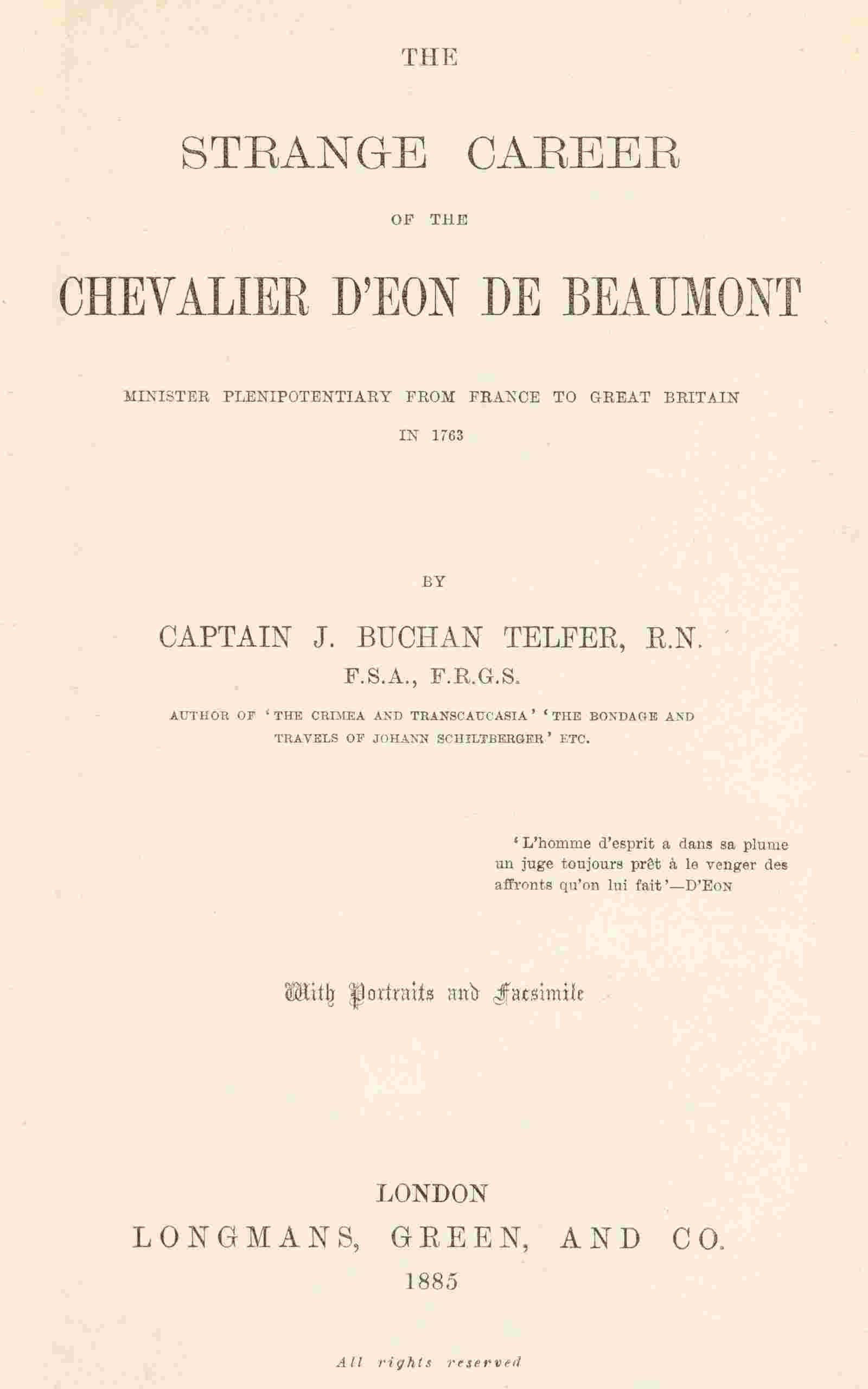
About This Book
The biography chronicles the Chevalier's rise through court service and secret diplomatic networks, recounting missions, espionage, and clashes with official envoys while assessing contradictory memoirs and archival records. The author assembles letters, official papers, portraits, and facsimiles to reconstruct political intrigue surrounding the secret correspondence of Louis XV, highlight disputes over the subject's conduct and claims, and weigh contemporary and later accounts against primary documents. The narrative balances anecdote and documentary evidence to map a public career entwined with persistent personal mysteries that shaped reputation and controversy.