
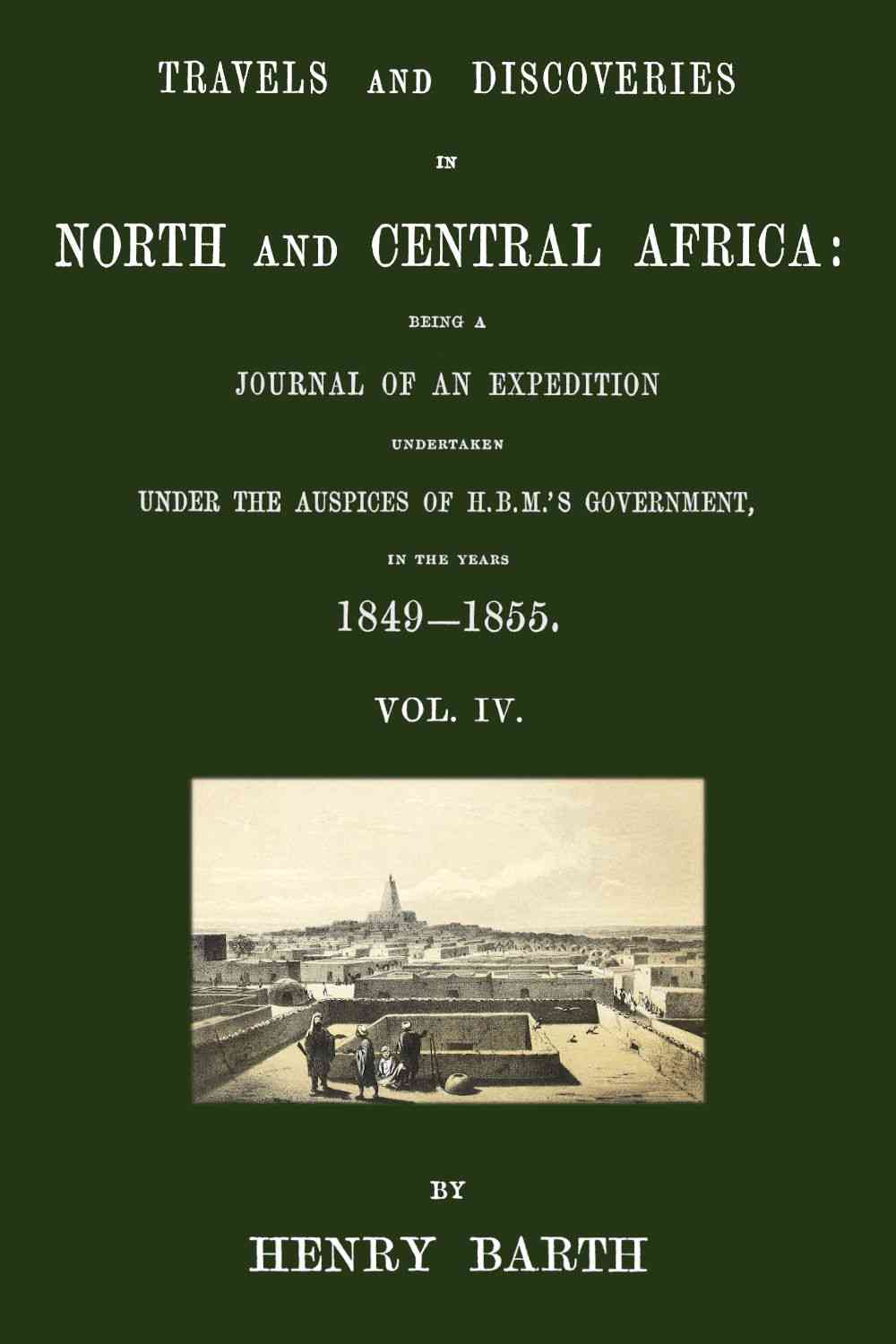
- 1. Outer entrance, leading into a large square surrounded with a double moat, and containing three huts for the guards.
- 2. Second entrance, leading from this outwork through the outer moat which surrounds the town.
- 3. Gate leading into the projecting angle of the wall, from which a second gate leads into the town.
- 4. Granite mounts inside the town.
- 5. Outer moats of the wall.
- 6. Situation of my tent.
- 7. Granite mount outside the town.
- 8. Open pasture-grounds.
The town was said to have been founded only three years before, being peopled from the remains of other places, which were destroyed by the enemy. It may contain from 8000 to 9000 inhabitants; but it had recently suffered from a conflagration. The wall was full of loopholes, and it had a gate on each side except the eastern one.
Having made our way with great difficulty through the moats, instead of taking up our quarters inside the wall, to the great astonishment of the people we pitched our tent outside, at some distance from the western gate. Such was the confidence which we placed in our firearms. A rocky eminence, such as are met with also inside the town, started up at some little distance from our camping-ground; and a majestic dorówa, the largest tree of this species which I saw on my journey, shaded the place to a considerable extent, but attracted a number of people, who disturbed my privacy. The ghaladíma had taken a northerly road, to the town of Tsaúrí, which he had recently founded, and did not arrive till the afternoon.
Friday, March 25th.On mounting my horse in the morning to pursue my march, a Púllo came up to me and handed me a letter, which he begged me to take to a relative of his in Timbúktu. This showed his full confidence in my success; and it did not fail to inspire me with the same feeling. The inhabitants of the town marched out their band of musicians, who played a farewell to us; and the several troops of horsemen, in their picturesque attire, thronged along the path winding between the granite mounds which broke the level on all sides. Groups of deléb and dúm palms towered, with their fan-shaped foliage, over the whole scenery.
We had now entered the more unsafe border country between the Mohammedans and pagans, while changing our direction from south to west; and the cultivation was less extensive, although even here a little cotton was to be seen. After a march of about eight miles we traversed the site of a deserted town called Takabáwa, inclosed between rocky cliffs on all sides, and at present changed into a large cotton-ground, the inhabitants having sought refuge in the more rocky district towards the south. But although the destructive influence which war had exercised upon this province was plainly manifested by the site of another town which we passed soon afterwards, yet the country was not quite deserted, and even small herds of cattle were observed further on. Meanwhile the dúm palm became entirely predominant, and rocky cliffs and eminences continued to break the surface; but beyond a rocky ridge which, dotted with an abundance of monkey-bread trees, crossed our path, the country became more level and open, enlivened by herds, and exhibiting an uninterrupted tract of cultivation.
Thus we reached the walls of the considerable town of Zékka, and here again we had to make our way with difficulty through the moats which started off from the walls as a sort of outwork, when we pitched our tent on the west side, in the shade of two large dorówa trees. Even here I did not choose to take up my quarters inside the town, which was full of people. Besides those detachments which had come along with us, there arrived here also an auxiliary troop of 110 horse from Záriya, together with the governor of Úmmadaú with twenty horsemen. The Kanáwa, or people of Kanó, who were proceeding to Sókoto, had continued their march straight to Úmmadaú, in order to take up their quarters in that place.
Besides numbers of sick people from the town, who came to solicit my medical assistance, I received also a visit in the evening from one of the five governors of the place, who bears the title of serkí-n-Féllani. He came to ask whether I had not for sale another pair of pocket pistols, such as I had given to the governor of Kátsena; for my eccentric friend played with the small arms I had made him a present of, all the day long, to the great alarm of everybody, so that the rumour of my possessing such articles had spread over the whole of this part of Sudán, and even Kaúra had pestered me greatly on this account.
In the town of Zékka resides also the former governor of the wealthy town or district of Rúma, mentioned repeatedly by Captain Clapperton, but destroyed by the Góberáwa after the period of his travels; that officer still bears the title of serkí-n-Rúma. There was a pond of dirty water near our encampment; but good drinkable water was only to be obtained from a watercourse at a considerable distance, which, although dry at present, afforded wells at very little depth in its gravelly bottom.
Saturday, March 26th.We remained here the whole forenoon, as we had now the most difficult part of our journey before us; but instead of having leisure to prepare myself for an unusual amount of exertion, all my spare time was taken up by a disagreeable business,—the governor of Kátsena having succeeded in seducing from my service, in the most disgraceful manner, the Ferjáni Arab, whom I had hired for the whole journey to Timbúktu and back, and whom I could ill afford to lose. This lad, who had accompanied Ibrahím Bashá’s expedition to Syria and an expedition to Kordofán, and who had afterwards resided with the Welád Slimán for some time in Kánem, might have been of great use to me in case of emergency. But, as it was, I could only be grateful to Providence for ridding me of this faithless rogue at so cheap a rate: and the insidious governor at least had no reason to boast of his conduct; for the Arab, as soon as he found himself well mounted, and dressed in a bernús, by his new master, took to his heels, and, following the track with which he had become acquainted in my company, succeeded in reaching Zínder, and from thence returned to his native country.
We here separated from most of our companions,—the governor of Kátsena, as well as the people from Kanó and Záriya, who were carrying tribute to the sultan of Sókoto, remaining behind, and only an escort or “rékkia” of fifty horsemen continuing in our company. The hostile army of the Góberáwa being in this neighbourhood, the danger of the road further on was very considerable; and the Kanáwa and Zozáwa or Zegézegé, of whom the latter carried 2,000,000 shells, 500 tobes, and 30 horses, as tribute, were too much afraid of their property to accompany us. There had also arrived a troop of about 100 fatáki with asses laden entirely with the famous dodówa cakes; but they also remained behind.
The governor himself, however, escorted us for a mile or two, to a large korámma called Mejídi, which no doubt forms one of the branches of the korámma of Búnka, and contains several wells, where we watered our horses and filled our water-skins for a night’s march. Fine cotton-grounds and fields of onions fringed the border of the valley.
As soon as we left this winding watercourse, we entered a dense forest only occasionally broken by open spots covered with reed grass, and we pursued our march without interruption the whole night, with the exception of a short halt just in the dusk of the evening. I had taken the lead from the beginning; and the ghaladíma, who was fully sensible of the great advantage of my firearms, sent messenger after messenger to me till he brought me to a stand, and thus managed to get all his slaves and camels in advance, so that I could only proceed very slowly. After a march of little more than twelve miles from the korámma, we entered a fertile and picturesque sort of vale, inclosed towards the north and south by rocky cliffs, and intersected by a narrow strip of succulent herbage, where water is apparently to be found at a little depth. This is the site of the town of Moníya, which had likewise been destroyed by the Góberáwa three years previously. Their army had even encamped here the previous day; and when our companions found the traces of their footsteps, which indicated that they had taken an easterly direction, all the people were seized with fright, and the intention which had been entertained, of resting here for a few hours of the night, was given up, and with an advanced guard of twenty horse, and a guard of from fifty to sixty, we kept cautiously and anxiously on.
About midnight we again entered dense forest, consisting chiefly of underwood. We marched the whole night, and emerged in the morning into open cultivated country. We then passed several small hamlets, and, crossing first a small and further on a larger watercourse, reached, a little before nine o’clock, the considerable place Búnka, surrounded by a clay wall about twelve feet in height, and by a half natural half artificial stockade of dense forest. In this town, the governor of which is directly dependent upon the ghaladíma of Sókoto, my protector had taken quarters; but, true to my old principle, I here also preferred encamping outside, and, turning round the town, on the south side, along a very winding and narrow passage through dense prickly underwood, I pitched my tent on the west side, in the midst of an open suburb consisting of several straggling groups of huts.
The inhabitants of the village proved to be industrious and sociable, and, soon after we had encamped, brought me several articles for sale, such as good strong ropes, of which we were greatly in want. In general a traveller cannot procure good ropes in these countries; and, for an expedition on a larger scale, he does well to provide himself with this article. The ropes made of ngille or the dúm bush last only a few days; and those made of hides, which are very useful in the dry season, for tying up the legs of the camels, and even for fastening the luggage, are not fit for the rainy season. We also bought here a good supply of tamarinds, plenty of fowls (for from thirty to forty kurdí each), and a little milk. Part of the inhabitants of this village, at least, consisted of Ásbenáwa settlers; and they informed us that the army of the Góberáwa had come close to their town, but that they had driven them back.
The town itself, though not large, is tolerably well inhabited, containing a population of about 5000. It is skirted on the east side by a considerable watercourse, at present dry, but containing excellent water close under the gravelly surface, and forming a place of resort for numbers of the grey species of monkey.
The approach of the rainy season was indicated by a slight fall of rain.
Monday, March 28th.The ghaladíma, whom the imminence of the danger had induced to fix his departure for the next day, instead of allowing a day for repose, had already gone on in advance a considerable way, when we followed him, and soon after left on our right a large cheerful-looking hamlet, shaded by splendid trees, and enlivened by numbers of poultry. Extensive cultivated grounds testified to the industry of the inhabitants, who likewise belonged to a tribe of the Ásbenáwa, or rather to a mixed race of people. Having then crossed dense underwood, where the Mimosa Nilotica, here called “elkú,” was standing in full blossom, while the ground consisted of sand, we reached, after a march of about a mile, the south-eastern corner of the wall of the considerable town of Zýrmi. The watercourse of Búnka had been close on our left, providing the inhabitants with a never-failing supply of excellent water, which is found close under the surface of the fine gravel which composes its bed.
Zýrmi is an important town even at present, but, being under the dominion of the Fúlbe, is only capable of preserving its existence by a constant struggle with Góber and Marádi. However, the governor of this town is not now master of the whole of Zánfara, as he was in the time of Captain Clapperton, who visited it on his journey to Sókoto[37], the Fúlbe, or Féllani, having found it more conducive to their policy to place each governor of a walled town, in this province, under the direct allegiance of Sókoto, in order to prevent the loss of the whole country by the rebellion of a single man. Some ninety or one hundred years ago, before the destruction of the capital, this province was almost the most flourishing country of Negroland; but it is at present divided into a number of petty states, each of which follows a different policy; hence it is difficult to know which towns are still dependent upon the dominion of Sókoto, and which adhere to their enemies the Góberáwa.[38] The town is still tolerably well inhabited, the western more densely than the eastern quarter.
The direct road leads along the wall, and close beyond passes by the site of the former town Dáda; but, in order to water my horse, I descended into the korámma, which was here encompassed by banks about twenty-five feet high, the gradually-shelving slopes of which were laid out in kitchen-gardens, where onions were cultivated. Passing then a tract thickly overgrown with monkey-bread trees, we traversed a straggling village, the whole appearance of which left a feeling of peace and comfort, rather than of the constant state of warfare which prevails in this country. But everything in human life depends on habitude; and these poor people, not knowing any better, bear the state of insecurity to which they are exposed, without uneasiness.
Numerous neat cottages were just being built; and the western end of the village especially, being adorned by several groups of the gónda tree, or Erica Papaya, had a very pleasant appearance. Dyeing-pits are not wanting in any of the larger towns of Zánfara; and a numerous herd of cattle met our view close beyond the village.
When we again reached the direct road, the neighbourhood of our friends was distinctly indicated by a very strong and not quite aromatic smell, which proceeded from the luggage of those of the caravan of native traders (or fatáki) who had attached themselves to our troop in Zékka, leaving their more cautious brethren behind. The merchandise of these small traders consisted, for the most part, of those vegetable cakes, called dodówa, which I have mentioned repeatedly, and which constitute an important article of trade, as the dorówa or Parkia, from the fruit of which those cakes are made, thrives in great abundance in the province of Zegzeg, while it is comparatively rare in the provinces of Kébbi and Góber. Three thousand of these cakes constitute an ass-load, and each of them in general is sold in Sókoto for five kurdí, having been bought on the spot for one urí; so that the profit, being not less than 500 per cent., makes this commerce attractive for poor people, notwithstanding the dangerous state to which this road is at present reduced. The return freight which these petty merchants bring back from Sókoto, generally consists of the salt of Fógha.
Our further road conducted us through a more rugged district, intersected by numerous small watercourses with very rocky beds, and mostly covered with dense forest only now and then broken by a small tract of cultivated ground producing even a little cotton. Thus we reached the town of Dúchi, the name of which, meaning “the rocks,” served well to indicate the peculiar nature of the place, which has a very wild and romantic appearance—a labyrinth of rocky eminences intersected by a small ravine, as shown in the woodcut: the dwellings, which are scattered about in several groups, can scarcely be seen, owing to the prevalence of rocks. Several groups of dúm palms contribute greatly to enhance the picturesque character of the place.
Having got inside the wall, which consisted of loose stones, we had some difficulty in finding a fit spot for encamping, and at length, having traversed the whole place, pitched our tent, not far from the western gate, but still inside the wall, in the shade of a fine tsámia or tamarind tree, and close to a small group of huts. The principal hamlet lies nearer the east side. The little watercourse contained only a very small supply of water under the gravelly surface of the bed; but on my return from the west, in the autumn of the following year, a foaming brook was rushing along it. The interesting character of the scenery induced me, in the course of the night, to leave my tent and to sit down for a while on a rock, which commanded the whole interior of the town. There I had a charming prospect over the scene by clear moonlight, while people were busily employed the whole night, collecting the small supply of water from the channel, for their next day’s wants.
Tuesday, March 29th.In order to pass the narrow gate, if gate it may be called, I was obliged to have the two posts which encompassed it on each side removed. The whole country round about is rocky, with only a slight covering of fertile soil, so that nothing but Indian millet is cultivated, which thrives very well in rocky ground. But the country was adorned with a tolerable variety of trees, such as monkey-bread trees, most of which had young leaves, the dorówa, the kadeña, and the merké. While crossing a small rocky ridge, we were joined by a troop of people bearing large loads of cotton upon their heads, which they were carrying to the considerable market of Badaráwa. This cotton was distinguished by its snow-white colour, and seemed to be of very good quality.
Beyond the rocky ridge, the country became more open, rich in trees and cultivated fields; and having passed a village, we turned round the south-western corner of the walled town of Sabón Bírni, making our way with great difficulty, and not without some damage to the fences as well as to our luggage, through the narrow lanes of an open suburb. The western side of the town was bordered by a korámma containing a considerable sheet of stagnant water of very bad quality, and fringed all round by a border of kitchen-gardens, where onions were cultivated. The governor of Sabón Bírni, like that of Zýrmi, is directly dependent on the emír of Sókoto. The name or title of his dominion is Bázay.
From hence, along a path filled with market people, we reached the walled town of Badaráwa, which, like most of the towns of Zánfara, is surrounded on all sides with a dense border of timber, affording to the archers, who form the strength of the natives, great advantage in a defence, and making any attack, in the present condition of the strategetical art in this country, very difficult. In the midst of this dense body of trees there was a very considerable market, attended by nearly 10,000 people, and well supplied with cotton[39], which seemed to be the staple commodity, while Indian millet (sorghum) also was in abundance. A great number of cattle were slaughtered in the market, and the meat retailed in small quantities. There was also a good supply of fresh butter (which is rarely seen in Negroland), formed in large lumps, cleanly prepared, and swimming in water; they were sold for 500 kurdí each. Neither was there any scarcity of onions, a vegetable which is extensively cultivated in the province of Zánfara, the smaller ones being sold for one urí, the larger ones for two kurdí each. These onions are mostly cultivated round a large tebki, about half a mile to the west of the town, which even at the present season was still of considerable size. Instead of entering the narrow streets of the town, I pitched my tent in the open fields, at a considerable distance from the wall; for I was the more in want of fresh air, as I was suffering greatly from headache. The consequence was that I could not even indulge in the simple luxuries of the market, but had recourse to my common medicine of tamarind water.
There was some little danger here, not so much from a foreign foe as from our proximity to a considerable hamlet of Tawárek of the tribe of the Itísan, who have settlements in all these towns of Zánfara. While endeavouring to recruit myself by rest and simple diet, I received a visit from an intelligent and well-behaved young fáki, Mʿallem Dádi, who belonged to the suite of the ghaladíma, and whose company was always agreeable to me. He informed me that the Zánfaráwa and the Góberáwa had regarded each other with violent hatred from ancient times,—Babári, the founder of Kaláwa, or Alkaláwa, the former capital of Góber, having based the strength and wellbeing of his own country on the destruction of the old capital of Zánfara, ninety-seven years previously. Hence the people of Zánfara embarked heart and soul in the religious and political rising of the sheikh ʿOthmán against his liege lord the ruler of Góber. I learned also that the same amount of tribute, which I have before mentioned as carried on this occasion by the messengers of Záriya to the emír el Múmenín, was paid almost every second month, while from Kátsena it was very difficult to obtain a regular tribute, the governor of that town generally not paying more than 400,000 kurdí and forty articles, such as bernúses, kaftans, &c., annually. It was only an exceptional case, arising from the exertions of the ghaladíma as I was told, that he had sent, this year, 800,000 shells, besides a horse of Tárki breed, of the nominal value of 700,000 kurdí.
Wednesday, March 30th.Allowing my camels to pursue the direct road, I myself took a rather roundabout way, in order to get a sight of the tebki from which the town is supplied; and I was really astonished at the considerable expanse of clear water which it exhibited at this time of the year (shortly before the setting in of the rainy season), when water in the whole of Negroland becomes very scanty. The ground consisted of fine vegetable soil, while the cultivation along the path was scarcely interrupted; and in passing a hamlet we saw the inhabitants making the first preparations for the labours of the field. Cotton was also cultivated to a considerable extent. About a mile and a half further on, at the village of Sungúruré, which is surrounded with a strong keffi, I observed the first rúdu, a sort of light hut consisting of nothing but a thatched roof raised upon four poles from eight to ten feet in height, and affording a safe retreat to the inhabitants, during their night’s rest, against the swarms of mosquitoes which infest the whole region along the swampy creeks of the Niger, the people entering these elevated bedrooms from below, and shutting the entrance behind them, as represented in the accompanying woodcut.
Leaving, then, the walled town of Katúru close on our left, we entered a dense forest richly interwoven with creeping plants, and intersected by a large korámma with a very uneven bottom, affording sufficient proof of the vehemence of the torrent which at times rushes along it. At present it contained nothing but pools of stagnant water in several places, where we observed a large herd of camels, belonging to a party of Itísan, just being watered, while tobacco was cultivated on the border of the korámma. A little further on, the torrent had swept away and undermined the banks in such a manner that they presented the appearance of artificial walls. We met several natives on the road, who, although Fúlbe or Féllani (that is to say, belonging to the conquering tribe) and themselves apparently Mohammedans, wore nothing but a leather apron round their loins.
Thus we reached, a little past noon, the town Sansánne ʿAísa, which was originally a mere fortified encampment or “sansánne.” But its advanced and in some respects isolated position, as an outlying post against the Góberáwa and Mariyadáwa, rendered it essential that it should be strong enough by its own resources to offer a long resistance; and it has in consequence become a walled town of considerable importance, so that travellers generally take this roundabout way, with a strong northerly deviation. Here also the wall is surrounded with a dense forest, affording a sort of natural fortification.
Having entered the town and convinced myself of its confined and cheerless character, I resolved even here to encamp outside, though at considerable risk; and I went to the well, which was about half a mile distant to the south, and, being five fathoms in depth, contained a rich supply of excellent water. Here a small caravan of people from Ádar, laden with corn and about to return to their native home, were encamped; and I pitched my tent on an open spot, close to some light cottages of Itísan settlers, who immediately brought me a little fresh cheese as a specimen of their industry, and were well satisfied with a present which I made them in return, of a few razors and looking-glasses. These Tawárek are scattered over the whole of Western Súdán, not only frequenting those localities occasionally as traders, but even sometimes settled with their wives and children. Their women also did not fail to pay us a visit in the afternoon; for they are extremely curious and fond of strangers.
When I had made myself comfortable, I received a visit from the ghaladíma of the town; he brought me the compliments of the governor, who was a man of rather noble birth, being nobody else but ʿAlí Káramí, the eldest son and presumed successor of ʿAlíyu the emír el Múmenín. He bears the pompous title of serkí-n-Góber, “lord of Góber,” although almost the whole of that country is in the hands of the enemy. Having taken his leave, the messenger soon returned accompanied by Alháttu, the younger brother of the ghaladíma of Sókoto, who was anxious to show his importance, bringing me a fat sheep as a present, which I acknowledged by the gift of a fine heláli bernús, besides a red cap and turban; and the governor expressed his satisfaction at my present by sending me also corn for my horses, and half a dozen fowls. In the evening we had a short but violent tornado, which usually indicates the approach of the rainy season; but no rain fell, and we passed the night very comfortably in our open encampment, without any accident.
Thursday, March 31st.We had a very difficult day’s march before us,—the passage of the wilderness of Gúndumi,—which can only be traversed by a forced march, and which, even upon a man of Captain Clapperton’s energies, had left the impression of the most wearisome journey he had ever performed in his life. But before returning into our westerly direction, we had first to follow a north-westerly path leading to a large pond or tebki, in order to provide ourselves with water for the journey. It was still a good-sized sheet of water, though torn up and agitated by numbers of men and animals that had preceded our party from the town; and we were therefore very fortunate in having provided ourselves with some excellent clear water from the well close to our place of encampment. The pond was in the midst of the forest, which towards its outskirts presented a cheerful aspect, enlivened by a great number of sycamore trees and even a few deléb palms, but which here assumed the more monotonous and cheerless character which seems to be common to all the extensive forests of Negroland.
The beginning of our march, after we had watered our animals and filled our water-skins, was rather inauspicious, our companions missing their way and with their bugles calling me and my people, who were pursuing the right track, far to the south, till, after endeavouring in vain to make our way through an impervious thicket, and after a considerable loss of time, anything but agreeable at the beginning of a desperate march of nearly thirty hours, we at length with the assistance of a Púllo shepherd regained the right track. We then pursued our march, travelling without any halt the whole day and the whole night through the dense forest, leaving the pond called tebki-n-Gúndumi at some distance on our left, and not meeting with any signs of cultivation till a quarter before eleven the next morning, when, wearied in the extreme and scarcely able to keep up, we were met by some horsemen, who had been sent out from the camp at Gáwasú to meet us, provided with water-skins in order to bring up the stragglers who had lagged behind from fatigue and thirst. And there were many who needed their assistance—one woman had even succumbed to exhaustion in the course of the night; for such a forced march is the more fatiguing and exhausting as the dangers from a lurking enemy make the greatest possible silence and quiet indispensable, instead of the spirits being kept up with cheerful songs as is usually the case. But having once reached the cultivated grounds, after a march of two miles and a half more we arrived at the first gáwasú trees which surround the village which is named after them, “Gáwasú.” In the fields or “kárkará” adjoining this village, ʿAlíyu the emír el Múmenín had taken up his camping-ground, and was preparing himself for setting out upon an expedition against the Góber people.
It was well that we had arrived—having been incessantly marching for the last twenty-six hours, without taking into account the first part of the journey from the town to the pond; for I had never seen my horse in such a state of total exhaustion, while my people also fell down immediately they arrived. As for myself, kept up by the excitement of my situation, I did not feel much fatigued, but on the contrary felt strong enough to search without delay through the whole of my luggage, in order to select the choicest presents for the great prince of Sókoto, who was to set out the following morning, and upon whose reception depended a good deal of the success of my undertaking. The afternoon wore on without my being called into the presence of the sultan, and I scarcely expected that I should see him that day; but suddenly, after the evening prayer, Alháttu made his appearance with some messengers of the chief, not in order to hasten my present, but first to give me a proof of their own hospitality, and bringing me a very respectable present consisting of an ox, four fat sheep, and two large straw sacks or tákrufa containing about four hundred pounds weight of rice, with an intimation at the same time that ʿAlíyu wished to see me, but that I was not now to take my present with me. I therefore prepared myself immediately; and on going to the sultan’s we passed by the ghaladíma, who had been lodged in a courtyard of the village, and who accompanied us.
We found ʿAlíyu in the northern part of the village, sitting under a tree in front of his quarters, on a raised platform of clay. He received me with the utmost kindness and good humour, shaking hands with me and begging me to take a seat just in front of him. Having paid my compliments to him on behalf of the Queen of England, I told him that it had been my intention to have paid him a visit two years previously, but that the losses which we had met with in the first part of our journey had prevented me from carrying out my design. I had scarcely finished my speech, when he himself assured me that at the right time he had received the letter which I had addressed to him through the sultan of Ágades (informing him of the reason why we could not then go directly to pay him our compliments), and that from that moment up to the present time he had followed our proceedings, and especially my own, with the greatest interest, having even heard at the time a report of my journey to Ádamáwa.
I then informed him that in coming to pay him my compliments I had principally two objects in view,—one of which was that he might give me a letter of franchise guaranteeing to all British merchants entire security for themselves and their property in visiting his dominions for trading purposes; and the second, that he might allow me to proceed to Timbúktu, and facilitate my journey to that place (which was greatly obstructed at the present moment by the rebellion of the province of Kebbi) by his own paramount authority. Without reserve he acceded to both my requests in the most cheerful and assuring manner, saying that it would be his greatest pleasure to assist me in my enterprise to the utmost of his power, as it had only humane objects in view, and could not but tend to draw nations together that were widely separated from each other. At the same time he expressed, in a very feeling way, his regret with regard to ʿAbd Allah (Capt. Clapperton), whose name I had incidentally mentioned, intimating that the then state of war, or “gába,” between Bello and the sheikh el Kánemí, the ruler of Bórnu, had disturbed their amicable relations with that eminent officer, whom in such a conjuncture they had not felt justified in allowing to proceed on his errand to their enemy. In order to give him an example how, in the case of foreign visitors or messengers, such circumstances ought not to be taken into account, I took this opportunity to show him that the ruler of Bórnu, although in open hostility with the most powerful of his (ʿAlíyu’s) governors, nevertheless had allowed me, at the present conjuncture, to proceed on my journey to them without the slightest obstacle. He then concluded our conversation by observing that it had been his express wish to see me the very day of my arrival, in order to assure me that I was heartily welcome, and to set my mind at rest as to the fate of Clapperton, which he was well aware could not fail to inspire Europeans with some diffidence in the proceedings of the rulers of Sókoto.
With a mind greatly relieved I returned to my tent from this audience. The dusk of the evening, darkened by thick thunder-clouds, with the thunder rolling uninterruptedly, and lighted up only by the numerous fires which were burning round about in the fields where the troops had encamped under the trees, gave to the place a peculiar and solemn interest, making me fully aware of the momentous nature of my situation. The thunder continued rolling all night long, plainly announcing the approach of the rainy season, though there was no rain at the time. Meanwhile I was pondering over the present which I was to give to this mighty potentate, who had treated me with so much kindness and regard on the first interview, and on whose friendship and protection depended in a great measure the result of my proceedings; and thinking that what I had selected might not prove sufficient to answer fully his expectation, in the morning, when I arose, I still added a few things more, so that my present consisted of the following articles:—a pair of pistols[40], richly ornamented with silver, in velvet holsters; a rich bernús (Arab cloak with hood) of red satin, lined with yellow satin; a bernús of yellow cloth; a bernús of brown cloth; a white heláli bernús of the finest quality; a red cloth kaftan embroidered with gold; a pair of red cloth trowsers; a Stambúli carpet; three loaves of sugar; three turbans and a red cap; two pairs of razors; half a dozen large looking-glasses; cloves, and benzoin.
Having tied up these presents in five smart handkerchiefs, and taking another bernús of red cloth with me for the ghaladíma, I proceeded first to the latter, who received his present with acknowledgments, and surveyed those destined for his master with extreme delight and satisfaction. We then went together to ʿAlíyu, and found him in a room built of reeds, sitting on a divan made of the light wood of the tukkurúwa; and it was then for the first time that I obtained a distinct view of this chief, for on my interview the preceding night it had been so dark that I was not enabled to distinguish his features accurately. I found him a stout middle-sized man, with a round fat face exhibiting, evidently, rather the features of his mother, a Háusa slave, than those of his father Mohammed Bello a free and noble Púllo, but full of cheerfulness and good humour. His dress also was extremely simple, and at the same time likewise bore evidence of the pure Púllo character having been abandoned; for while it consisted of scarcely anything else but a tobe of greyish colour, his face was uncovered, while his father Bello, even in his private dwelling, at least before a stranger, never failed to cover his mouth.
He received me this time with the same remarkable kindness which he had exhibited the preceding evening, and repeated his full consent to both my requests, which I then stated more explicitly, requesting at the same time that the letter of franchise might be written at once, before his setting out on his expedition. This he agreed to, but he positively refused to allow me to proceed on my journey before his return from the expedition, which he said would not be long; and, acquainted as I was with the etiquette of these African courts, I could scarcely expect anything else from the beginning. He then surveyed the presents, and expressed his satisfaction repeatedly; but when he beheld the pistols, which I had purposely kept till the last, he gave vent to his feelings in the most undisguised manner, and, pressing my hands repeatedly, he said, “nagóde, nagóde, barka, ʿAbd el Kerím, barka”—“I thank you, God bless you, ʿAbd el Kerím, God bless you.” He had evidently never before seen anything like these richly-mounted pistols, which had been selected in Tripoli by the connoisseur eyes of Mr. Warrington, and surveyed the present on all sides. It was to these very pistols that I was in a great measure indebted for the friendly disposition of this prince, while the unscrupulous governor of Kátsena, who had heard some report about them, advised me by all means to sell them to himself, as his liege lord would not only not value them at all, but would even be afraid of them.
Soon after I had returned to my tent, the ghaladíma arrived, bringing me from his master 100,000 kurdí, to defray the expenses of my household during his absence; and I had afterwards the more reason to feel grateful for this kind attention, although the sum did not exceed forty Spanish dollars, as I became aware, during my stay in Wurno, how difficult it would have been for me to have changed my dollars into kurdí. I then satisfied my friend Alháttu the younger brother of the ghaladíma, whose behaviour certainly was far from disinterested, but who, nevertheless, had not proved quite useless to me.
Although we were here in the camp outside, and the people busy with their approaching departure, yet I received visits from several people, and amongst others, that of a Weled Ráshid of the name of Mohammed, who, on my return from Timbúktu followed me to Kúkawa in the company of his countryman the learned Áhmed Wadáwi. This man having left his tribe on the south-eastern borders of Bagírmi, had settled in this place many years before; and having accompanied several expeditions or forays, he gave me an entertaining description of the courage of the Féllani-n-Sókoto, although he had some little disposition to slander, and even related to me stories about the frailties of the female portion of the inhabitants of the capital, which I shall not repeat.
Sunday, April 3rd.Being anxious that the letter of franchise should be written before the sultan set out, I sent in the morning my broker ʿAlí el Ágeren, with a pound of Tower-proof gunpowder, to the prince, in order to remind him of his promise; and he returned after a while, bringing me a letter signed with the sultan’s seal, which on the whole was composed in very handsome terms, stating that the prince had granted the request of commercial security for English merchants and travellers, which I as a messenger of the Queen of England had made to him. But the letter not specifying any conditions, I was obliged to ask for another paper, written in more distinct terms; and although ʿAlíyu’s time was of course very limited, as he was just about to set out with his army, even my last request was complied with, and I declared myself satisfied. I was well aware how extremely difficult it is to make these people understand the forms of the articles in which European governments are wont to conclude commercial treaties. In regions like this, however, it seems almost as if too much time ought not to be lost on account of such a matter of form before it is well established whether merchants will really open a traffic with these quarters; for as soon as, upon the general condition of security, an intercourse is really established, the rulers of those countries themselves become aware that some more definite arrangement is necessary, while, before they have any experience of intercourse with Europeans, the form of the articles in which treaties are generally conceived fills them with the utmost suspicion and fear, and may be productive of the worst consequences to any one who may have to conclude such a treaty.
The sultan was kind enough, before he left in the afternoon, to send me word that I might come and take leave of him; and I wished him with all my heart success in his expedition, as the success of my own undertaking, namely, my journey towards the west, partly depended upon his vanquishing his enemies. Giving vent to his approval of my wishes by repeating that important and highly significant word not more peculiar to the Christian than to the Mohammedan creed, “Amín, amín,” he took leave of me, in order to start on his expedition, accompanied only by a small detachment of cavalry, most of the troops having already gone on in advance. I had also forwarded a present to Hámmedu, the son of ʿAtíku an elder brother and predecessor of Bello; but he sent it back to me, begging me to keep it until after his return from the expedition. The ghaladíma also, who was to accompany the sultan, called, before his departure, in order that I might wind round his head a turban of gaudy colours, such as I then possessed, as an omen of success.
After all the people were gone, I myself could not think of passing another night in this desolate place, which is not only exposed to the attacks of men, but even to those of wild beasts. Even the preceding night the hyenas had attacked several people, and had almost succeeded in carrying off a boy, besides severely lacerating one man, who was obliged to return home without being able to accompany the army. An hour, therefore, after the sultan had left his encampment, we ourselves were on our road to Wurno, the common residence of ʿAlíyu, where I had been desired to take up my quarters in the house of the ghaladíma; but I never made a more disagreeable journey, short as it was, the provisions which the sultan had given me encumbering us greatly, so that at length we were obliged to give away the heifer as a present to the inhabitants of the village of Gáwasú. It thus happened that we did not reach our quarters till late in the evening; and we had a great deal of trouble in taking possession of them in the dark, having been detained a long time at the gateway, which itself was wide and spacious, but which was obstructed by a wooden door, while there was no open square at all inside the gate, nor even a straight road leading up from thence into the town, the road immediately dividing and winding close along the wall.
[34]See the description which Clapperton gives of the manner in which these cakes are prepared. (Denham and Clapperton’s Travels, ii. p. 125.)
[35]The wells here were eight fathoms.
[37]Clapperton, Second Expedition, p. 150.
[38]For further details on this subject, see Appendix I.; and for an outline of the history of Zánfara, see the Chronological Tables.
[39]It was extensively cultivated in this province at the beginning of the sixteenth century. (Leo Africanus, lib. vii. c. 13.)
[40]I may as well add, that the richly-mounted pistols which chiefly aided me in obtaining the friendship of this powerful chief, as well as another pair which I afterwards gave to Khalílu the ruler of Gando, and also several other things, were paid for with my own money, which was forwarded to Tripoli by my family at the suggestion of the Chevalier Bunsen, as well as two harmonica, one of which I gave to ʿAlíyu, and the other to the sheikh el Bakáy.
CHAP. LVII.
RESIDENCE IN WURNO.
I shall preface the particulars of my residence in Wurno with a short account of the growth of the power of the Fúlbe or Féllani in this quarter, and of the present condition of the empire of Sókoto.
There is no doubt that, if any African tribe deserves the full attention of the learned European, it is that of the Fúlbe (sing. Púllo), or Fúla, as they are called by the Mandingoes; Féllani (sing. Baféllanchi), by the Háusa people; Felláta, by the Kanúri; and Fullán, by the Arabs. In their appearance, their history, and the peculiar character of their language, they present numerous anomalies to the inhabitants of the adjacent countries. No doubt they are the most intelligent of all the African tribes, although in bodily development they cannot be said to exhibit the most perfect specimens, and probably are surpassed in this respect by the Jolof. But it is their superior intelligence which gives their chief expression to the Fúlbe, and prevents their features from presenting that regularity which we find in other tribes, while the spare diet of a large portion of that tribe does not impart to their limbs all the development of which they are capable, most of them being distinguished by the smallness of their limbs and the slender growth of their bodies. But as to their outward appearance, which presents various contrasts in complexion as well as in bodily development, we must first take into account that the Fúlbe, as a conquering tribe, sweeping over a wide expanse of provinces, have absorbed and incorporated with themselves different and quite distinct national elements, which have given to their community a rather varying and undecided character.
Moreover, besides such tribes as have been entirely absorbed, and whose origin has even been referred to the supposed ancestors of the whole nation, there are others which, although their pedigree is not brought into so close a connexion with that of the Fúlbe, nevertheless are so intermingled with them, that they have quite forgotten their native idiom, and might be confounded with the former by any traveller who is not distinctly aware of the fact. Prominent among these latter are the Sissílbe, as they call themselves, or Syllebáwa, as they are called in Háusa, whom I shall have occasion to mention on my visit to Sókoto, and who are nothing but a portion of the numerous tribe of the Wákoré or Wángaráwa, to whom belong also the Súsu and the so-called Mandingoes; and while that portion of them who are settled in Háusa have entirely forgotten their native idiom, and have adopted, besides the Fulfúlde language, even the Háusa dialect, their brethren in the more western province of Zaberma use their own idiom at the present time almost exclusively.
On the other hand, foremost among those tribes who have been entirely absorbed by the community of the Fúlbe are the Toróde or Torunkáwa, who, although they are considered as the most noble portion of the population in most of the kingdoms founded by the Fúlbe, yet evidently owe their origin to a mixture of the Jolof element with the ruling tribe[41], and in such a manner that, in point of numbers, the former enjoyed full superiority in the amalgamation; but it is quite evident that, even if we do not take into account the Toróde, the Jolof have entered into the formation of the remarkable tribe of the Fúlbe or Fúla, in a very strong proportion, although the languages of these two tribes at present are so distinct, especially as far as regards grammatical structure; and it is highly interesting that Áhmed Bábá (who, by occasional hints, allows us to form a much better idea of the progress of that tribe, in its spreading over tracts so immense, than we were able to obtain before we became acquainted with his history of Súdán) intimates distinctly that he regards the Jolof as belonging to the great stock of the Fullán or Fúlbe[42], although at the present time the terms “Jolof” and “Púllo” seem to be used in opposition, the one meaning a person of black, the other an individual of red complexion.
It is this element of the Toróde in particular which causes such a great variety in the type of the Fúlbe community, the Toróde being in general of tall stature and strong frame, large features, and of very black complexion, while the other sections of that tribe are always distinguished by a tinge of red or copper colour.
But besides the Toróde, who, as I have said, in most cases as well in Fúta as in Sókoto, at present form the ruling aristocracy, there are many other nationalities which have been absorbed in this great conquering nation, and which, on the contrary, are rather degraded. The most interesting among these latter, at least in the more eastern tracts occupied by the Fúlbe, are certainly the Jawámbe, as they are called by the Fúlbe, but rather, as they call themselves, Zoghorán, or as they are named by the Háusa people, Zoromáwa. This tribe, which we find at present quite absorbed by the Féllani, and, at least in the provinces of Háusa and Kébbi, reduced to the occupation of mere brokers, we still find, during the period of the Áskia, that is to say, in the sixteenth century of our era, quite distinct from the community of the Fúlbe or Féllani, as a tribe by themselves, settled to the S.E. of the Great River, where it enters the province of Másina[43]; and it was this tribe which, having been continually persecuted by the Songhay during the height of their sway, at a later period, when that empire had been laid prostrate by the musketeers of Morocco, contributed the most to its ruin, and conquered great part of it, particularly the most fertile provinces, such as Bára and Kármina.
Nearly the same character distinguishes the tribe of the Laúbe on the Senegal, who, in general, at the present time have been reduced to the rank of carpenters, but, nevertheless, at a former period evidently constituted a distinct tribe.[44] It is these degraded tribes—viz. besides those above mentioned, the Mábube or Mábe, considered in general as weavers; the Gergasábe, or shoemakers; the Waílube, or tailors; the Wambaibe, or singing men; the Waúlube, or beggars,—who impart to the community of the Fúlbe the character of a distinction into castes, especially as all of them, in the imaginary pedigree of the Púllo stock, have been carried back to one common progenitor called Só; but we find the same degraded families among the Jolof.[45]
The absorbing of these western tribes, especially the Jolof and Wákoré by the Fulfúlde nation, furnishes at the same time an unquestionable and unmistakable proof that the march of conquest of the latter proceeded from west to east, and not in an opposite direction, as has been the generally-adopted view of those who have touched upon the subject. No doubt it is impossible for us with our faint knowledge of the migration of tribes in general, and of African tribes in particular, to explain how this tribe came to settle in the region along the lower course of the Senegal, as their type is distinguished in so very remarkable a manner from the character of the other tribes settled in that neighbourhood, and evidently bears more resemblance to some nations whose dwelling-places are in the far east, such as the Malays, with whom M. Eichwaldt, in his ingenious but hypothetical essay on the Fúla[46] has endeavoured to connect them by way of Meroë. I myself am of opinion that their origin is to be sought for in the direction of the east; but this refers to an age which for us is enveloped in impenetrable darkness, while what I have said about the progress of their conquest from west to east relates to historical times, comprising the period from the fourteenth century downwards.[47] In this respect the mission of two religious chiefs of this tribe from Melle (where they resided at the time) to Bíri the king of Bórnu, who ruled about the end of the thirteenth and the beginning of the fourteenth century[48], is of the highest interest, as it shows at once that this tribe, even at that early period, was distinguished by its religious learning, and gives a proof of the progress of the tribe from west to east. Some other facts which have come to our knowledge with regard to the progress of this tribe eastward will be mentioned in the chronological tables; here I will only call the reader’s attention to the circumstance, that we find, among the most intimate friends and most stanch supporters of Mohammed el Háj Áskia, a man of the name of ʿAlí Fulánu, while in general it was the policy of the Songhay dynasty, which was begun by that great ruler of Negroland, to keep in check this tribe, the conquering tendency of which could not but become apparent to intelligent rulers, notwithstanding the humble character of “berroróji,” under which they used to immigrate and settle in foreign countries; and this is the acknowledged reason why the Gabéro, a tribe whom we shall meet in the course of our proceedings on the river below Gágho, have entirely forgotten their Fulfúlde idiom, not having been allowed, for a certain period, to use it. Whether it be true, as the Féllani-n-Háusa assert, that Kanta, the founder of the homonymous dynasty of Kébbi in the very beginning of the sixteenth century was originally a slave of a party of Fúlbe settled in the country, a fact which, if confirmed, would prove the early settlement of the tribe in this country, I am unable to decide, although it is certainly true that in the course of the sixteenth century the Fúlbe became strong enough, in the regions on the east side of the Ísa or Kwára, to exercise a great influence in the struggles which ensued between the successors of the first Kanta, while it was a chief of their tribe, the ruler of Danka, or Denga, who, according to Áhmed Bábá[49], first began his predatory incursions into the Songhay territory, laying waste the fertile and once extremely populous region along the Rás el má. It is thus explained how, even in the beginning of the seventeenth century, Fúlbe tribes were settled in several places of Bagírmi.[50]
But just on account of the vastness of the region over which they were scattered, were these people, while pursuing only their own local interest, powerless even in these loosely-connected and almost crumbling kingdoms, where they had found a new home, with the exception of Bághena, where they appear to have formed a nucleus of greater strength, but destitute of any religious impulse.
A new epoch for this wide-spread tribe did not open till the beginning of this century, when, in the year 1802, Báwa the ruler of Góber summoned to his presence the sheikh ʿOthmán, together with the other chiefs of the tribe, and severely reprimanded them on account of the pretensions which they were beginning to put forward. It was then that ʿOthmán, who, being settled in the village Dághel, performed the office of imám to his countrymen, and had begun to give them a new religious impulse, which raised them above their petty interests, filled with indignation at the manner in which he, the great Moslim, was treated by those pagans, was roused to the attempt of making himself and his tribe independent of the will of the native ruler of the country, and having assembled his countrymen, who now conferred upon him the dignity and authority of a sheikh, raised the standard of revolt; but his proceedings, at least as far as regarded Góber and the capital Alkaláwa, were far from proving successful at the beginning, he being vanquished in almost every encounter: but the fanatical zeal of his followers, whom he continually inspired with fresh energy by his religious songs[51], was so great that gradually he overcame all these obstacles, and at length succeeded in laying the foundation of a vast empire, being greatly assisted in his career by his brother ʿAbd Alláhi, who, although his senior, had been the first to pay him homage, and by his son Mohammed Bello. He took up his residence first at Gando, where he was besieged for a long time, and afterwards at Sifáwa, till, as described by Captain Clapperton in the excellent and concise account of this struggle[52] which he has given in the report of his second journey, Othmán ended his life in a sort of fanatical ecstasy or madness.
He was followed by Mohammed Bello, who endeavoured to introduce more order into the empire thus consolidated, and who, on the whole, must rank high among the African princes, being distinguished not less by his great love of learning and science than by his warlike spirit, although his military achievements were far from being always successful. But he has had the misfortune, after enjoying a great name in Europe, for a short time, for the kind and generous spirit in which he received Captain Clapperton on his first journey, to incur the severest condemnation on account of the manner in which he treated that same enterprising traveller on his second journey. No doubt he was a distinguished ruler; but he must not be judged according to European ideas. He had to struggle hard, not less against the native tribes anxious to assert their independence, than against his great rival Mohammed el Kánemí the king of Bórnu, who, just at the time of Clapperton’s second stay, pressed him very closely, and having successfully overrun the eastern provinces of the Fulfúlde or Felláta empire, threatened Kanó. Hence this political position, together with the instigations of the Arabs, who feared for their commerce with Negroland if the road from the south should be opened, will account in some measure for his treatment of the English traveller, who perhaps urged his going to the sheikh of Bórnu with too much energy. However, there is no doubt that Bello’s successor and brother, ʿAtíku, who ruled from the year 1832 till 1837, would have weakened the interest of the European public in the example which Bello gave of an energetic and generous ruler in those distant and out-of-the-way regions, if his career had become known to them; for he seems to have fully belied the expectation, of “a mean prince,”[53] which he raised when still living in his retirement, as a jealous king’s brother, without power and influence. But his reign was too short for consolidating sufficiently the loosely-connected empire, although, as long as he lived, full security is said to have reigned. The spirit of independence broke out more strongly under his successor ʿAlíyu, a son of Bello by a female slave, who, save a well-meaning and cheerful disposition, does not appear to have inherited many of the noble qualities of his father, and least of all his warlike spirit; and hence the lamentable condition in which I found this extensive kingdom, while there is scarcely any hope that affairs will assume a more consolidated character before another more energetic ruler succeeds to ʿAlíyu. Nevertheless the kingdom or empire, even at the present time, still comprises the same provinces which it did at its most flourishing period, with the exception of Khadéja, the governor of which has made himself independent; but the military strength of these provinces, especially as regards cavalry, as well as the amount of revenue, is greatly impaired, although the latter, collected from all the provinces[54] together, certainly exceeds one hundred millions of shells, or about 10,000l. sterling, besides an equal value in slaves and native cloth, or articles of foreign produce. The whole strength of the empire, if the distracted state of each province allowed its quota to be withdrawn from thence, would certainly still form an imposing force,—viz., the cavalry of the seat of government, together with the subjected parts of Kébbi and Zánfara, about 5000; the cavalry of Kanó, from 5000 to 7000; that of Baúchi, from 1500 to 2000; that of Zégzeg, 3000; Ádamáwa, 2000; Kátsena and Mésaw, each about 1000; Katágum, 1200; Marmar and Shéra, each 500; Bobéru, 600; Dáura, 400; Kazáure, about 200. But we have seen to what a state Zánfara is at present reduced, while the curious manner in which Kébbi is portioned out between the rulers of Sókoto and Gando[55] cannot fail to cause a great deal of jealousy and controversy between the two courts, at the very centre of power; and as for Ádamáwa, there are still so many hostile elements in the interior of that half-subdued province, that it is impossible to withdraw from thence a particle of its home force; nay, even the province of Kanó is so harassed and distracted by the continual inroads of the governor of Khadéja, that the ruler of that province is scarcely able to send a few hundred horsemen to join the army of his liege lord. We have seen how that same rebel governor of Khadéja repeatedly defeated a numerous host taken from almost all the provinces of the empire, which had been sent against him; and we shall see what were the inglorious manœuvrings of ʿAlíyu himself, when he led out, in person, his army against the enemy during my stay in Wurno, of which I shall now proceed to give a short diary.
Monday, April 4th.Having entered my quarters in the dark, I had no idea of their character; and it was not till the following day that I became aware of it. They consisted, as shown in the accompanying wood-cut, of a spacious courtyard containing nothing but a clay building, which comprised two apartments, besides a small granary, built of clay, but which was covered all round with straw at the setting-in of the rainy season, in order to protect it from violent rains. The clay hall had been built by Ábú, the elder brother and the predecessor of the present ghaladíma, who greatly surpassed the latter in warlike energy, and who fell in Zánfara during that unfortunate expedition against the Góberáwa, the preparations for which Mr. Overweg witnessed during his stay in Marádi, in the beginning of the summer of 1851. The principal apartment of this clay hall, supported by two massive columns, with an average temperature of 94°, was an excellent abode during the hottest part of the day, when it felt very cool and pleasant; but it was rather oppressive in the morning and evening, when the air outside was so much cooler. But in the courtyard there was not the slightest shade, all the trees in this quarter of the town, as well as the huts consisting of reed, having been swept away by a great conflagration the preceding year, a young kórna tree, which had been planted at a later period, only just beginning to put forth its foliage. The whole courtyard, also, was in a most filthy state, characteristic of the manners of the natives in their present degraded moral and political situation. The first thing, therefore, that I had to do, in order to make myself tolerably comfortable, was to cleanse out this Augean stable, to build a hut for my servants, and a shady retreat for myself. I was well aware that the latter, which it was not easy to make water-tight, would become useless with the first considerable fall of rain; but I entertained the hope that, before that time, I should be able to set out on my journey.