About This Book
The author advances a racialist interpretation of history, arguing that innate differences among human groups determine the rise, character, and decline of civilizations. He claims racial traits are permanent and unequal in physical beauty, strength, intellect, and linguistic capacity, and that intermixture produces degeneration and hybrid cultures. Social institutions, governments, religion, and environment are treated as secondary or ineffective causes. Organized chapters define civilization, discuss physiological separation and mixing of races, examine alleged intellectual and linguistic hierarchies—favoring a white or Aryan family—and conclude by summarizing how racial composition is presented as the primary factor shaping historical outcomes.
About the Author

More Books by This Author
 Kaukaasialainen tanssijatar
by comte de Arthur Gobineau
Kaukaasialainen tanssijatar
by comte de Arthur Gobineau
 La fleur d'or
by comte de Arthur Gobineau
La fleur d'or
by comte de Arthur Gobineau
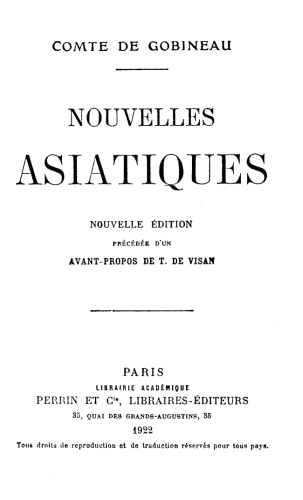 Nouvelles Asiatiques
by comte de Arthur Gobineau
Nouvelles Asiatiques
by comte de Arthur Gobineau
 The Moral and Intellectual Diversity of Races / With Particular Reference to Their Respective Influence in the Civil and Political History of Mankind
by comte de Arthur Gobineau
The Moral and Intellectual Diversity of Races / With Particular Reference to Their Respective Influence in the Civil and Political History of Mankind
by comte de Arthur Gobineau