
About This Book
The essays analyze how collective life and the state arise from overlapping associations, distinguish public concerns from private ones, and critique theories that see the state as either the highest ethical whole or mere coercive machinery. It traces how technological change and specialized expertise have dispersed public attention, weakening democratic control, and argues for reconstructing a deliberative public through improved communication, shared intelligence, and educational habits. The argument examines the functions of law, the selection and accountability of officials, tensions between experts and democratic participation, and the idea of a Great Community that relies on informed communication and scientific inquiry to coordinate social aims.
About the Author

More Books by This Author
 China, Japan and the U.S.A. / Present-Day Conditions in the Far East and Their Bearing on the Washington Conference
by John Dewey
China, Japan and the U.S.A. / Present-Day Conditions in the Far East and Their Bearing on the Washington Conference
by John Dewey
 Creative Intelligence: Essays in the Pragmatic Attitude
by John Dewey
Creative Intelligence: Essays in the Pragmatic Attitude
by John Dewey
 Democracy and Education: An Introduction to the Philosophy of Education
by John Dewey
Democracy and Education: An Introduction to the Philosophy of Education
by John Dewey
 Essays in Experimental Logic
by John Dewey
Essays in Experimental Logic
by John Dewey
 Ethics
by John Dewey
Ethics
by John Dewey
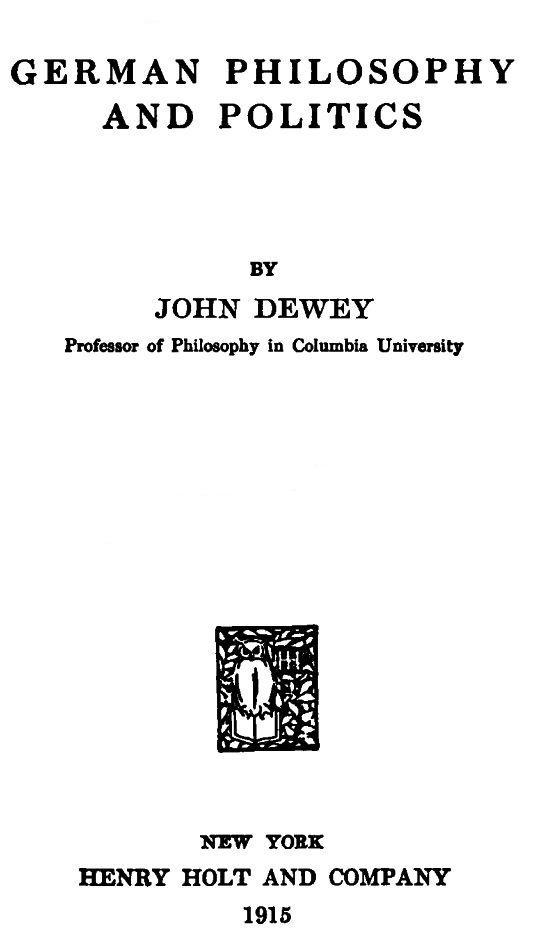 German philosophy and politics
by John Dewey
German philosophy and politics
by John Dewey
You May Also Like
 "About My Father's Business": Work Amidst the Sick, the Sad, and the Sorrowing
by Thomas Archer
"About My Father's Business": Work Amidst the Sick, the Sad, and the Sorrowing
by Thomas Archer
 "Beautiful Thoughts"
by Henry Drummond
"Beautiful Thoughts"
by Henry Drummond
 "Bethink Yourselves!"
by graf Leo Tolstoy
"Bethink Yourselves!"
by graf Leo Tolstoy
 "How Can I Help to Abolish Slavery?" or, Counsels to the Newly Converted
by Maria Weston Chapman
"How Can I Help to Abolish Slavery?" or, Counsels to the Newly Converted
by Maria Weston Chapman
 "I Believe" and other essays
by Guy Thorne
"I Believe" and other essays
by Guy Thorne
 "Imperialism" and "The Tracks of Our Forefathers"
by Charles Francis Adams
"Imperialism" and "The Tracks of Our Forefathers"
by Charles Francis Adams