
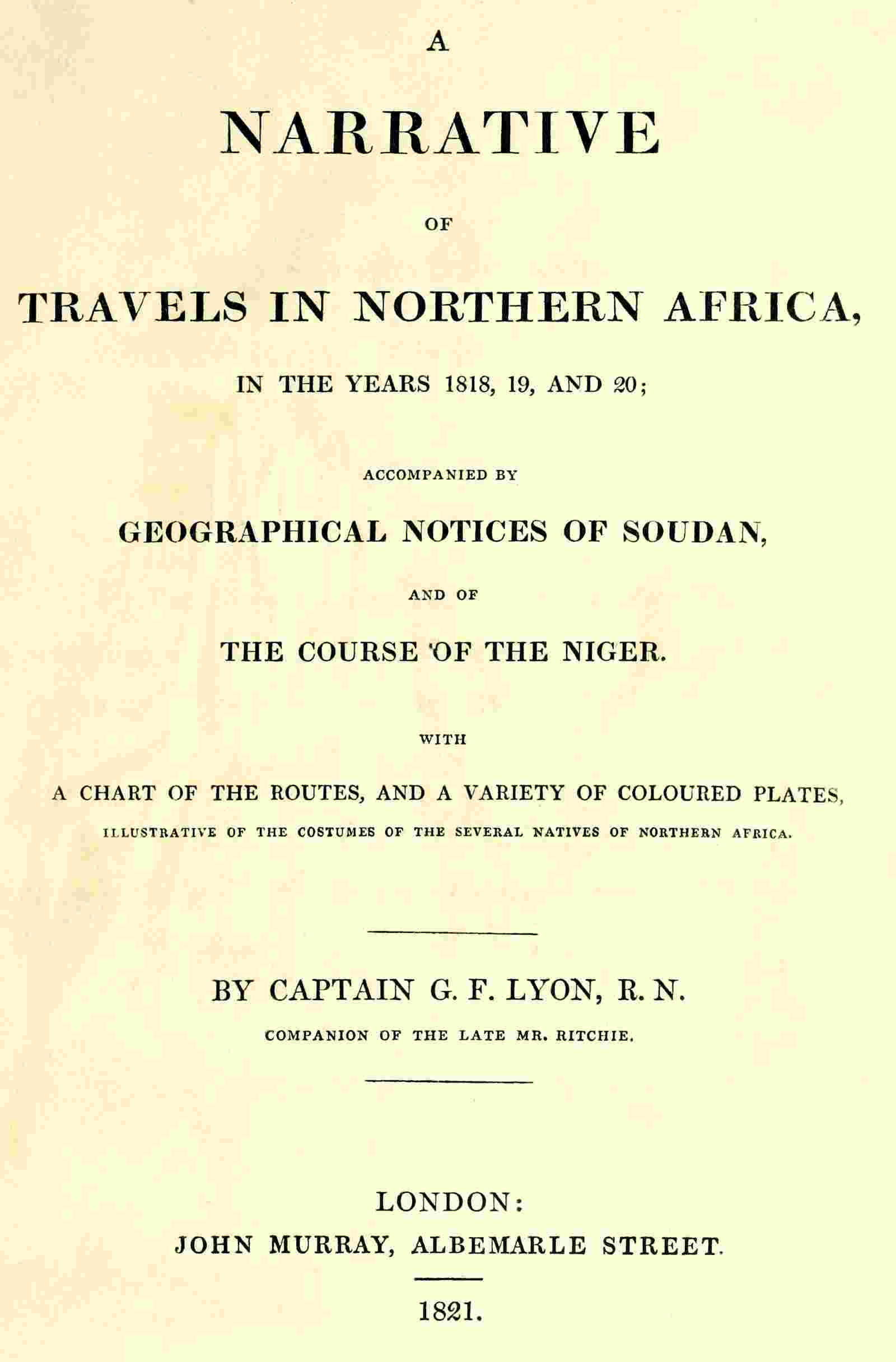
The Project Gutenberg eBook of A narrative of travels in northern Africa in the years 1818, 19, and 20; accompanied by geographical notices of Soudan and of the course of the Niger
Title: A narrative of travels in northern Africa in the years 1818, 19, and 20; accompanied by geographical notices of Soudan and of the course of the Niger
Author: G. F. Lyon
Contributor: William Buckland
Release date: May 22, 2023 [eBook #70833]
Language: English
Original publication: United Kingdom: John Murray, 1821
Credits: Galo Flordelis (This file was produced from images generously made available by The Internet Archive)
A
NARRATIVE
OF
TRAVELS IN NORTHERN
AFRICA,
IN THE YEARS 1818, 19, AND
20;
ACCOMPANIED
BY
GEOGRAPHICAL NOTICES OF
SOUDAN,
AND OF
THE COURSE OF THE NIGER.
WITH
A
CHART OF THE ROUTES, AND A VARIETY OF COLOURED PLATES,
ILLUSTRATIVE OF THE COSTUMES OF THE
SEVERAL NATIVES OF NORTHERN AFRICA.
BY CAPTAIN G. F. LYON, R.
N.
COMPANION OF THE LATE MR. RITCHIE.
LONDON:
JOHN MURRAY, ALBEMARLE STREET.
1821.
LONDON:
PRINTED BY THOMAS DAVISON,
WHITEFRIARS.
TO
HIS MOST EXCELLENT MAJESTY
GEORGE THE
FOURTH.
Sire,
For the gracious condescension of Your Majesty, in permitting me to place the following pages under Your Royal Patronage, I shall ever be impressed with the most sincere gratitude.
That Your Majesty may long, happily, and uninterruptedly reign in the hearts and over the destinies of your faithful people, is the constant and fervent prayer of,
Your Majesty’s
Most dutiful and most devoted
Subject and Servant,
GEORGE FRANCIS LYON.
March, 1821.
PREFACE.
The situation of an author, when he presents himself to the scrutinizing observation of the public, must ever be one of the greatest doubt and anxiety; but as the following pages are intended only to detail facts in the plainest manner, without attempt at embellishment of any kind, it is hoped that they will not only meet with indulgence from the general reader, but escape, without very severe comment, from the examination of the critic. All that can be said in their recommendation is, that they adhere strictly to truth, and that not a single incident described by the author is in the slightest degree exaggerated; on the contrary, he has not only abridged but, in some instances, entirely omitted to mention circumstances which occurred to him, fearing either to excite doubt in the minds of his readers, or by too long details to trespass on their patience.
The Tour is divided into two parts. The first comprizes the original progress of the mission from Tripoli to Morzouk, where the unfortunate Mr. Ritchie died: the second embraces the author’s examination of the remainder of the kingdom of Fezzan, from the death of his companion, until the final return of the mission to Tripoli; it being deemed too hazardous to attempt advancing farther into the interior, without fresh authority and additional pecuniary supplies from Government.
In that part of the journey which was undertaken after the death of Mr. Ritchie, the state of the temperature is, by a thermometer, graduated according to Reaumur.
In consequence of Mr. Ritchie’s frequent and debilitating attacks of illness, and his having relied too much on a singularly retentive memory, he had, from time to time, delayed committing his remarks to paper, in the delusive anticipation of ease and leisure, which, unhappily, he was destined never to enjoy; and it was thus owing to an unfortunate procrastination, that much valuable information has been lost to the world.
The present journal, therefore, although regularly kept, must necessarily be very inferior to that which would have been produced by Mr. Ritchie, had he been blessed with better health and prolonged life; but, however great his loss may be considered in a scientific point of view, this circumstance, it is earnestly hoped, will operate as an additional claim, on the part of the author, to the kind consideration of the public, to whom he offers his little work only as an humble substitute for one which would have been far better arranged; trusting that in his total want of pretension and ready admission of its defects, it may meet the general indulgence, which he can claim on no other account.
The author is indebted to the kindness of the Rev. W. Buckland, Professor of Mineralogy at Oxford, for the interesting paper on the geology of the kingdom of Fezzan.
DIRECTIONS TO THE BINDER,
FOR PLACING THE PLATES.
| Map to face the title-page. | PAGE |
| Costume of Tripoli | 7 |
| Tripoli Costume | 17 |
| Triumphal Arch | 18 |
| Arabs exercising | 46 |
| Bonjem | 67 |
| Sand Wind | 70 |
| Piper and Dancer | 75 |
| Castle of Morzouk | 98 |
| Tuarick in a Leather Shirt | 110 |
| Tuarick of Ghraat | 113 |
| Costume of Soudan | 161 |
| Negresses of Soudan | 182 |
| Tibboo Woman—Full Dress | 225 |
| Tibboo of Gatrone | 235 |
| Tuarick on his Maherry | 293 |
| Camel conveying a Bride | 299 |
| Slave Kafflé | 325 |
CONTENTS.
| CHAPTER I. | |
| The Author’s Departure from Malta — Arrival at Tripoli — Character of Mohammed el Mukni, Bey of Fezzan — Equipment of Mr. Ritchie and the Author — Costume of the Natives of Tripoli — Character of the Marāboots, and Celebration of their annual Festival — The Natives of Tripoli — Their Habits, Customs, &c. — Public Baths — Punishments — Costumes of the Women — Tripoline Marriages and Funerals — Funeral of the Bashaw’s Grand-daughter — Resignation of M. Dupont — Journey to the Gharian Mountains and Benioleed, in Company with Mr. Ritchie — General Appearance of the Country — Arrival at the Gharian Mountains — Visit to the Sheikh — Short Account of the Passes — Roman Tomb — Castle of Gharian — Distressed State of Usadena — Account of the People of Gharian — Set out for Benioleed, through the gravelly Desert — Arrival at Benioleed — Character of the Inhabitants — Its Population — Description of the Arabs — Their Religion, Manners, Habits, &c. | Page 1 |
| CHAPTER II. | |
| JOURNEY FROM TRIPOLI TO MORZOUK. | |
| Preparations for their Departure, in Company with Mohammed el Mukni — Encampment in the Mountains of Terhoona, and at the Wells of Melghra — Arrival at Benioleed — Interview with the Wife of the Sheikh, of the Kafflé — Their Christian Friends return to Tripoli — Punishment of an Arab for Theft — Journey over the Desert — Remains of a Roman Castle — Continuation of the Journey, until their Arrival at Sockna — Entry into that City — Description of it — Manner of raising the Tribute Money — Accompany the Sultan’s Son to Hoon and Wadan, to receive the Taxes — Account of those Places — Return to Sockna — Leave Sockna — Singular Custom imposed on Travellers in passing the Soudah Mountains — Arrival at Nufdai — Clear the Soudah Mountains — And travel over the gravelly Plain, through the Pass of Kenair, to the Well of Om el Abeed — Visit the Towns of Zeighan and Samnoo, famed for their Marāboots — Encamp at Temenhint — Arrival at Sebha, where the Black Population commences — Pass on to Ghroodwa — Entry to Morzouk, the Capital of Fezzan | 58 |
| CHAPTER III. | |
| ARRIVAL AT MORZOUK. | |
| Mode of travelling across the Desert — Interview with the Sultan — Description of Morzouk — Population — Castle of the Sultan — Illness and severe Distress of the Author and his Companions — Arrival of a Kafflé of Tuarick — Fast of Rhamadan — Departure of an Expedition to obtain Slaves from the Country of Borgoo — Diseases of the Inhabitants, and the Native Methods of Cure — Feast of Aidel Shraya — Observations on the Tuarick — Their Religion, Dress, Customs, and Language — Ghraat — Its Government, Laws, and Trade — Market there — Arrival of a Kafflé from Bornou with Slaves — Information respecting Bornou and the surrounding Countries, as collected from the Traders — Of Kashna and Soudan, in general — Account of Hornemann and his Death — Tembuctoo — General Remarks on the Geography of the Interior, and probable Course of the Niger — Vocabulary of the Fellātta Language — Conjectures on the Fate of Park | 89 |
| CHAPTER IV. | |
| Articles of Commerce between Fezzan and the Interior, as well as to Egypt, Bornou, and Waday — Gonja — Description of Ghadams — Benewaleed and Benewazeed — Reports of a Successor to Mukni — His Illness — Gardens — Costumes of the Natives — Their Amusements — Visits to the Sultan’s Family — Celebration of the Feast of Aid el Kebire — Sickness and Sufferings of the Author and his Companions — Education of the Children of Morzouk — Revenues of the Sultan of Fezzan — Illness and lamented Death of Mr. Ritchie — His Funeral — Determination of the Author to penetrate to the Southward of Morzouk | 152 |
| CHAPTER V. | |
| Departure for Tegerry, through Zuela and Gatrone — Arrival at Zaizow — Pass on to Traghan — Visit Gardens and Springs — Arrival at Zaitoon and Touela — Pass Villages of Maghwa and Taleb — Arrival at Hamera — Illness — Leave Hamera — Bearings of its neighbouring Villages — Large Salt Plain — Arrival at Zuela — Description of Inhabitants — Author’s Illness — Ancient Buildings — Hospitality of the Shreefs — Leave the Town — Arrival at Terboo — Its Wretchedness — Curious Story of Marāboot — Arrival at Mejdool — Journey across the Desert, and Arrival at Gatrone — Feast of Milood — Costume, Character, and general Description of the Tibboo — Description of Gatrone — Accounts of Tibesty and Waday, from a Tibboo Trader — Tibboo Language — Leave Gatrone in order to meet the Grazzie — El Bakkhi — Tibboo Manner of making Tar — Arrival at Tegerry | 202 |
| CHAPTER VI. | |
| Castle of Tegerry — Description of the Town — Some Accounts of the Desert of Bilma — Salt Lake of Agram — Ride out on the Desert — Leave Tegerry — Belford’s dangerous State — Return to Gatrone — Arrival of the Grazzie, or Slave-hunters, with many Captives and Camels — Account of their Excursion, and of Borgoo and Wajunga — Manner of making Captives — Leave Gatrone in Company with the Grazzie — Mestoota — Reception at Deesa — Feast at Zaizow — Return to Morzouk — Go out to witness the Triumph of the Slave-hunters — Sultan’s Reception of his Son — Remarks on Grazzies — Accounts of Slave-markets — Arrival of Aboo Becker, and Continuation of Mukni in Command — Further Accounts of the Countries of the Tibboo — Arrangements in the Sale of Slaves, so as to ensure the Sultan his Share | 239 |
| CHAPTER VII. | |
| OF FEZZAN. | |
| Aspect of the Country — State of Cultivation — Minerals — Animals — Birds — Vegetable Productions — Fruits — Esculents — Time and Manner of cultivating Grain — Water — Towns — Food of Inhabitants — Possibility of improving Agriculture — Tenure of Lands — Weights and Measures — Government — Principal People — Character of the Natives — Inroads into the Negro Countries — State of the Slave Trade — Crimes and Punishments — Character of the Natives — Religion — State of Literature and Ingenuity — Language — State of the Women — Records — Slavery and the Slave Trade — Laws relative to the Issue of Slaves | 270 |
| CHAPTER VIII. | |
| Arrangements for our Departure from Morzouk — Parting with the Sultan — Leave Morzouk to return to Tripoli — Sleep at Dgleim — Mode of conducting a Kafflé of Slaves — Arrival at Ghroodwa — Pass two Days at Sebha — Are joined by more Kafflés — Marriage of an Arab — Account of the Wadey Shati — Arrive at Temenhint — Zeghen Om el Abeed — Pass of Kenair — Pass over the five Days Desert to Sockna — Troubles at Sockna — Further Description of that Place | 290 |
| CHAPTER IX. | |
| Leave Sockna — Stop at Hammam — Well of Temedd — Sufferings of the Slaves — Arrive at Bonjem — Danger on the Desert — Zemzem — Sofageen — Storm in the Mountains — See two Roman Ruins — Arrive at Zleetun — Description of that Place — Leave Zleetun — Visit Lebida — Illness — Arrival at Tripoli — Account of the Negroes of the Kafflé — General Notices of the Desert — Belford’s bad State of Health — Departure from Tripoli — Pass Quarantine at Leghorn — Return over the Continent to England | 323 |
MAP
of a Route through the
REGENCY OF TRIPOLI
طربلس
AND
KINGDOM OF FEZZAN
فزّان
Performed in the Years 1818-19 & 20.
BY CAPTN. G. F. LYON.
R.N.
Engraved under the direction of A. Arrowsmith.
London, Published by John Murray, 50 Albemarle Strt. March, 1821.
TRAVELS
FROM
TRIPOLI TO
MOURZOUK.
CHAPTER I.
The Author’s Departure from Malta — Arrival at Tripoli — Character of Mohammed el Mukni, Bey of Fezzan — Equipment of Mr. Ritchie and the Author — Costume of the Natives of Tripoli — Character of the Marāboots, and Celebration of their annual Festival — The Natives of Tripoli — Their Habits, Customs, &c. — Public Baths — Punishments — Costumes of the Women — Tripoline Marriages and Funerals — Funeral of the Bashaw’s Grand-daughter — Resignation of M. Dupont — Journey to the Gharian Mountains and Benioleed, in Company with Mr. Ritchie — General Appearance of the Country — Arrival at the Gharian Mountains — Visit to the Sheikh — Short Account of the Passes — Roman Tomb — Castle of Gharian — Distressed State of Usadena — Account of the People of Gharian — Set out for Benioleed, through the gravelly Desert — Arrival at Benioleed — Character of the Inhabitants — Its Population — Description of the Arabs — Their Religion, Manners, Habits, &c.
IN the month of September, 1818, Mr. Ritchie, a gentleman of great science and ability, employed by the British government on a mission to the interior of Africa, arrived at Malta from Marseilles, attended by M. Dupont, a Frenchman in his pay, whom he had engaged for the purpose of collecting and preparing objects of natural history. It was understood that Captain Marryat, of the Royal Navy, was also to have accompanied Mr. Ritchie; but that circumstances had occurred which induced that gentleman to relinquish his intention of joining the mission. Soon after Mr. Ritchie’s arrival in Malta, I was fortunate enough to become acquainted with him, and hearing him express his disappointment at having failed to obtain Captain Marryat as his companion on the proposed expedition, I ventured to offer my best endeavours to supply his place, and although conscious that I had but little talent to boast, I yet hoped that the zeal by which I was actuated would in some degree make amends for my deficiencies in other respects. Mr. Ritchie, without hesitation, accepted my proposal, and in consequence lost no time in applying to Admiral Sir C. V. Penrose, Commander-in-Chief in the Mediterranean, to solicit the necessary leave for my quitting the Albion. Sir C. Penrose, in the kindest and most flattering manner, acceded to the request, and immediately wrote in my favour to the Lords of the Admiralty, to obtain permission for me to belong to the mission. Mr. Ritchie in the meantime occupied himself in making preparations for his departure; and, as an addition to his small party, engaged a ship-wright from the dockyard, Malta, named John Belford (who, as well as myself, was a volunteer), to accompany him. His arrangements thus made, Mr. Ritchie, on the 10th October, sailed for Tripoli in the Admiral’s schooner, leaving me behind, anxiously awaiting an answer from England to the application made for me. I employed this period of suspense in acquiring the Arabic alphabet, and in otherwise preparing myself for the object in view. On 19th November the wished for permission arrived, and on November 21st I sailed from Malta in the tender for Tripoli, at which place I arrived on the 25th of November, 1818. I found Mr. Ritchie still there, and likely to remain sometime longer. He was residing in the house of the British consul, Colonel Warrington, who received me most hospitably, and invited me to take up my quarters under his roof. Mr. Ritchie’s intention being to proceed to Mourzouk, مرزوك the capital of Fezzan فزّان with the Sultan of that country, his motions were to be regulated by the departure of this person, who, as we learned, was about to take with him a large body of men, for the purpose of waging war on the inhabitants of Waday, واداي (the Borgoo of Brown) which is to the southward and eastward of Fezzan; but as the people of Tripoli were by no means alert in coming forward, and as the Bashaw did not appear much inclined to compel them, no just idea could be formed as to the probable time of our setting off.
Mohammed el Mukni محمد المكني who at Tripoli is called the Bey of Fezzan, (but who takes the title of sultan on entering his own territories), is a man of about fifty years of age, of a fine martial appearance, and of great personal strength; but withal of an insatiable ambition and excessive avarice. He was one of the chief supporters and friends of the Bashaw during the reign of his father, and was afterwards of considerable assistance to him in quelling the disturbances which took place on his usurping the throne. Mukni was at this time in great favour, and considered as a person of much consequence. After his father’s death he became Bey el Noba, or collector of the Bashaw’s tribute from the Sultan of Fezzan, and went thither annually to receive it. Though the tribute was trifling, the office of Bey el Noba was held of great importance. It was while acting in this capacity that Horneman accompanied him to Fezzan. Mukni’s frequent visits to that country gave him opportunities of ascertaining that the sum paid as the tribute was but a very small part of the immense gains of the reigning Sultan; and having once determined on getting the kingdom into his own hands, he soon found means to influence the Bashaw to permit his removing the reigning family, under pretence that such a change would be for the Bashaw’s sole emolument. In 1811, therefore, he took a body of men by the Gharian mountains, and succeeded in reaching Mourzouk undiscovered. The detail of his proceedings would be wholly uninteresting; suffice it to say, that his ambitious views were fully accomplished. He caused the Sultan and his brother to be strangled, as well as the principal Mamluke and his two eldest sons; and pretending that it was unsafe to leave Mourzouk immediately after these acts of cruelty and injustice, he had the address to persuade the Bashaw to appoint him his viceroy, promising to increase the tribute to 15,000 dollars annually, whereas that of the former Sultan did not exceed 5000. Having thus established himself, he waged war on all his defenceless neighbours, and annually carried off 4000 or 5000 slaves. From one of these slave-hunts into Kanem he had just returned to Tripoli, with a numerous body of captives and many camels, and was, in consequence, in the highest favour with the Bashaw.
I learnt on my arrival that Mr. Ritchie had several times had interviews with the Bashaw, to whom he made many valuable presents; and that His Highness was fully informed of his proposed journey and plans respecting the interior. Though Mr. Ritchie himself never communicated with me on this subject, or made known what occurred at these interviews, I have every reason to conclude they were favourable to the object he had in view, and that the protection of the Bashaw, as far as his power extended, was fully ensured to the mission. The Sultan of Fezzan also on his side made the most flattering promises of protection; declaring that he only awaited the opportunity of showing his good will, and that, when arrived in his own dominions, he would act towards Mr. Ritchie as a brother, and assist him in all things to the utmost of his power. After my own introduction to Mukni, I frequently heard him repeat these expressions of regard towards Mr. Ritchie, and they extended also to myself, whom he promised equally to protect and assist.
With so powerful and friendly an ally as we had every reason to consider Mukni, we of course felt perfect security and confidence in the future, and we remained in the firm hope and assurance that all these flattering professions would be fully realised on our arrival in the kingdom of Fezzan. In a few days after I reached Tripoli I was introduced by the British Consul to the Bashaw; but as it was a private audience only, I had no opportunity of witnessing the splendour of his court. As neither Mr. Ritchie nor myself were yet equipped in our Moorish costume, which we were particularly advised by the Bashaw to adopt, we did not appear much in public; but having procured the Consul’s permission to reside in a house once belonging to the Portuguese consulate, we removed there in order to prepare ourselves for our outfit. I furnished myself with a horse and the greater part of my equipments, Mr. Ritchie not possessing sufficient funds for that purpose.
When presented to the Bashaw, it was thought absolutely necessary, by way of adding consequence and respectability to the mission, that I should be styled captain. I was therefore introduced as a Rais, or commander of a ship of war. Had I been supposed to have held an inferior rank, my reception by the great man would not have been so flattering, there being no intermediate gradation known in that country.
On the 5th of December, 1818, having accepted an invitation to pass the evening at the house of the Sheikh el Bled, or Governor of the town, we sent for an old barber to shave our heads; and our beards (which we had suffered to grow, and which now made a respectable appearance), were put in order for the occasion.
Our costume was that of the better class of Tripolines, who have two kinds of dresses; the one long, and worn chiefly by elderly men and persons of great consequence; the other short, and worn generally. For the information of future travellers, I shall enumerate the different articles of clothing.
Short Dress.
Sidrea.—A waistcoat fitting tight to the body, without any opening in front, having only holes for the neck and arms. It is pulled on in the same manner as the Guernsey frock used by seamen.
Farmela is a second waistcoat, open in front, and having broad gold lace and buttons, but no button-holes. It hangs over the sidrea.
Zibboon.—A jacket, the sleeves of which are embroidered. These first three dresses are confined round the waist by the band of the trowsers, which come outside them. A broad belt of silk or gold is then passed round the body. Over the jacket is an embroidered waistcoat without sleeves, called
Bidrïah.—All these dresses may be of different colours, the most brilliant and gaudy being chiefly in request. On walking out, a hooded cloak of very finely spun white wool is thrown over all, and on great occasions a cloth one of the same form, bordered with rich gold lace, is used. This cloak is called Bornouse. The trowsers are immense, and of silk or cloth, according to the pleasure of the wearer.
The Long Dress
Consists of the two under waistcoats: over them is worn a caftan, which is a long gown or robe, embroidered in front and at the sleeves. Over this is worn a
Beneish, which resembles a caftan in shape, but differs in the disposition of the ornaments.
Jerba is a caftan with short sleeves, and is often worn in lieu of the Beneish.
| Drawn from Nature by G. F. Lyon. | On Stone by M. Gauci. |
Costume of Tripoli.
London. Published by J. Murray Albemarle
St. Feb.1.1821.
C. Hullmandel’s Lithography.
Over these dresses woollen and cloth Bornouses are worn. The turbans are various, according to fancy: shawls of Cashmere, or imitations of those of Europe, are considered as the most splendid. Green turbans, it is well known, can be worn by none who are not shreefs, or descendants of the prophet. Blue, being the colour confined to the Jews, is of course not used in the turbans of the Mohammedans.
In riding out, boots of red, and sometimes yellow Morocco leather are worn, a pad being closely tied round each ankle before putting them on, in order to prevent the large stirrups from hurting the leg. When not riding, yellow slippers, with soles of the same kind as the upper leathers, are used, and are slipped into large solid ones of the same colour with thick soles when walking out. These last are always left at the door on entering a room. Red shoes are also worn by the middle class. The Jews are restricted to black. The trappings of the horse are gaudy, and as cumbrous as those of its rider. The saddles are high before and behind, much the same as those used in Spain. Under them, on the back of the horse, are five or six cloths of different colours, which are so arranged that the edges of each are shown. The saddles are frequently covered with highly embroidered velvet, or richly embossed gilt cases. Over the seat is thrown a saddle-cloth, bordered with gilt lace and embroidery. The stirrups are from a foot to twenty inches in length, and are generally gilt.
Having thus given a sketch of the costume of the Tripoli men, I conceive it necessary to mention that we fully adopted the dress and appearance of Moslems, using all our endeavours to become acquainted with their manners. Mr. Ritchie assumed the name of Yussuf el Ritchie, يوسف الريتشي Belford was called Ali, Dupont Mourad, and I was styled Said ben abd Allah سعيدبن عبدالله. We found no difficulty in procuring a fighi (or clerk) of one of the mosques to visit us at stated periods to instruct us in reading. He also, at my particular request, gave me all the requisite information respecting the ceremonies used in prayer; and when I became perfect in them, I taught them to Mr. Ritchie.
Every thing now seemed to promise well, as far as our residence in Tripoli was concerned; but Mr. Ritchie felt much anxiety respecting a further allowance from government, as we had scarcely more than money sufficient to pay the hire of our camels to Mourzouk, and beyond that place we were uncertain how we could procure a fresh supply for the use of the mission. Mr. Ritchie had brought with him a good deal of merchandize; but, from what he learnt at Tripoli, it was likely to be of little service to us, as it consisted of few or none of the articles of trade most commonly used in the interior.
Sidi Mohammed d’Gheïs, formerly minister to the Bashaw, but who had retired some years since on account of total blindness, showed us every attention, and by his kind assistance afforded us most useful information. He had travelled much in Europe, and was well acquainted with our customs, so that he was perfectly qualified to caution us on many points which, had we remained in ignorance of them, would inevitably have betrayed us to be Christians to the people in the interior.
It would be useless to attempt giving any description of the city of Tripoli, as it has already been done by far more able pens than mine; but of any particular occurrences which attracted my attention during my residence there, I conceive I may be allowed to make mention. The most extraordinary characters are the Marāboots, مرابوت a set of people much spoken of in all Moslem countries; but it strikes me that the requisites necessary to constitute one of these saints are not every where the same. In the interior they consist in keeping up the outward show of sanctity, in abstaining from proscribed liquors, in avoiding improper or profane expressions, in being faithful to the limited number of wives (namely four), and in not intriguing with the wives of other men; whilst in Tripoli such forbearance is by no means considered necessary. The Marāboots there, are of two classes: idiots, who are allowed to say and do whatever they please; and men possessed of all their senses, who, by juggling and performing many bold and disgusting tricks, establish to themselves the exclusive right of being the greatest rogues and nuisances to be met with. There are mosques in which these people assemble every Friday afternoon, and where they eat snakes, scorpions, &c. affecting to be inspired, and committing the greatest extravagancies.
On the 9th of January, 1819, their annual festival began, and continued for three days, with all its barbarous ceremonies. On, or rather before this day, the great Marāboot is supposed to inspire those who are to appear in the processions, and who, according to their abilities, are more or less mad and furious. The natural fools are always ready for the exhibition; and it is amusing to observe their looks of astonishment at being on that day, more than any other, brought into notice. During the time the Marāboots (who are guarded and attended by a great number of people) are allowed to parade the streets, no Christians or Jews can with any safety make their appearance, as they would, if once in the power of these wretches, be instantly torn to pieces; indeed, wherever they show themselves on their terraces or from windows, they are sure of a plentiful shower of stones from the boys who are in attendance.
As I was in the dress of the country, and very anxious to witness the whole of the ceremonies, I ventured to go out with our Dragoman, and to make my way to the mosque from which the procession was to set out. I certainly felt that my situation was a very dangerous one; but being resolved on the attempt, and telling the man to follow me closely, I dashed in with the crowd, and succeeded in getting near the Saints, who, with dishevelled hair, were rapidly turning round, and working themselves into a most alarming state of frenzy. A band of barbarous music was playing to them, while several men were constantly employed in sprinkling them with rose-water. Had I been discovered, my life would have been in very great jeopardy; but fortunately I was able to keep my countenance, and to pass unnoticed; and when the performers were sufficiently inspired, sallied out with them, and followed through the streets. One had a large nail run through his face from one cheek to the other; and all had bitten their tongues in so violent a manner as to cause blood and saliva to flow copiously. They were half naked, at intervals uttering short groans and howls; and as they proceeded (sometimes three or four abreast leaning on each other,) they threw their heads backwards and forwards with a quick motion, which caused the blood to rise in their faces, and their eyes to project from the sockets to a frightful degree. Their long black hair, which grew from the crown of the head (the other parts being closely shaven), was continually waving to and fro, owing to the motion of the head. One or two, who were the most furious, and who continually attempted to run at the crowd, were held by a man on each side, by means of a rope, or a handkerchief tied round the middle. As we passed through one of the streets, a party of Maltese and other Christians were discovered on a terrace, and were instantly assailed by showers of stones. I observed that whenever the Marāboots passed the house of a Christian, they affected to be ungovernable, and endeavoured to get near it, pretending they made the discovery by smelling out Unbelievers. After following for an hour or two, during which I witnessed the most horrible and revolting scenes, I returned home, when, to my great amusement, I learnt that a rumour prevailed of my having been attacked and very ill treated; and that I had, in defending myself, stabbed a Marāboot, and ran away, no one knew whither. I was happy to be enabled in person to contradict these reports, and to prove that I had escaped not only unhurt, but unobserved. There were two parties who traversed the town; but from their being of opposite sects, and at war with each other, it was so arranged that they should take different routes.
That which I did not see was the superior one, and took its departure from under the walls of the castle. It was headed by a man named Mohammed, who had been much at our house, going on errands, and attending our horses. I did not, until afterwards, know he was so celebrated a character. Before the time of the procession he was confined in a dungeon, in consequence of his becoming very furious. When all was in readiness for the ceremony, the Bashaw took his station in the balcony overlooking the Arsenal, and this man was set at liberty, when he rushed on an ass, and with one thrust pushed his hand into the animal’s side, from which he tore its bowels, and began to devour them. Many eat dogs, and other animals; and on that day a little Jew boy was killed in the street, either by the Marāboots or their followers.
As the power of taking up serpents and scorpions is supposed to constitute a Marāboot, I determined on acquiring that honorable title. Mr. Ritchie bought some snakes, which we all learnt to handle, and I soon found out an effectual way of taking up the largest scorpions without the slightest chance of being stung. However, in order to observe the ceremonies practised by these pretended saints, I sent a servant in search of one of the most celebrated, under pretence of wishing myself to become a Marāboot. This fellow went through numberless prayers and ceremonies, spitting in my hands, taking rose-water in his mouth, and sprinkling my face with it, reciting occasional prayers, and then washing his own mouth and hands in rose-water. After bottling up this sacred fluid, he told me to drink it on a particular day, which he named, and I then should be as highly gifted as himself; thus concluding his instructions, which, of course, I did not think myself bound to observe.
There are two grand markets held weekly, one on the sands behind the town every Tuesday, and the other on Fridays, about four miles distance, amongst the gardens of the Meshea مشيه which form a stripe of about three or four miles in breadth, between the beach and the desert.
In the town are Bazaars, which are open every day. These are streets, covered in overhead. The shops of merchants are ranged on each side, and are very small. Slaves and goods are carried about before the traders by auctioneers, who keep up a continual din, each calling the price last bidden. The Jews have a quarter of the town expressly to themselves, where they have their shops, and in which they are shut up every evening at sunset. This place is called Zanga t’el Yahood زنقامتا اليحود. These people are much persecuted, yet they contrive to engross all the trade and places of profit. They are forbidden, as I before observed, to wear gaudy clothes, and are only allowed turbans of blue.
Several houses set apart for the reception of merchants and their goods are called Fondook, فندوك and answer to the description given of the Caravanseras of the East. There are a few schools at which reading and writing, though to no great extent, are taught in a very noisy manner. A knowledge of letters, however, is by no means necessary to constitute a great man, or to advance him to any post of trust: of this there exists an example in the present minister, Sidi Hamet (who was formerly Rais el Marsa, or Captain of the port), and who can neither read nor write. We had often heard this circumstance, and one day put into his hands the Koran, with the wrong side uppermost, begging him to repeat to us a few lines of it. He evaded our request by pretending to read to himself for a short time, with the book still turned the wrong way; when assuming a very sagacious look, he returned it to us, observing, that “it was very well written,” and thus convincing us we had not been misinformed respecting his ignorance. The Sheikh el Bled, or Governor of the town, is considered a very good scholar, and ready accountant, though he was once a boatman in the harbour. The contrast between the rigidity of some Moslems, and the indifference of others respecting association with Christians, is curiously exemplified in this man. He had sent his son to learn Italian under a Roman Catholic priest, without at all disguising the circumstance.
Drunkenness is more common in Tripoli than even in most towns in England. There are public wine-houses, at the doors of which the Moors sit and drink without any scruple; and the Saldanah, or place of the guard, is seldom without a few drunkards. The greater part of the better sort of people also drink very hard; but their favourite beverage is Rosolia, an Italian cordial, and it is not uncommon for visitors, when making calls, to give unequivocal hints that a little rum would be well received. Prostitutes are in large numbers, and are obliged (if known to be such) to live in a particular part of the town (called Zanga t’el Ghaab زنقامت الغعب or quarter of the prostitutes), under a Chowse, or superintendent, appointed expressly for that purpose. These women are obliged daily to supply food for the Bashaw’s dogs which guard the Arsenal.
A kind of bad Italian is generally spoken by the Inhabitants of the town; so that Christians have not much difficulty in transacting business.
I observed a singular custom to be prevalent amongst all Moors and Arabs, from the Bashaw down to the poorest camel-driver, which is that of eructation, and which they perform as often and as loudly as possible. Great men go through this ceremony with a solemnity and dignity altogether imposing; stroking their beards, and thanking God for the great relief they have obtained. Mukni was quite a professor in this way; and his little son Yussuf (a boy of about eight years of age,) promised fair to be equally accomplished. Both of the last mentioned personages had also a peculiar way of blowing their noses in the ends of their turbans.
Mamlukes (who are either renegades, or purchased slaves from Georgia or Circassia), enjoy the highest offices; and the Bashaw’s daughters are not permitted to marry any others. The Admiral of the fleet is a Mamluke, a Scotchman by birth, and now named Mourad Rais. He was in banishment during our stay at Tripoli; but we learnt from the Consul and chief people that he bore an excellent character.
The public Baths are of the same kind as those said to be used in Turkey and Egypt; although not so magnificent in point of ornament or size. The bather, on stripping, is girded round the middle with a linen cloth, and one also is thrown over the shoulders, which is taken off on entering the vapour chamber. This is a large circular room, having a dome, through which the light is admitted by many small holes well stopped with glass, and by which means the air is entirely excluded. The light is much obscured by the vapour, which constantly rises; lamps are therefore kept burning, those who first enter being for a time unable to see their way. Round the sides of the chamber are raised broad stone benches, and a large square place of the same description is in the centre; under these are the fires which heat the bath, and it is necessary to lie down on them in order to become ready for the operations of the men whose business it is to rub and clean the bathers. Water is then thrown over the body, so as to induce a quicker perspiration. The heat is excessive, and we had no Thermometer highly enough graduated to ascertain the temperature. When a sufficient time has elapsed to produce languor and strong perspiration, an assistant approaches and rubs the skin with a glove of hair, in such a way as to cause the cuticle to peel off in large dark rolls, however clean and white the skin may have appeared previously to this operation. He then proceeds to shampooing (called Temerse تمرس). The operations having thus finished, some soap is brought to the bather, and he remains sitting under a spout of warm water as long as he pleases. Dry cloths are then brought to him, and being well wrapped up, he is conducted to an outer room, where pipes and coffee are placed before him, with incense to perfume the beard, after which he dresses and sallies out. The price for the bath alone, without soap, is about five pence; though it was always more expensive to us than to the natives. The men come in the morning, and the women in the afternoon.
When the Bashaw rides to the Messhia, or gardens behind the town, he is accompanied by his sons, and a large troop of horsemen, consisting of Mamlukes and the principal people of his court, well mounted and splendidly attired. They ride in a confused body round his person, and have no idea of regularity in their motions. A few occasionally leave the main troop at full speed, screaming and making flourishes with their muskets, which they discharge, and then return to their ranks. On re-entering the town, the whole party charge in groups of ten or twelve, each firing while the horses are in full speed, which has an exceeding pretty effect. The horses (who are trained to the practice), as soon as they hear the explosion, turn suddenly round on their haunches, and canter back to the place from which they started. The beach being of hard sand, is admirably adapted for these manœuvres.
More than half of the guards are black, and as they are all dressed differently, their appearance is very curious. No uniformity is observed either in the shape or colour of their horses, whose bits are so severe, that they are seldom without raw and bleeding mouths. The stirrups (which act as spurs) are used so roughly as frequently to leave large gashes in the poor animal’s flanks. It is considered highly ornamental to brand the thighs of horses with lines and stars.
The mode of punishment at Tripoli (and, I believe, all other Mohammedan towns), is totally different from any of those practised by Europeans. Some crimes are considered capital by law; but many are rendered so by the whim of the Bashaw, in which case, hanging, decapitating, and strangling are used. The Moors are never employed as hangmen; but the first Jew who happens to be at hand has that office conferred upon him, and is obliged to accompany the culprit to the ramparts over the town gate, attended by the guards and mob, when he puts on the rope well or ill according to his ability, attaching it to a bolt fixed in the wall for that purpose. The unfortunate victim is then forced through an embrazure, and suspended by the side of the gateway, so as to be seen by all who enter or leave the town. When decapitation is the punishment, the head alone is exposed to public view.
Torture is not unfrequently made use of; but as all punishments of that kind are confined to the dungeons of the castle, no one can or dares give any description of the nature of it. Theft (as presented by the Koran) is punished by cutting off a hand, and, if to a very great extent, a foot also; but repeated offences of this kind extend sometimes to an amputation of the other hand or foot, and I once saw a man, who, for a capital crime, had been mutilated in this manner. The operation is performed with a razor. The limb is first tied tight above the joint with a piece of cord, and the hand or foot is taken out of the socket of the wrist or ankle joint. The stump is then dipped into hot pitch, and the sufferer is permitted to go away with his friends; and it is astonishing how soon he recovers without any other dressing than the one which I have mentioned. Beating with a stick on the posteriors or soles of the feet is the general punishment for minor offences; although in some cases it is so severe as to occasion death. Four or five hundred lashes are frequently given; but fifty is about the general allowance. Some culprits, who, by bribery, or other means, are able to influence the persons employed to see the sentence executed, contrive to stuff their trowsers so as to escape without much suffering. This punishment is inflicted equally on all ranks, at the pleasure of the Bashaw; and should even his own sons, his Minister, or the Sheikh of the town, displease him, they would be obliged to submit to it, as well as the lowest of his subjects; nor would they consider themselves at all degraded, or their dignity in any degree lessened by it.