
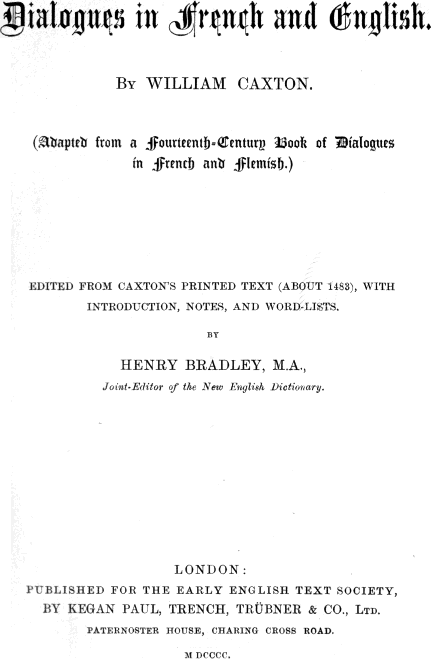
INTRODUCTION.
The work now for the first time reprinted from Caxton’s original edition has been preserved in three copies. One of these is in the Library of Ripon Cathedral, another in the Spencer Library, now at Manchester, and the third at Bamborough Castle. A small fragment, consisting of pp. 17-18 and 27-28, is in the Bodleian Library. The text of the present edition is taken from the Ripon copy. I have not had an opportunity of seeing this myself; but a type-written transcript was supplied to me by Mr. John Whitham, Chapter Clerk of Ripon Cathedral, and the proofs were collated with the Ripon book by the Rev. Dr. Fowler, Vice-Principal of Bishop Hatfield’s Hall, Durham, who was kind enough to re-examine every passage in which I suspected a possible inaccuracy. It is therefore reasonable to hope that the present reprint will be found to be a strictly faithful representation of the original edition.
The earlier bibliographers gave to the book the entirely inappropriate title of ‘Instructions for Travellers.’ Mr. Blades is nearer the mark in calling it ‘A Vocabulary in French and English,’ but, as it consists chiefly of a collection of colloquial phrases and dialogues, the designation adopted in the present edition appears to be preferable. As in other printed works of the same period, there is no title-page in the original edition, so that a modern editor is at liberty to give to the book whatever name may most accurately describe its character. The name of Caxton does not occur in the colophon, which merely states that the work was printed at Westminster; but the authorship is sufficiently certain from internal evidence. On the ground of the form of type employed, Mr. Blades inferred that the book was printed about 1483. However this may be, there are, as will be shown, decisive reasons for believing that it was written at a much earlier period.
A fact which has hitherto escaped notice is that Caxton’s book is essentially an adaptation of a collection of phrases and dialogues in French and Flemish, of which an edition was published by Michelant in 18751, from a MS. in the Bibliothèque Nationale.
The text of Caxton’s original cannot, indeed, have been precisely identical with that of the MS. used by Michelant. It contained many passages which are wanting in the Paris MS., and in some instances had obviously preferable readings. Caxton’s English sentences are very often servile translations from the Flemish, and he sometimes falls into the use of Flemish words and idioms in such a way as to show that his long residence abroad had impaired his familiarity with his native language. The French respaulme cet hanap, for instance, is rendered by ‘spoylle the cup.’ Of course the English verb spoylle never meant ‘to rinse’; Caxton was misled by the sound of the Flemish spoel. Caxton’s ‘after the house,’ as a translation of aual la maison (throughout the house), is explicable only by a reference to the Flemish version, which has achter huse. The verb formaketh, which has not elsewhere been found in English, is an adoption of the Flemish vermaect (repairs). Another Flemicism is Caxton’s whiler (= while ere) for ‘some time ago,’ in Flemish wilen eer. It is still more curious to find Caxton writing ‘it en is not,’ instead of ‘it is not’; this en is the particle prefixed in Flemish to the verb of a negative sentence. As is well known, Caxton’s translation of ‘Reynard the Fox’ exhibits many phenomena of a similar kind. From all the circumstances, we may perhaps conclude that Caxton, while still resident in Bruges, added an English column to his copy of the French-Flemish phrase-book, rather as a sort of exercise than with any view to publication, and that he handed it over to his compositors at Westminster without taking the trouble to subject it to any material revision.
The original work contains so many references to the city of Bruges that it is impossible to doubt that it was compiled there. According to Michelant, the Paris MS. was written in the first half of the fourteenth century. The MS. used by Caxton must itself have been written not later than the second decade of the fifteenth century; unless, indeed, it was an unaltered transcript from an older MS. The evidence on which this conclusion is based is somewhat curious. Caxton’s text contains two passages in which the pope is spoken of as still resident at Avignon. Now the ‘Babylonish captivity’ of the popes ended in 1378; and, even if we suppose that at Bruges the Avignon anti-popes were recognized by some persons to the very last, the latest date at which these passages could have been written is the year 1417. It is not easy to understand how it was possible for Caxton to leave uncorrected these references to a state of things which he must have known had long ceased to exist. The only explanation of the fact seems to be that, as has been suggested above, he sent his many years old MS. to the press without going over it again. It may be remarked that one of the Avignon passages does not occur in the text as printed by Michelant. As it would be absurd to suppose that it was introduced by Caxton himself, the inference is clear that his copy of the original work was fuller than that contained in the Paris MS. Probably Caxton may have added a few lines here and there—the mention of certain English towns and fairs on pp. 18-19, and that of English bishoprics on p. 23, for instance, were most likely inserted by him. But by far the greatest portion of the matter which is peculiar to Caxton’s form of the dialogues may be confidently ascribed to his original, on account of the frequent occurrence of passages in which, while the French is quite correct, the English translation shows imperfect understanding of the sense.
One of the most remarkable differences between Caxton’s form of the dialogues and that which is preserved in the Paris MS. consists in the transposition of several of the sections in that portion of the work to which the title ‘Le Livre des Mestiers’ is most properly applicable (pp. 24-44 of Caxton’s edition). In both versions the sections in this portion are arranged in the alphabetical order of the Christian names of the persons referred to; but the names connected with particular employments are not always the same in the two versions. Thus in Michelant the bowyer is called Filbert, in Caxton he is Guillebert; in Michelant the carpenter is Henri, in Caxton Lambert; in Michelant the tiler is Martin, in Caxton Lamfroy; and so on. The resulting transpositions render it somewhat difficult at first sight to perceive the substantial identity of the matter in the two books. If an editor wished to print Caxton’s text and that of the Paris MS. in parallel columns, he would need to have recourse to the ingenious device adopted by Professor Skeat in the Clarendon Press edition of the three recensions of Piers Plowman; that is to say, all the sections in which the names have been altered would have to be given twice over in each column—with large print where they occur in their alphabetical place, and with small print opposite to the corresponding sections in the other text. It is hard to see why the person who made the later version followed by Caxton should have taken the trouble to alter the names and re-arrange the material in the new alphabetical order. One might almost suspect that the names were those of actual tradesmen in Bruges, and that the alterations represent changes that had taken place between the earlier and the later edition of the book.
The French of the Paris MS. is the Picard dialect of the former half of the fourteenth century. The French of Caxton’s book retains many of the original north-eastern forms, but is to a considerable extent modernized and assimilated to the literary language of a later period. Such ‘etymological’ spellings as recepueur, debuoit, are common in Caxton’s text, but rarely occur in Michelant. The following comparative specimen of the two versions will afford some notion of the orthographical and grammatical differences between them, and also of the degree in which Caxton’s English was influenced by his Flemish original.
| MICHELANT. | CAXTON. | ||
Pierres le bateur a l’arket |
Pietre de coutenslaerre |
Pyere le bateure de laine |
Peter the betar of wulle |
Va tout useus, |
Gaet al ledich, |
Va tout oyseux, |
Gooth alle ydle, |
Car ses doiiens |
Want siin deken |
Car son doyen |
For his dene |
Li ha desfendu son mestier |
Heeft hem verboden sin ambocht |
Lui a deffendu son mestier |
Hath forboden hym hys craft |
Sur l’amende de xx. sauls, |
Up de boete van xx. scelle, |
Sour l’amende de vingt solz, |
Vpon thamendes of xx. shelyngs, |
Dusqu’ a dont qu’il aura |
Tote dien dat hi sal hebben |
Jusques a dont quil aura |
Till that he shall haue |
Achaté le franchise. |
Ghecocht sine vrihede. |
Achatte sa franchise. |
Bought his franchyse. |
Il s’en plaindra |
Hi sals hem beclaghen |
Il sen plaindra |
He shall complaine hym |
Au bourghmaistre, |
Den buerghmeestre, |
Au burchmaistre, |
Unto bourghmaistre, |
Et li doiiens, ne si jurei |
Ende de dekene no sine gheswoerne |
Et les gardiens des mestiers |
And the wardeyns of the crafte |
N’en font conte. |
Ne micken niet. |
Nen font compte. |
sette not therby. |
Pol li cuveliers |
Pauwels de cupre |
Poul le cuuelier |
Poule the couper |
Fait et refait cuves, |
Maect ende vermaect cupen, |
Faict et refaict les cuues, |
Maketh and formaketh the keupis, |
Cuviers et tonniaux, |
Cupekine ende vaten, |
tonniaulx, vaissiaux |
Barellis, vassellis |
Chercles et tonnelets |
Houpen ende tonnekine. |
Courans et gouttans. |
Lekyng and droppyng. |
Il ont doilloires, wembelkins, |
Si hebben paerden, spikelboren, |
||
Forets, tareales, et planes. |
Foretten, navegheeren ende scaven. |
||
Paulins le mesureur de blé |
Pauwelin de corenmetere |
Paulin le mesureur de bled |
Paulyn the metar of corne |
A si longement mesuret, |
Heeft so langhe ghemeten. |
A tant mesure |
Hath so moche moten |
De bled et de mestelon |
Of corne and of mestelyn, |
||
Qu’il ne puet plus |
Dat hi mach nemmeer |
Quil ne peult plus |
That he may no more |
Par che grande villeche; |
Mit sire groter outheide; |
de viellesse; |
for age; |
Car il est tout kenus. |
Want hi es al calv. |
Il est tout gryse. |
He is alle graye. |
Il donna [sic] a chescun sa mesure. |
He gyueth to euerich his mesure. |
||
Pirote, si filleulle, |
Pierote, siin dochterkine, |
Pieronne sa filleule |
Pieryne his doughter |
Est la pire garche |
Es die quaetste dierne |
Est la pieure grace |
Is the shrewest ghyrle |
Que je sache |
Die ic weet |
Que ie sache |
That I knowe |
Dechà mer, ne delà. |
An disside der zee, no an ghene zide. |
de cha la mere. |
on this side the see. |
Quintins li tonliers |
Quintin de tolnare |
Quintin le tollenier |
Quyntyne the tollar |
|
A pris de mi |
Heeft ghenomen van mi |
A pris de moy |
Hath taken of me |
Une lb. de gros |
1 lb. grot |
Vng liure de gros |
A pound of grotes |
Plus qu’il ne devoit; |
Meer dan hi sculdich was; |
Plus quil ne debuoit prendre |
More than he ought to take |
Du droit tonlieu; |
Of right tolle. |
||
Si m’en trairai |
Zo dat ic sal trucken |
Sy me trayeray |
So shall I drawe me |
Au recheveur |
Vor den ontfanghere |
Au recepueur |
Vnto the receyuour |
Pour faire me plainte, |
Omme te doene mine claghe |
||
Et pour men droit requerre. |
Ende omne min recht te versoukene. |
Pour men droit requerre. |
For my right to requyre. |
In the present edition Caxton’s text has been literally reproduced, except that obvious misprints are corrected (the original readings being given in the marginal notes2), and that modern punctuation has been added for the sake of intelligibility. Where Caxton leaves a space for an illuminated initial (a small letter being printed in the middle to serve as a guide) I have used a large capital. The List of English Words at the end is intended to contain all the words that require any explanation, or are on any account noteworthy. The List of French Words, which I was unable to prepare on account of ill-health, has been compiled by Mr. Henry Littlehales.
HENRY BRADLEY.
1. Le Livre des Mestiers: Dialogues français-flamands composés au XIVe siècle par un maître d’école de la ville de Bruges. Paris: Librairie Tross.
2. Misprints affecting only the word-division, however, have been corrected without remark.
NOTES.
317. This corresponds with the beginning of the French-Flemish dialogues printed by Michelant. The preceding table of contents may have been added by Caxton himself.
48. The French should no doubt read quil y ait, as in Michelant, but Caxton translates the erroneous reading.
836. There is some mistake here. Michelant’s text has cavecheul, bed’s head.
839-106. Michelant’s text is here quite different, enumerating the parts of the body and the articles necessary for the toilet.
1319. Confite is a misreading on Caxton’s part for confire, comfrey; Michelant has the right word.
1531. Sera should be fera, as in Michelant; the sense is ‘the abatement which you will make will cause it to be sold.’ Caxton attempts to translate the erroneous reading sera, but his translation makes no sense.
161-1719. This interesting portion of the dialogue is not in Michelant.
1818. It en is not = Flemish het en es niet. Evidently when this was written Caxton had become more familiar with Flemish than with his native language.
1826-1910. The names of English towns in this list are added by Caxton.
2214-259. The enumeration of ecclesiastical and civil dignitaries is much more full here than in Michelant’s text, but it is probable that Caxton had before him an amplified copy of the original work, as the mention of the pope’s residence at Avignon obviously cannot have been inserted by him. The names of English bishoprics, however, are most likely added by Caxton.
246. Bogars in the French column (rendered by lewd freris, i.e. lay brothers) appears to be a mistake for Begars, Beghards.
2637. Spoylle the cuppe. Another proof that Caxton had forgotten his English. The Flemish is spoel den nap, ‘rinse the cup’; the English spoil of course never had the sense ‘to rinse.’
2912. Byledyng is an attempt at literal interpretation of the French deduit, delight.
2913. Serouge (serourge) is properly ‘brother-in-law’; it is not clear whether Caxton’s rendering cosen alyed is a mistranslation, or whether the French word was used at Bruges in the extended sense.
304-6. This reference to the truce between the English and the Scots is not, as might perhaps be thought, an insertion by Caxton. Michelant considers the truce in question to be that of the year 1340.
3030-33. Michelant’s text omits these lines, to the manifest injury of the sense.
3523-25. Caxton seems here to have found his MS. illegible: Michelant’s text has ‘Fremius [? read Fremins] ses voisins Dist qu’el vault bien son argent.’
378-30. This emphatic praise of the writer’s craft is not in Michelant; probably it expresses Caxton’s own sentiments.
3836. Enprintees, which Caxton amazingly renders ‘enprinted,’ is doubtless a mistake for enpruntes, borrowed. The occurrence of this mistake shows that the passage must have been in Caxton’s original, though it is not in Michelant’s text. Caxton’s account of the bookseller’s stock is much fuller than that in Michelant, but apparently this is not due, as might naturally be supposed, to his own interest in the subject.
4417. Formaketh, literally adopted from the Flemish vermaect, repairs.
4426. Filleule is god-daughter, not ‘daughter.’ The Flemish has dochterkine, which, though literally = ‘little daughter,’ was used for ‘god-daughter.’
461. It is curious that the names beginning with S and T, which appear in Michelant, are omitted by Caxton. Possibly a leaf was missing in his original.
5022. From this line to the end seems to be an addition by Caxton.
[CAXTON’S DIALOGUES]
[Or ‘A Book for Travellers,’ Typ. Ant. i. 315: or ‘A Vocabulary,’ Blades, ii. 133.]
[TABLE OF CONTENTS.]
| FRENSSHE. | ENGLISSH. | ||
| Cy commence la table | Hier begynneth the table | ||
| De cest prouffytable doctrine, | Of this prouffytable lernynge, | ||
| Pour trouuer tout par ordene | For to fynde all by ordre | ||
| Ce que on vouldra aprendre. | That whiche men wylle lerne. | 4 | |
|
|
|||
| [PAGE] | |||
Premierment, linuocacion de la |
3 | Fyrst, the callyng of the trinite; |
|
Comment on doibt chescun saluer; |
4 | How every man ought grete othir; |
|
| Les meubles aual la mayson; | 6 | The catayllys langyng to the house; |
8 |
Les noms des chars & de beestes1; 1 beestis |
10 | The names of flessh and of bestis; |
|
Et doysiaulz priues & sauuages; |
10 | And of byrdes tame and wylde; | |
| Les noms des poyssons de mer; | 11 | The names of fysshes of the see; |
|
| Et des poyssons des Ryuiers; | 12 | And of fysshes of the Riuers; | 12 |
| Les noms de compenaiges; | 12 | The names of whyte mete; | |
| Les noms des fruis darbres; | 13 | The names of the fruytes of trees; |
|
| Les noms des pluiseurs arbres; | 13 | The names of diuerse trees; | |
| Les noms des potages; | 13 | The names of potages; | 16 |
Les noms des communs beuurages; |
14 | The names of comyn drynkes; | |
| La marchandyse des draps | 14 | The marchandise of clothe | |
| Des diuerses villes et festes; | 18 | Of diuerse tounes and fayres; | |
| Les marchandises des laines; | 19 | The marchandyse of wulle; | 20 |
Les noms des cuyrs & des peaulx; |
19 | The names of hydes and of skynnes; |
|
| Les noms des apotecaires; | 19 | The names of the apotecaries; | |
| Les noms des Oyles, | 20 | The names of Oyles, | |
| Des coleurs des paintres; | 20 | Of the colours of paynters; | 24 |
| Les noms des crasseries, | 20 | The names of coriars, | |
Des aluns et daultres tainctures; |
20 | Of alume and of othir colours; | |
| Les noms des tous metauls; | 21 | The names of all metals; | |
| Les noms des merceries; | 21 | The names of merceryes; | 28 |
| Les noms des pluiseurs graines; | 22 | The names of diuerse graynes; | |
| Des prelats de saincte eglyse, | 22 | Of the prelates of holy chirche, |
|
| Du pape, cardinaulz, euesques, | 22 | Of the pope, cardinals, bisshops, |
|
Archeuesques, abbes, et officiaulx, |
23 | Archebisshops, abbotes, and officials, |
4 |
| Des moynes et gens de lordene; | 23 | Of monkes and folke of ordre; | |
| De lempereur, roys, et roynes, | 22 | Of themperour, kynges, and quenes, |
|
| Des ducs, countes, et princes, | 24 | Of dukes, erles, and princes, | |
| Barons, cheualiers, escuyers; | 24 | Barons, knyghtes, and squyers; | 8 |
Les noms dhommes et des femmes, |
25 | The names of men and of wymmen, |
|
|
Et des mestiers, selon lordre de |
26 |
And of craftes, after thordre of |
|
|
Les grandes festes et termes de |
28 |
The grete festes and termes of the |
12 |
Des orfeures, tisserans, & foulons1, 1 foulous |
31 | Of goldsmythes, weuers, and fullers, |
|
Tondeurs, pigneresses, fileresses; |
32 | Sheremen, kempsters, spynsters; |
|
| Des lormiers et armurers, | 33 | Of bridelmakers and armorers, | 16 |
| Des tailliers & Vieswariers, | 34 | Of tayllours and vpholdsters, | |
Des taincturiers2 & drappiers, 2 taiuc- |
35 | Of dyers and drapers, | |
Des boulengiers & cordewaniers, |
35 | Of bakers and shoomakers, | |
Des escripuains & arceniers, |
36 | Of skriueners and boumakers, | 20 |
| Des moulniers & bouchiers, | 37 | Of mylnars and bochiers, | |
| Des poissonners & teliers, | 38 | Of fysshmongers and of lynweuers, |
|
Des chaudeliers3 & libraries, 3 chan- |
38 | Of ketelmakers and librariers, | |
Des gauntiers & corbelliers, |
40, 38 | Of glouers and of maundemakers, |
24 |
| Des painturers & vsuriers, | 39 | Of paintours and vsuriers, | |
Des couureurs de tieulles & destrain, |
40 | Of tylers and thatchers, | |
Des charpentiers & feultriers, |
39 | Of carpenters and hatmakers, | |
| Des chauetiers et boursiers, | 41 | Of cobelers and pursers, | 28 |
| Des cousturiers et especiers, | 42 | Of shepsters and spycers, | |
| Des coultiers et hosteliers, | 42 | Of brokers and hosteliers, | |
| Des touriers et cuueliers, | 43 | Of kepars of prisons and coupers, |
|
| Des mesuriers et messagiers, | 44 | Of metars and messagiers, | 32 |
| Des chartons et changiers, | 45 | Of carters and chaungers, | |
Des monnoyers et pastesiers, |
45 | Of myntemakers and pybakers, | |
| Des jougleurs & teneurs, | 46 | Of pleyers and tawyers, | |
| Des vairriers et serruriers, | 46 | Of makers of greywerke and lokyers, |
36 |
| Des gorliers et huchiers, | 46 | Of gorelmakers and joyners, | |
| Des parcenniers; | 47 | Of parchemyn makers; | |
| Et les parolles que chescun | 49 | And the wordes that eueryche | |
| Pourra apprendre pour aler | May lerne for to goo | 40 | |
CONTENTS. OBJECT OF THE BOOK. PROLOGUE.
| Dun pays au ville a aultre; | 49 | Fro one lande or toune to anothir; |
|
| Et plus aultres raysons | And moo othir resons | ||
| Que seroyent trop longues | That shold be over longe | ||
| De mettre en cest table. | To sette in this table. | 4 | |
| En la fin de cest doctrine | 50 | In the ende of this doctrine | |
| Trouueres1 la maniere 1 Trouuerers | Shall ye fynde the manere | ||
| Pour aprendre acompter | 51 | For to lerne rekene | |
Par liures, par soulz, par deniers. |
By poundes, by shelynges, by pens. |
8 | |
| Vostre recepte et vostre myse | Your recyte and your gyuing oute |
||
| Raportes tout en somme. | Brynge it all in somme. | ||
| Faittes diligence daprendre. | Doo diligence for to lerne. | ||
Fuyes oyseusete, petyz et grandes, |
Flee ydlenes, smal and grete, | 12 | |
Car tous vices en sount sourdans. |
For all vices springen therof. | ||
|
|
|||
| Tres bonne doctrine | Ryght good lernyng | ||
| Pour aprendre | For to lerne | ||
| Briefment fransoys et engloys. | Shortly frenssh and englyssh. | 16 | |
OV
nom du pere, |
In the name of the fadre, | |
| And of the soone, | ||
| Et du sainte esperite, | And of the holy ghoost, | |
| Veul commencier | I wyll begynne | 20 |
| Et ordonner ung livre, | And ordeyne this book, | |
| Par le quel on pourra | By the whiche men shall mowe | |
| Roysonnablement entendre | Resonably vnderstande | |
| Fransoys et engloys, | Frenssh and englissh, | 24 |
Du tant comme cest escript |
Of as moche as this writing | |
| Pourra contenir et estendre; | Shall conteyne and stratche; | |
Car il ne peult tout comprendre; |
For he may not alle comprise; | |
| Mais ce quon ny trouuera | But that which can not be founden |
28 |
| Declaire en cestui | Declared in this | |
| Pourra on trouuer ailleurs, | Shall be founde somwhere els, | |
| En aultres liures. | In othir bookes. | |
| Mais sachies pour voir | But knowe for trouthe | 32 |
| Que es lignes de cest aucteur | That in the lynes of this auctour |
|
Sount plus de parolles et de raysons |
Ben moo wordes and reasons | |
| Comprinses, et de responses, | Comprised, and of ansuers, | |
Que2 en moult daultres liures. 2 Qne |
Than in many othir bookes. | 36 |
Qui ceste liure vouldra aprendre |
Who this booke shall wylle lerne |
|
| Bien pourra entreprendre | May well entreprise or take on honde |
THIS IS A TRADER’S HANDBOOK. HOW TO SALUTE FOLK.
Marchandises dun pays a lautre, |
Marchandises fro one land to anothir, |
|
| Et cognoistre maintes denrees | And to knowe many wares | |
|
Que1 lui seroient bon achetes 1 Qne |
Which to hym shalbe good to be |
|
| 4 | ||
| Ou vendues pour riche deuenir. | Or solde for riche to become. | |
| Aprendes ce liure diligement; | Lerne this book diligently; | |
Grande prouffyt y gyst vrayement. |
Grete prouffyt lieth therin truly. |
|
| [CH. I.] | ||
|
OR scaues quil affiert |
NOw knowe what behoueth |
8 |
| Quand vous alles par les rues, | Whan ye goo by the streetes, | |
| Et vous encountres aulcuns | And ye mete ony | |
| Que vous cognossies, | That ye knowe, | 12 |
|
Ou2 quilz soyent de vostre |
Or that they be of your |
|
| Soyes ysnel et apparaillies | Be swyft and redy | |
De luy ou deulx premier saluer, |
Hym or hem first to grete, | 16 |
Sil est ou sils sount hommes de valeur. |
Yf he be or they be men of valure. |
|
| Ostes vostre chappron | Doo of your hood | |
| Pour dames & damoysellys; | For ladies and damoyselles; | |
| Se ilz ostent leur chaperon, | Yf they doo of their hood, | 20 |
| Sy le remettes de vous mayns. | So sette it on agayn with your handis. |
|
| En telle maniere | In such manere | |
| Les poes saluer: | May ye salewe them: | |
| “Sire, dieu vous garde!” | “Syre, god you kepe!” | 24 |
| Cest le plus bryef | That is the shortest | |
| Que on puise dyre | That one may saye | |
| Aux gens en saluant. | To the peple in salewyng. | |
| Ou, en aultres vsages:— | Or, in othir vsages:— | 28 |
| “Syre, vous soyes bien venus.” | “Sire, ye be welcome.” | |
| “Vous, dame ou damoyselle, | “Ye, lady or damoyselle, | |
| Vous soyes la bien venu.” | Ye ben welcome.” | |
| “Sire, dieu vous doinst bon jour.” | “Syre, god gyue you good daye.” | 32 |
|
“Dame, bon jour vous doinst nostre |
“Dame, good daye giue you our |
|
| “Compaignon ou amye, | “Felawe or frende, | |
| Vous soies le bien venus.” | Ye be welcome.” | 36 |
|
“Que faictes vous? comment vous |
“What do ye? how is it with |
|
| “Bien; que bien vous aies.” | “Well; that well mote ye haue.” | |
| “Ou aues este si longement? | “Where haue ye ben so longe? | 40 |
SALUTATIONS. HOW TO TAKE LEAVE OF FOLK.
| Je ne vous vey piecha.” | I haue not seen you in longe tyme.” |
|
| “Jay este longement hors du pays.” | “I haue ben longe out of the contre.” | |
| “En quel pays?” | “In what contre?” | |
| “Sire, ce seroit | “Syre, that shold be | 4 |
| Trop a racompter; | Ouermoche for to telle; | |
Mais sil vous plaist aulcune chose |
But if you plaise ony thyng | |
| Que ie puisse fayre, | That I may doo, | |
| Commandes le moy | Commaunde it me | 8 |
| Comme a celuy | As to hym | |
| Qui volentiers le feroit.” | That gladly shall doo it.” | |
| “Sire, grand mercy | “Syre, gramercy | |
| De vous courtoyses parolles | Of your courtoys wordes | 12 |
| Et de vostre bonne volente; | And of your good wyll; | |
| Dieu le vous mire!” | God reward you!” | |
| “Dieu le me laisse deseruyr! | “God late me deserue it! | |
| Sachies certainement1 1 certaineint | Knowe ye certaynely | 16 |
| Que vous ne y estes | That ye be not | |
| Point engaignies2, 2 eugaignies | Nothyng deceyued5, 5 deceyned | |
| Car ce vous feroye ie, | For that wold I doo | |
| Pour vous et pour les vostres. | For you and for youris. | 20 |
| A dieu vous comande. | To god I you commaunde. | |
| Je prenge congie3 a vous.” 3 cougie | I take leue of you.” | |
| Respondes ainsi: | Ansuere thus: | |
| “Nostre sire vous conduyse!” | “Our lorde conduyte you!” | 24 |
| “A dieu soyes vous comandes!” | “To god mote ye be commaunded!” | |
| “Dieu vous ait en sa sainte garde!” | “God you haue in his holy kepyng!” | |
| “Allez a dieu4. 4 dien | “Goo ye to god. | |
| Salues moy la dame | Grete me the lady | 28 |
| (Ou la damoyselle) | (Or the damyselle) | |
| De vostre mayson | Of your house | |
| (Ou de vostre hostel), | (Or of your heberow), | |
| Vostre femme, vous enfans, | Your wyf, your children, | 32 |
| Vostre mary, | Your husbonde, | |
| Vostre fyltz et vous filles, | Your sones and your doughtres, | |
| Toute vostre maisnye. | Alle your meyne. | |
| Si me recomandes | Also recommaunde me | 36 |
| A mon seigneur, | To my lorde, | |
| A mes damoyseauls, | To my yong lordes, | |
| A ma dame, | To my lady, | |
| A ma damoyselle, | To my yong lady, | 40 |
TAKING LEAVE. WINDOWS, BEDS AND BEDDING.
A vostre pere et a vostre mere, |
To your fadre and to your modre, |
|
A vostre tayon et a vostre taye, |
To your belfadre & to your beldame, |
|
A vostre oncle et a vostre aunte, |
To your eme & to your aunte, |
|
A vostre cosyns et a vostre cosynes, |
To your cosyns and to your nieces, |
4 |
| A vous cousyns germains, | To your cosyns germayns, | |
A vostre nepheux & a vostre nieces, |
To your neueus & to your nieces, |
|
Qui sont enfans de vostre frere |
Whiche ben children of your brother |
|
| Ou de vostre soeur. | Or of your suster. | 8 |
| Vous freres, vous soeurs, | Your brethern, your sustres, | |
| Ne loublies mye.” | Forgete them not.” | |
| “Je le vous feray voulentiers. | “I shal do it for you gladly. | |
| A dieu vous command.” | To god I commaunde you.” | 12 |
| “Or alles a dieu.” | “Now goo to god.” | |
| Cy finent les salutations | Thus enden the salutations | |
| Et les responses. | And the ansueris. | |
| [CH. II.] | ||
|
OR mestoet auant parler |
NOw standeth me for to speke |
16 |
| Cest a sauoyr des besongnes | That is to saye of thinges | |
| Que on vse aual le maison, | That ben vsed after the hous, | |
| De quoy on ne peult synon. | Of whiche me may not be withoute. |
20 |
| De la maison premiers diray, | Of the hous first I shall saye, |
|
| En auenture, se besoing est. | On auenture, if it be to doo. | |
| La maison bien ordonne | The hous well ordeyned | |
| Doybt estre bien fenestree | Ought to be well wyndowed | 24 |
| De pluiseurs fenestres | Of diverse wyndowes | |
| Par quoy il ait grand clarte. | By which it haue grete light. | |
| Il y affiert aux chambres | Hit behoueth to the chambres | |
| Solliers, greniers. | Loftes and garettis. | 28 |
| [CH. III.] | ||
|
QVi vin veult maintenier |
WHo wyne wyll mayntene |
|
| Et vne basse chambre | And a lowe chambre | |
| Pour prendre aisement. | For to take his easement. | 32 |
| Ores vous conuient avoir lits; | Now must ye haue beddes; | |
| Lyts des plummes; | Beddes of fetheris; | |
| Pour les poures suz gesir, | For the poure to lye on, | |
| Lyts de bourre; | Beddes of flockes; | 36 |
| Sarges, tapites, | Sarges, tapytes, | |
| Kieultes poyntes | Quiltes paynted | |
| Pour les lits couurir; | For the beddes to couere; | |
| Couuertoyrs ainsi; | Couerlettes also; | 40 |
BED-FURNITURE, POTS AND PANS, CANS AND BOTTLES.
| Bankers qui sont beaulx; | Bankers that ben fayr; | |
| Dessoubs le lite vng calys; | Under the bedde a chalon; | |
| Estrain dedens; | Strawe therin; | |
| Bancs, chaiers, | Benches, chayers, | 4 |
| Lesons, selles; | Lystes, stoles; | |
| Pots de keuure, chaudrens, | Pottes of coppre, kawdrons, | |
| Chaudiers, paiels, | Ketellis, pannes, | |
| Bachins, lauoirs, | Basyns, lauours, | 8 |
| Pots de terre, | Pottes of erthe, | |
| Cannes de terre | Cannes of erthe | |
| Pour aller al eawe; | For to go to the watre; | |
| Ces choses trouueres vous | Thise thinges shall ye fynde | 12 |
| En le potterye. | In the potterye. | |
| Se vous aues de quoy, | Yf ye haue wherof, | |
| Faittes que vous ayes | Doo that ye haue | |
| Ouurages destain, | Werkes of tynne, | 16 |
| Pots destain1 et cannes, 1 de stain | Pottes of tynne and cannes, | |
| Cannes de deux lots, | Cannes of two stope, | |
| Cannes dun sestier, | Cannes of a sextier, | |
| Lotz et demy lotz, | Stopes and half stopes, | 20 |
| Pintes et demy pintes. | Pintes and half pintes. | |
| Ung lot est appelle | A stope is called | |
| Eu aucun lieu2 vng quart. 2 ancun lien | In somme place a quarte. | |
| Ce sont les mesures | Thise ben the mesures | 24 |
| Que je3 scay nommer: 3 ye | That I can name: | |
| Mais les bouteilles | But the botellis | |
| Destain, de boz, de cuir, | Of tyn, of wode, of lether, | |
| Treuue on de toutes manieres. | Men fynd of all maneris. | 28 |
| Or vous conuient auoir | Now must ye haue | |
| Platteaux destain, | Platers of tyn, | |
| Escuyelles, sausserons, | Disshes, saussers, | |
| Sallieres, trenchores; | Sallyers, trenchours; | 32 |
| Ces choses trouueres | Thise thinges shall ye fynde | |
| De boz et de terre. | Of tree and of erthe. | |
| Couuercles de keuuer, | Couercles of coppre, | |
| De terre, et de fer, | Of erthe, and of yron, | 36 |
| Or apres vng esculier, | Now after a disshe fat, | |
| La on met dedens | Where me leyeth therin | |
| Les deuantdittes choses. | The forsaid thinges. | |
| Les louches de boz, | And the spones of tree, | 40 |
FURNITURE, UTENSILS, PLATE AND CLOTHING.
| Les louches dargent, | The spones of siluer, | |
| Metton la on veult, | That dooe2 men where they wylle, 2 dooo |
|
| En plus seure garde. | In most sure kepyng. | |
| Le louche de pot entour le feu; | The ladle of the pot about the fyre; | 4 |
| Trepiet pour asseoir sus; | Treuet for to sette it on; | |
| Sur laistre appertient | Vpon the herthe belongeth | |
| Laigne ou tourbes, | Woode or turues, | |
| Deux brandeurs de fer, | Two andyrons3 of yron, 3 andyrous | 8 |
| Ung estenelle, ung greyl. | A tonge, a gredyron. | |
| Ung grauwet, | A flessh hoke, | |
| Coutieaulx pour taillier | Knyues for to cutte | |
| Ce quon vouldra, | That what me shall wylle, | 12 |
| Ung couttel de poree | A choppyng knyf | |
| Pour taillier la poree. | for to choppe wortes. | |
| Hanaps dargent, | Cuppes of silver, | |
| Hanaps dorees, | Cuppes gylte, | 16 |
| Coupes door, | Couppes of goold, | |
| Hanaps a pies; | Cuppes with feet; | |
| Ces choses mettes | Thise things set ye | |
| En vostre huche ou escrijn; | In your whutche or cheste; | 20 |
| Vos joyaulx en vostre forchier | Your jewellis in your forcier | |
| Que on ne les emble. | That they be not stolen. | |
| Plente des linchieux, | Plente of shetes, | |
| Nappes, touwailles. | Bordclothes, towellis. | 24 |
| Pour faire a nous aulx | For to make to us garlyk | |
| Et saulses parmi le stamine, | And sauses thorugh the strayner, |
|
| Vous conuient1 auoir 1 connient | Ye muste haue | |
| Ung mortier, ung pestiel. | A morter, a pestyll. | 28 |
| A la perche pendent vos vestures, | On the perche hongen your clothes, | |
| Manteaulx, scurcorps, | Mantellis, frockes, | |
| Heuques, clocques, | Heukes, clokes, | |
| Cottes, pourpoints, | Cotes, doblettes, | 32 |
| Vestures, fourrures, | Clothes, furres, | |
| Vestures diuer et deste; | Wynter clothes and of somer; | |
| Les oreilliers sur le lite; | The pelowes on the bedde; | |
| Sur le queuerchief | Upon the keuerchief | 36 |
| Chemises, brayes, | Chertes, briches, | |
| A tout le braieul. | With the pauntcher4. 4 panutcher | |
| Quand vous estes desvestues | Whan ye be vnclothed | |
| On treuue fourrures | Me fyndeth furres | 40 |
FURS, WHITE MEATS, WIFE, PARENTS AND CHILDREN.
| Descurieus1, daigneaulx, 1 Descuriens | Of beuers and of lombes, | |
Plichons de lieures et de conins. |
Pylches of hares and of conyes. |
|
| Mettes en le tresoier | Sette into the cupbort | |
| Vostre pain, vostre fourmage, | Your brede, your chese, | 4 |
| Vostre bure, vostre viande, | Your butter, your mete, | |
| Et aultres companages, | And othir white mete, | |
| Le relief de la table. | The leuynge of the table. | |
| Faictes quil y aist du seel | Doo that ther be salte | 8 |
| Et des voires. | And glases. | |
| Cy fine le tierce chapitle. | Here endeth the thirde chapitre. |
|
| [CH. IV.] | ||
|
OR entendes, petys & grands, |
Now understande, litell and grete, |
|
| 12 | ||
| Dune aultre matere | Of an othir matere | |
| La quele ie comence. | The whiche I wyll begynne. | |
| Se vous estes maries, | Yf ye be maried, | |
| Et vous aues femme, | And ye haue a wyfe, | 16 |
| Et vous ayes marye, | And ye haue a husbonde, | |
| Se vous maintenes paisiblement, | So mayntene you pesibly, | |
| Que vous voisins ne disent | That your neyghbours saye not | |
| De vous fors que bien: | Of you othirwyse than well: | 20 |
| Ce seroit virgoingne. | Hit shold be shame. | |
| Se vous aues pere & mere, | If ye haue fader and moder | |
| Si les honnoures tousiours; | So worshippe them alleway; | |
| Faictes leur honneur; | Doo to hem worshipp; | 24 |
| Deportes les; | Forbere them; | |
| Car selon le commandement | For after the commaundement | |
| Et conseil de cathon, | And the counseill of cathon, | |
| Les doibt en honnourer; | Men ought to worshippe them; | 28 |
| Car il dist en son liure: | For he saith in his booke: | |
| “Honnoure pere & mere.” | “Worshippe fader and moder.” | |
| Se vous aues enfans, | Yf ye haue children, | |
| Si les chastoyes de la verge, | So chastyse them with the rodde, |
32 |
| Et les instrues | And enforme them | |
| De bonnes meurs | With good maners | |
| Le temps quilz soient jofnes; | the tyme that they be yong; | |
| Les envoyes a lescole | Sende them to the scole | 36 |
| Aprendre lire et escripre, | To lerne rede and to write, | |
| quilz ne resambloient bestes. | That they resemble not bestis. | |
| Soyes debonnair | Be ye buxom | |
| Enuers touttes gens— | Vnto alle folke— | 40 |