
The Project Gutenberg eBook of Grammar of the New Zealand language (2nd edition)
Title: Grammar of the New Zealand language (2nd edition)
Author: Robert Maunsell
Release date: February 14, 2014 [eBook #44897]
Most recently updated: October 24, 2024
Language: English
Credits: Produced by Heiko Evermann, Chris Pinfield and the Online
Distributed Proofreading Team at http://www.pgdp.net (This
book was produced from scanned images of public domain
material from the Google Print project.)
Transcriber's Note:
A macron (e. g. "ā") indicates a long vowel and a breve (e. g. "ă") indicates a short vowel.
Various notes and remarks of less importance to a beginner are set in smaller type: c. f. the last paragraph of the Preface to the First Edition.
There are minor inconsistencies beween the sections listed in the Table of Contents and those in the text itself.
Inconsistent hyphenation has been retained. Apparent errors of punctuation, capitals and italics, that are inconsistent with the sense of the text, have been corrected.
Apparent errors or obscure type affecting Maori or English spelling have also been corrected. Maori corrections are listed at the end of the text.
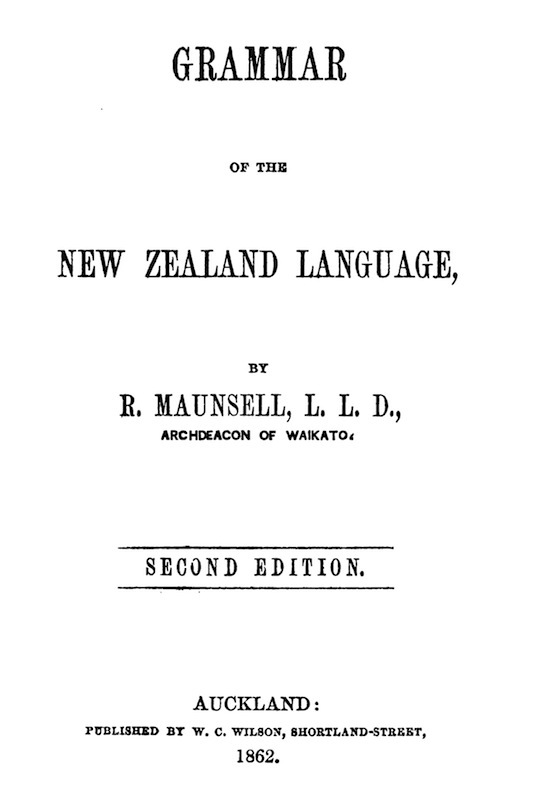
GRAMMAR
OF THE
NEW ZEALAND LANGUAGE,
R. MAUNSELL, L. L. D.,
ARCHDEACON OF WAIKATO.
SECOND EDITION.
AUCKLAND:
PUBLISHED BY W. C. WILSON, SHORTLAND-STREET,
1862.
AUCKLAND:
PRINTED BY W. C. WILSON, "NEW ZEALANDER" OFFICE.
PREFACE.
The first edition of this Grammar having been for many years exhausted, and a considerable demand for some means of acquiring an accurate knowledge of the Maori language having recently arisen, the author has been induced to republish the work with such alterations as the attention which he has in the meantime given to the subject, during long labours of translation, has caused him to deem advisable.
Amongst the principal of these alterations is the omission of many passages exhibiting extreme niceties of the language, which, although useful to the finished scholar, were thought to be scarcely necessary to the ordinary student, and were complained of as embarrassing to the beginner.
The author begs to express his acknowledgments to his friend Mr. Fenton, late Resident Magistrate of Waikato, and one of the few who have studied the language grammatically, for carrying the present work through the press.
PREFACE TO FIRST EDITION.
Independently of minute and numerous subdivisions, it may, perhaps, be correct to state that there are spoken in this the northern island seven leading dialects, each more or less distinguished from the other—viz., 1st, the Rarawa, or that spoken to the northward of Kaitaia; 2nd, the Ngapuhi, or that spoken in that portion of the island as far south of Kaitaia as Point Rodney on the eastern coast, and Kaipara on the western; 3rd, the Waikato, or that spoken in the district lying between Point Rodney and Tauranga on the east, and Kaipara and Mokau on the west; 4th, that spoken in the Bay of Plenty; 5th, the dialect of the East Cape and its neighbourhood, in which, perhaps, may be included that of Rotorua, though in these two places many little differences might be detected; 6th, that spoken in the line of coast between Port Nicholson and Wanganui, though here, also, at least four distinct branches might be traced; 7th, and last, that spoken between Wanganui and Mokau. The dialect of Taupo may be, perhaps, considered a mixture of those of Rotorua and Waikato.
All these may be stated to bear to each other a remarkable radical affinity. Many words, it is true, may be found in one which are unknown in another; but the grammar of any will give a great insight into the texture of all.
The Waikato dialect is very generally known throughout the larger portion of the island. It has deeply tinctured that of Taupo, is well known at Tauranga and the Bay of Plenty, and has been carried to the summits of Taranaki by the multitudes whom its fierce warriors once dragged from thence in slavery, and whose chains have been since snapped by the power of the Gospel. Ngapuhi to the northward are well acquainted with it, from the number of slaves who had been fetched from thence by the warrior Hongi; and a little before his time it was carried to the neighbourhood of Port Nicholson by two large and distinct migrations—one by Ngatitoa, who were the original possessors of Kawhia, another by Ngatiraukawa, who formerly occupied Maungatautari, and as far as Taupo.
The four tribes also who now occupy the banks of the Thames resided, formerly, for a very long period, in Waikato, and, being sprung from the same stock, speak a language so similar that a critical ear can scarcely tell the difference between the dialects of the two people.[1]
The origin of this people,—what part of this island was first occupied,—whether it was not colonized by different migrations from different islands,—are points as yet buried in darkness.
That it was not occupied by merely one migration has ever been the opinion of the author since he heard of the different condition and habits of the people of the East Cape and those of Waikato. A survey of the different dialects will confirm the conjecture, and nowhere can we get a better illustration than at Taupo. For that magnificent lake, in the centre of the island, and the point of meeting for two parties, as they approach from either coast, presents also a remarkable diversity in the languages spoken on the eastern and western banks. On the eastern, the dialect corresponds closely with that of Rotorua, from which it is distant about a four days' journey; on the north-western, which is occupied by a remnant left by the Ngatiraukawa in their great migration to the southward, the dialect is remarkably similar to that spoken in Waikato.[2]
The points of similarity between the fundamental principles of the Hebrew language and those of Maori have been occasionally noticed: not, however, because the author entertains any opinion that the two languages can claim any direct relationship to each other. Upon this only would he insist, in reply to those who would bind him down to the model of some of the European grammars, that Maori, like Hebrew, is altogether different from those languages in structure; that every subject of scientific inquiry must have rules and an arrangement suited to its nature; and that, as it would be absurd to construct the English on the basis of the Latin, so would it be more out of course to think of finding in Maori declensions, conjugations, modes of comparison, &c., &c., as accurately defined, or conducted on the same principles, as those of languages so polished, and so adapted for expressing, as well the minutest varieties in thought, as the tenderest emotions of the feelings.
And here the author would acknowledge his obligations to Professor Lee for his theory of the Hebrew tenses. On no other hypothesis can a satisfactory solution be given of the Maori tense.
The student is requested to notice that the remarks that are more suited to a beginner are printed in large type, and that matters which are of less importance to him are contained in the smaller. It will be, perhaps, most advisable for him to omit the perusal of the latter until he has mastered the former.
[1] Marutuahu, from Kawhia, is the great progenitor of the Thames tribes, and his name is often used to designate that people. Kawhia, we may add, is the place at which, according to the accounts of the people of Waikato, Taranaki, as well as those of Ngatiruanui, the early immigrants landed.
[2] These remarks might also be extended to Rotorua lakes, on the north-western extremity also of which are residing another remnant of Ngatiraukawa, whose dialect is, as far as the author recollects, different from that spoken by Ngatiwakaane.
EXPLANATION OF ABBREVIATIONS.
- adj.—adjective.
- adv.—adverb.
- n.—noun.
- part. adj.—participial adjective.
- v.—verb.
- v. a.—verb active.
- vid. S.—denotes that further information will be found in the Syntax.
TABLE OF CONTENTS.
| CHAP. I. ORTHEOPY. |
|
| The letters of Maori | 1 |
| Of the sound of the Vowels | 1-4 |
| Of the Diphthongs | 4-7 |
| Homogeneous sounds, when they meet in a sentence | 7 |
| Of the Consonants | 7-9 |
| A table of peculiarities of pronunciation in the principal dialects | 9 |
| CHAP. II. OF THE ARTICLE. |
|
| The Articles | 10 |
| Of the definite article te | 10-12 |
| Of its plural nga | 12 |
| Of the indefinite article he | 12 |
| Of te tahi when used as an article | 12 |
| Of the particle a | 13 |
| CHAP. III. OF THE NOUNS. |
|
| Nouns primitive and derivative | 16 |
| Compound words | 17 |
| Verbal nouns | 17-18 |
| Proper names | 18-19 |
| Gender of nouns | 19-20 |
| Number of nouns | 21 |
| Of the postfix ma | 21 |
| Reduplication of nouns | 21 |
| Cases of nouns | 22 |
| CHAP. IV. OF THE ADJECTIVES. |
|
| Their gender, number, and case | 23 |
| Reduplication of | 23 |
| CHAP. V. OF THE NUMERALS. |
|
| Of the cardinals | 24 |
| Their prefixes | 24 |
| Their manner of combination, &c. | 25 |
| Prefixes for denoting | |
| ——persons | 26 |
| ——distribution | 26 |
| ——fractions of length | 26 |
| Ordinals. | |
| Three ways for denoting them | 26 |
| CHAP. VI. OF THE PRONOUNS. |
|
| Of the personal pronouns | 27-29 |
| Of the possessive pronouns | 29 |
| Of the relative pronouns | 29-30 |
| Of the demonstrative pronouns | 30-31 |
| Of nei, na, and ra | 30 |
| Of the interrogative pronouns | 31 |
| Mode of supplying the defect of distributive pronouns | 32 |
| Of the indefinite pronouns | 32-33 |
| CHAP. VII. OF THE VERBS. |
|
| Verbs primitive, derivative, and compound | 34-35 |
| Mood | 35-36 |
| Tense | 36-38 |
| Imperative mood | 39-42 |
| Paradigm of tense in simple sentences | 42-52 |
| Passive voice (table of examples) | 48 |
| ——remarks on | 49 |
| Verbal nouns (their formation) | 51-52 |
| Neuter verbs | 52 |
| Participial adjectives | 53 |
| CHAP. VIII. OF THE PREPOSITIONS. |
|
| List of prepositions | 55-56 |
| Remarks on them | 56-64 |
| Proper meaning of na, ma, &c. | 64-72 |
| CHAP. IX. OF THE ADVERBS. |
|
| Primitive and derivative adverbs | 73-74 |
| Classification and list of adverbs and adverbial expressions | 74-86 |
| CHAP. X. OF THE PARTICLES. |
|
| Atu, mai, ake, iho, ai, ano, ra, koa, u, hoki, kau | 87-94 |
| CHAP. XI. | |
| Of the conjunctions | 95-98 |
| CHAP. XII. | |
| Of the interjections | 99-101 |
| CHAP. XIII. OF THE SYNTAX. Preliminary Remarks. |
|
| Terms explained | 102 |
| Complex and incomplex propositions | 103 |
| Remarks on the general features of Maori | 103-104 |
| Epanorthosis | 104-105 |
| CHAP. XIV. SYNTAX OF THE ARTICLE. |
|
| Ko an article | 106 |
| Its peculiar features | 106-109 |
| The omission of the article | 109 |
| He and te tahi | 109-110 |
| The particle a | 110-111 |
| CHAP. XV. SYNTAX OF THE NOUN. |
|
| Nouns in apposition | 112 |
| Article prefixed to them | 112 |
| Preposition | 113 |
| Exceptions | 113-114 |
| Clauses in epanorthosis, irregularity of | 114 |
| The answer to a question, construction of | 114-115 |
| Possessive Case denotes | |
| ——Intensity | 115 |
| ——Date of an act | 115 |
| ——Useful in predication | 115 |
| ——Used instead of other cases | 116 |
| ——Position of, when the governing word is twice repeated | 116 |
| ——Governing word often omitted | 116 |
| Material, or quality, of a thing how denoted by a substantive | 116-117 |
| The form of the substantive often used for that of the adjective | 117 |
| Objective Case. | |
| ——position of | 117-118 |
| How compound words govern others | 118 |
| Kai prefixed to a verb | 118 |
| Te prefixed to proper names | 118 |
| Ngati and rangi | 118 |
| O and A, distinction between | 118-120 |
| CHAP. XVI. SYNTAX OF THE ADJECTIVES. |
|
| Position of adjectives | 121 |
| Verbal adjectives | 121 |
| Exceptions | 121-122 |
| Many adjectives to one substantive | 122 |
| One adjective to two or more substantives | 122-123 |
| Of the forms occasionally assumed by the adjective | 123 |
| Comparison of adjectives | 123-125 |
| CHAP. XVII. SYNTAX OF NUMERALS. |
|
| Particles prefixed to numerals | 126-127 |
| Case following | 127 |
| Position of numeral | 127 |
| Repetition of numeral | 127-128 |
| Tua and whaka as numeral prefixes | 128-129 |
| CHAP. XVIII. SYNTAX OF PRONOUNS. |
|
| Position of pronouns | 130 |
| Often omitted | 130-131 |
| Singular and dual often denote a tribe | 131 |
| ——Other uses of | 131 |
| A Pronoun in the singular will refer to a noun in the plural | 131 |
| ——in the third person will refer to the first or second person | 131-132 |
| ——used for the conjunction and | 132 |
| The noun belonging to the pronoun often omitted | 132 |
| Relative Pronouns, the substitutes for them | 132-133 |
| Demonstrative Pronouns. | |
| ——useful as auxiliaries | 133 |
| ——other peculiarities of | 133-134 |
| Nei, na, and ra | 134 |
| Interrogative Pronouns (strange use of) | 134-135 |
| CHAP. XIX. SYNTAX OF THE VERB. The Verbal Particles. |
|
| E | 136-137 |
| Ana | 137 |
| E—ana | 138 |
| Ka | 138-139 |
| I | 139 |
| Kua | 139-142 |
| Kia | 143-144 |
| Kia and ki te, distinction between | 144 |
| Sometimes no verbal particle prefixed | 144-145 |
| Ai, as used in connexion with the verb | 145-147 |
| Whaka, uses of | 147-149 |
| Adverbs as auxiliaries | 149 |
| Defect of substantive verb, how supplied | 149-150 |
| Prepositions as auxiliaries | 150 |
| Tendency of Maori verb to assume the form of a substantive | 150-152 |
| The finite verb may follow the oblique case | 152 |
| Predication performed by the possessive case | 152-155 |
| Compound tenses | 155 |
| Other circumstances which affect the time or voice of a verb | 155-159 |
| Verbs associated to qualify each other | 159 |
| Repetition of verbs | 159 |
| ——of other words | 159-160 |
| Passive verbs, use of | 160 |
| Sometimes supplanted by the active | 160-162 |
| Neuter verbs which assume the passive form | 162 |
| CHAP. XX. OF THE PREPOSITIONS, ADVERBS, AND CONJUNCTIONS. |
|
| 163-167 | |
CHAPTER I.
OF THE
PRONUNCIATION OF MAORI.
THE LETTERS OF MAORI ARE AS FOLLOWS
| NAME. | ||
| A. | a as in fall fat. | |
| E. | e as a in acorn. | |
| H. | ha. | |
| I. | i as i in French or ee in sleep. | |
| K. | ka. | |
| M. | ma. | |
| N. | na. | |
| O. | o. | |
| P. | pa. | |
| R. | ra. | |
| T. | ta. | |
| U. | u. | |
| W. | wa. | |
| NG. | nga. |
OF THE SOUNDS OF THE VOWELS.
A.
Has three sounds; the slender, somewhat broader, and the full broad sound.
1. The slender, as in hat, pat.
2. The somewhat broader; as in mar, far, father.
3. The full broad; as in wall, hall, &c.
The following is a list of words classified under these heads:
| 1. | 2. | 3. |
| patu, to strike. | patu, partition of a house. | |
| mătua, a father. | mātua, fathers. | whana, to kick. |
| mărama, the moon. | mārama, tight. | wahi, a place. |
| taki, to drag a canoe in water. | taki, take from the fire. | whaki, to confess. |
| matenga, death. | matenga, head. | ware, a plebeian. |
| tăringa, ear. | tāringa, waiting for. | |
| păkaru, broken. | pākarua, v. p. broken. | |
| pakeke, hard. | pakeke, to creak. | |
| tăngata, a man. | ..... ..... | tāngata, men. |
| tahu, to burn. | tahuhu, a ridgepole. | whare, a house. |
The second and third head differ but little from each other, and it sometimes may be difficult to decide under which of the two the sound should be classed.
The reader is requested to notice that the distinctions above made, are not founded so much on the length of the sound, as on the differences of the sounds themselves. If the length of the sound be considered, other classes, (at least two,) might easily be established; but the learner would, we fear, be more perplexed than benefitted by the addition.
The speaker should remember that in some compound words the last syllable of the first word, if it end in a, is pronounced strong; e. g.
- Patungā-poaka; place where pigs are killed. Ma-hingā-kai; a cultivation. Matā-pu; the lead of a gun, a bullet. Ta te tutuā tu; the plebeian's manners.
Note.—There are exceptions to this rule which it would be well for the student of observation to notice.
In pronouncing such words as kata, mata, tata, the speaker must be careful not to slur over the first a, as if it were keta, meta, &c. It should be pronounced clearly and distinctly.
E
Is pronounced as a in bate, hate, &c., only not quite so slow, or so broad. Perhaps the final e in the French words café, felicité, would be a closer resemblance; e. g., koe, rea, re, kete, mate, tenei, rere.
(2.) As e in poetical, there; e. g., tena, renga-renga, kete, rere.
Few sounds in Maori are more frequently mis-pronounced by foreigners than e. Tohe, ngare, kumea, hoea mai te waka, te reinga, te rangi, rewera, korero, have been all so carelessly pronounced as to sound to the native ear as if spelt, tohi, ngari, kumia, hoia mai ti waka, to reinga, to rangi, Rewara, kororo. The reader should also be careful not to give e the dipthongal sound of ei; as in ne the interrogative particle, &c.
I
I is pronounced like the French i; as ee in sleep, green, &c.; when distinctly and fully pronounced it imparts much melodiousness to the sentence; e. g. ariki, kīki, to chatter, &c.
In the following it has a shorter sound: kĭki, crowded; mĭti, tĭti, &c.
N. B.—The speaker should be careful not to confound i with the Maori e; as in such words as wakatoi, hoi, &c.
O
Has a long and a short sound, a long; as toto, to drag.
A short; as toto, blood.
N. B.—We have no sound in Maori to correspond to the o in not, hot, pot, &c.
This sound is also uniform in kind, and always corresponds to oo in book, &c. It sometimes, however, experiences a more quick, sometimes a more slow pronunciation.
The following table exhibits two variations beginning with the shorter:—
| 1. | 2. |
| tŭri, a knee. | tŭtū, disobedient. |
| tŭtŭ, same as tupakihi of Ngapuhi. | tūtū (manu), a birdstand. |
| kŭkŭ, a shell. | kūkū, a pigeon. |
| kŭhu. | tūtūa. |
| hūna. | |
| ŭtŭ, to pay. | ūtu, to draw water. |
In pronouncing u the speaker will have to guard against the error of those who prefix the aspirate when no aspirate is admissible. According to them u, utu, &c., are pronounced as if spelt hu, hutu.
He will also have to beware of the more common and stubborn error of giving u the dipthongal sound of u in cube, tube, mute, &c.—tonu, ketu, tonutia, are, in this way, pronounced as if spelt toniu, toniutia, ketiu.
U, again, is sometimes, by careless speakers, confounded with o, and vice versâ. Thus ihu, nose; niho, tooth; have been erroneously pronounced as if spelt iho, nihu.
OF THE DIPTHONGS.
This portion of Maori literature has been as yet but little explored; and as each person's notions will vary with the acuteness of his ear, and the extent to which his judgment has been exercised, we may be prepared to expect a considerable discrepancy of opinion.
We shall therefore proceed with caution, and offer only what may be most useful, and most necessary for the student.
The field of discussion may be much limited if we first define what we mean by the word "dipthong."
The best definition we can find, and the one most suited to the nature of the dipthong, is, we think, that of Mr Smith, in Walker. "A dipthong," he says, "I would define to be two simple vocal sounds uttered by one and the same emission of breath, and joined in such a manner that each loses a portion of its natural length; but from the junction produceth a compound sound equal in the time of pronouncing to either of them taken separately, and so making still but one syllable."
Following this definition, three tests for a dipthong suggest themselves.
1. The emission of the two sounds by the same breath.
2. Their amalgamation, or more correctly, their coalescing; for each vowel in the Maori dipthong is distinctly heard.
3. The abbreviation of the natural length of each simple sound.
In applying these rules to the dipthongs, it will be perhaps most prudent to divide them, under the present imperfect state of our knowledge, into two classes. 1. The certain, or those of the dipthongal character of which there can be but little question. 2. The doubtful, or those upon which inquirers may be likely to entertain different opinions.
The dipthongs which we consider certain, are as follows:
- aa, ae, ai, ao, au, ee, ei, ii, oo, ou, uu.
On these we will offer a few remarks.
Those dipthongs which are formed by a double letter, such as aa, are distinguished by a stronger and fuller sound; as in Wakaaro, rapuutu, &c.
Is a sound for which it is difficult to find a parallel in English, and which most speakers confound with ai in such words as waewae, waeroa, paewae, &c.
The English aye comes perhaps closer to it. It must be pronounced broad and open, and care must be taken to keep out the squeezed sound of the i.
AI
May be well represented by the i in shine.
AO
Has no representative in English that we are aware of. In pronouncing it, the speaker must be careful to let the o be distinctly, but not too prominently, heard; and considerable care will be required to keep it distinct from au in the following words, as otawhao, whawhao, tao, hao, &c.: neither again must the speaker divide the dipthong into two syllables, as some speakers do in otaota, &c.
AU
May be pronounced like ou in drought, trout, pound, &c.
EI
May be represented by the ai in hail, pail, &c. Care must be taken not to suppress altogether the i, as is sometimes done in such words as tenei, penei, &c.
OU
Is a sound of some difficulty. There is no sound that we are aware of in the English language that exactly corresponds to it. Low, sow, mow, &c., may be made to resemble it, by pronouncing them slowly, and letting the sound die away into u.
Most foreigners are apt to pronounce it as a simple o. The first syllable of koutou is one of very difficult pronunciation. Without great care it will be variously pronounced, as if koitou, kotou, or kutu.
By not attending to these distinctions the speaker will often lose the benefit of a good thought. A speaker, guarding his hearers against spiritual temptations, borrowed his illustration from a poukaka (the perch for the parrot by which it is caught,) telling them that Satan often presents poukakas to attract them to ruin; unfortunately, however, instead of poukaka he used pokaka, a squall of wind and rain, and only expressed his point by exciting their risibility.
The doubtful class of dipthongs are au, (as in mau, for thee, tau, thy,) ai, (as in maia, brave) ea, eo, eu, io, iu.
On these we do not wish at present to make many observations. We believe that there is a considerable difference amongst Maori speakers respecting them. Our own idea is, that there may be a few occasions on which some might be considered dipthongs; and that those occasions are, the position of the syllable, whether at the end of the word, or elsewhere, as also whether it come under the influence of the accent.
We cannot dismiss this subject without mentioning two particulars, very necessary to be remembered by all who wish to attain to an accurate pronunciation of Maori. First, as it is in English, every sentence is to be pronounced as if one word. 2. Homogeneous vowels will, when they meet, almost always run into a dipthong.
The following sentence, koia i whiriwhiria ai e ia to ratou uri, would be thus pronounced by a native, koiai-whiri-whiriai-eia-to-ratouri. Koia ia i riri ai would run, koiai-aiririai.
This subject of homogeneous vowels coalescing into dipthongs, is one which has not received the attention it merits.
OF THE CONSONANTS.
H.
This is the same as the English h.
It is not however known on the western coast of New Zealand to the southward of Mokau, in the district of Taranaki. Its place is supplied by a curious stammer or jirk of the voice. A gentle sibilancy accompanies its pronunciation amongst Ngapuhi, which some speakers erroneously confound with sh.
K has the sound of the English k; as in kill, &c.
M. N. P.
M, N, P, have the same sound as in English.
R.
R has two sounds: (1) rough; as in rain, river, &c.; e. g., kahore, rorea, roro, roto.
(2) The second is more soft, and is formed by a gentle jar of the tongue against the palate; so gentle indeed is the vibration, that most foreigners pronounce it like d or l, as in raro, ruru, rimu, pouaru, pari, muri, mariri, koiri, korikori, kouru, maru.
T.
This is a letter which few Europeans pronounce correctly. It is not pronounced like the t in temper, tea, &c.; but rather like the sharp th of apathy, sympathy, Athens, apothecary. Those who watch a native's tongue while pronouncing this letter, will find that the rule for attaining this sound is, to apply the tongue, not to the root, but to the top of the teeth, and hardly emit a.
W.
Has two sounds, one simple, as that in wind, &c., e. g., wai, water, waka, a canoe, ware, a plebeian.
2. An aspirated w, as in when, where, &c.; whai, follow, whare, a house, &c.
NG.
The speaker should be careful, in uttering this sound not to separate the n from the g, as is sometimes done by foreigners. The n and g intimately coalesce, and those who have learned to pronounce the French encore will find no difficulty in catching it. The following rule will, we trust, help the beginner.
Press the middle of the tongue to the roof of the mouth, near the throat, and simultaneously relax the pressure, and pronounce na. Of course care must be taken that the tip of the tongue does not touch the palate.[3]
Following is a table setting forth a few of the variations in pronunciation of the leading dialects of New Zealand.
It will be observed that the name of a place is employed to denote the dialect for which that place and its vicinity are remarkable.