
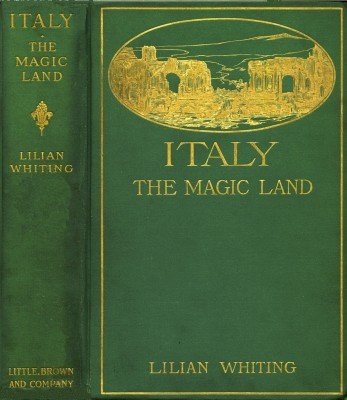
The Project Gutenberg eBook of Italy, the Magic Land
Title: Italy, the Magic Land
Author: Lilian Whiting
Release date: August 10, 2009 [eBook #29658]
Language: English
Credits: Produced by Juliet Sutherland, Emanuela Piasentini and the
Online Distributed Proofreading Team at http://www.pgdp.net
ITALY
THE MAGIC LAND
BY
LILIAN WHITING
AUTHOR OF “THE FLORENCE OF LANDOR,” “THE LAND OF
ENCHANTMENT,” “THE WORLD BEAUTIFUL,” ETC.
We dropped into the Magic Land!”
Illustrated from Photographs
BOSTON
LITTLE, BROWN, AND COMPANY
1907
Copyright, 1907,
By Little, Brown, and Company.
——
All rights reserved
Published November, 1907
THE GRIFFITH-STILLINGS PRESS, BOSTON, U.S.A.
TO
ELLA
(Mrs. Franklin Simmons)
WHOSE EARTHLY FORM REPOSES IN THE BEAUTIFUL ROMAN CEMETERY,
WHERE POETIC ASSOCIATIONS WITH KEATS AND SHELLEY HAUNT THE
AIR,—UNDER THE SCULPTURED “ANGEL OF THE RESURRECTION,”
WITH ITS MAJESTIC SYMBOLISM OF THE TRIUMPH OF
IMMORTALITY,—BUT WHOSE RADIANT PRESENCE
STILL TRANSFIGURES THE LIFE THAT HELD
HER IN IMMORTAL DEVOTION,—
THESE PAGES ARE INSCRIBED,
WITH THE UNFORGETTING LOVE OF
LILIAN WHITING.
Rome, Italy, May Days, 1907.
PREFATORY NOTE
That Florence, the “Flower City,” receives only a passing allusion in this record of various impressions that gleam and glow through the days after several visits to the Magic Land, is due to the fact that in a previous volume by the writer—one entitled “The Florence of Landor”—the lovely Tuscan town with its art, its ineffable beauty, and its choice social life, formed the subject matter of that volume. Any attempt to portray Florence in the present book would savor only of the repetition of loves and enthusiasms already recorded in the previous work in which Walter Savage Landor formed the central figure. For that reason no mention of Florence, beyond some mere allusion, is attempted in these pages, which only aim to present certain fragmentary impressions of various sojourns in Italy, refracted through the prism of memory. Whatever inconveniences or discomfort attend the traveller swiftly fade, and leave to him only the precious heritage of resplendent sunset skies, of poetic association, of artistic beauty. In spirit he is again lingering through long afternoons in St. Peter’s till the golden light through the far windows of the tribune is merged into the dusk of twilight in which the vast monumental groups gleam wraith-like. Again he is ascending the magnificent Scala Regia, and lingering in the Raphael Stanze, or in the wonderful sculpture galleries of the Vatican, or sauntering in the sunshine on the Palatine. In memory he is again spellbound by ancient and mediæval art. In the line of modern sculpture the work of Franklin Simmons in Rome is a feature of Italy that haunts the imagination. No lover of beauty would willingly miss his great studios in the Via San Nicolo da Tolentino, with their wealth of ideal creations that contribute new interest to the most divine of all the arts.
The world I love, and that I fain would live in;
So speak to me of artists and of art,
Of all the painters, sculptors, and musicians
That now illustrate Rome.”
The mystic charm of the pilgrimage to Assisi; the romance that reflects itself in the violet seas and flaming splendors of the sky on the shores of Ischia and Capri; the buried treasures of Amalfi; the magnetic impressiveness of the Eternal City,—all these enter into life as new forces to build and shape the future into undreamed-of destinies.
L. W.
The Brunswick, Boston,
October Days, 1907.
CONTENTS
| PAGE | ||
| I | The Period of Modern Art in Rome | 3 |
| II | Social Life in the Eternal City | 127 |
| III | Day-Dreams in Naples, Amalfi, and Capri | 227 |
| IV | A Page de Conti from Ischia | 281 |
| V | Voices of St. Francis of Assisi | 341 |
| VI | The Glory of a Venetian June | 389 |
| VII | The Magic Land | 423 |
| Index | 459 | |
LIST OF ILLUSTRATIONS
| Temple, Taormina | Frontispiece in Photogravure |
| Angel, Church of San Andrea delle Fratte, Rome | Page 32 |
| Detail from the Stuart Monument, St. Peter’s, Rome | 33 |
| Tomb of Clement XIII, St. Peter’s, Rome | 42 |
| “The Genius of Death,” Detail from the Tomb of Clement XIII, St. Peter’s, Rome | 43 |
| “La Fortuna,” Accadémia di San Luca, Rome | 47 |
| Spanish Steps, Piazza Trinità dei Monti, Rome | 72 |
| Tomb of Pio Nono, San Lorenzo (Fuori le Mura) Rome | 75 |
| “The Dance of the Pleiades” | 91 |
| “Grief and History,” Detail from Naval Monument, Washington | 105 |
| “The Genius of Progress Leading the Nations” | 107 |
| “Mother of Moses” | 108 |
| “Valley Forge” | 110 |
| La Pieta, St. Peter’s, Rome | 117 |
| Villa Medici, Rome | 135 |
| Entrance to Villa Pamphilia-Doria, Rome | 159 |
| Statue of Christ, Ancient Church of San Martina, Rome | 192 |
| Castel San Angelo and St. Peter’s, Rome | 204 |
| Porta San Paola, Pyramid of Caius Cestius, Rome | 216 |
| Castel Sant’Elmo, Naples | 231 |
| Ancient Temple, Baiæ | 241 |
| Ischia, from the Sea | 283 |
| La Rocca, Ischia | 295 |
| Castello di Alfonso, Ischia | 306 |
| Detail from “Parnassus,” Raphael Stanze, Palazzo Vaticano, Rome | 311 |
| Vittoria Colonna, Galleria Buonarroti, Florence | 312 |
| San Francescan Convent-Church, Assisi | 346 |
| St. Francis d’Assisi, The Duomo, Assisi | 365 |
| Santa Chiara, The Duomo, Assisi | 375 |
| Baiæ and Ischia, from Camaldoli | 381 |
| Ruins of the Greek Theatre, Taormina, Sicily | 429 |
| Ponte Vecchio, Florence | 430 |
| Campo Santo, Genoa | 453 |
In wafting of the incalculable wind
Come blown at midnight through our prison-bars.”
THE MAGIC LAND
The full south breeze our forehead fanned;
And, under many a yellow star,
We dropped into the Magic Land.
*****
We caught the gleam of sea-maids’ hair;
The glimmering isles and rocks among
We moved through sparkling purple air.
ITALY, THE MAGIC LAND
I
THE PERIOD OF MODERN ART IN ROME
That youth’s sweet-scented manuscript should close?
The nightingale that in the branches sang,
Oh, where and whither flown again,—who knows?
Omar Khayyam.
Rome, as the picturesque city of the Popes in the middle years of the nineteenth century, was resplendent in local color. It was the Rome of sunny winters; the Rome of gay excursions over that haunted sea of the Campagna to pictorial points in the Alban and Sabine hills; the Rome of young artist life, which organized impromptu festas with Arcadian freedom, and utilized the shadow or the shelter of ruined temples or tombs in which to spread its picnic lunches and bring the glow of simple, friendly intercourse into the romantic lights of the poetic, historic, or tragic past. There were splendid Catholic processions and ceremonials that seemed organized as a part of the stage scenery that ensconced itself, also, with the nonchalance of easy possession, in the vast salons of historic palaces where tapestried walls and richly painted ceilings, arched high overhead, with statues dimly seen in niches here and there, and the bust of some crowned Antoninus, or radiant Juno, gleaming from a shadowy corner, all made up the mise-en-scène of familiar evenings. There were lingering hours in the gardens of the Villa Medici into whose shades one strolled by that beguiling path along the parapet on Monte Pincio, through the beautiful grove with its walks and fountains. The old ilex bosquet, with its tangled growth and air of complete seclusion, had its spell of fascination. Then, as now, the elevated temple, at the end of the main path, seemed the haunt of gods and muses. In all the incidental, as well as the ceremonial social meeting and mingling, art and religion were the general themes of discussion. This idyllic life—
And all the high necessities of art”—
has left its impress on the air as well as its record on many a page of the poet and the romancist. The names that made memorable those wonderful days touch chords of association that still vibrate in the life of the hour. For the most part the artists and their associates have gone their way—not into a Silent Land, a land of shadows and vague, wandering ghosts—but into that realm wherein is the “life more abundant,” of more intense energy and of nobler achievement; the realm in which every aspiration of earth enlarges its conception and every inspiration is exalted and endowed with new purpose; the realm where, as Browning says,—
The poet’s vision recognizes the truth:—
—Is it here on homely earth?
Is it yonder, worlds away,
Where the strange and new have birth,
That Power comes in full play?”
The names of sculptor, painter, and poet throng back, imaged in that retrospective mirror which reflects a vista of the past, rich in ideal creation. Beautiful forms emerge from the marble; pictorial scenes glow from the canvas; song and story and happy, historic days are in the very air. To Italy, land of romance and song, all the artists came trooping, and
they dropped into the Magic Land. If the wraiths of the centuries long since dead walked the streets, they were quite welcome to revisit the glimpses of the moon and contribute their mystery to the general artistic effectiveness of the Seven-hilled City. All this group of American idealists, from Allston and Page to Crawford, Story, Randolph Rogers, Vedder, Simmons, and to the latest comer of all, Charles Walter Stetson, recognized something of the artist’s native air in this Mecca of their pilgrimage.
It was, indeed, quite natural, on account of the stupendous work of Michael Angelo and the unrivalled museums of the Vatican, that Rome should have become pre-eminently the artistic centre of the nineteenth century and should have attracted students and lovers of art from all parts of the world. The immortal works of the two great periods, the Greek and the Renaissance,—the art that was forever great because it was the outgrowth of profound religious conviction,—were enshrined in the churches and the galleries of Rome. The leading countries of Europe sent here their aspiring students and established permanent academies for their residence. Germany, France, and England were thus represented. Thorwaldsen came as a pensioner from the Academy of Fine Arts in Copenhagen; and it was during his life, and that of the noble Canova, that Rome began to be recognized as the modern world-centre of art. Was it not a natural sequence that the early painters and sculptors who came to study under the stimulating influences of the great masterpieces of the past should linger on in the city whose very air became to them the breath of inspiring suggestion? Where but in Rome would have come to Crawford the vision of his “Orpheus” and of his noble Beethoven? or to Story his “Libyan Sibyl,” and that exquisite group, “Into the Silent Land”? or to Vedder his marvellous creations of “The Fates Gathering in the Stars,” the “Cumæan Sibyl,” or the “Dance of the Pleiades”? to Simmons his triumphant “Angel of the Resurrection,” and “The Genius of Progress Leading the Nations”? or to Stetson that ineffable vision of “The Child,” and that wonderful group called “Music”? whose coloring Titian or Giorgione might well mistake for their own.
Under the Pontifical régime the general character of Rome was mediæval and religious. The perpetual festas of the church made the streets constantly picturesque with their processions of monks, and friars, and priests, and these wonderful blendings of color and scenic effect stimulated the artistic sense. The expenses of living in Rome were then only a fraction of what the cost is at the present time; and as the city was the resort of the wealthy and cultured few, the artists were surrounded by the stimulus of critical appreciation and of patronage. Their work, their dreams, were the theme of literary discussion, and focussed the attention of the polite world. Their studios were among the important interests to every visitor in the Eternal City. In those days the traveller did not land with his touring car at Naples, make “the run” to Rome in a record that distanced any possibilities of railroad trains, pass two or three days in motoring about the city and its environs, seeing the exterior of everything in a dissolving view and the interior of nothing,—as within this time, at least, he must flash on in his touring car to Florence. On the contrary, the traveller proceeded to Rome with serious deliberation, and with a more realizing sense of undertaking a journey than Walter Wellman experiences in attempting to fly in his aero-car to the North Pole and send his observations across the polar seas by wireless telegraphy. The visitor went to Rome for a winter, for a year, and gave himself up to leisurely impressions. Rome was an atmosphere, not a spectacle, and it was to be entered with the lofty and reverent appreciation of the poet’s power and the artist’s vision.
In Rome, Thomas Cole painted some of his best pictures; and in Rome or Florence wrought a long list of painters and sculptors. Whether in the Eternal City or in the Flower City, their environment was alike Italy—the environment of the Magic Land. Among the more prominent of all these devotees of Beauty several nationalities were represented. Each might have said of his purpose, in the words of William Watson:—
Among these artists there flash upon memory the names of Vanderlyn, Benjamin West, Allston, Rauch, Ange, Veit, Tenerani, Overbeck, Schadow, Horace Vernet, Thorwaldsen, John Gibson, Hiram Powers, Crawford, Page, Clark Mills, Randolph Rogers, William Rinehart, Launt Thompson, Horatio and Richard Greenough, Thomas Ball, Anne Whitney, Larkin G. Mead, Paul Akers, William Wetmore Story, Harriet Hosmer, J. Rollin Tilton, and, later, Elihu Vedder, Moses Ezekiel, Franklin Simmons, Augustus St. Gaudens, and Charles Walter Stetson, the name of Mr. Stetson linking the long and interesting procession with the immediate life of to-day. Of these later artists Story, Miss Hosmer, Ezekiel, Vedder, Simmons, and Stetson are identified with Rome as being either their permanent or their prolonged residence. Mr. St. Gaudens was a transient student, returning to his own country to pursue his work; and of two young sculptors, Hendrick Christian Anderson and C. Percival Dietsch, time has not yet developed their powers beyond an experimental stage of brilliant promise.
The Rome of the artists of clay and canvas was also the Rome of the poets and romancists, of authors in all lines of literary achievement. How the names of the procession of visitors and sojourners in the Eternal City, from Milton, Goethe, and Mme. de Staël to Henry James, Marion Crawford, Richard Bagot, and Grace Ellery Channing (Mrs. Charles Walter Stetson), gleam from that resplendent panorama of the modern past of Rome! Like the words in electric fire that flash out of the darkness in city streets at night, there shine the names of Shelley and of Keats; of Gladstone, on whom in one memorable summer day, while strolling in Italian sunshine, there fell a vision of the sacredness and the significance of life and its infinite responsibility in the fulfilment of lofty purposes. What charming associations these guests and sojourners have left behind! Hawthorne, embodying in immortal romance the spirit of the scenic greatness of the Eternal City; Margaret Fuller, Marchesa d’Ossoli, allying herself in marriage with the country she loved, and living in Rome those troubled, mysterious years that were to close the earthly chapter of her life; Robert and Elizabeth Browning, the wedded poets, who sang of love and Italy; Harriet Beecher Stowe, finding on the enchanted Italian shores the material which she wove with such irresistible attraction into the romance of “Agnes of Sorrento;” Longfellow, with his poet’s vision, transmuting every vista and impression into some exquisite lyric; Lowell, bringing his philosophic as well as his poetic insight to penetrate the untold meaning of Rome; Thomas William Parsons, making the country of Dante fairly his own; Thackeray, with his brilliant interpretation of the comédie humaine; Emerson, who, oblivious of all the glories of art or the joys of nature, absorbed himself in writing transcendental letters to his eccentric, but high-souled aunt, Mary Moody Emerson; Ruskin, translating Italian art to Italy herself; Dr. Samuel Gridley Howe and his poet wife, Mrs. Julia Ward Howe, in the first flush of their bridal happiness, when Mrs. Howe’s impassioned love for the Seven-hilled City inspired many a lyric that mirrors the Roman atmosphere of that day; Kate Field, with a young girl’s glad enthusiasm over the marvellous loveliness of a Maytime in Rome, and her devotion to those great histrionic artists, Ristori and Salvini; George Stillman Hillard, leaving to literature the rich legacy of his “Six Months in Italy,”—a work that to this day holds precedence as a clear and comprehensive presentation of the scenic beauty, the notable monumental and architectural art, and the general life and resources of this land of painter and poet. Other names, too, throng upon memory—that of William Dean Howells, painting Italian life in his “Venetian Days,” and charming all the literary world by his choice art; and among later work, the interesting interpretations of Rome and of social life in Rome, by Marion Crawford, Henry James, and Richard Bagot,—in chronicle, in romance, or in biographical record. During the last quarter of the nineteenth century, indeed, the visitors to Rome—authors, artists, travellers of easy leisure—defy any numerical record. Mrs. Louise Chandler Moulton, poet, romancist, and delightful raconteur as well, has recorded some charming impressions of her various sojourns in Rome both in her “Random Rambles” and in “Lazy Tours.” Of the Palatine Hill we find her saying:—
“Sometimes we go to the Palace of the Cæsars, and look off upon the heights where the snow lingers and the warm light rests, making them shine like the Delectable Mountains. Nearer at hand are the almond trees, in flower, or the orange trees, bright at once with their white, sweet blossoms and their golden fruit.”
Mrs. Moulton writes of the “stately dwellers” in Rome whom time cannot change; and to whom, whenever she returns, she makes her first visit; some of whom are in the mighty palace of the Vatican and some of whom dwell in state in the Capitol.
“The beautiful Antoninus still wears his crown of lotus in Villa Albani and the Juno whom Goethe worshipped reigns forever at the Ludovisi,” she writes; “I can never put in words the pleasure I find in these immortals.” Mrs. Moulton loved to wander in the Villa Borghese “before the place is thronged with the beauty and fashion of Rome as it is in the late afternoon. I do not wonder that Miriam and Donatello could forget their fate in these enchanted glades,” she wrote, “and dance as the sunbeams danced with the shadows. Sometimes I seem to see them where the sun sifts through the young green leaves, and her beauty—her human, deep-souled beauty—and his fantastic grace are the only things here that cannot change.
“The walls will crumble; the busts of kings and heroes and poets will lose their contours, the lovely Roman ladies also grow old and fade, and vanish from sight and from memory; but still these two, hopeless yet happy, will dance in these wild glades immortally beyond the reach of the effacing years.”
The visit to Rome of the Rev. Dr. Phillips Brooks—later the Bishop of Massachusetts—is immortalized in the most lifelike portrait bust of the great preacher ever modelled; a bust in which the genius of the sculptor, Franklin Simmons, found one of its noblest expressions, and has perpetuated, with masterly power, the energy of thought, at once profound and intense, in the countenance of Bishop Brooks. These, and many another whom the gods have loved and dowered with gifts, rise before any retrospective glance over the comparatively recent past of Rome. Bishop Brooks passed there the Holy Week of one Lenten season, and of the Miserere in the Sistine Chapel he wrote that it was certainly the most wonderful music to which he had ever listened; and he added:—
“The Miserere in the Sistine, the Benediction from the balcony, the solemn moment of the elevation of the Host on Easter, and the illumination of St. Peter’s, these all seem to reach very remarkably the great ideal of the central religious commemoration of Christendom.”
It was in the winter of 1828 that Mr. Longfellow first visited Rome, which “is announced,” he wrote, “by Nero’s tomb,” and he quotes Dupaty’s lines:—
C’est le tombeau de Neron qui l’annonce.”
Mr. Longfellow expressed his love for the Eternal City, and in a personal letter[1] he said:—
“I have been so delighted with Rome that I have extended my residence much beyond my original intention. There is so much in the city to delay the stranger; the villages in the environs are so beautiful, and there is such a quiet and stillness about everything that, were it in my power, I should be induced to remain the whole year round. You can imagine nothing equal to the ruins of Rome. The Forum and the Coliseum are beyond all I had ever fancied them; and the ruined temples and the mouldering aqueducts which are scattered over the Campagna; I do not believe there is a finer view in the world than that from the eastern gate of the city, embracing the Campagna, with its ruined aqueducts diverging in long broken arcades, and terminated by the sweep of the Albanian hills, sprinkled with their white villages, and celebrated in song and story! But the great charm of the scene springs from association; and though everything in Italy is really picturesque, yet strip the country of its historic recollections,—think merely of what it is, and not of what it has been,—and you will find the dream to be fading away.
“You would be shocked at the misery of the people, especially in the Pope’s dominions: but their element seems to be in rags and misery; and with the ceremonials of their religion and the holidays of the church, which average nearly three a week, they are poor—and lazy and happy. I mean, happy in their way.”
In a later visit the poet was domiciled in an hotel on the Piazza Barberini, where the wonderful view included then the entire city “to where St. Peter’s dome darkens against the sunset.” Of this visit his brother, Rev. Samuel Longfellow, writes:—
“Here Mr. Longfellow became for the season the centre of the group of American visitors and resident artists, whose well-known names need not be recounted. Here he made, also, acquaintances among the Italians,—especially the Duke of Sermoneta, the Dantean scholar, and Monsignore Nardi, of the papal court. The Pope himself he did not visit. An interesting acquaintance was that made with the Abbé Liszt, who was spending the winter in Rome, having rooms in the abandoned Convent of Santa Francesca, in the Forum. Calling there one evening, in company with Mr. Healy the artist, the inner door of the apartment was opened to them by Liszt himself, holding high in his hand a candle which illuminated his fine face. The picture was so striking that Mr. Longfellow begged his companion to put it upon canvas,—which he did; and the painting now hangs in the library of Craigie House. At a morning visit, Liszt delighted the party with a performance upon his Chickering pianoforte.
“To see Rome, as all travellers know, is a work for many months; and it was pursued with tolerable diligence. But Mr. Longfellow was never a good sight-seer. He was impatient of lingering in picture galleries, churches, or ruins. He saw quickly the essential points, and soon tired of any minuter examination.”
But long, indeed, before nineteenth-century artists and authors laid siege to the Eternal City, in the far-away years of 1638, Milton visited Rome, and there still remains the tablet, on the wall of the casa in the Via delle Quattro Fontane in which he stayed, a tablet bearing an inscription giving the date of his visit; as, also, in Via Machella, there is an inscription marking the place where Scott lived during his visit to Rome. Goethe made his memorable tour to Italy in 1786—fourteen years before the dawn of the nineteenth century—and wrote: “I feel the greatest longing to read Tacitus in Rome;” and again (an observation with which every visitor to the Eternal City will sympathize) he noted:—
“It grows more and more difficult for me to render an account of my residence in Rome, for as we always find the sea deeper the further we go, so it is with me in observation of this city. . . . Wherever we go and wherever we stand, we see about us a finished picture,—forms of every kind and style; palaces and ruins; gardens and wastes; the distant and the near houses; triumphal arches and columns,—often all so close together that they might be sketched on a single sheet. One should have a thousand points of steel with which to write, and what can a single pen do? and then in the evening one is weary and exhausted with the day of seeing and admiring. Here one reads history from within outward.”
Chateaubriand, who in his earliest youth had visited America as the guest of Washington, passed the winter of 1803-4 in Rome, and his pictorial transcriptions of the city and its environs are among the most exquisite things in literary record. As, for instance, this description of a sunset from Monte Mario:—
“I was never weary of seeing, from the Villa Borghese, the sun go down behind the cypresses of Monte Mario, and the pines of the Villa Pamphili planted by Le Notre. I have stood upon the Ponte Molle to enjoy the sublime spectacle of the close of day. The summits of the Sabine hills appeared of lapis lazuli and pale gold, while their bases and sides were bathed in vapors of violet or purple. Sometimes lovely clouds, like fairy cars, borne along by the evening wind with inimitable grace, recall the mythological tales of the descent of the deities of Olympus. Sometimes old Rome seems to have spread all over the west the purple of her consuls and her Cæsars, beneath the last steps of the god of day. This rich decoration does not vanish so quickly as in our climate. When we think the hues are about to disappear they revive on some other point of the horizon; one twilight follows another and the magic of sunset is prolonged.”
It was in the same year that Mme. de Staël visited Rome and recorded, in her glowing romance, “Corinne,” the impressions she received. In the spring of 1817 Lord Byron found in Rome the inspiration that he transmitted into that wonderful line in “Childe Harold”:—
It was two years later that Shelley passed the spring in the Seven-hilled City, retiring to Leghorn later, to write his tragedy of “The Cenci.”
In Rome the visitor follows Michael Angelo and Raphael through the various churches and museums. The celebrated sibyls of Raphael are in the Santa Maria della Pace; his “Isaiah” is in San Agostino and his “Entombment” in the Casino of the Villa Borghese. While the sublime work of Michael Angelo in the Sistine Chapel is always one of the first things in Rome to which the traveller goes to study that incomparable work portraying the Creation—the Prophets and the Sibyls, the Angels and the Genii, that record the impassioned power of the master—yet all footsteps turn quickly, too, to the church called San Pietro in Vincoli, near the house in which Lucrezia Borgia lived, in which is the colossal Moses of Michael Angelo. As it stands, it fails to convey the first design of the great sculptor. Originally intended for the tomb of Pope Julius II, the plan included a massive block of marble (some forty by twenty feet) surmounted by a cornice and having its niches, its columns, and its statues, of which the Moses was to have been one. It would then have been judged relatively to the entire group, while now it is seen alone, and thus out of the proportions that were in the mind of the artist. The entire conception, indeed, was to unite sculpture and architecture into one splendid combination. “Thus the statue of Moses was meant to have been raised considerably above the eye of the spectator,” writes Mr. Hillard, “and to have been a single object in a colossal structure of architecture and sculpture, which would have had a foreground and a background, and been crowned with a mass at once dome-like and pyramidal. Torn, as it is, from its proper place; divorced from its proportionate companionship; stuck against the wall of a church; and brought face to face with the observer,—what wonder that so many of those who see it turn away with no other impressions than those of caricature and exaggeration!”
Mr. Hillard adds:—
“But who that can appreciate the sublime in art will fail to bow down before it as embodied in this wonderful statue? The majestic character of the head, the prodigious muscles of the chest and arms, and the beard that flows like a torrent to the waist, represent a being of more than mortal port and power, speaking with the authority, and frowning with the sanctions of incarnate law. The drapery of the lower part of the figure is inferior to the anatomy of the upper part. Remarkable as the execution of the statue is, the expression is yet more so; for notwithstanding its colossal proportions, its prominent characteristic is the embodiment of intellectual power. It is the great leader and lawgiver of his people that we see, whose voice was command, and whose outstretched arm sustained a nation’s infant steps. He looks as if he might control the energies of nature as well as shape the mould in which the character of his people should be formed. That any one should stand before this statue in a scoffing mood is to me perfectly inexplicable. My own emotions were more nearly akin to absolute bodily fear. At an irreverent word, I should have expected the brow to contract into a darker frown, and the marble lips to unclose in rebuke.”
William Watson condenses his impressions of this majestic sculpture in the following quatrain.—
Remoteness of Jehovah’s colloquist,
Nearness of man’s heaven-advocate—are here:
Alone Mount Nebo’s harsh foreshadow is miss’d.”
The impressive group of sculptures and buildings on the Campidoglio—where once the shrine of Jupiter Capitolinus stood—owes its present picturesque scheme largely to Michael Angelo. The fascination of the long flights of steps leading from the Piazza Aracöeli to the Capitoline, where the ancient bronze equestrian statue of Marcus Aurelius forever keeps guard, is indescribable. The historic statues of Castor and Pollux mark the portals; on either hand there are seen the Muses of ancient sculpture, the Palazzo Senatoriale and the Palazzo dei Conservatori. There is in the entire world no more classic ground than is found in this impressive grouping of art and architecture.
The genius of Raphael has recorded itself in those brilliant and imperishable works that enthrall the student of art in the Raphael stanze in the Vatican. He was imbued with the spirit of Greek art, and while Titian is a greater colorist, while Correggio, Botticelli, Perugino, and other artists that could be named equal or exceed Raphael in certain lines, yet as the interpreter of the profoundest thought, and for his philosophic grasp and his power to endow his conceptions with the most brilliant animation, he stands alone. The religious exaltation of “The Transfiguration” reveals the supreme degree of the divine genius of Raphael. That this painting was the last work of his life, that it was placed above his body as it lay in state, and was carried in his funeral procession, invests it with peculiar interest.
As a draftsman Raphael was second only to Michael Angelo, with whom he must forever share the immortality of fame. The Academy in Venice holds some of his choicest drawings, and in the Venetian sketch-book in the National Gallery in London are many of his small pictures, including that of the “Knight’s Dream.”
It was in the autumn of 1508, when Raphael was in his twenty-fifth year, that he was called to Rome in the service of the Pope. The Pontiff at this time was Pope Julius II, whose successor was Leo X, and under their pontificates (from 1508 to 1520) Raphael produced these masterpieces which stand unrivalled in the world save by the creations of Michael Angelo in the Capella Sistina. The celebrated “Four Sibyls” of Raphael are not, however, in the stanze of the Vatican, but in the Church of San Maria della Pace. In the Palazzo Vaticano these four wonderful stanze entrance the visitor; the Stanza della Signatura, the Stanza d’Eliodoro, the Stanza dell’Incendio and the Sala di Constantino.
For the decoration of these stanze several painters from Umbria had been summoned,—Perugino, Sodoma, Signorelli, and others; but when Raphael had produced the “Disputa” in the Sala della Signatura, Pope Julius II recognized the work as so transcendent that he ordered the other artists to cease and even had some of their paintings obliterated that there might be more space for the exercise of Raphael’s genius. In the “Disputa” are glorified the highest expressions of the human intellect—the domain portrayed being that of Theology, Philosophy, Poetry, and Justice. The splendor of this creation transcends all attempts of interpretation in language. Against a background of gold mosaic are portrayed these typical figures enthroned on clouds where genii flit to and fro bearing tablets with inscriptions. Theology holds in the left hand a book, while the other points to the vision of angels; Poetry, laurel-crowned, is seen seated on a throne with books and lyre; Philosophy wears a diadem, and Justice, with her balance and her sword, is also crowned. The title of this marvellous work is misleading. Its message is not that of disputation but of beatitude. At the altar are grouped the congregation; the mystic spell of heavenly enthusiasm enfolds the scene as an atmosphere, as above the heavens open and the glorified Christ, surrounded by the saints who have kept the faith, is disclosed to the devotees kneeling below, while a choir of listening angels bend over them from the distant clouds in the background.
Under Poetry are grouped Apollo and the Muses, and the figures of Homer, Dante and Virgil, of Petrarcha, Anacreon and Sappho, of Pindar and of Horace are recognized. The great scholars seen in the Philosophy include Plato and Aristotle, while in the groups under Justice, Moses and Solon are seen.
“Raphael seems to have never known despair,” remarked Franklin Simmons of the work of this divine genius. “His paintings reveal no struggle, but seem to have been produced without effort, as if brought into existence by an enchanter’s wand.”
No observation could more vividly interpret the wonderful effect produced on the student by Raphael, and he cannot but recall the truth expressed in these lines of Festus:—