
The Project Gutenberg eBook of Æsthetic as science of expression and general linguistic
Title: Æsthetic as science of expression and general linguistic
Author: Benedetto Croce
Translator: Douglas Ainslie
Release date: April 28, 2017 [eBook #54618]
Most recently updated: October 23, 2024
Language: English
Credits: Produced by Marc D'Hooghe at Free Literature (online soon
in an extended version, also linking to free sources for
education worldwide ... MOOC's, educational materials,...)
Images generously made available by the Internet Archive.
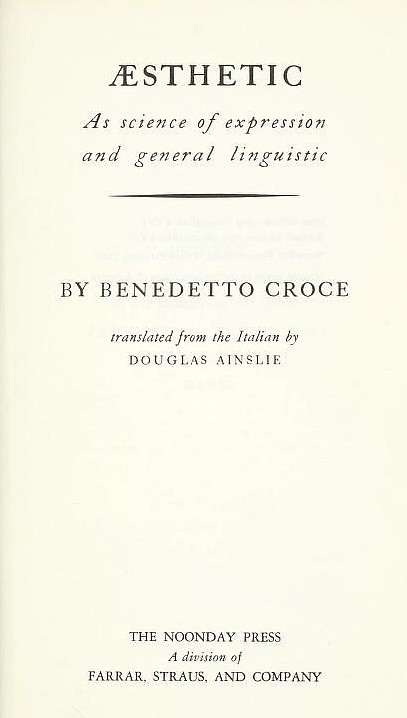
ÆSTHETIC
As science of expression and general linguistic
BY
BENEDETTO CROCE
translated, from the Italian by
DOUGLAS AINSLIE
THE NOONDAY PRESS
A division of
FARRAR, STRAUS, AND COMPANY
1920
THE
ÆSTHETIC
IS DEDICATED BY THE AUTHOR
TO THE MEMORY OF HIS PARENTS
PASQUALE AND LUISA SIPARI
AND OF HIS SISTER
MARIA
Benedetto Croce's Philosophy of the Spirit, in the English translation
by Douglas Ainslie, consists of 4 volumes (which can be read separately):
1. Aesthetic as science of expression and general linguistic. (This
is the second augmented edition. A first ed. is also available at
Project Gutenberg.)
2. Philosophy of the practical: economic and ethic. (In preparation)
3. Logic as the science of the pure concept.
4. Theory and history of historiography. (In preparation)
Transcriber's note.
CONTENTS
EXTRACT FROM INTRODUCTION xix
NOTE BY THE TRANSLATOR xxv
AUTHOR'S PREFACE xxvii
I
THEORY OF ÆSTHETIC
I 1
INTUITION AND EXPRESSION
Intuitive knowledge—Its independence with respect to intellectual knowledge—Intuition and perception—Intuition and the concepts of space and time—Intuition and sensation—Intuition and association—Intuition and representation—Intuition and expression—Illusion as to their difference—Identity of intuition and expression
II 12
INTUITION AND ART
Corollaries and explanations—Identity of art and intuitive knowledge—No specific difference—No difference of intensity—The difference is extensive and empirical—Artistic genius—Content and form in Æsthetic—Criticism of the imitation of nature and of the artistic illusion—Criticism of art conceived as a fact of feeling, not a theoretical fact—Æsthetic appearance, and feeling—Criticism of the theory of æsthetic senses—Unity and indivisibility of the work of art—Art as liberator
III 22
ART AND PHILOSOPHY
Inseparability of intellectual from intuitive knowledge—Criticism of the negations of this thesis—Art and science—Content and form: another meaning—Prose and poetry—The relation of first and second degree—Non-existence of other forms of cognition—Historicity—Its identity with and difference from art—Historical criticism—Historical scepticism—Philosophy as perfect science. The so-called natural sciences, and their limits—The phenomenon and the noumenon
IV 32
HISTORICISM AND INTELLECTUALISM IN ÆSTHETIC
Criticism of the probable and of naturalism—Criticism of ideas in art, of theses in art, and of the typical—Criticism of the symbol and of the allegory—Criticism of the theory of artistic and literary kinds—Errors derived from this theory in judgements on art—Empirical sense of the divisions of kinds
V 39
ANALOGOUS ERRORS IN THE THEORY OF HISTORY AND IN LOGIC
Criticism of the philosophy of History—Æsthetic intrusions into Logic—Logic in its essence—Distinction between logical and non-logical judgements—Syllogistic—Logical falsehood and æsthetic truth—Reformed logic—Note to the fourth Italian edition
VI 47
THE THEORETIC ACTIVITY AND THE PRACTICAL ACTIVITY
The will—The will as an ulterior stage in respect to knowledge—Objections and explanations—Criticism of practical judgements or judgements of value—Exclusion of the practical from the æsthetic—Criticism of the theory of the end of art and of the choice of content—Practical innocence of art—Independence of art—Criticism of the saying: the style is the man—Criticism of the concept of sincerity in art
VII 55
ANALOGY BETWEEN THE THEORETIC AND THE PRACTICAL
The two forms of the practical activity—The economically useful—Distinction between the useful and the technical—Distinction of the useful from the egoistic—Economic will and moral will—Pure economicity—The economic side of morality—The merely economical and the error of the morally indifferent—Criticism of utilitarianism and the reform of Ethics and of Economics—Phenomenon and noumenon in practical activity
VIII 61
EXCLUSION OF OTHER SPIRITUAL FORMS
The system of the spirit—The forms of genius—Non-existence of a fifth form of activity—Law; sociability—Religion—Metaphysic—Mental imagination and the intuitive intellect—Mystical Æsthetic—Mortality and immortality of art
IX 67
INDIVISIBILITY OF EXPRESSION INTO MODES OR DEGREES AND CRITICISM OF RHETORIC
The characters of art—Non-existence of modes of expression—Impossibility of translations—Criticism of the rhetorical categories—Empirical sense of the rhetorical categories—Their use as synonyms of the æsthetic fact—Their use to indicate various æsthetic imperfections—Their use in a sense transcending æsthetic, in the service of science—Rhetoric in the schools—The resemblances of expressions—The relative possibility of translations
X 74
ÆSTHETIC FEELINGS AND THE DISTINCTION BETWEEN THE BEAUTIFUL AND THE UGLY
Various significations of the word feeling—Feeling as activity —Identification of feeling with economic activity—Criticism of hedonism—Feeling as a concomitant of every form of activity —Meaning of certain ordinary distinctions of feelings—Value and disvalue: the contraries and their union—The beautiful as the value of expression, or expression without qualification—The ugly, and the elements of beauty which compose it—Illusion that there exist expressions neither beautiful nor ugly—True æsthetic feelings and concomitant and accidental feelings—Criticism of apparent feelings
XI 82
CRITICISM OF ÆSTHETIC HEDONISM
Criticism of the beautiful as that which pleases the higher senses—Criticism of the theory of play—Criticism of the theory of sexuality and of triumph—Criticism of the Æsthetic of the sympathetic: meaning in it of content and form—Æsthetic hedonism and moralism—The rigoristic negation, and the pedagogic justification of art—Criticism of pure beauty
XII 87
THE ÆSTHETIC OF THE SYMPATHETIC AND PSEUDO-ÆSTHETIC CONCEPTS
Pseudo-æsthetic concepts, and the Æsthetic of the sympathetic—Criticism of the theory of the ugly in art and of the overcoming of it—Pseudo-æsthetic concepts belong to Psychology—Impossibility of rigorous definitions of them—Examples: definitions of the sublime, of the comic, of the humorous—Relation between these concepts and æsthetic concepts
XIII 94
THE "PHYSICALLY BEAUTIFUL" IN NATURE AND IN ART
Æsthetic activity and physical concepts—Expression in the æsthetic sense, and expression in the naturalistic sense—Representations and memory—The production of aids to memory—Physical beauty—Content and form: another meaning—Natural beauty and artificial beauty—Mixed beauty—Writings—Free and non-free beauty—Criticism of non-free beauty—Stimulants of production
XIV 104
ERRORS ARISING FROM THE CONFUSION BETWEEN PHYSICS AND ÆSTHETIC
Criticism of æsthetic associationism—Criticism of æsthetic Physics—Criticism of the theory of the beauty of the human body—Criticism of the beauty of geometrical figures—Criticism of another aspect of the imitation of nature—Criticism of the theory of the elementary forms of the beautiful—Criticism of the search for the objective conditions of the beautiful—The astrology of Æsthetic
XV 111
THE ACTIVITY OF EXTERNALIZATION. TECHNIQUE AND THE THEORY OF THE ARTS
The practical activity of externalization—The technique of externalization—Technical theories of the different arts—Criticism of æsthetic theories of particular arts—Criticism of the classification of the arts—Criticism of the theory of the union of the arts—Relation of the activity of externalization to utility and morality
XVI 118
TASTE AND THE REPRODUCTION OF ART
Æsthetic judgement: its identity with æsthetic reproduction—Impossibility of divergences—Identity of taste and genius—Analogy with other activities—Criticism of æsthetic absolutism (intellectualism) and relativism—Criticism of relative relativism—Objection founded on the variation of the stimulus and of psychic disposition—Criticism of the distinction of signs into natural and conventional—The surmounting of variety—Restorations and historical interpretation
XVII 128
THE HISTORY OF LITERATURE AND OF ART
Historical criticism in literature and art: its importance—Literary and artistic history: its distinction from historical criticism and from the æsthetic judgement—The method of artistic and literary history—Criticism of the problem of the origin of art—The criterion of progress and history—Non-existence of a single line of progress in artistic and literary history—Errors committed against this law— Other meanings of the word "progress" in relation to Æsthetic
XVIII 140
CONCLUSION: IDENTITY OF LINGUISTIC AND ÆSTHETIC
Summary of the study—Identity of Linguistic with Æsthetic—Æsthetic formulation of linguistic problems—Nature of language—Origin of language and its development—Relation between Grammar and Logic—Grammatical kinds or parts of speech—The individuality of speech and the classification of languages—Impossibility of a normative Grammar—Didactic organisms—Elementary linguistic facts, or roots—Æsthetic judgement and the model language—Conclusion
II
HISTORY OF ÆSTHETIC
I 155
ÆSTHETIC IDEAS IN GRÆCO-ROMAN ANTIQUITY
Point of view of this History of Æsthetic—Mistaken tendencies, and attempts towards an Æsthetic, in Græco-Roman antiquity—Origin of the æsthetic problem in Greece—Plato's rigoristic negation—Æsthetic hedonism and moralism—Mystical æsthetic in antiquity—Investigations as to the Beautiful—Distinction between the theory of Art and the theory of the Beautiful—Fusion of the two by Plotinus—The scientific tendency: Aristotle—The concepts of imitation and of imagination after Aristotle: Philostratus—Speculations on language
II 175
ÆSTHETIC IDEAS IN THE MIDDLE AGES AND RENAISSANCE
Middle Ages. Mysticism: Ideas on the Beautiful—The pedagogic theory of art in the Middle Ages—Hints of an Æsthetic in scholastic philosophy—Renaissance: Philography and philosophical and empirical inquiries concerning the Beautiful—The pedagogic theory of art and the Poetics of Aristotle—The "Poetics of the Renaissance"—Dispute concerning the universal and the probable in art—G. Fracastoro—L. Castelvetro—Piccolomini and Pinciano—Fr. Patrizzi (Patricius)
III 189
FERMENTS OF THOUGHT IN THE SEVENTEENTH CENTURY
New words and new observations in the seventeenth century—Wit—Taste—Various meanings of the word taste—Fancy or imagination—Feeling—Tendency to unite these terms—Difficulties and contradictions in their definition—Wit and intellect—Taste and intellectual judgement—The "je ne sais quoi"—Imagination and sensationalism: the corrective of imagination—Feeling and sensationalism
IV 204
ÆSTHETIC IDEAS OF THE CARTESIAN AND LEIBNITIAN SCHOOLS, AND THE "ÆSTHETIC" OF BAUMGARTEN
Cartesianism and imagination—Crousaz and André—The English: Locke, Shaftesbury, Hutcheson and the Scottish School—Leibniz: "petites perceptions" and confused knowledge—Intellectualism of Leibniz—Speculations on language—J. C. Wolff—Demand for an organon of inferior knowledge—Alexander Baumgarten: his "Æsthetic"—Æsthetic as science of sensory consciousness—Criticism of judgements passed on Baumgarten—Intellectualism of Baumgarten—New names and old meanings
V 220
GIAMBATTISTA VICO
Vico as inventor of æsthetic science—Poetry and philosophy: imagination and intellect—Poetry and history—Poetry and language—Inductive and formalistic logic—Vico opposed to all former theories of poetry—Vico's judgements of the grammarians and linguists who preceded him—Influence of seventeenth-century writers on Vico—Æsthetic in the Scienza Nuova—Vico's mistakes—Progress still to be achieved
VI 235
MINOR ÆSTHETIC DOCTRINES OF THE EIGHTEENTH CENTURY
The influence of Vico—Italian writers: A. Conti—Quadrio and Zanotti—M. Cesarotti—Bettinelli and Pagano—German disciples of Baumgarten: G. F. Meier—Confusions of Meier—M. Mendelssohn and other followers of Baumgarten—Vogue of Æsthetic—Eberhard and Eschenburg—J. G. Sulzer—K. H. Heydenreich—J. G. Herder—Philosophy of language
VII 257
OTHER ÆSTHETIC DOCTRINES OF THE SAME PERIOD
Other writers of the eighteenth century: Batteux—The English: W. Hogarth—E. Burke—H. Home—Eclecticism and sensationalism: E. Platner—Fr. Hemsterhuis—Neo-Platonism and mysticism: Winckelmann—Beauty and lack of significance—Winckelmann's contradictions and compromises—A. R. Mengs—G. E. Lessing—Theorists of ideal Beauty—G. Spalletti and the characteristic—Beauty and the characteristic: Hirt, Meyer, Goethe
VIII 272
IMMANUEL KANT
I. Kant—Kant and Vico—Identity of the concept of Art in Kant and Baumgarten—Kant's "Lectures"—Art in the Critique of Judgment—Imagination in Kant's system—The forms of intuition and the Transcendental Æsthetic—Theory of Beauty distinguished by Kant from that of Art—Mystical features in Kant's theory of Beauty
IX 283
THE ÆSTHETIC OF IDEALISM: SCHILLER, SCHELLING, SOLGER, HEGEL
The Critique of Judgment and metaphysical idealism—F. Schiller—Relations between Schiller and Kant—The æsthetic sphere as the sphere of Play—Æsthetic education—Vagueness and lack of precision in Schiller's Æsthetic—Schiller's caution and the rashness of the Romanticists—Ideas on Art: J. P. Richter—Romantic Æsthetic and idealistic Æsthetic—J. G. Fichte—Irony: Schlegel, Tieck, Novalis—F. Schelling—Beauty and character—Art and Philosophy—Ideas and the gods: Art and mythology—K. W. Solger—Fancy and imagination—Art, practice and religion—G. W. F. Hegel—Art in the sphere of absolute spirit—Beauty as sensible appearance of the Idea—Æsthetic in metaphysical idealism and Baumgartenism—Mortality and decay of art in Hegel's system
X 304
SCHOPENHAUER AND HERBART
Æsthetic mysticism in the opponents of idealism—A. Schopenhauer—Ideas as the object of art—Æsthetic catharsis—Signs of a better theory in Schopenhauer—J. F. Herbart—Pure Beauty and relations of form—Art as sum of content and form—Herbart and Kantian thought
XI 312
FRIEDRICH SCHLEIERMACHER
Æsthetic of content and Æsthetic of form: meaning of the contrast—Friedrich Schleiermacher—Wrong judgements concerning him—Schleiermacher contrasted with his predecessors—Place assigned to Æsthetic in his Ethics—Æsthetic activity as immanent and individual—Artistic truth and intellectual truth—Difference of artistic consciousness from feeling and religion—Dreams and art: inspiration and deliberation—Art and the typical—Independence of art—Art and language—Schleiermacher's defects—Schleiermacher's services to Æsthetic.
XII 324
THE PHILOSOPHY OF LANGUAGE: HUMBOLDT AND STEINTHAL
Progress of Linguistic—Linguistic speculation at the beginning of the nineteenth century—Wilhelm von Humboldt: relics of intellectualism—Language as activity: internal form—Language and art in Humboldt—II. Steinthal: the linguistic function independent of the logical—Identity of the problems of the origin and the nature of language—Steinthal's mistaken ideas on art: his failure to unite Linguistic and Æsthetic
XIII 334
MINOR GERMAN ÆSTHETICIANS
Minor æstheticians in the metaphysical school—Krause, Trahndorff, Weisse and others—Fried. Theodor Vischer—Other tendencies—Theory of the Beautiful in nature, and that of the Modifications of Beauty—Development of the first theory: Herder—Schelling, Solger, Hegel—Schleiermacher—Alexander von Humboldt—Vischer's "Æsthetic Physics"—The theory of the Modifications of Beauty: from antiquity to the eighteenth century—Kant and the post-Kantians—Culmination of the development—Double form of the theory: the overcoming of the ugly: Solger, Weisse and others—Passage from abstract to concrete: Vischer—The "legend of Sir Purebeauty"
XIV 350
ÆSTHETIC IN FRANCE, ENGLAND AND ITALY DURING THE FIRST HALF OF THE NINETEENTH CENTURY
Æsthetic movement in France: Cousin, Jouffroy—English Æsthetic— Italian Æsthetic—Rosmini and Gioberti—Italian Romantics. Dependence of art
XV 358
FRANCESCO DE SANCTIS
F. de Sanctis: development of his thought—Influence of Hegelism—Unconscious criticism of Hegelism—Criticisms of German Æsthetic—Final rebellion against metaphysical Æsthetic—De Sanctis' own theory—The concept of form—De Sanctis as art-critic—De Sanctis as philosopher
XVI 370
ÆSTHETIC OF THE EPIGONI
Revival of Herbartian Æsthetic—Robert Zimmermann—Vischer versus Zimmermann—Hermann Lotze—Efforts to reconcile Æsthetic of form and Æsthetic of content—K. Köstlin—Æsthetic of content. M. Schasler —Eduard von Hartmann—Hartmann and the theory of modifications —Metaphysical Æsthetic in France: C. Levêque—In England: J. Ruskin —Æsthetic in Italy—Antonio Tari and his lectures—Æsthesigraphy
XVII 388
ÆSTHETIC POSITIVISM AND NATURALISM
Positivism and evolutionism—Æsthetic of H. Spencer—Physiologists of Æsthetic: Grant Allen, Helmholtz and others—Method of the natural sciences in Æsthetic—H. Taine's Æsthetic—Taine's metaphysic and moralism—G. T. Fechner: inductive Æsthetic—Experiments—Trivial nature of his ideas on Beauty and Art—Ernst Grosse: speculative Æsthetic and the Science of Art—Sociological Æsthetic—Proudhon—J. M. Guyau—M. Nordau—Naturalism: C. Lombroso—Decline of linguistic—Signs of revival: H. Paul—The linguistic of Wundt
XVIII 404
ÆSTHETIC PSYCHOLOGISM AND OTHER RECENT TENDENCIES
Neo-criticism and empiricism—Kirchmann—Metaphysic translated into Psychology: Vischer—Siebeck—M. Diez—Psychological tendency. Teodor Lipps—K. Groos—The modifications of the Beautiful in Groos and Lipps—E. Véron and the double form of Æsthetic—L. Tolstoy—F. Nietzsche —An æsthetician of Music: E. Hanslick—Hanslick's concept of form —Æstheticians of the figurative arts: C. Fiedler—Intuition and expression—Narrow limits of these theories—H. Bergson—Attempts to return to Baumgarten: C. Hermann—Eclecticism: B. Bosanquet —Æsthetic of expression: present state 404
XIX 420
HISTORICAL SKETCHES OF SOME PARTICULAR DOCTRINES
Result of the history of Æsthetic—History of science and history of the scientific criticism of particular errors
I. RHETORIC: OR THE THEORY OF ORNATE FORM. 422
Rhetoric in the ancient sense—Criticism from moral point of view—Accumulation without system—Its fortunes in the Middle Ages and Renaissance—Criticisms by Vives, Ramus and Patrizzi—Survival into modern times—Modern signification of Rhetoric: theory of literary form—Concept of ornament—Classes of ornament—The concept of the Fitting—The theory of ornament in the Middle Ages and Renaissance—Reductio ad absurdum in the seventeenth century—Polemic concerning the theory of ornament—Du Marsais and metaphor—Psychological interpretation—Romanticism and Rhetoric: present day
II. HISTORY OF ARTISTIC AND LITERARY KINDS 436
The kinds in antiquity: Aristotle—In the Middle Ages and Renaissance—The doctrine of the three unities—Poetics of the kinds and rules: Scaliger—Lessing—Compromises and extensions—Rebellion against rules in general—G. Bruno, Guarini—Spanish critics—G. B. Marino—G. V. Gravina—Fr. Montani—Critics of the eighteenth century—Romanticism and the "strict kinds": Berchet, V. Hugo—Their persistence in philosophical theories—Fr. Schelling—E. von Hartmann—The kinds in the schools
III. THE THEORY OF THE LIMITS OF THE ARTS 449
The limits of the arts in Lessing—Arts of space and arts of time—Limits and classifications of the arts in later philosophy: Herder and Kant—Schelling, Solger—Schopenhauer, Herbart—Weisse, Zeising, Vischer—M. Schasler—E. v. Hartmann—The supreme art: Richard Wagner—Lotze's attack on classifications—Contradictions in Lotze—Doubts in Schleiermacher
IV. OTHER PARTICULAR DOCTRINES 459
The Æsthetic theory of natural beauty—The theory of æsthetic senses—The theory of kinds of style—The theory of grammatical forms or parts of speech—Theory of æsthetic criticism—Distinction between taste and genius—Concept of artistic and literary history—Conclusion
BIBLIOGRAPHICAL APPENDIX 475
EXTRACT FROM INTRODUCTION TO THE FIRST ENGLISH EDITION, 1909
I can lay no claim to having discovered an America, but I do claim to have discovered a Columbus. His name is Benedetto Croce, and he dwells on the shores of the Mediterranean, at Naples, city of the antique Parthenope.
It was at Naples, in the winter of 1907, that I first saw the Philosopher of Æsthetic. Benedetto Croce, although born in the Abruzzi, Province of Aquila (1866), is essentially a Neapolitan, and rarely remains long absent from the city, on the shore of that magical sea where once Ulysses sailed, and where sometimes yet (near Amalfi) we may hear the Syrens sing their song. But more wonderful than the song of any Syren seems to me the Theory of Æsthetic as the Science of Expression, and that is why I have overcome the obstacles that stood between me and the giving of this theory, which in my belief is the truth, to the English-speaking world.
. . . . . . . . . .
The solution of the problem of Æsthetic is not in the gift of the Muses.
This Philosophy of the Spirit is symptomatic of the happy reaction of the twentieth century against the crude materialism of the second half of the nineteenth. It is the spirit which gives to the work of art its value, not this or that method of arrangement, this or that tint or cadence, which can always be copied by skilful plagiarists: not so the spirit of the creator. In England we hear too much of (natural) science, which has usurped the very name of Philosophy. The natural sciences are very well in their place, but discoveries such as aviation are of infinitely less importance to the race than the smallest addition to the philosophy of the spirit. Empirical science, with the collusion of positivism, has stolen the cloak of philosophy and must be made to give it back.
. . . . . . . . . .
Yet though severe, the editor of La Critica is uncompromisingly just, and would never allow personal dislike or jealousy, or any extrinsic consideration, to stand in the way of fair treatment to the writer concerned. Many superficial English critics might benefit considerably by attention to this quality in one who is in other respects also so immeasurably their superior. A good instance of this impartiality is his critique of Schopenhauer, with whose system he is in complete disagreement, yet affords him full credit for what of truth is contained in his voluminous writings.
. . . . . . . . . .
This thoroughness it is which gives such importance to the literary and philosophical criticisms of La Critica. Croce's method is always historical, and his object in approaching any work of art is to classify the spirit of its author, as expressed in that work. There are, he maintains, but two things to be considered in criticizing a book. These are, firstly, what is its peculiarity, in what way is it singular, how is it differentiated from other works? Secondly, what is its degree of purity?—That is, to what extent has its author kept himself free from all considerations alien to the perfection of the work as an expression, as a lyrical intuition? With the answering of these questions Croce is satisfied. He does not care to know if the author keep a motor-car, like Mæterlinck; or prefer to walk on Putney Heath, like Swinburne. This amounts to saying that all works of art must be judged by their own standard. How far has the author succeeded in doing what he intended?
. . . . . . . . . .
As regards Croce's general philosophical position, it is important to understand that he is not a Hegelian, in the sense of being a close follower of that philosopher. One of his last works is that in which he deals in a masterly manner with the philosophy of Hegel. The title may be translated, "What is living and what is dead of the philosophy of Hegel." Here he explains to us the Hegelian system more clearly than that wondrous edifice was ever before explained, and we realize at the same time that Croce is quite as independent of Hegel as of Kant, of Vico as of Spinoza. Of course he has made use of the best of Hegel, just as every thinker makes use of his predecessors and is in his turn made use of by those that follow him. But it is incorrect to accuse of Hegelianism the author of an anti-hegelian Æsthetic, of a Logic where Hegel is only half accepted, and of a Philosophy of the Practical which contains hardly a trace of Hegel. I give an instance. If the great conquest of Hegel be the dialectic of opposites, his great mistake lies in the confusion of opposites with things which are distinct but not opposite. If, says Croce, we take as an example the application of the Hegelian triad that formulates becoming (affirmation, negation and synthesis), we find it applicable for those opposites which are true and false, good and evil, being and not-being, but not applicable to things which are distinct but not opposite, such as art and philosophy, beauty and truth, the useful and the moral. These confusions led Hegel to talk of the death of art, to conceive as possible a Philosophy of History, and to the application of the natural sciences to the absurd task of constructing a Philosophy of Nature. Croce has cleared away these difficulties by showing that if from the meeting of opposites must arise a superior synthesis, such a synthesis cannot arise from things which are distinct but not opposite, since the former are connected together as superior and inferior, and the inferior can exist without the superior, but not vice versa. Thus we see how philosophy cannot exist without art, while art, occupying the lower place, can and does exist without philosophy. This brief example reveals Croce's independence in dealing with Hegelian problems.
I know of no philosopher more generous than Croce in praise and elucidation of other workers in the same field, past and present. For instance, and apart from Hegel, Kant has to thank him for drawing attention to the marvellous excellence of the Critique of Judgment, generally neglected in favour of the Critiques of Pure Reason and of Practical Judgment; Baumgarten for drawing the attention of the world to his obscure name and for reprinting his Latin thesis in which the word Æsthetic occurs for the first time; and Schleiermacher for the tributes paid to his neglected genius in the History of Æsthetic. La Critica, too, is full of generous appreciation of contemporaries by Croce and by that profound thinker, Gentile.
. . . . . . . . . .
There can be no doubt of the great value of Croce's work as an educative influence, and if we are to judge of a philosophical system by its action on others, then we must place the Philosophy of the Spirit very high. It may be said with perfect truth that since the death of the poet Carducci there has been no influence in Italy to compare with that of Benedetto Croce.
. . . . . . . . . .
Of the popularity that his system and teaching have already attained we may judge by the fact that the Æsthetic, despite the difficulty of the subject, is already in its third edition in Italy, where, owing to its influence, philosophy sells better than fiction; while the French and Germans, not to mention the Czechs, have long had translations of the earlier editions. His Logic is on the point of appearing in its second edition, and I have no doubt that the Philosophy of the Practical will eventually equal these works in popularity. The importance and value of Italian thought have been too long neglected in Great Britain. Where, as in Benedetto Croce, we get the clarity of vision of the Latin, joined to the thoroughness and erudition of the best German tradition, we have a combination of rare power and effectiveness, which can by no means be neglected.
The philosopher feels that he has a great mission, which is nothing less than the leading back of thought to belief in the spirit, deserted by so many for crude empiricism and positivism. His view of philosophy is that it sums up all the higher human activities, including religion, and that in proper hands it is able to solve any problem. But there is no finality about problems: the solution of one leads to the posing of another, and so on. Man is the maker of life, and his spirit ever proceeds from a lower to a higher perfection.
. . . . . . . . . .
I believe that Croce will one day be recognized as one of the very few great teachers of humanity. At present he is not appreciated at nearly his full value. One rises from a study of his philosophy with a sense of having been all the time as it were in personal touch with the truth, which is very far from the case after the perusal of certain other philosophies.
Secure in his strength, Croce will often introduce a joke or some amusing illustration from contemporary life, in the midst of a most profound and serious argument. This spirit of mirth is a sign of superiority. He who is not sure of himself can spare no energy for the making of mirth. Croce loves to laugh at his enemies and with his friends. So the philosopher of Naples sits by the blue gulf and explains the universe to those who have ears to hear. "One can philosophize anywhere," he says—but he remains significantly at Naples.
Thus I conclude these brief remarks upon the author of the Æsthetic, confident that those who give time and attention to its study will be grateful for having placed in their hands this pearl of great price from the diadem of the antique Parthenope.
DOUGLAS AINSLIE.
THE ATHENÆUM, PALL MALL,
May 1909.
NOTE BY THE TRANSLATOR
TO THE SECOND ENGLISH EDITION
This second edition of the Æsthetic will be found to contain the complete translation of the historical portion, which I was obliged to summarize in the first edition. I have made a number of alterations and some additions to the theoretical portion, following closely the fourth (definitive) Italian edition, and in so doing have received much advice and assistance of value from Mrs. Salusbury, to whom I beg to tender my best thanks. I trust that this new edition will enable all those desirous of studying the work to get into direct touch with the thought of the author.
THE ATHENÆUM, PALL MALL, S.W.,
November 1920.
AUTHOR'S PREFACE
This volume is composed of a theoretical and of a historical part, which form two independent but complementary books.
The nucleus of the theoretical part is a memoir, bearing the title Fundamental Theses of an Æsthetic as Science of Expression and General Linguistic, which was read at the Accademia Pontaniana of Naples during the sessions of February 18 and May 6, 1900, and printed in vol. xxx. of its Acts. The author has added few substantial variations, but not a few additions and amplifications in rewriting it, also following a somewhat different sequence with a view to rendering the exposition more plain and easy. The first five chapters only of the historical portion were inserted in the Neapolitan review Flegrea (April 1901), under the title Giambattista Vico, First Discoverer of Æsthetic Science, and these also reappear amplified and brought into harmony with the rest.
The author has dwelt, especially in the theoretical part, upon general questions which are side-issues in respect to the theme that he has treated. But this will not seem a digression to those who remember that, strictly speaking, there are no particular philosophical sciences, standing by themselves. Philosophy is unity, and when we treat of Æsthetic or of Logic or of Ethics, we treat always of the whole of philosophy, although illustrating for didactic purposes only one side of that inseparable unity. In like manner, owing to this intimate connexion of all the parts of philosophy, the uncertainty and misunderstanding as to the æsthetic activity, the representative and productive imagination, this firstborn of the spiritual activities, mainstay of the others, generates everywhere else misunderstandings, uncertainties and errors: in Psychology as in Logic, in History as in the Philosophy of Practice. If language is the first spiritual manifestation, and if the æsthetic form is language itself, taken in all its true scientific extension, it is hopeless to try to understand clearly the later and more complicated phases of the life of the spirit, when their first and simplest moment is ill known, mutilated and disfigured. From the explanation of the æsthetic activity is also to be expected the correction of several concepts and the solution of certain philosophic problems which generally seem to be almost desperate. Such is precisely the spirit animating the present work. And if the present attempt and the historical illustrations which accompany it may be of use in winning friends to these studies, by levelling obstacles and indicating paths to be followed; if this happen, especially here in Italy, whose æsthetic traditions (as has been demonstrated in its place) are very noble, the author will consider that he has gained his end, and one of his keenest desires will have been satisfied.
NAPLES, December 1901.
In addition to a careful literary revision, (in which, as well as in the revision of the notes, I have received valuable help from my friend Fausto Nicolini) I have in this third edition made certain alterations of theory, especially in Chapters X. and XI. of Part I., suggested by further reflexion and self-criticism.
But I have refrained from introducing corrections or additions of such a kind as to alter the original plan of the book, which was, or was meant to be, a complete but brief æsthetic theory set in the framework of a general sketch of a Philosophy of the Spirit.
The reader who desires a complete statement of the general or collateral doctrines or a more particular exposition of the other parts of philosophy (e.g. the lyrical nature of art) is now referred to the volumes on Logic and the Philosophy of Practice, which together with the present work compose the Philosophy of the Spirit which in the author's opinion exhausts the entire field of Philosophy. The three volumes were not conceived and written simultaneously; if they had been, some details would have been differently arranged. When I wrote the first I had no idea of giving it, as I have now done, two such companions; and I therefore designed it to be, as I say, complete in itself. In the second place, the present state of the study of Æsthetic made it desirable to append to the theoretical exposition a somewhat full history of the science, whereas for the other parts of Philosophy I was able to restrict myself to brief historical notes merely designed to show how, from my point of view, such a history would best be composed. Lastly, there are many things which now, after a systematic exposition of the various philosophical sciences, I see in closer connexions and in a clearer, or at least a different, light; a certain hesitation and even some doctrinal errors visible here and there in the Æsthetic, especially where subjects foreign to Æsthetic itself are being treated, would now no longer be justified. For all these reasons the three volumes, in spite of their substantial unity of spirit and of aim, have each its own physiognomy, and show marks of the different periods of life at which they were written, so as to group themselves, and to demand interpretation, as a progressive series according to their dates of publication.
With what may be called the minor problems of Æsthetic, and the objections which have been or might be brought against my theory, I have dealt and am continuing to deal in special essays, of which I shall shortly publish a first collection which will form a kind of explanatory and polemical appendix to the present volume.
November 1907.
In revising this book once more for a fourth edition, I take the opportunity of announcing that the supplementary volume of essays promised above was published in 1910 under the title Problems of Æsthetic and Contributions to the History of Æsthetic in Italy.
B. C.
May 1911.