
The Project Gutenberg eBook of The English-American, His Travail by Sea and Land: or, A New Survey of the West-India's
Title: The English-American, His Travail by Sea and Land: or, A New Survey of the West-India's
Author: Thomas Gage
Release date: March 25, 2017 [eBook #54425]
Most recently updated: October 23, 2024
Language: English
Credits: Produced by Clare Graham and Marc D'Hooghe at Free
Literature (online soon in an extended version, also linking
to free sources for education worldwide ... MOOC's,
educational materials,...) Images generously made available
by the Internet Archive.
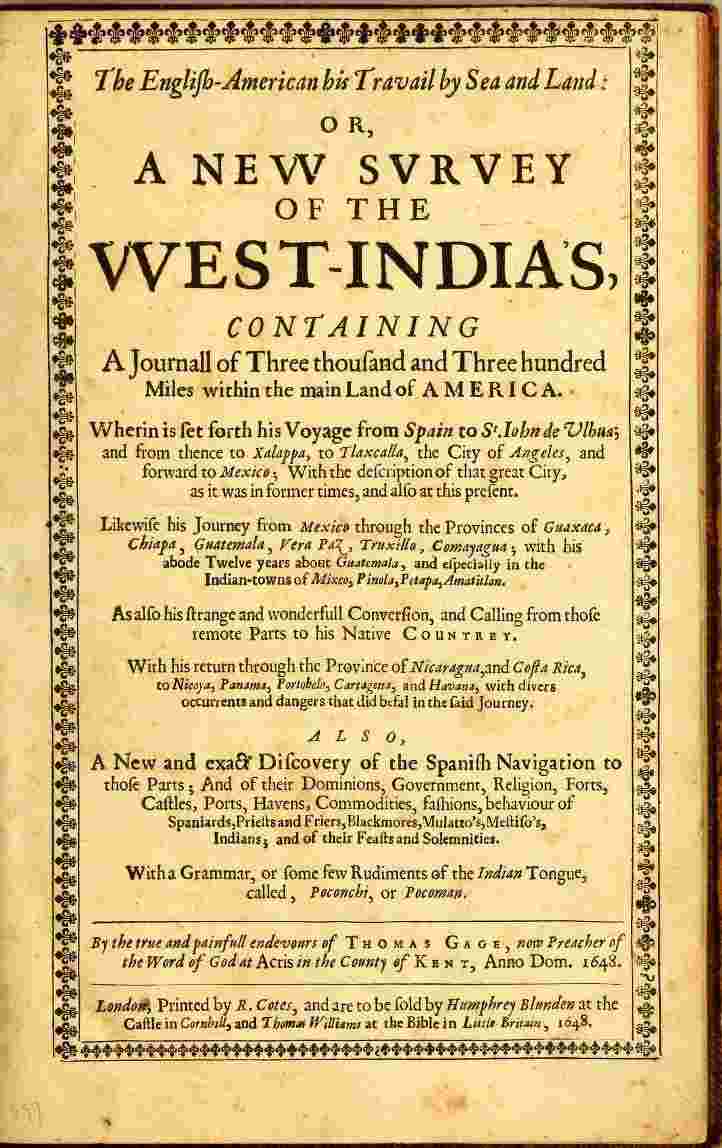
The English-American his Travail by Sea and Land:
OR,
A NEW SURVEY OF THE WEST INDIA'S,
CONTAINING
A Journall of Three thousand and Three hundred Miles within the main Land of AMERICA.
Wherin is set forth his Voyage from Spain to St. John de Ulhua; and from thence to Xalappa, to Tlaxcallan, the City of Angeles, and forward to Mexico; With the description of that great City, as it was in former times, and also at this present.
Likewise his Journey from Mexico through the Provinces of Guaxaca, Chiapa, Guatemala, Vera Paz, Truxillo, Comayagua; with his abode Twelve years about Guatemala, and especially in the Indian-towns of Mixco, Pinola, Petapa, Amatitlan.
As also his strange and wonderfull Conversion, and Calling from those remote Parts to his Native Countrey.
With his return through the Province of Nicaragua, and Costa Rica, to Nicoya, Panama, Portobelo, Cartagena, and Havana, with divers occurrents and dangers that did befal in the said Journey.
ALSO,
A New and exact Discovery of the Spanish Navigation to those Parts; And of their Dominions, Government, Religion, Forts, Castles, Ports, Havens, Commodities, fashions, behaviour of Spaniards, Priests and Friers, Blackmores, Mulatto's, Mestiso's, Indians; and of their Feasts and Solemnities.
With a Grammar, or some few Rudiments of the Indian Tongue, called, Poconchi, or Pocoman.
By the true and painfull endevours of Thomas Gage, now Preacher of the Word of God at Acris in the County of Kent. Anno Dom. 1648.
London, Printed by R. Cotes, and are to be sold by Humphrey Blunden at the Castle in Cornhill, and Thomas Williams at the Bible in Little-Britain, 1648.
CONTENTS
To His Excellency
Sr. THOMAS FAIRFAX Knight,
Lord FAIRFAX
of
CAMERON,
CAPTAIN-GENERALL
of the Parliaments Army;
And of all their Forces in ENGLAND, and
the Dominion of WALES.
May it please your Excellency,
The Divine Providence hath hitherto so ordered my life, that for the greatest part thereof, I have lived (as it were) in exile from my native Countrey: which happened, partly, by reason of my education in the Romish Religion, and that in forraign Universities; and partly, by my entrance into Monasticall orders. For twelve years space of which time, I was wholly disposed of in that part of America called New-Spain, and the parts adjacent. My difficult going thither, being not permitted to any, but to those of the Spanish Nation; my long stay there; and lastly my returning home, not onely to my Country, but to the true knowledg and free-profession of the Gospels purity, gave me reason to conceive, That these great mercies were not appointed me by the heavenly Powers, to the end I should bury my Talent in the earth, or hide my light under a bushell, but that I should impart what I there saw and knew to the use and benefit of my English Country-men; And which the rather I held my self obliged unto, because in a manner nothing hath been written of these Parts for these hundred years last past, which is almost ever since the first Conquest thereof by the Spaniards, who are contented to lose the honour of that wealth and felicity they have there since purchased by their great endevours, so they may enjoy the safety of retaining what they have formerly gotten in peace and security. In doing whereof I shall offer no Collections, but such as shall arise from mine own observations, which will as much differ from what formerly hath been hereupon written, as the picture of a person grown to mans estate, from that which was taken of him when he was but a Childe; or the last hand of the Painter, to the first or rough draught of the picture. I am told by others, that this may prove a most acceptable work; but I doe tell my self that it will prove both lame and imperfect, and therefore had need to shelter my self under the shadow of some high protection, which I humbly pray your Excellency to afford me; nothing doubting, but as God hath lately made your Excellency the happy instrument, not onely of saving my self, but of many numbers of godly and well-affected people in this County of Kent, (where now I reside by the favour of the Parliament) from the imminent ruine and destruction plotted against them by their most implacable enemies; so the same God who hath led your Excellency through so many difficulties towards the settlement of the peace of this Kingdom, and reduction of Ireland, will, after the perfecting thereof (which God of his mercy hasten) direct your Noble thoughts to employ the Souldiery of this Kingdom upon such just and honourable designes in those parts of America, as their want of action at home may neither be a burden to themselves nor the Kingdome. To your Excellency therefore I offer a New-World, to be the subject of your future pains, valour, and piety, beseeching your acceptance of this plain but faithfull relation of mine, wherein your Excellency, and by you the English Nation shall see what wealth and honor they have lost by one of their narrow hearted Princes, who living in peace and abounding in riches, did notwithstanding reject the offer of being first discoverer of America; and left it unto Ferdinando of Arragon, who at the same time was wholly taken up by the Warrs, in gaining of the City and Kingdome of Granada from the Moores; being so impoverished thereby, that he was compelled to borrow with some difficulty a few Crowns of a very mean man, to set forth Columbus upon so glorious an expedition. And yet, if time were closely followed at the heels, we are not so farr behinde, but we might yet take him by the fore-top. To which purpose, our Plantations of the Barbadoes, St. Christophers, Mems, and the rest of the Caribe-Islands, have not onely advanced our journey the better part of the way; but so inured our people to the Clime of the Indies, as they are the more inabled thereby to undertake any enterprise upon the firm Land with greater facility. Neither is the difficulty of the attempt so great, as some may imagine; for I dare be bold to affirm it knowingly, That with the same pains and charge which they have been at in planting one of those pettie Islands, they might have conquer'd so many great Cities, and large Territories on the main Continent, as might very well merit the title of a Kingdome. Our Neighbors the Hollanders may be our example in this case; who whilst we have been driving a private Trade from Port to Port, of which we are likely now to be deprived, have conquered so much Land in the East and West-Indies, that it may be said of them, as of the Spaniards, That the Sunn never sets upon their Dominions. And to meet with that objection by the way, That the Spaniard being intituled to those Countries, it were both unlawfull and against all conscience to dispossess him thereof. I answer, that (the Popes donation excepted) I know no title he hath but force, which by the same title, and by a greater force may be repelled. And to bring in the title of First-discovery; to me it seems as little reason, that the sailing of a Spanish Ship upon the coast of India, should intitle the King of Spain to that Countrey, as the sayling of an Indian or English Ship upon the coast of Spain, should intitle either the Indians or English unto the Dominion thereof. No question but the just right or title to those Countries appertains to the Natives themselves; who, if they shall willingly and freely invite the English to their protection, what title soever they have in them, no doubt but they may legally transferr it or communicate it to others. And to say, That the inhumane butchery which the Indians did formerly commit in sacrificing of so many reasonable Creatures to their wicked Idols, was a sufficient warrant for the Spaniards to divest them of their Country; The same argument may by much better reason be inforced against the Spaniards themselves, who have sacrificed so many millions of Indians to the Idol of their barbarous cruelty, that many populous Islands and large Territories upon the main Continent, are thereby at this day utterly uninhabited, as Bartholomeo de las Casas, the Spanish Bishop of Guaxaca in New-Spain, hath by his Writings in Print sufficiently testified. But to end all disputes of this nature; since that God hath given the earth to the sons of Men to inhabite; and that there are many vast Countries in those parts, not yet inhabited either by Spaniard or Indian, why should my Country-men the English be debarred from making use of that, which God from all beginning no question did ordain for the benefit of mankinde?
But I will not molest your Excellency with any further argument
hereupon; rather offering my self, and all my weak endevours
(such as they are) to be employed herein for the good of my
Country; I beseech Almighty God to prosper your Excellency,
Who am
The most devoted and humblest of
your Excellencies servants,
THO. GAGE.
UPON
This WORTHY WORK,
Of his most worthy Friend
THE
AUTHOR.
Reader, behold presented to thine eye,
What us Columbus off'red long agoe,
Of the New-World a new discoverie,
Which here our Author doth so clearly show;
That he the state which of these Parts would know,
Need not hereafter search the plenteous store
Of Hackluit, Purchas and Ramusio,
Or learn'd Acosta's writings to look o're;
Or what Herera hath us told before,
Which merit not the credit due from hence,
Those being but reck'nings of anothers score.
But these the fruits of self-experience:
Wherein our Author useth not the sence
Of those at home, who doe their judgments leave,
And after wandring farr with vast expence,
See many things, which they doe ne'r perceive;
Laborious are by study much at home
To know those Parts, which they came lately from.
Less doth he use us as the late writ Books
Of Journeys made unto the Levant-States;
Wherein when we doe pry with curious looks,
Of Greece and Troy to know the present fates;
They tell us what Thucidides relates,
What Strabo writes, what Homer crown'd with bayes,
What Authors more, who have out-worn their daies,
Besides what Plutarch and Polibius sayes:
So what they were, not what they are, they sing,
And shew their reading, not their travailing.
But here our Author neither doth us tell,
Or to us shew one inch of Sea or Ground,
Unless such acts which in his time befell,
Or what his eyes saw the Horizon bound:
He uttereth nought at all he heard by sound,
He speaks not of a City or a Street,
But where himself hath often gone the round,
And measured o're with his industrious feet.
And yet it must acknowledg'd be for true,
Since worthy Hawkins, and the famous Drake
Did first present unto the English view
This New-found-world, for great Eliza's sake;
Renowned Rawleigh twice did undertake
With labours great, and dangers not a few,
A true discovery of these Parts to make,
And thereof writ both what he saw and knew.
But as the man who in a Ship doth pass
Our narrow Seas, the flowings of each tide,
The Ships course, soundings, turnings of the glass,
What Land he makes on North or Southern side,
He may impart: But who they be abide,
Or what Religion, Language, or what Nation
Possess each Coast; since he hath never tride,
How can he make thereof a true Relation?
So those who have describ'd these Parts before,
Of Trade, Winds, Currents, Hurican's doe tell,
Of Headlands, Harbours, tendings of the shore,
Of Rocks and Isles: wherein they might as well
Talk or a Nut, and onely shew the shell;
The kernell neither tasted, touch'd nor seen
Had yet remain'd; but that it so befell,
That these Relations to us made have been;
Differing as much from what before y'have heard,
As doth a Land-Map from a Seamans Card.
But how these truths reveal'd to us should bee,
When none but Spaniards to those Parts may go;
Which was establish'd by severe Decree,
Lest Forain people should their secrets know;
This Order yet to be neglected so,
As that our Author had permission free,
Whose Nation too they count their greatest foe,
Seemeth almost a miracle to me.
Sure the prescience of that power Divine,
Which safely to those parts did him convey,
Did not for nought his constant heart incline
There twelve whole years so patiently to stay:
That he each thing exactly might survay,
Then him return'd, nay more did turn to us,
And to him shew'd of bliss the perfect way,
Which of the rest seems most miraculous.
For had the last of these not truly been,
These fair Relations we had never seen.
Nor can I think but this most usefull Book
In time to come, may like some new-born Starr,
Direct such Wisemen as therein will look,
And shew their way unto these Regions farr.
And though we now lie sunk in Civill war,
Yet you the worthy Patriots of this Land,
Let not your hearts be drowned in despair,
And so your future happiness withstand.
For time will come you shall enjoy a Peace,
But then no longer you must joy in sinn,
When they no more shall raign, these Wars shall cease,
And then your after bliss shall soon beginn.
The fiery trialls which you now are in,
In stead of foes shall prove your best of friends,
And you from servile base affection win,
To fit your hearts for high and Nobler ends:
Your Drums which us'd to beat their Martiall dance
Upon the banks of Garone, Seine and Soane;
Whilst you trode measures through the Realm of France,
Doe now at home (Oh grief!) on both sides groane,
As if they did your ill spilt blood bemoane;
Which long agoe with Richard, England's King,
When he the holy Warr maintain'd alone,
Their dreadfull notes did through Judea ring.
Now shall the tawnie Indians quake for fear,
Their direfull march to beat when they doe hear;
Your brave Red-Crosses on both sides display'd,
The noble Badges of your famous Nation,
Which you yet redder with your bloods have made,
And dy'd them deep in drops of detestation.
You shall again advance with reputation,
And on the bounds of utmost Western shore
Shall them transplant, and firmly fix their station,
Where English Colours ne'r did fly before.
Your well-built Ships, companions of the Sunn,
As they were Chariots to his fiery beams,
Which oft the Earths circumference have runn,
And now lie moar'd in Severn, Trent, and Tems,
Shall plough the Ocean with their gilded Stems,
And in their hollow bottoms you convay
To Lands inrich'd with gold, with pearls and gems,
But above all, where many thousands stay
Of wronged Indians, whom you shall set free
From Spanish yoke, and Romes Idolatry.
All this and more by you shall sure be done,
Yet I no Prophet, nor no Prophets sonne.
THOMAS CHALONER.
A NEW SURVEY OF THE WEST-INDIES.
CHAP. I.
How Rome doth yearly visit the American and Asian Kingdoms.
The policy, which for many yeares hath upheld the erring Church of Rome, hath clearly and manifestly been discovered by the many Errors which in severall times by sundry Synods or Generall Councells, (which commonly are but Apes of the Popes fancy, will, pleasure, and ambition) have been enacted into that Church. And for such purposes doth that man of Sinne, and Antichristian tyrant, keep constantly in Rome so many poor Pensionary Bishops as hounds at his table, smelling out his ambitious thoughts, with whom he fills the Synods, when he calls them, charging them never to leave off barking and wearying out the rest of the Prelates, untill they have them all as a prey unto his proud and ambitious designes; from which if any of them dare to start, not onely their Pensions shall be surely forfeited, but their souls shall bee cursed, and they as Hereticks Anathematized with a Censure of Excommunication latæ sententiæ. Hence sprung that Master-piece of Policy, decreeing that the Pope alone should be above the Generall Councell, lest otherwise one Mans pride might be curbed by many heads joyned together; And secondly, that Synodicall definition, that the Pope cannot erre, that though the Councels power, wisdome and learning were all sifted into one mans brain, all points of faith straitned into one head and channell; yet the People should not stagger in any lawfull doubts, nor the learned sort follow any more the light of reason, or the sunshine of the Gospel, but all yeelding to blind Obedience, and their most holy Fathers infallibility, in the foggie and Cimmerian mist of ignorance, might secure their souls from erring, or deviating to the Scylla or Charybdis of Schism and Heresie. What judicious eye, that will not be blinded with the napkin of ignorance, doth not easily see that Policy only hath been the chief Actor of those damnable Opinions of Purgatory, Transubstantiation, Sacrifice though unbloody (as they term it) of the Mass, Invocation of Saints, their Canonization or installing of Saints into the kingdom of heaven, Indulgences, auricular Confession, with satisfactory Penance, and many such like: All which doubtles have been commanded as points of Faith, not so much to save those wretched souls, as to advance that crackt-brain head in the conceits of his Europæan wonderers, who long agoe were espyed out by the Spirit of John wondring after the Beast, worshipping him for his power, and saying, Who is like unto the Beast, who is able to make warre with him? Revel. 13. 3, 4. Thus can Policy invent a Purgatory, that a Pope may be sought from all parts of Europe, nay now from East and West India's, to deliver souls from that imaginary Fire which never God created, but he himself hath fancyed, that so much glory may be ascribed to him, and his power wondered at, who can plunge into torments, condemn to burning, and when he list, deliver out of fire. Much more would he be admired, and his goodnesse extolled, if he would deliver at once all those his Purgatory Prisoners without that Simoniacall receipt of money. But policy can afford an infinite price and value of a sacrifice of the Masse, to delude the ignorant people, that though they leave their whole estates to enrich Cloysters, and fat proud Prelates and Abbots; yet this is nothing, and comes farre short (being finite) to that infinite Sacrifice, which onely can and must deliver their scorching, nay broyling souls: And if this infinite Sacrifice be not enough, (which will not be enough, whereas Christs infinit satisfaction was not enough in the opinion in that erroneous Church) Policy will give yet power to a Pope si divitiæ affluant, if money and rich bribes abound, to grant such plenary Indulgences, which may upon one Saints day, or at such a Saints Altar, work that soul out, which lyeth lurking and frying in the deepest pit of Purgatory. O who is like unto the Beast? But will those that wonder at him, bee also wondred at as workers of wonders and miracles? Policy will give power to a Pope to canonize such, and set them at Gods right hand, fit to be prayed unto, and called upon as Judges of our necessities, and Auditors of our wants: But this honor must be given, after that the whole Colledge of Cardinalls have been clothed with new Purple Robes, and Loads of money brought to the Court of Rome; Witness those many thousand pounds, which the City of Barcelona, and the whole Country of Catalonia spent in the Canonizing of Raimundus de Pennafort, a Dominican Fryer: Witnesse at least ten Millions, which I have been credibly informed, that the Jesuites spent for the canonization of their two Twins, Ignatius Loiola, and Franciscus Xavier, whom they call the East India Apostle. And it is not seven years ago yet that it was my chance to travail from Frankford in Germany as far as Millan in company of one Fryer John Baptist a Franciscan, who told me, That was the fourth time of his going to Rome from Valencia in the Kingdome of Arragon in Spain about the Canonization of one John Capistrano of the same Order; and that besides the great Almes which he had begged over many Countreys, (and in that journey went purposely to Inspurg to the Prince Leopoldo for his Almes and Letters of commendation to the Pope and Cardinals) he had spent of the City of Valencia onely five thousand Duckets, and yet was not his Saint enthroned, as he desired, in heaven; But still money was wanting, and more demanded for the dignifying with a Saints title him, who had lived a Mendicant and begging Frier. Thus are those blinded Nations brought by Policy to run to Rome with rich treasures, and thus doe they strive who shall have most Saints of their Countrey or Nation, though impoverishing themselves; whilst at Rome ambition and Policy say not, It is enough, fit mates for the Horsleech his two daughters, crying, Give, give, Prov. 30. 15. Give, say they, and the rigid Penance justly to be imposed upon thee for thy sinnes most hainous, shall be extenuated and made easie for thee. Give, say they, and thou shalt be dispensed with to marry thy nearest Kinswoman or Kinsman. It would be a long story to insert here how the Popes Policy sucks out of England our gold and silver for the authorizing of our Papists private Chambers and Altars for the gaining of Indulgences in them, and delivering of souls out of Purgatory, when Masses are said and heard at them. Thus hath Romes policy blinded and deceived many of the European Kingdomes; and with the same greedinesse gapes at Asia and America. Who would not admire to see that at this day in America onely, the Popes authority and usurped power is extended to as many Countreys as all Europe containes, wherein no Religion but meer blinde Obedience and subjection to that Man of Sin is known? And daily may it more and more encrease, whereas the King of Spain gloryeth to have received from the Pope power over those Kingdomes farr greater than any other Princes of Europe have enjoyed from him. But the pity is, that what power these Princes have, they must acknowledge it from Rome, having given their own power and strength unto the Beast, Revel. 17. 13. suffering themselves to be divested of any Ecclesiasticall power over the Clergy, and unabled to tender any Oath of Supremacy and Allegiance to their own and naturall subjects, onely so farre as his Holinesse shall give them power. Which, Policy since the first Conquest of the West India's, and ambition to advance the Popes name, hath granted to the Kings of Spain, by a speciall title, naming those Kingdomes, El Patrimonio Real, The Royall Patrimony; upon this Condition, that the King of Spain must maintain there the preaching of the Gospel, Fryers, Priests and Jesuites to preach it with all the erroneous Popish doctrines, which tend to the advancement of the Popes glory, power, and authority. So that what power hee hath divested himself of, and invested the Pope with; what power other Princes are divested of, and the King of Spain in his Kingdomes of Europe, from medling in Ecclesiasticall affaires, or with Ecclesiasticall men; Arch-Bishops, Bishops, Preists, Jesuites, Monkes and Fryers; that same power by way of Royall Patrimony is conferred upon him in the India's only. And this only politickly to maintain there Popery; else never would it have so much increased there; for poor Preists and mendicant Fryers would never have had means enough to be at the charges of sending yeerly Flockes and Sholes of Fryers thither, neither to keep and maintain them there; neither would the covetousnesse of the Popes themselves have afforded out of their full and rich treasures, means sufficient for the maintaning of so many thousand Preachers as at this day are preaching there, more Rome and Antichrists name, then the name of Christ and the truth of the Gospel. And policy having thus opened way to those American parts, the charges thus being laid upon the Crown of Spain, and the honour of a Royall Patrimony, with power over the Clergy thus conferred upon the Kings of Spain, how doth the Pope yeerly charge the Catholike King with troopes of Jesuites and Fryers to be conveyed thither? Now the Jesuites (the best scholars of Romes policy) seeing this to bee thus setled between the Pope and the King of Spain, for the increasing of their Order, and to suppresse the increase of other Religions there, have thought first of a way of challenging all the India's to themselves, alleadging that Francis Xavierius companion of Ignatius Loiola was the first Preacher that ever preached in the East India's, and so by right that they being of his profession ought only to be sent thither. But this their way being stopped by the opposition of all other Religious orders, especially by the solicitation of one Fryer Diego Colliado, a Dominican, as hereafter I will shew more largely: Now, secondly, their policy is to leane more to the Popes of Rome, then any other of those Orders, by a speciall Vow which they make above the three Vowes of other orders, Poverty, Chastity, and Obedience to their superiors; to wit, to be alwaies ready to go to preach when or whither soever the Pope shall send them, and to advance his name, defend his power in what parts soever, maugre whatsoever danger, or opposition. Thus though the remotenesse of America may discourage other Orders from going thither to preach, and their freewill which is left unto them to make choice of so long and tedious a journey may retard their readinesse, and the dangers of the Barbarians unwillingnesse to submit to a Popes power, and admit of a new Religion as superstitious as their own, may affright them from hazarding their lives among a barbarous, rude, and idolatrous people; yet if all others faile, the Pope, and the Jesuites being thus agreed, and the King of Spain bound by the new Royall Patrimony, Preachers have nor, nor shall ever be wanting in those parts: And in stead of the old Jesuites and Preachers grown in age, yeerly are sent thither Missions (as they call them) either of Voluntiers, Fryers mendicants, Preists or Monkes, or else of forced Jesuites: All which entring once into the List and Bond of Missionaries, must abide there, and be maintained by the King of Spain ten yeers. And whosoever before the ten yeers expired, shall desire to see Spain again, or runagate-like shall return, may be constrained (if taken in Spain) to return again to the India's, as it happened whilst I lived in those parts, to one Fryer Peter de Balcazar a Dominican, who privily flying back to Spain, was the year after shipped, and restored again to his forced service under the Pope of Rome. And thus doth policy open the wayes to those remote and forain parts of America. Thus hath policy wrought upon the Kings of Spain; and Jesuiticall policy meeting with Antichrists policy and Ambition, doth Rome yeerly visit her new nursed Children, greeting that Infantile Church of Asia and America with troopes of messengers one after another, like Jobs messengers, bringing under pretence of salvation, damnation and misery to their poor and wretched souls.
CHAP. II.
Shewing that the Indians wealth under a pretence of their Conversion hath corrupted the hearts of poor begging Fryers, with strife, hatred and ambition.
It is a most true and certain saying, Odia Religionum sunt acerbissima, hatred grounded in points and differences of Religion (let me adde, if ambition blow the fire to that hatred) is the most bitter and uncapable of reconciliation. Nay, it is an observation worth noting of some (see Doctor Day upon the I Cor. 16. 9. Verse) that the neerer any are unto a conjunction in matters of Religion, and yet some difference retained, the deeper is the hatred; As hee observes, a Jew hates a Christian farre worse then hee doth a Pagan, or a Turke; a Papist hates a Protestant worse then hee doth a Jew, and a Formalist hates a Puritan worse then hee doth a Papist. No such hatred under heaven (saith hee) as that between a Formalist, and a Puritan, whereof our now Domestick and Civill Warres may bee a sad and woefull experience. A truth which made Paul burst out into a lamentable complaint, I Cor. 16. 9. saying, A great doore and effectuall is opened unto mee, and there are many adversaries.
And as when the doore of true Faith once is opened, then Adversaries begin to swarme and rage; so in all points of false and fained Religion where the entrance to it is laid open, hatred and enmity will act their parts. But much more if with such pretended Religion, Wealth and Ambition as counterfeit Mates thrust hard to enter at the opened doore, what strife, hatred, and envy doe they kindle even in the hearts of such who have vowed poverty and the contempt of worldly wealth? I may adde to what hath beene observed above, that no hatred is comparable to that which is betweene a Jesuite and a Fryer, or any other of Romes Religious Orders; And above all yet betweene a Jesuite, and a Dominican. The ambition and pride of Jesuites is inconsistent in a Kingdome or Common-wealth with any such as may bee equall to them in Preaching, Counsell or Learning. Therefore strive they so much for the education of Gentlemens Children in their Colledges, that by teaching the sonnes, the love of the fathers and mothers may bee more easily gained: and their love and good will thus gained, they may withall gaine to themselves whatsoever praise, honour, glory may bee fit to bee bestowed upon any other Ecclesiasticall Person. Which Policy and Ambition in them being so patent and knowne to all the World, hath stirred up in all other Religions a hatred to them uncapable ever of Reconciliation. This hath made them all to conspire against them, and to discover their unsatisfied covetousnesse in beguiling the rich widowes of what meanes hath beene left them by their deceased husbands, to erect and build those stately Colledges beyond the Seas, the sight whereof both outward and inward doth draw the ignorant people to resort more to their Churches and preaching then to any other. Thus whilest in Venice, they got the favour of one of the chief Senatours of that Common-wealth, they politickly drew him to make his will according to their will and pleasure, leaving to his son and heire no more then what they should think fit to afford him. But they appropriating to themselves the chiefest part of the young heires meanes, and with so proud a legacy thinking to overpower all other Orders, were by them opposed so, that the Will was called for by the whole State and Senatours of Venice, fully examined, and they commanded to restore to the heire the whole Estate as enjoyed by his Father. Well did that wise Senate conceive, that as one Noble man had been cheated by them of his fortunes, so might they one by one, and so at length the riches of Venice might become a treasure onely for Jesuites to maintaine the pride and pompe of their glorious fabricks. And though those vowed servants to the Pope obtained his Excommunication against the whole Estate of Venice upon non-complying with the foresaid Will and Testament; yet such was the preaching of all other Preists and Orders against them, that they caused the State to slight the Excommunication, and in lieu of making them heires of the deceased Senatours Estate, they shamefully banished them out of Venice. Thus also have the Preists and Fryers of Biscaya in Spain prevailed against the admitting of Jesuits into San-Sebastian, though by the favour of some they have in severall occasions obtained an house and erected a Bell to ring and summon in the People to their pretended Church and Colledge. Nay the very house wherein their Patron Ignatius Loiola lived, have they often seriously offered to buy for a Colledge; yet such hath been the opposition of the Preists and Fryers of that Countrey, that they have dashed to nought their often iterated endeavours to purchase that which they esteem their chiefest Relique. But to come neerer to our owne Countrey, what a combustion did this strife betweene Jesuites and other Preists of England cause among our Papists ten yeares agoe, when the Pope sending into England Doctor Smith pretended Bishop of Chalcedon to bee the Metropolitan head over all the Clergy and other Orders, how then was it to see the pride of the Jesuites as inconsistent with any one that might oversway them, or gain more credit then themselves? who never left persecuting the Bishop, till by the Popes Letters they had banished him out of England. Which curtesie, the secular Preists gaining yet a head over them with title of Archdeacon, Doctor Champney, have ever since sought to repay home, by endeavouring alwayes to cast them out of England, as pernicious to the State of this Kingdome, more then Fryers or any other sort of Preists; Which they have sufficiently made known by discovering their covetousnesse in encroaching upon many Houses and Farmes, enriching themselves, as namely at Winifreds Well (so tearmed by them) where they had bought an Inne; and speedily fell to building there that they might make it a Colledge for Jesuites to entertaine there all Papists comers and goers to that Well, and so might win to themselves the hearts of most of the Papists of the Land, who doe yearly resort thither to bee washed and healed upon any light occasion either of Head-ach, Stomack-ach, Ague, want of children, where they blindly phansie a speedy remedy for all maladies, or wants of this World. Thus have the Preists discovered further our English Jesuites covetousnesse in the building of the Sope-houses at Lambeth under the name of Mr. George Gage their purse-bearer, and since projecting the Monopoly of Sope under Sir Richard Weston, Sir Basil Brooke, and many others names, who were but Agents and Traders with the Jesuites rich and mighty Stocke. Thus came out the discovery of the Levelling of Hils and Mountaines, cutting of rocks at Leige in the Low Countryes at the Colledge of the English Jesuites, a worke for Gardens and Orchards for their Novices recreation and pastime, which (as I have heard from their owne mouthes) cost them thirty thousand pound, which gift they squeezed out of one onely Countesse of this Land. Like to this may prove their Colledge at Gaunt, for which they have obtained already a faire beginning of eight thousand pounds from the Old Countesse of Shrewsberry, and from the greatest part of the Estate of Mr. Sackefield, whom whilst they had him in their Colledges, they cherished with their best dainties, and with hopes that one day hee should bee a Canonized Saint of their Religious Order. All these knaveries doe even those Preists of the same Popish Religion discover of them, and thereby endeavor to make them odious. And though of all, the Jesuites be the most covetous, yet may I not excuse the Secular Preists, Benedictine Monks, and the Fryers from this damnable sinne; who also strive for wealth and meanes for their Doway, Paris and Lisboe Colledges, and lose no opportunities at the death of their Popish favourites for the obtaining a Legacy of one or two hundred Pounds, assuring them their soules shall bee the better for their Masses. Thus doe those miserable wretches in the very heat of their zeale of soules seeke to suppresse one another, and having vowed Poverty, yet make they the Conversion of England the onely object of their Ambition and unsatiable Covetousnesse. But above all is this envy and hatred found between Dominicans and Jesuites, for these owe unto them an old grudge, for that when Ignatius Loiola lived, his Doctrine de Trinitate (which hee pretended was revealed to him from heaven, for hee was certainely past the Age of studying at his Conversion) was questioned by the Dominicans, and hee by a Church Censure publickly and shamefully whipped about their Cloisters for his erroneous principles. This affront done to their chief Patron hath stirred up in them an unreconciliable hatred towards the Order of the Dominicans, and hath made them even cracke their braines to oppose Thomas Aquinas his Doctrine. How shamefully doe those two Orders indeavour the destruction of each other, branding one another with calumnies of heresie in the Opinions especially de Conceptione Mariæ, de libero arbitrio, de Auxiliis? And of the two, the Jesuites is more bold and obstinate in malice and hatred. How did they some twenty yeares agoe, all Spaine over, about the Conception of Mary stirre up the people against the Dominicans, in so much that they were in the very streets tearmed Hereticks, stones cast at them, the King almost perswaded to banish them out of all his Dominions, and they poore Fryers forced to stand upon their Guard in their Cloisters in many Cities, especially in Sevill, Osuna, Antiquera and Cordova, to defend themselves from the rude and furious multitude. Much like this was that publike Conference and disputation betweene Valentia the Jesuite and Master Lemos the Dominican, before the Pope, concerning their altercation de Auxiliis; When the cunning Jesuite hoping to brand with heresie the whole Order of Dominicans, had caused Augustines Workes to bee falsly printed at Lions, with such words which might directly oppose the Thomists Opinion; and had prevailed, had not Lemos begged of the Pope that the Originall Bookes of Augustin might bee brought out of his Vatican Library, where was found the quite contrary words, to what the false Jesuite had caused to be printed; hee was forced to confesse his knavery, was harshly reprehended, and with the apprehension of that great affront, the next night gave up his ghost to his father, the father of lies and falshood.
An other reason of this mortall enmity between these two Orders, is for that the Jesuites surpasse all others in ambition or honour, credit, and estimation, whence it is they cannot indure to behold the Dominicans to exceed them in any preferment. Now it is that by the Laws of Arragon and the Kingdome of Valencia, the Kings of Spain are tied to have a Dominican Fryer for their Confessor or ghostly father; which could but the Jesuites obtain, how would they then rule and govern Spain and the Kings heart? But though they could never yet prevail to alter this established law, yet have they prevailed now lately so that Antonio de Sotomayor the King of Spains Confessor should lie at rest in the Court of Madrid, with a pension and dry title only; and that Florencia that grand Statist should be Confessor to the Count of Olivares, the Royall Issue, the Queen, and should hear the Kings confessions oftner then his chosen and elected Confessor Sotomayor. Secondly, the Dominicans as first Authors of the Inquisition (which they prove from their Martyr Peter of Verona) still enjoy the highest places of that Court, which is a wofull sight to the Jesuites to see their Religion affaires handled, their Church kept pure from what they call heresy by any but themselves. O had they (as they have often strived for it) in their hands the judicature of that tribunall, how should all Dominicans, nay all sorts of Preists but their own, presently by them be branded with heresy? Thirdly, in Rome there is an other preferment successively due to Dominicans, from the time of Dominicus de Guzman founder of that Religion, to wit, to be magister Sacri Palatii, the Popes Palace master, instituted to this purpose that about him there may be some learned Divine (for commonly the Popes are more Statists, and Canonists, then Divines) to read a daily lecture of Divinity to such as will be instructed therein, and to resolve the Pope himselfe of whatsoever difficult points in Divinity may be questioned. This is the Dominicans due with a pension to maintain Coach and servants within the Palace of St. Peter. Which the Jesuites have often by favour and cunning Jesuiticall trickes endeavoured to bereave the Dominicans of; but proving labour in vain, they continue still in their unplacable enmity and hatred against them. And thus you see the fountaines of their strife; which as here in Europe hath been well seen, so hath this contentious fire overpowered the fire of their zeal of soules in the East and West-India's; and the wealth and riches of those Countries, the ambition of honor in their Gospel function hath more powerfully drawn them thither, then (what they pretend) the Conversion of a barbarous and idolatrous nation. This was well published to the view of the whole world by a most infamous libel which in the year 1626 fryer Diego di Colliado a missionary Fryer in Philippinas and Japan set out of the unheard of passages and proceedings of the Jesuites in those Eastern parts. At that time the Jesuites pretended that mission to themselves only, and petitioned the King of Spain, that only they might go thither to preach, having been the first plantation of Franciscus Xavier, and since continued successively by their Preists. To this purpose they remembred the King of the great charges he was at in sending so many Fryers and maintaining them there; all which should be saved, might they only have free ingresse into those Kingdomes. All which charges they offered themselves to beare, and further to bring up the Indians in the true faith, to instruct them and civilize them, to teach them all liberall sciences, and to perfect them in musick and all musicall instruments, and in fencing, dancing, vaulting, painting and whatsoever els might make them a compleat, and civill people. But against all this was objected by Diego Colliado, that not zeal only and charity moved them to this offer, but their ambition and covetousnesse, which would soon be seen in their encroaching upon the silly and simple Indians wealth, bringing instances of many thousand pounds which they had squeezed from the poore Barbarians in the Islands of Philippinas; And that their entring into Japan was more to enrich themselves, then to convert the Japonians to Christianisme; that whensoever they entred into that Kingdome they conveyed from Manila whole ships laden with the richest commodities of those Islands; that their trading was beyond all other Merchants trading, their Bench for exchange mony farre more accustomed then any other whither for China, for Japan, for Peru and Mexico; and that the Viceroy himselfe made use of none other, but theirs. That to keep out all other orders out of Japan, they had ingratiated themselves so farre, under pretence of trading, into the Emperours favour by gifts of Watches, Clocks, Dials, Lockes, and Cabinets, and such like presents of most curious and artificiall Workmanship, that they had got free accesse to his Court, and counselled him to beware of Fryers, which cunningly crept into his Kingdome to preach a new law, perswading him by rigorous search and enquiries to root them out: thus politickly for their own ends hindering the increase of Christianisme by any means or instruments save themselves; and blinding the Emperors eyes with their cunning insinuations, that he might not see in them, what they desired he might discover in others, that they might appear in sheep skins, and others clothed with wolves skins; and so the Fryers might have little heart to trade, but enough to doe to save themselves from the stormy persecution, whilst they freely might enjoy the liberty of rich trading. This brand upon these cunning foxes was commanded to be printed, thankes given to Diego Colliado for discovering to the Estate their crafty proceedings, with not a few tenents maintained by them in Japan even against their owne Soveraigne; a fat Bishoprick was offered to the Fryer, which he refusing, commission was given unto him for the raising of forty Fryers out of Spain, and the conducting of them to the Islands of Philippinas, and that it should be free for all Preists and Fryers, as well as Jesuites, to passe to those parts for the preaching of Christ and the extending of Christianisme among the Heathens and Barbarians. O that this my discovery made to England of those dissembling and false Preists, would make us wise to know and discover under the ashes of their pretended Religion, the fire of strife and contention which they kindle in Kingdomes, and to rake up that covetousnesse, which we may easily find in them; tending to the ruine of many fair estates, and to the temporall and spirituall danger of this our flourishing Kingdome!
CHAP. III.
Shewing the manner of the Missions of Fryers and Jesuites to the India's.
All the Kingdomes of America, that have been conquered by the Kings of Spain, are divided as into severall temporall governments, so into severall spirituall jurisdictions, under the name of Provinces, belonging unto severall religious Orders, and their Provincials. These though so farre distant from Europe, yet live with a dependency and subordination unto the Court of Rome, and are bound to send thither a strict account and relation of what most remarkable passages and successes happen there, as also what want of Preachers there is in every severall Province. Which is to be performed in this manner. Every religious Order (except the Jesuites and Dominicans, whose Generall continueth till death, unlesse a Cardinals cap be bestowed upon him) maketh election of one of the same order to be the head Ruler, or (as they call him) Generall over all those of the same profession every sixth year. The subjects unto this Generall which are dispersed in Italy, Germany, Flanders, France, Spain, East and West-India's are divided into sundry Provinces, as in Spain there is one Province of Andaluzia, another of Castilia nueva, new Castile, another of Castilia vieja, old Castile, another of Valencia, another of Arragon, of Murcia, of Catalonia; So likewise in America there is the Province of Mexico, of Mechoacan, of Guaxaca, of Chiapa and Guatemala, of Comayagua, Nicaragua and the like. Every Province of these hath a head named the Provinciall, chosen by the chief of the Province every three years; which election is called a Provinciall Chapter, and the former a Generall Chapter, which also is allotted to be in some chief City, commonly in Italy, France, or Spain. When the Provinciall Chapter is kept, then by the consent of all that meet in it is there one named by name of Procurator or Diffinitor, who is to goe in the name of the whole Province to the next election of the Generall, and there to demand such things as his Province shall think fit, and to give an account of the State of the Province from whence he is sent. Thus from the West-India's are sent Procurators, who commonly are the best prizes the Holland Ships meet with, for that they carry with them great wealth, and gifts to the Generalls, to the Popes and Cardinals and Nobles in Spain, as bribes to facilitate whatsoever just or unjust, right or wrong they are to demand. Among other businesses their charge is this, to make known the great want of laborers in the aboundant and plentifull harvest of the India's (though not all Provinces demand Preachers from Spain, as I will shew hereafter) and to desire a number of thirty or forty young Preists, who may be fit for any Indian language and to succeed the old standers.
The Order of the Province being read to the Generall, or his Generall Chapter, then are Letters Patents granted unto this Procurator from the Generall, naming him his Vicar Generall for such a Province, and declaring his sufficiency and worthy parts, (though none at all in him, as I have beene witnesse of some) the great paines hee hath taken in the new planted Indian Church, and how fit hee hath been judged to convey to those parts, a Million of such as shall voluntarily offer themselves for the propagation of Christianity amongst those Barbarians. Then the tauny Indian Fryer being well set out with high Commendations, and fairly painted with flattering Elogies, presents these his Patents (and with them peradventure a little wedge of Gold, a Box of Pearles, some Rubies or Diamonds, a Chest of Cochinill, or Sugar, with some boxes of curious Chocolatte, or some feather works of Mechoacan, some small fruits of his great paines and labour) to the Pope; who for his first reward gives him his Toe and Pantofle to kisse, seconding this honour with a joyfull countenance to behold an Apostle, judging him worthy of the best of the Indian wealth, and his soule peradventure fit for the title of a Saint; This complacency in the gift and the giver, breeds immediately a motus proprius in his Holinesse to grant a Bull with a degree of the Popes Commissary, wherein this poore Mendicant Fryer is inabled to runne over all the Cloisters of his Profession in Spain, to gather up his thirty or forty yong Preachers. Who for their better encouragement are at their first listing by the Popes Authority absolved à culpa et à poena, from all sinne, and from their Purgatory and Hell due unto it, by a plenary Indulgence. And whosoever shall oppose, or any way discourage this Popes Commissary, or those that are or would be listed by him, are ipso facto excommunicated with an Anathem reserved only to this Commissary or his Holiness himself. O what is it to see, when such a Commissaries coming is knowen, how the young birds, that as in Cages are shut up within the walls of a Cloister, leap and cherish themselves with hopes of liberty? What is it to see disordered Fryers, who for their misdemeanours, and leaping over their Cloister wals in the night to find out their wanton harlots, have been imprisoned, now rejoyce at the coming of a Popes Commissary, and Plenary Indulgence, freeing them from sinnes past, and fitting them for the Conversion of souls, though there be not one averted from their Harlot, nor as yet truly and unfainedly converted to the love of God? True it is, I have knowne some that have written their names in the list of Indian Missionaries, men of sober life and Conversation, moved onely with a blind zeale of encreasing the Popish Religion: yet I dare say and confidently print this truth without wronging the Church of Rome, that of thirty or forty which in such occasions are commonly transported to the India's, the three parts of them are Fryers of leud lives, weary of their retired Cloister lives, who have beene punished often by their Superiours for their wilfull back-sliding from that obedience which they formerly vowed; or for the breach of their poverty in closely retaining money by them to Card and Dice, of which sort I could here namely insert a long and tedious Catalogue; or lastly such, who have been imprisoned for violating their vow of chastity with leud and lascivious women, either by secret flight from their Cloisters, or by publike Apostatizing from their Order, and cloathing themselves in Lay-mens Apparell, to run about the safer with their wicked Concubines. Of which sort it was my chance to bee acquainted with one Fryer John Navarro a Franciscan in the City of Guatemala, who after hee had in secular apparell enjoyed the leud company of one Amaryllis a famous Woman player in Spain for the space of a year, fearing at last hee might bee discovered, listed himselfe in a Million to Guatemala, the year 1632, there hoping to enjoy with more liberty and lesse feare of punishment any lustfull or carnfull object. Liberty, in a word, under the Cloak of Piety and Conversion of Soules, it is, that drawes so many Fryers (and commonly the younger sort) to those remote American parts; where after they have learned some Indian language, they are licenced with a Parish Charge to live alone out of the sight of a watching Prior or Superiour, out of the bounds and compasse of Cloister walls, and authorized to keep house by themselves, and to finger as many Spanish Patacones, as their wits device shall teach them to squeeze out of the newly Converted Indians wealth. This liberty they could never injoy in Spain, and this liberty is the Midwife of so many foule falls of wicked Fryers in those parts. For the present onely, I shall return again to my Fryer John Navarro, who at his comming to Guatemala, being made for his wit and learning, Master and Reader of Divinity, and much esteemed of for his acute Preaching, among many others got the estimation and love of a chief Gentlewoman, (Qua semel est imbuta recens servabit odorem, testa diu) who continued in Navarro his heart the former sent of the unchast love of Amaryllis, so far that the Fryer being blinded and wounded with Cupids Arrow sticking in his heart, ran headlong to quench his lustfull thirst upon St. James his day, 1635. for bitter memory of the Tragical event (being the Spaniards common Advocate, and speciall Patron of that City, named St. Jago de Guatemala) where cruell Mars oppressing Venus in her wanton Acts, the injured husband acting Mars, & finding Navarro Cupids page saluting his Venus upon her bed, drew his sword, cutting the Fryer first in the head and face, who strugling with death, and purchasing his life with a swift and nimble flight to a Garden, where his own brother a Fryer of the same Order, & Pander to that foul act, entertained the Motherlesse children; for the husband having missed his fatall blow (willingly as some imagined, or unwillingly as others judged) in the Fryers heart, wilfully laid it in the throat of his unchast Wife, scarce leaving way for breath to make a speedy Confession of her sinne to Navarro his Brother; who tendring her soule as much as his Brother had tendred her body absolved her from her sinne, finding signes, though no uttering speech of Repentance, while the murderer fled, and the murdered lay in the doore of her house for a sad object to all, that immediately flocked thither to see that bloody Tragedy. The Wife being the same day buried, the Husband being retired to a close Sanctuary, Navarro was carried to his Convent to bee cured; and after his Cure was banished that Country; whom two yeares after it was my chance to meet in Cartagena returning to Spain with his scard face, bearing the marke of his lascivious life, and of that liberty which hee had injoyed in America. Such are the fruits of the zeale of those wretches, who upbraid our Church and Ministers for want of zeale to labour in the Conversion of Infidels. Who when they arrive to those parts, are entertained with ringing of Bells, with sounding of Trumpets most part of the way as they travaile, and as Apostles are received by the Indians, though soon like Judas they fall from their calling, and for pleasure and covetousnesse sell away Christ from their Soules. England may here learn to beware of such Converters, who are daily by name of Missionaries sent hither by the Pope to preach among us Popery; but like Navarro come to feed and cherish their wanton lusts, as I could give many instances, might I not be censured for long digressions in mingling English Histories with my American Travailes.
CHAP. IV.
Shewing to what Provinces of the East and West India's belonging to the Crown of Castilia are sent Missions of Fryers and Jesuites. And specially of the Mission sent in the yeare 1625.
In all the Dominions of the King of Spain in America, there are two sorts of Spaniards more opposite one to another then in Europe the Spaniard is opposite to the French, or to the Hollander, or to the Portingall; To wit, they that are born in any parts of Spain and goe thither, and they that are borne there of Spanish parents, whom the Spaniards, to distinguish them from themselves, terme Criolio's, signifying the Natives of that Countrey. This hatred is so great, that I dare say, nothing might bee more advantagious then this, to any other Nation that would conquer America. And nothing more easily gained, then the Wils and affections of the Natives of the Country, to joyne with any other Nation to free and rescue themselves from that subjection, or kind of Slavery, which they suffer under the hard usage of the Spaniards, and their partiall Government and justice toward them, and those that come from Spain. This is so grievous to the poore Criolio's or Natives, that my selfe have often heard them say, They would rather bee subject to any other Prince, nay to the Hollanders, then to the Spaniards, if they thought they might enjoy their Religion; and others wishing the Hollanders, when they tooke Truxillo in Honduras, had stayed in it and entred further into the land, they should have been welcome to them; and that the Religion they enjoyed with so much slavery, was nothing sweet unto them. This mortall hatred betwixt these two sorts of Spaniards, made the Criolio's so ready to joyn against the Marquesse of Gelves Viceroy of Mexico, in the tumult and mutiny of that City, wherein they cleaving to Don Alonso de Zerna, the Arch-Bishop caused the Viceroy to escape for his life by flight, and would then have utterly rooted out the Spanish Government, had not some Preists disswaded them from it; but of this I shall speak more largely hereafter. The cause of this deadly hatred hath proceeded from a jealousie which the Spaniards have ever had of the Criolio's, that they would faine withdraw themselves first from the commerce with Spain, and secondly, from the Government which is laid upon them; which is such, that the Criolio's must be alwaies under, and a subject, alwaies governed, but scarce any a Governour. Never yet was there seen any Criolio made Viceroy of Mexico, or Peru; or President of Guatemala, or Santa fe, or S. Domingo; or Governour of Yucatan, Cartagena, Havana; or Alcalde Mayor (as they call them) of Soconusco, Chiapa, San Salvador, and such like places of credit. So likewise in the Courts of Chancery, as Sto. Domingo, Mexico, Guatemala, Lima, and the rest, where commonly there are Six, called Oydores and one Fiscal, scarce one of them to be found a Criolio, or native of the Countrey; though there be among them those that descended of the chief Conquerors; as in Lima and Peru the Pizarros, in Mexico and Guaxaca the house of the Marquesse Del Valle, Ferdinando Cortez his Successors, others of the house of Giron, others of the house of Alvarado, others of the Guzmanes, finally many of the chiefest houses of Spain; yet none of these ever preferred to any dignity. And not onely thus are they kept from offices, but daily affronted by the Spaniards as uncapable of any Government, and termed halfe Indians by them.
Which generall contempt hath also spread it selfe in the Church, where no Criolio Preist is scarce ever preferred to be a Bishop, or Canon in a Cathedrall Church, but all such as come from Spain. So likewise in the religious orders they have many years indeavored to keep under and suppress such as have bin admitted to their orders of the natives of the Countrey, lest the number of them should prevail against those that are brought from Spain; they have been very nice in choosing of them, & though they have been forced to admit of some, yet stil the Provincials, the Priors, and all Superiors have been Spaniards born in Spain. Till now lately some Provinces have got the upper hand and prevailed against the Spaniards, & have so filled their cloisters with Criolio's or natives, that they have utterly refused to admit the supplies of Spanish Missions which formerly were sent unto them, and till this day are sent to others. In the Province of Mexico there are Dominicans, Franciscans, Augustines, Carmelites, Mercenarians, and Jesuites, whereof the Jesuites and Carmelites only to this day prevail against Criolio's, bringing every two or three years Missions from Spain. The last Mission that was sent to the Mercenarians was the year 1625. and then was the opposition such between that Mission and the Criolio's, that in the election of the next Provinciall in their Cloister of Mexico, the Fryers drew knives one against another, and were like to kill each other, had not the Viceroy gone to their Cloister to make peace, and imprison some of them. Yet at last by the multitude of voices the native party prevails, and till this day have exempted themselves from Spanish Missions, alleadging (as others have done) that they have Fryers enough in their Cloisters, and need none to be sent them from Spain; submitting themselves to the Pope, and presenting to him as stately gifts as ever Spaniards did before them. In the Province of Guaxaca none admit of Missionaries from Spain; true it is the Dominicans are but newly subdued by the Criolian party; and as yet are strongly pleading at Rome for Spanish Fryers, alleadging that the glory and lustre of their Religion hath been much blurred since the non-admittance of supplies of their zealous Compatriots. The Province of Guatemala, (which is of a large extent) containing Guatemala, Chiapa, the Zoques, part of Tabasco, the Zeldales, the Sacapulas, the Vera Paz, all the coast lying to the South sea Suchutepeques and Soconusco, Comayagua, Honduras, S. Salvador, Nicaragua hath in it these orders chiefly, Dominicans, Franciscans, Augustines, (who are subject to Mexico being one poore Cloister in Guatemala) Jesuites also in Guatemala subject to the government of Mexico and Mercenarians; whereof the three orders of Dominicans, Franciscans, and Mercenarians, are the only Preachers and parish Preists throughout all the forenamed Provinces. And these three Orders have still kept under the Criolian party, never as yet suffering any of them to be Provinciall, bringing every two or three years some one year and some another, Missions of Fryers from Spain to maintain and keep up their faction against the Criolians. The Provinces of Peru being more distant from Spain, and hard to come to by sea, have no Missions sent unto them. There are of the most Romish religious orders, yet the chief are Dominicans; and they all live above their vow of poverty, abounding in wealth, riot, liberty and pleasures. In the Kingdome of Nuevo reino de Granada, and Cartagena, Santa fee, Barinas, Popayan, and the government of St. Martha, are Dominicans, Jesuites, Franciscans, Carmelites, Augustines and Mercenarians, whereof the Dominicans, Jesuites and Franciscans till this day admit of Missions from Spain. The Island of Cuba, Jamaica, la Margarita, Puerto rico, all are subject to the head Provinciall of Santo Domingo, being Dominicans, Jesuites, and Franciscans, and have all now and then Missions from Spain. Yucatan hath in it only Franciscans, who live most richly and plentifully, and strongly uphold the Spanish faction with European Missions: Mechoacan belongeth to the Mexican Fryers, and is in the same condition as was said before of Mexico. Thus have I briefly run over all America that pertains to the Crown of Castilia: for the East-India's they belong to the Crown of Portingall and Brasill, as first discovered and possessed by the Portingalls, and now doubtlesse are subject to King John, the new King of Portingall. Yet the Islands of Philippinas are subject to the King of Spain, and there are Dominicans, Franciscans, Augustines, and Jesuites, all which lie still in wait in Manila the Metropolitan City, for some sure shipping to Japan, to convert that Kingdome. And though they admit of some few Criolio's among them, especially some of their Converts of China and Japan; yet their chief number and strength is of Spanish Missionaries, who are more frequently conveyed thither then to the parts afore-mentioned of America. First they are sent in the ships that are bound for Nueva Espana and Mexico; and after they have rested two or three moneths in Mexico, they are sent to Acapulco, lying on the Mar del Zur, there they are shipped in two great Caracks which yearly go and come richly laden with China, Japan, and all East-India ware from Manila to Acapulco to enrich Mexico with farre greater riches then any are sent by the North sea from Spain. The voiage from Acapulco thither, is longer then from Spain to Mexico, and easy and pleasant, though the return is farre longer and most dangerous. The year of our Lord 1625. there were four Missions sent; the one of Franciscans to Yucatan, the other of Mercenarians to Mexico, the other two of Dominicans and Jesuites to Philippinas. At which time it was my fortune to reside among the Dominicans in Xerez in Andaluzia. The Popes Commissary for that Mission was Fryer Matheo de la Villa, who having a Commission for thirty and having gathered some 24 of them about Castilia and Madrid, sent them by degrees well stored with mony to Cales, to take up a convenient lodging for himselfe and the rest of his crew, till the time of the setting forth of the Indian Fleet. This Commissary named one Fryer Antonio Calvo to be his substitute, and to visit the Cloisters of Andaluzia lying in his way; namely Cordova, Sevill, St. Lucar, and Xerez, to try if out of them he could make up his compleat number of thirty, which was after fully compleated. About the end of May came this worthy Calvo to Xerez, and in his Company one Antonio Melendez of the Colledge of St. Gregory in Valladolid, with whom I had formerly neer acquaintance. This Melendez greatly rejoyced when he had found mee; and being well stocked with Indian Patacones, the first night of his coming invited me to his chamber to a stately supper. The good Xerez Sack which was not spared, set my friend in such a heat of zeale of converting Japonians, that all his talke was of those parts never yet seen, and at least six thousand leagues distant. Bacchus metamorphosed him from a Divine into a Orator, and made him a Cicero in parts of Rhetoricall eloquence. Nothing was omitted that might exhort mee to joyne with him in that function, which he thought was Apostolicall. Nemo Propheta in patria sua, was a great argument with him; sometimes he propounded Martyrdome for the Gospel sake, and the glory after it, to have his life and death printed, and of poore Fryer Antony a Clothiers son of Segovia to bee stiled St. Anthony by the Pope, and made collaterall with the Apostles in heaven; thus did Bacchus make him ambitious of honor upon the earth, and preferrement in heaven. But when he thought this Rhetoricke had not prevailed, then would he act a Midas and Croesus, fancying the India's paved with tiles of gold and silver, the stones to be Pearls, Rubies, and Diamonds, the trees to bee hung with clusters of nutmegs bigger then the clusters of grapes of Canaan, the fields to be planted with Sugar Canes, which should so sweeten the Chocolatte, that it should farre exceed the milke and hony of the land of promise; the silkes of China hee conceited so common, that the sailes of the Ships were nothing else; finally he dreamed of Midas happinesse, that whatsoever he touched should be turned to gold: Thus did Xerez Nectar make my friend and mortified Fryer, a covetous worldling. And yet from a rich covetous Merchant did it shape him to a Courtier in pleasures; fancying the Philippinas to be the Eden, where was all joy without teares, mirth without sadnesse, laughing without sorrow, comfort without griefe, plenty without want, no not of Eves for Adams, excepted only that in it should be no forbidden fruit, but all lawfull for the taste and sweetning of the palate; and as Adam would have been as God, so conceited Melendez himselfe a God in that Eden, whom travelling, Indian Waites and trumpets should accompany; and to whom, entring into any Town, nosegaies should be presented, flowers and boughes should be strowed in his way, Arches should be erected to ride under, Bels for joy should be rung, and Indian knees for duty & homage, as to a God, should be bowed to the very ground. From this inducing argument, and representation of a Paradise, he fell into a strong Rhetoricall point of curiosity; finding out a tree of knowledge, and a Philosophicall maxime, Omnus homo naturaliter scire desiderat, man naturally inclines to know more and more; which knowledge he fancied could be no where more furnished with rare curiosities then in those parts; for there should the Gold and Silver, which here are fingered, in their growth in the bowels of the earth be known; there should the pepper be known in its season, the nutmeg and Clove, the Cinnamon as a rine or bark on a tree; the fashioning of the Sugar from a green growing Cane into a loaf; the strange shaping the Cochinil from a worme to so rich a Scarlet die; the changing of the Tinta which is but grasse with stalke and leaves into an Indigo black dye, should be taught and learned; and without much labour thus should our ignorance be instructed with various and sundry curiosities of knowledge and understanding. Finally, though Xerez liquor (grapes bewitching tears) had put this bewitching eloquence into my Antonies brain, yet he doubted not to preferre before it his wine of Philippinas, growing on tall and high trees of Coco, wherein he longed to drinke a Spanish Brindis in my company to all his friends remaining behind in Spain. Who would not bee moved by these his arguments to follow him, and his Calvo, or ball pated Superiour? Thus supper being ended my Melendez desired to know how my heart stood affected to his journey; and breaking out into a Voto a Dios with his converting zeal, he swore he should have no quiet nights rest untill he were fully satisfied of my resolution to accompany him. And having learned the Poets expression, Quid non mortalia pectora cogis, Auri sacra fames? he offered unto me halfe a dozen of Spanish pistols, assuring me that I should want nothing, and that the next morning Calvo should furnish me with whatsoever monies I needed, for to buy things necessary for the comfort of so long and tedious a journy. To whom I answered, suddain resolutions might bring future grief and sorrow, and that I should that night lye down and take counsell with my pillow, assuring him that for his sake I would doe much, and that if I resolved to goe, my resolution should draw on an other friend of mine, an Irish Fryer, named Thomas Deloon. Thus tooke I my leave of my Melendez, and retired my self to my chamber and bed, which that night was no place of repose and rest to me as formerly it had been. I must needs say Melendez his arguments, though most of them moved me not; yet the opportunity offered me to hide my self from all sight and knowledge of my dearest friends, stirred up in me a serious thought of an angry and harsh letter, which not long before I had received out of England from mine own father, signifying unto me the displeasure of most of my friends and kindred, and his own grievous indignation against me, for that having spent so much money in training me up to learning, I had not only utterly refused to be of the Jesuites Order (which was his only hopes) but had proved in my affections a deadly foe and enemy unto them. And that he would have thought his money better spent, if I had been a Scullion in a Colledge of Jesuites, then if I should prove a Generall of the Order of Dominicans; that I should never think to be welcome to my Brothers nor kindred in England, nor to him; that I should not expect ever more to heare from him, nor dare to see him if ever I returned to England; but expect that he would set upon mee even Jesuites, whom I had deserted and opposed, to chace mee out of my Country; that Hailing house though hee had lost it with much more meanes for his Religion during his life; yet with the consent of my Eldest Brother (now Governour of Oxford, and Masse-founder in that our Famous University) hee would sell it away; that neither from the Estate, or money made of it, I might injoy a childs part due unto mee. These reasons stole that nights rest from my body, and sleep from my eyes, teares keeping them unclosed and open, lest Cynthia's black and mourning Mantle should offer to cover, close and shut them. To this Letters consideration was joyned a strong opposition, which serious Studies & ripenesse of Learning, with a carefull discussion of some Schoole-points and Controversies had bred in mee against some chief of the Popish Tenents. Well could I have wished to have come to England, there to satisfie and ease my troubled Conscience; well considered I, that if I stayed in Spain, when my Studies were compleatly finished, the Dominicans with a Popes Mandamus would send me home for a Missionary to my Country. But then well considered I the sight of a wrathfull Father, the power of a furious Brother a Colonell, who (as now landed in England to search me out, and do me mischief) then, when Zephryus with a pleasant gale seconded his Popish zeale, might violently assault mee. Well considered I the increased rout and rable of both their great friends, the Jesuites, who what with Court friends power, what with subtile plots and Policies would soone and easily hunt me out of England. Lastly, well considered I my Melendez his last inducing Argument of the increase of knowledge naturall by the insight of rich America and flourishing Asia, and of knowledge spirituall by a long contemplation of that new planted Church, and of those Church Planters lives and Conversations. Wherefore after a whole nights strife and inward debate, as the glorious Planet began to banish nights dismall horror, rising with a bright and cheerefull countenance, rose in my minde a firme and setled resolution to visit America, and there to abide till such time as Death should surprise my angry Father, Ignatius Loiola his devoted Mecænas, and till I might there gain out of Potosi or Sacatecas treasure that might Counterpoise that Childs part, which for detesting the foure Cornered Cap, and black Coat of Jesuites, my Father had deprived mee of. So in recompence of the Supper which my friend Anthony had bestowed upon mee, I gave him a most pleasing breakfast by discovering unto him my purpose and resolution to accompany him in his long and Navall journey. And at noon I feasted him with a dinner of one dish more then his breakfast, to wit, the company also of my Irish friend Thomas Deloon. After dinner wee both were presented to Calvo the bald pate Superiour; who immediately imbraced us, promised to us many curtesies in the way, read unto us a Memorandum of what dainties he had provided for us, what varieties of fish and flesh, how many Sheep, how many Gammons of Bacon, how many fat Hens, how many Hogs, how many barrels of white Bisket, how many Jars of wine of Casalla, what store of Rice, Figs, Olives, Capars, Raysins, Lemmons, sweet and sowre Oranges, Pomegranates, Comfits, Preserves, Conserves and all sorts of Portingall sweet meates; hee flattered us that hee would make us Masters of Arts, and of Divinity in Manila; then opened hee his purse, and freely gave us to spend that day in Xerez, and to buy what most we had a mind to, and to carry us to Cales; Lastly hee opened his hands to bestow upon us the holy Fathers Benediction, that no mischiefe might befall us in our way; I expected some Relique or naile of his great toe, or one of his velvet Pantofles to kisse; But peradventure with frequent kissing through Italy and all Castilia it was even worn thredbare. Much were wee frowned at by the Dominicans our chiefest friends of Xerez, but the liberty which with Melendez we injoyed that day about the City of Xerez tooke from us all sad thoughts, which so suddaine a departure from our friends might have caused in us. And Calvo much fearing that the love of some Nuns (too powerfull with Spanish Fryers) might yet keep us back from pursuing our purposed journey, with cunning policy perswaded us to depart from Xerez the next morning. Which willingly wee performed in company of Melendez and another Spanish Fryer of that City (leaving our Chests and Bookes to Calvo to send after us) and that day wee travailed like Spanish Dons upon our little Boricoes, or Asses towards Puerto de Santa Maria, taking in our way that stately Convent of Cartusians, and the River of Guadalethe, the former Poets River of oblivion, tasting of the fruits of those Elysian fields and Gardens and drinking of Guadalethes Crystall Streams, that so perpetuall oblivion might blind and cover all those Abstractive Species which the intuitive knowledge of Spains and Xerezes pleasant objects had deeply stamped in our thoughts and hearts. At evening wee came to that Puerto so famous for harbouring Spains chief Gallies, and at that time Don Frederique de Toledo; who hearing of the arrivall of foure Indian Apostles, would not loose that occasion of some Soule-Sanctification (which he thought might bee his purchase) by entertaining us that night at Supper. The Town thought their Streets blessed with our walking in them, and wished they might injoy some Reliques from us, whom they beheld as appointed to Martyrdome for Christ and Antichrists sake together; the Galley slaves strived who should sound their Waits and Trumpets most joyfully, Don Frederique spared no cost in Fish and Flesh that night, doubting not but that receiving foure Prophets, hee should receive a fourefold reward hereafter. Supper being ended, wee were by Don Frederique his Gentlemen conveyed to the Cloister of the Minims appointed by Don Frederique to lodge us that night, who to shew their brotherly love washed our feet, and so recommended us to quiet and peaceable rest. The next morning after a stately breakfast bestowed upon us by those poor Mendicant Fryers, a boat was prepared for us and Don Frederique his Gentlemen to wait on us, and to convey us to Cales. Where wee found out our fellow Apostles, and the Popes Commissary Fryer Mathew De la Villa, who welcomed us with Romes Indulgences, a culpa & a poena, and with a flourishing Table stored with Fish and Flesh for dinner. There wee continued in daily honour and estimation, enjoying the sights most pleasant which Cales both by Sea and Land could afford unto us, untill the time of the Fleets departing. Which when it drew neere, our Grand Apostle Fryer Mathew De la Villa, (whom wee thought burned with zeal of Martyrdome) tooke his leave of us; shewing us the Popes Commission to nominate in his place whom hee list, and naming bald Calvo for Superiour, returning himselfe to Madrid with more desire to enjoy a Bishoprick in Spain (as wee understood) then to sacrifice his life in Japan. His departure caused a Mutiny among us, and cooled the spirit of two of our Missionaries, who privily fled from us. The rest were pleased with honest Calvo, for that hee was a simple and ignorant old man, (whom they could more jeere then any way respect) more Scullion-like in daily greazing his white habit with handling his fat Gammons of Bacon, then like a Popes Commissary; for his Masters Toe the proudest of our Missioners then would willingly have kissed; yet Calvoes greazy fists the humblest would loath to have kissed. Thus under a sloven was that Apostolicall Mission to bee conveyed first to Mexico three thousand Spanish Leagues from Spain, and afterwards three thousand Leagues further from thence to Manila the Metropolitan and Court City of the Islands of Philippinas.