
- Abbot of Unreason, 13.
- Abnormal Appetite, 28, 29, 30, 31, 32, 233, 311, 314, 316.
- Abortion, 105;
- produced by mistletoe, 105.
- See also under Parturition.
- Aconite, used to poison panthers; human ordure the antidote, 244.
- Afghans, flatulence regarded as a deadly insult by, 161.
- After-birth, 216, 224, 226, 235, 236, 343, 354, 355;
- a remedy for witchcraft, 215;
- in philters, 224;
- as an anti-philter, 354, 355.
- See also Therapeutics.
- Agaric, 71, 77, 81, 82, 83;
- the cause of fairy circles, 82, 83;
- excluded from Brahminical dietary, 92, 109.
- See also Mushrooms.
- Aghozis, a Hindu sect who eat human ordure, 40, 126.
- Agnus Castus, 225.
- Agriculture, 26, 80, 128, 129, 140, 180, 190, 191, 192, 193, 345, 350, 351, 353, 438;
- taught to men by Saturn, 129;
- urine and ordure in, 129;
- cow dung used to make threshing-floors in France and Italy, 180;
- religious rites in connection with, in China, 345;
- catamenial women marched round the Roman fields, 450,—see also the description from “Hiawatha;”
- the touch of a catamenial woman ruined vines, fruit trees, etc., 353;
- “fool ploughs,” 438.
- See also under Latrines.
- “Aiguilette, nouer l’.” See Witchcraft, Ligatures.
- Album Græcum. See Dog Dung.
- Alcohol, 39;
- mixed with urine in drink, 39;
- abstained from by Lamas while making sacred pills, 50;
- invented by the Chinese, 2197 B.C. 75, 76;
- obtained from mushrooms, 81.
- See Intoxicants, 379.
- Alder. See Tree and Plant Worship; Cures by Transplantation.
- Ale, 39, 232.
- See Bride-ale, Intoxicants.
- Amanita Muscaria. See Mushrooms.
- Amber, 289;
- believed to be whale’s dung, 271.
- Ambergris, 48.
- Ammonia, 39, 199, 201;
- probably suggested by a prior use of urine, 199.
- Ammonia, urate of, and guano, used in phthisis.
- Amulets and talismans, 28, 42, 43, 44, 45, 47, 48, 49, 51, 52, 225, 226, 237, 363, 364, 370, 371, 391, 403, 441, 454, 458;
- mistletoe used as an amulet, in Sweden, 108;
- in England, 108, 111;
- cow ordure and urine, as, 112;
- the first tooth dropped by a child an amulet, 363.
- See Excrement, Grand Lama, Patriarch of Constantinople.
- Amulets and talismans, 225, 245, 267.
- Analysis of the mani or sacred pills of the Buddhists, 53.
- Ancestor worship, 459, 460. See Spirits, Gods.
- Ancestors, skulls of, used as drinking-cups, in Thibet, 250.
- Animal Worship. See under Therapeutics, Philters, Aphrodisiacs, Parturition, Ordeals and Punishments, Monasticism, Cosmetics, Amulets and Talismans, Cures by Transplantation, Tattooing.
- Anthropomancy. See Divination.
- Anti-natural god of the Sioux, 267.
- Aphrodisiacs, 78;
- mushrooms regarded as, 78, 80, 90, 94;
- onions and garlic regarded as, 93, 94;
- mistletoe regarded as, 103, 104;
- ordure and urine regarded as, 216, 217;
- leopard’s dung regarded as, 217;
- nettles regarded as, 216, 217, 390;
- antiphrodisiacs, 224;
- the testes of the fox used as an, 225.
- April Fool’s Day, 432, 437.
- See Festival of Huli.
- Aqua ex stercore. See Excrement.
- Aristophanes says that Esculapius ate excrement, 129;
- calls thunder flatulence, 163;
- calls doctors “excrement eaters,” 278, 279.
- Arms and armor, 219.
- Arms and armor, 241, 242, 312, 313, 323.
- See War Customs.
- Asclepius, surnamed Pharmacion (the druggist), believed to have been the first writer who counselled the use of human excrement in Therapeutics, 278.
- Aspersions, 105 (see Mistletoe, Holy Water, Lustration, Courtship and Marriage), 113, 220, 225, 236, 247, 261, 300, 393, 398, 399, 428;
- urine of Hottentot priest used in aspersions at weddings, funerals, etc., 229;
- upon young warriors at time of initiation, 238, 239;
- urine of Moorish bride at time of initiation, 229,—see Queen of Madagascar;
- the water in which Russian bride had been bathed at time of initiation, 231,—see Bride-Ale.
- Aspersions with urine in “Witches’ Mass,” 274, 383, 388;
- urine used by the Highlanders for aspersing their cattle, 398, 390.
- See Lingams.
- Aspersions, 113, 225, 264. See Rue.
- Aspersions, by the Queen of Madagascar, 60.
- See Lustrations, Hottentot Marriages, Courtship and Marriage, Holy Water.
- Asphalt dissolved by the catamenial fluid, 350, 385;
- also by human urine, 385.
- Assafœtida, 322, 343, 389, 425, 444;
- called “Merde du Diable,” 343, 444.
- See under Garlic, Stench, Perfume.
- Assyria, dung gods of, 130, 132.
- Aztecs used poisonous mushrooms in their sacred dances, 89, 90.
- Bacchanalia, 62, 63, 64, 75, 89, 90, 394, 440.
- Bang. See Intoxicants.
- Banians of India swear by cow dung, 112;
- eat cow-dung, 119.
- Baptism, 232;
- mock baptism, 232.
- Barrington, “Observations on the Statutes,” comments on tenures of land by flatulence, 166.
- Basilisk, eggs of, would hatch only in dung, or under a toad, 268.
- Bathing. See Lustration.
- Bedouins eructate as a matter of civility, 161;
- consider flatulence a deadly insult, 161, 257, 258.
- Beds and bedding, urination in bed, how prevented, 271, 375, 384;
- defilement of, how occasioned, 379.
- Beer, 232.
- Beer. See Intoxicants.
- Belgium, the mannikin of Brussels, 165.
- Bel-phegor, filthy rites connected with his worship, 132, 154, 155, 156, 157, 158, 160, 161, 173;
- interview between Moses and Jehovah, 160;
- analogous rites among the Hebrews and Parsis, 161.
- Bembino, or Isaic table, 13.
- Benet, S. V., notes on urine as a dentrifice, 204.
- Bhikshuni of Thibet, 147.
- Bile, Human. See Therapeutics.
- Bitumen. See Asphalt.
- “Black drink” of Creeks and Seminoles, 242;
- of Imbando, Africa, 240, 250.
- Bladders, 239, 434.
- Bladders, 239, 378, 384, 415, 416, 417, 422, 423, 424, 434, 437, 438, 439, 464, 465;
- mark of distinction for gallantry among Hottentots, 239;
- use by Apache and other American savages, 434.
- See Sausage.
- Bleaching.
- See Industries.
- Blood-covenant, 240.
- Boletus, variety of mushroom, is worshipped in Africa, 80, 91.
- “Bona Dea,” one of the names of the goddess Rhea or Cybele, had urinal aspersions in her rites, 394.
- Bones, in medicine. See Therapeutics, Cures by Transplantation.
- “Bora.” See Initiation, 240, 241.
- “Borgie Well,” near Glasgow, made mad all who drank of its waters, 76.
- Borneo, Dyaks of, have the Hebrew custom in regard to the covering up of the evacuations, 146.
- Bourkans, or spirits of the Kalmucks,—one of them eats his own excrement, 49.
- Boutan, merchants of, strewed ordure over their food, 45.
- Brahmins of India, use of cow ordure and urine in religion, 112, 113, 114, 115, 118, 119, 122, 124.
- Brain, in Medicine. See Therapeutics, Marriage, Aspersions.
- Bread, urine and excrement, in making, 32, 38.
- “Bread of the Gods” (Mexicans), 89, 90, 91;
- “Cockle Bread,” a Phallic game in England, 221, 222.
- Bride, “Bride-Ale,” 232.
- See Courtship.
- Bridges, a toll of flatulence exacted from prostitutes crossing the bridge of Montluc, in France, 166, 168, 169.
- Brussels, the mannikin of, a Phallic idol, 165.
- Buddhism, the god “Sakya-Muni” eats his own excrement, 49.
- Buddhists, 147, 251.
- Buddhists supposed to be related to the Druids, 99.
- See Lamas, Grand Lama.
- Bull of Ernulphus, bishop of Rochester, 251.
- Burial. See Mortuary Ceremonies.
- Calculus, in medicine. See Therapeutics.
- Cape of Good Hope. See Hottentots, etc.
- Capuchins, their beastly customs, 147, 148.
- Castes of India, restoration to the, 113.
- See also Clans.
- Casting urine, 396.
- Catamenia, 218, 219, 224, 296, 318, 392, 393, 394.
- Catamenia, a catamenial woman could cure “King’s Evil,” 60;
- mushrooms used as emmenagogues, 83, 108;
- mistletoe used as an emmenagogue, especially that of the oak, 108;
- seclusion during the duration of the catamenia, in Alaska, 104, 150;
- catamenia used in making love-philters, 217, 218, 219, 224,—see Philters;
- to preserve chastity, 219;
- in diseases, 219,—see Therapeutics;
- in witchcraft, 210,—see also Witchcraft, 377 to 404;
- philters made of catamenia were rendered abortive by hen-dung, 224, 225, 226;
- asses’ dung restrained excessive catamenia, 278;
- superstitions connected with the catamenia, 350,—see Cosmetics, 367;
- catamenial fluid had to be sprinkled upon mandrake before it could be pulled out of the ground, 271, 376, 385.
- Cemetery, urinating through the wedding ring while in a cemetery baffled witchcraft, 231.
- See also under Mortuary Ceremonies.
- Cerdier states that the Africans worship the mushroom, 80.
- Ceremonial observances, 206, 207, 208, 211;
- on Holy Thursday among Russian dissenters, 162;
- urine drunk in the marriage ceremonies of the Siberians, 228.
- See also Initiation.
- Ceremonial, tenacity of. See Survivals.
- Ceremonies in connection with agriculture in China, 345;
- in pulling medicinal herbs, etc. See Mandrake, Therapeutics; see also Weeping, Kissing, Spitting, Saliva, Shaving, Flatulence, Urination, Oblations of Urine and Excrement.
- Chaise percée of the Grand Lama, 42;
- the tripod of Esculapius a chaise percée, 129.
- Chamber-pots, 175, 251.
- Charlotte Elizabeth, Princess of Bavaria, a coarse letter from, 32.
- Charms, 188, 230, 370, 371, 373, 405, 424, 430, 442, 443, 457, 458, 461, 462.
- See also Magic, Amulets and Talismans, Witchcraft, Cures by Transplantation.
- Chastity. See Continence, Anti-Philters.
- Cheese, curds, human urine used in making cheese in Germany, 181;
- and in Switzerland, 181;
- a “survival” of the preceding practice among the Pennsylvania Germans, 396.
- Childbirth. See Parturition.
- “Chinook Olives,” 38, 424.
- Chrysocollon, a cement made of urine, etc., 182, 183.
- Clallums of B. North America, Orgies of, 63.
- Clans, 185, 186, 187, 188, 456, 457, 466;
- the Roman clans were convened upon the appearance of a case of epilepsy, 456, 457, 466.
- See Castes, Totemism, Tattooing.
- Clemens Alexandrinus, his account of excrement gods, 127, 128.
- Cloacina, Roman goddess of privies, 127, 134, 264.
- Club-houses of secret orders, 9.
- Cockatrice. See Basilisk.
- “Cockle-Bread,” a Phallic game in England, 221, 222.
- Collyrium. See Eye Troubles.
- “Comitialia” (see under Epilepsy; also under Clans), 456, 457, 466.
- Commodus, the Roman Emperor, ate excrement, 30.
- Coral, 181, 216;
- color of, restored by hanging in a privy, 181;
- coral a remedy for witchcraft, 216.
- Cord, sacred, 122.
- See Initiation, Girdle.
- Cosmetics, 88, 287, 306, 307, 314, 330, 352, 353, 366, 367, 368, 369;
- the dung of pigeons, mice, crocodiles, bulls, starlings, cows, men, lizards, foxes, dogs, sparrows, chickens, donkeys, geese, etc., used as; also the meconium of infants, sperm of frogs, catamenia, “Aqua Omnium Florum,” 369.
- Courtship and marriage, 19, 48, 66, 67, 68, 96, 107, 185, 216 to 233;
- brides fumigated with incense made from the excrement of the Patriarch of Constantinople, according to Arabian writers, 48;
- bride and groom sprinkled with the urine of the Hottentot shamans, 59, 221;
- divination in regard to courtship and marriage, 96;
- the maiden who was not kissed under the mistletoe would not be married within the year, 103;
- “ligatures,” 107, 221;
- wives in Borneo tattooed on the thighs, 185;
- Apache-Yuma matrons tattoo, 186;
- urine drunk at marriages in Siberia, 228.
- See Philters, Aphrodisiacs, Ligatures, Ring, Wedding, Bride, Wool.
- Coprolite, 184.
- “Cry, the more you, the less you piss,” 182.
- Crepitus, the God of Flatulence. See Flatulence.
- Crypto-Jews, 18.
- Cures by transplantation, 349.
- Cybele. See “Bona Dea,” 445.
- Dandelion, superstitions in connection with, 248.
- Dandruff, 304, 306, 328, 331.
- Dandruff. See Hair.
- Dentrifice, urine used as a, 203, 204, 205.
- Devil’s posterior kissed, 384.
- Devil’s presents all turned to filth and dross, 270.
- Diseases, all cured by mistletoe, 99, 104, 105, 107;
- catamenia, used in cure of,—see Catamenia, Therapeutics;
- ordure and urine used in the cure of,—see Therapeutics, Transference of;
- see “Cures by Transplantation;”
- sacred diseases,—see Epilepsy;
- the heathen theory of disease, 423, 441, 442, 443, 444, 445, 446, 456, 458, 457, 462.
- Divination, 11, 13, 14, 15, 16, 90, 96, 107, 126, 155, 233, 234, 246, 247, 248.
- See “Cockle-Bread,” Urinoscopy, Gambling, Dice, Visions, Onions, Omens, Courtship and Marriage, Parturition.
- Dreams, 253.
- “Drink of Oblivion” of the Druids, 106.
- Drink, the “Mad Potion,” Wysoccan, 242.
- Drinks, 380.
- Drinks. See Foods, Urine as a Beverage, Intoxicants, Eau de Mille Fleurs, Table Liqueurs.
- Druidism, 372.
- Druids. See Mistletoe.
- Ducking-stool. See Ordeals and Punishments.
- Dung, all earthly joys compared to, by the Apostle Paul, by Saint Matthew, and by Thomas à Kempis, 271.
- Dung, definition of, 52,—see Pedung, Excrement, Dung-carts, 11, 12, 13, 14, 15;
- dung-heaps used in punishment, 87;
- dung-gods, 127, 128, 130, 131, 132, 133,—see Excrement Gods;
- dung thrown by Australian neophytes, 237,—see Parturition;
- thrown at Guinea negresses in their first pregnancy, 237.
- Dung of whales, amber was believed to be, 271.
- Dung, the eggs of the basilisk would hatch only in, 269.
- Dungi, king of Chaldea, B.C. 2,000, 52.
- Dyaks of Borneo, cover up their evacuations, 146.
- Dyeing. See Industries.
- Dyeing of Hair. See Hair.
- Ear-Wax. See Therapeutics.
- Easter eggs, 323.
- See Eggs.
- Eau de Mille Fleurs, made of cow dung, 30, 330;
- in medicine, see Therapeutics.
- Eggs, in “Cures by Transplantation” (q. v.); a plausible explanation of the meaning of the custom of exchanging Easter eggs, 465.
- Emetics. See Therapeutics.
- Enchantment. See Magic.
- Esculapius ate excrement, 129.
- Eucharist, errors in connection with the doctrine of the, 54, 55, 56.
- Eucharistic bread sprinkled with human semen by the Manicheans and Albigenses, 220.
- Eunuch, the urine of, used as an aphrodisiac, 224;
- also as an antiphrodisiac, 224;
- and as a remedy for sterility, 233, 281;
- emasculation, a religious rite among Hottentots, 238, 239;
- also among the Galli, priests of Cybele, 394.
- Evergreens at Christmas. See Mistletoe.
- Excrement, Animal. See Therapeutics, Ordeals, Myths, Insults, Sacrifice, Industries, Agriculture, Commerce, Fuel, Hair, Smoking, Philters, Witchcraft, Virility.
- Excrement eaten, 240.
- Excrement gods, of Romans, of Egyptians, of Assyrians, of Hebrews, of Mexicans; Esculapius an excrement god; the excrement gods of the Moabites; Bel-Phegor an excrement god, 127, 128, 129, 130, 131, 132.
- Excrement, Human, see Grand Lama of Thibet;
- in Medicine, see Therapeutics;
- in Punishments, see Ordeals and Punishments;
- in Initiation, see Initiation;
- in Industries, see Industries;
- in Witchcraft, see Witchcraft;
- was believed to be the greatest panacea against Witchcraft;
- see Cures by Transplantation.
- See also Agriculture, Commerce, Fuel, Hair Dye, Hair, Philters, Courtship and Marriage, Virility, Ligatures, War Customs, Divination, Ordeals, Myths, Insults, Cosmetics, Amulets and Talismans.
- Excrement, in jewelry, 184.
- Exorcism. See Incantation.
- Ezekiel, Hebrew prophet, 119, 120, 121;
- eats human ordure in his food; eats cow-dung in his food; lies for 390 days on one side and 40 days on the other, 120;
- an explanation of his behavior, 241.
- Fairies, 232.
- Festivals, religious, their commemorative character, 24.
- Fetiches. See Idols, Gods, Amulets, and Talismans.
- Fingers, human, necklace of, deposited by the author in the National Museum, Washington, D. C., 364.
- Flap-Dragons. See “Healths in Urine,” 229.
- Flattery, Cape (B. North America), Indians of, have an orgy induced by poisonous mushrooms, 48, 65.
- Flatulence, of fairies, 87;
- flatulence would kill the Eskimo god “Torngarsuk,” if witchcraft were going on in a house, 157;
- the Devil put to flight by flatulence, 163, 444;
- flatulence avoided by the Hebrews while at prayer, also by the Parsis; considered a deadly insult by Bedouins and Afghans, 161, 257;
- a contest for championship among the Arabs, 161;
- adored by the Romans, by the Egyptians, by the Hebrews, by the Moabites, by the Assyrians, in the worship of Bel-peor, 127 to 163;
- the bibliography of the subject, 162;
- tenures of land in England by flatulence, 165, 166, 167;
- a toll of flatulence exacted of prostitutes who for the first time crossed the bridge of Montluc in France, 168;
- called “Sir Reverence,” by the Irish immigrants to the United States, 169;
- in games in England, 173;
- Satan “lets a f—t,” in the old Moralities, 173;
- the punishment for, among small boys in Philadelphia, Pa., 174, 175, 176;
- in obscene tales, 119, 120.
- Flesh, Human. See Mummy, Corpse, Therapeutics.
- “Flowers as Emblems” (Standard, London), 298.
- Fly Agaric. See Mushroom.
- Fly Poison. See Mushroom, Amanita, Agaric, 58.
- Fox, Charles James, the English orator, his essay upon flatulence; essay upon wind, 112.
- Fuel, human excrement said to have been used as, 120;
- the excrement of animals known to have been used as, 120, 195, 196, 197, 198;
- among Israelites, 120.
- Fullers. See Industries, Bleaching.
- Fungus. See Mushroom, Mistletoe.
- Games, 252, 253, 254;
- sailors’, 254;
- harvest, 253.
- Garlic, Lamas abstain from it while making mani pills, 60;
- Chinese priests abstain from it while sacrificing, 95;
- used by the Scandinavians to frustrate witchcraft, 96;
- an article of diet from the earliest ages, 96;
- the smell of garlic accounted a sign of vulgarity in the time of Shakespeare, 96;
- offered to the manes of the dead by the Greeks, 96;
- invoked as a God by the Egyptians, 96;
- not eaten by the Pelusians, 96;
- Peruvian priests abstained from it while engaged in sacrifice, 95.
- Gods believed to become incarnate in the medicine men, 59,—see Lamas;
- children in the Samoan Islands are called the “excrement of such and such a god,” 69;
- Bacchus or Dionysius, 62;
- Mithras, 62;
- “Bread of the Gods” (Mexico), 90;
- Egyptian gods, 94;
- onions and garlic adored as gods, 94.
- See also Mushrooms and Mistletoe, Dung-Gods, Cloacina, Crepitus.
- Gods, heathen, idea of, 157.
- Golden Bough, The, James G. Frazer, M. A., London, 1890. See Frazer.
- Gomez. See Nirang.
- Grace, Herb of, Rue so called.
- Grand Lama of Thibet, his excrements made into amulets, 43, 44, 45, 46, 47, 48, 49, 50, 51, 52;
- his urine mixed in food, 44;
- the same ideas in Ireland, 57, 68, 60;
- and in Uganda, Africa, 60;
- the excrement of the Grand Lama made into snuff, 214.
- Guerlichon, Saint, Phallic statue near Bruges, 430.
- Hair, 240;
- in medicine,—see Therapeutics, 343, 345.
- See also “Cures by Transplantation,” 345, 412.
- See Witchcraft.
- Hair, urine used in eradicating dandruff from, 198, 199, 280, 314;
- excrement of different kinds used as a dye for, 199;
- camel’s dung and urine good for, 280;
- bull’s urine good for, 280.
- Ha-o-kah, the anti-Natural god of the Sioux, 106.
- Harvest Games. See Games.
- Haschish. See Intoxicants.
- “Healths in urine,” 229.
- See Flap-Dragons.
- Helmont, Von. See Oritrika.
- Herb of Grace, Rue so-called. See Rue, 224, 225.
- Holi, huli, hulica, festival of, 432, 434.
- Holy water, 51, 60, 61, 105, 108, 116, 211, 225, 228, 229, 247, 261, 264, 383, 388, 394, 398, 399, 428, 431;
- sweet-scented water used in sacred rites by Lamas, 51;
- the urine of the Hottentot medicine men was looked upon as holy water, 60, 229;
- the water of the mistletoe used as, 105, 108.
- See also “Water of Immortality.”
- Cow urine regarded as holy water by Parsees and Hindus, 116;
- holy water superseded a former use of urine, 211, 261;
- urine used instead of, in “Witches’ Mass,” 383, 388, 394, 397, 398;
- the water of the river Ganges held to be holy, 428;
- lingam, 304, 305, 431;
- “yellow water,” 431.
- Hom, the sacred plant of the Magi; its resemblance to mistletoe, 101.
- “Hommes habillés en Femme,” 22, 23.
- Horns, as symbols of power, 408;
- in witchcraft, 245.
- Hospitality. In Siberia, women are presented to distinguished guests who must drink their urine, 228, 316.
- Hugo, Victor, refers to the tax of flatulence imposed upon prostitutes in France, 168.
- “Hum,” the sacred drink of the Parsis, 380.
- Hunting and fishing, mistletoe ensured success in, 109;
- sacrifices offered to the god of, 161;
- bladders worn by distinguished Hottentot hunters, 244.
- Idols, 354;
- women of the, 406.
- “Impenetrability of Weapons,” 219.
- Incantation. See under Witchcraft; see also Singing, Music.
- Incantations, 218.
- Industries, 177 to 195.
- Initiation, 189, 240, 243, 383, 384;
- Indians compelled to eat cow-dung before, 114, 119;
- tattooing upon, 185;
- Parsis drink bull urine, 238;
- Hottentot young men emasculated and sprinkled with urine at time of, 238, 239;
- Eskimo candidate for the honor of medicine men, had to be accustomed to the smell of urine from babyhood, 239;
- initiation of witches, 402.
- See also Confirmation.
- Insanity. See Mania.
- Insults, 87, 114, 253, 254, 255, 256, 257, 379;
- ordure and urine in, 87;
- the Hebrews revile each other’s temples, calling them “Houses of Dung,” 114.
- Intoxicants, sacred character of, 75, 89, 90, 91;
- at weddings, 229.
- See Mushrooms, Mistletoe, Haschish, Wine, Urine.
- Intoxication, sacred, 380.
- Ireland, called the “Urinal of the Planets,” 269.
- Isaiah, Hebrew prophet, supposed to refer to the mistletoe, 101;
- had attacks of mania, 121;
- compared human justice “panno menstruatæ,” 253.
- Jewelry, excrement as, 184.
- Jews’ Ears. See Mushrooms.
- Kadeshim, 406.
- Kashima, 206, 207, 434.
- Kempis, Thomas à, compared all human joys to dung, 271.
- King’s Evil, could be cured by the touch of the king, 60, 61;
- or by that of a menstruating woman, 60, 61:
- the first of these beliefs is evidently a “survival” of man worship, 60, 61;
- could be cured by the urine of a male child, 300.
- Kingsley, J. W., M.D., his views on Ur-orgies, 65, 70.
- Kissing. See under Phallism, 103, 104, 173, 222;
- under Mistletoe, 103, 104.
- As a religious rite in the Christian church, 104;
- kissing the post of Billingsgate, London, 173.
- “Knife, The,” a secret order of the Zuñis, 6;
- “Knife, the Winged,” a god of the Zuñis of New Mexico, 9.
- Kutka, a god of the Kamtchatkans, falls in love with his own excrement, 267.
- Lajarde, his definition of “Cow’s Water,” 113.
- Lamas, 42, 43, 44, 47, 48, 49, 50, 51, 52, 53, 58, 59, 82, 118, 126;
- among the Irish, 58, 69, 82.
- See Grand Lama of Thibet, Priests, Buddhists.
- Lamas of Thibet, 358.
- See Bhikshunis, Buddhists.
- Latrines, 131-153.
- Loretto, shrine of, tattooing practised at, 190.
- Love-Philters, 223.
- See Philters, Divination, Courtship and Marriage.
- Lustral Water, 240, 400.
- Lustration. See Aspersion, Baptism.
- “Mad Potion,” Wysoccan, 243.
- Magic, mistletoe believed to have magical powers, 100;
- Osthanes, the Persian, the first writer upon magic, according to Pliny, 376.
- See under Eunuch, Aphrodisiacs, Witchcraft, Amulets and Talismans, Charms, Incantations.
- Magical Impenetrability. See under War Customs.
- Mandrake, 376.
- Mandrake, before pulling it out of the ground, it was anointed with the urine of a woman and the catamenia of a virgin, 376.
- “Mangeurs de Blanc,” 287.
- Mania, induced by drinking the water of the “Borgie well” of Glasgow, 76;
- induced by poisonous mushrooms, 79;
- human ordure and urine a cure for, 314, 339;
- Ezekiel and Isaiah had attacks of, 121.
- Manicheans, bathed in urine, 211;
- sprinkled the Eucharistic bread with semen, 229.
- Man worship, 59, 60, 61, 459, 460,—
- see Grand Lama of Thibet;
- see Gurus;
- see Patriarch of Constantinople, 36;
- see Excrement, Pedung;
- the same ideas in Ireland, 60;
- and in Uganda, Africa, 60;
- the existence of man worship in Europe, 61;
- connected with the belief in the power of the king’s touch, to cure the King’s Evil, 61.
- Marriage. See Courtship and Marriage.
- Marrow, human, in medicine, see Therapeutics;
- in witchcraft, see Witchcraft.
- Matthew, Saint, compares all human joys to dung, 271.
- Meconium,—see Therapeutics;
- a cosmetic, see Cosmetics.
- Medicine-men of the Ove-hereros, Africa urinate on the sick in order to effect cures, 339.
- Menstruation. See Catamenia.
- “Merde du Diable,” assafœtida so called, 444.
- Merde, Holy. See Excrement.
- Metals, transmutation of. See Potable Gold.
- Human urine used in effecting, 183.
- Milk vessels in Africa, washed out with human urine, 199;
- a good flow of milk assured by washing the cow’s udders with urine, 211;
- a good flow of milk assured in a woman’s breasts, by washing them with urine, 211;
- in medicine,—see Therapeutics;
- sprinkled by nursing women upon a fire, 391;
- milk of cow sprinkled upon the lingam, 428, 431.
- Mistletoe, 74, 75, 92, 99, 100, 101, 102, 103, 104, 105, 106, 154, 301;
- spoken of in Cingalese Myths, 92, 99, 100, 101, 102, 103, 104, 105, 106;
- why venerated by the Druids, 99, 100, 101;
- adored by the Massagetæ and the Persians, 101, 102;
- and by the ancients generally, 100;
- a cure for sterility, 101, 102;
- Virgil called it “Branch of Gold,” 101;
- Charon dumb in the presence of, 101;
- a Phallic symbol, 101, 102;
- a berry plucked off with every kiss, 103;
- kissing under, 103;
- dedicated to Mylitta, 103;
- mistletoe of the oak, pear, and hazel, will produce abortion, 104;
- alleged to have been held sacred by the mound-builders, 107.
- Mistletoe, when found growing on the oak, represented man, 110.
- Mock baptism, 232.
- Mortuary ceremonies, 150, 152, 162, 261, 262, 263;
- purification in, 150;
- the vagina, urethra, nostrils, rectum, etc., of corpses closed by the Pelew islanders, 162;
- defilement from touching a corpse, 261.
- Mound-builders, alleged to have held mistletoe sacred, 76.
- Mourning, 262;
- urine and ordure as signs of, 262;
- Australians in mourning rub themselves with the moisture from the corpse, 261.
- See Mortuary Ceremonies.
- Muhongo, an African boy from Angola.
- Muk-a-Moor. See Mushrooms.
- Mummy, in medicine, see Therapeutics;
- in love-philters, see Philters.
- Museum, National. See National Museum.
- Museum, Washington, D.C., 364.
- Mushrooms, poisonous mushrooms used in Ur-orgies, 65 to 91;
- obeyed as a god by the Siberians, 70, 75;
- at the “Holy Well of the Borgie,” Glasgow, 76;
- adored as a god by the Africans, 79;
- detested by Hindus, 92.
- Musk, odor of, restored by hanging it in a privy, 181;
- in medicine,—see Therapeutics;
- human excrement was called musk by Paracelsus, 341.
- Mylitta, Babylonian goddess of venery; prostitution in her temples, 101, 103, 404, 405, 406, 407, 408.
- Myths, 151, 226, 256, 266-271.
- Nails, in medicine,—see Therapeutics;
- see Witchcraft; Cures by Transplantation.
- Names, 59, 123, 124, 442;
- in Samoa, children are named the “excrement of Tongo,” or some other god, 59;
- in India, and among the Parsis, children are sprinkled with cow urine, when named, 153;
- the name of the victim had to be invoked in a substitutive sacrifice, 124;
- the name of the patient had to be mentioned when medicinal herbs were gathered, 442.
- Nanacatl, the poisonous mushroom used in Mexican orgies, 89, 90.
- Necklace of human fingers, deposited by the author in the National Museum, Washington, D. C., 364.
- Necromancy. See Witchcraft.
- “Nehue-cue,” a secret order of the Zuñis, 7, 8, 9.
- Nirang, 8, 122, 391.
- See Urine, Gomez, Cow Urine, Lustrations.
- Omens. See Divination.
- Ordeals and Punishments, 249, 250, 251, 252, 253.
- Ordure. See Excrement.
- Origen, 108.
- Osthanes, the magician, accompanied the army of Xerxes into Greece, and, according to Pliny, was the first writer on magic; his views on the magical effects of human urine, 376.
- Ove-hereros, of Africa, their medicine-men urinate on the sick in order to effect cures, 339.
- Parsis, anoint themselves with the ordure and urine of the cow, 7, 8, 48;
- drink cow urine, 7, 8, 48, 113, 122, 211;
- asperse themselves with cow urine, 113, 122;
- use of bull urine at time of confirmation, 238.
- Parturition, mushrooms given to bring about pregnancy, 83;
- the Hindu women’s method for aiding pregnancy, 93;
- mistletoe given to aid childbirth, 100;
- and to cure sterility, 100, 101, 102, 103, 104;
- human ordure and urine drunk to remedy sterility, 126;
- Apache-Yuma women tattoo themselves when anxious to become mothers, 186;
- ceremonies connected with the first pregnancy of Guinea negresses, 210, 211;
- the breasts of Scotch women bathed with human urine, 210, 211;
- the breasts of the women of the French peasantry bathed with human urine, 210, 211;
- a pessary of meconium to cure sterility, 233;
- English women drank the urine of husband to aid them in labor, 234;
- idem, France, 235;
- Germany, etc. 305;
- teeth worn as amulets during pregnancy, 364;
- in the Kala-Vala, it is narrated that a maiden became pregnant after swallowing a berry, 108.
- Paschasius, a Roman judge, sprinkled Saint Lucy with urine because she was a witch, 394.
- Pastimes. See Games.
- Paul, the apostle, compares all human joys to dung, 271.
- Pelusium, onion was worshipped as a god in, 96;
- the people did not eat onions or garlic, 96;
- they adored flatulence, 155.
- Penance. See Ordeals and Punishments.
- Perspiration, a component of love-philters; in medicine, 290, 412.
- See Therapeutics, Cures by Transplantation.
- Phallic dances, the Phallus fungus, 79;
- a Phallic importance seems to have attached to the onion, 96;
- likewise to the mistletoe, 103;
- “Jack of Hilton,” apparently a Phallic idol, 165, 166;
- the “Mannikin” of Brussels, another, 165, 166;
- the Phallic game of “Cockle Bread,” 221, 222.
- See under Lingam.
- Phallism, 7, 12, 79, 103, 117, 165, 166, 221, 222, 261, 428, 429, 430, 431.
- Pharmacy, among savages, is always a matter of religion, 277.
- See Therapeutics.
- Philosopher’s stone, 226, 304, 305.
- See Transmutation of Metals;
- see “Potable Gold.”
- Philters, ordure and urine in, 216, 217, 218, 223;
- death the punishment for making them of ordure and urine, 216;
- philters were also made of perspiration, semen, and catamenia, 216, 217, 218, 219;
- made by transfusion of blood, 219;
- anti-philters, 224, 225, 226.
- Phosphorus. See Industries.
- “Piss, the more you, the less you cry,” 275.
- Placenta, see After-Birth;
- in philters, see Philters.
- Plaster, see Industries.
- Pledges, 228, 240, 427, 457, 458;
- human urine drunk as a pledge of friendship in Siberia, 228.
- See under Blood Covenant, 240;
- see under Human Sacrifice, 457.
- Poison, 58, 234,—see Mushrooms;
- see “Imbando;” human ordure an antidote for, 311, 312, 313, 322, 323;
- human ordure also used by the Japanese as a cure for the wounds of poisonous weapons, 311, 312;
- also for the same purpose by other nations, 312, 313;
- the patient’s own urine an antidote for, 320, 322;
- the bites of venomous animals, mad dogs, and snakes, cured by human ordure, 312;
- and by urine, 414;
- but there was no “Cure by Transplantation” for poison, 412.
- “Potable Gold,” 303, 305.
- See Transmutation of Metals, 183.
- Pregnancy. See Parturition.
- Presents, those received from the devil always turned into filth, 401.
- Priests, 10, 11, 12, 15, 19, 20, 25, 30, 31, 32, 33, 34, 35, 36, 37, 38, 60, 67, 68, 69, 70, 71, 72, 89, 109, 110, 115, 116, 128, 129, 135, 156;
- the water in which they defecated, drunk by pious Irish kings, 58;
- the Chinese priests have mushrooms as part of their diet, 81;
- the chief priest of the Romans was called the greatest bridge builder, 169, 170, 171;
- priests tattooed the young men, 185, 186;
- the priests of Jupiter Ammon made sal ammoniac, 195;
- Hottentot priests sprinkled their urine upon wedding guests, young warriors, and mourners, 229;
- priests were the earthly representatives of their deities, 322, 362;
- the skulls of Buddhist priests used in divination, 359.
- Prostitution, sacred prostitution, 101, 103, 168, 404, 405, 406, 407;
- a toll of flatulence exacted of prostitutes crossing bridge of Montluc in France, 168, 169;
- in the South Sea Islands, 135;
- in Paris, 337;
- prostitutes in Rome offered expiations of catamenia, 350;
- the prostitutes of Amsterdam believed that horse-dung brought them luck, 405;
- the prostitutes of Babylon, 404, 405, 406;
- of Patagonia, 407.
- Purification. See Lustration, Mortuary Ceremonies, Aspersion, Holy Water.
- Queen of Madagascar asperses her subjects with the water in which she has bathed, 60.
- Rain, the urine of the gods, 270.
- Rainbow, 180, 267, 442;
- regarded generally by the savage mind as a panacea, 442,
- and by the Africans as a serpent, 267.
- Rattles, 6, 437;
- sometimes consulted as oracles, 437;
- and adored as a god, 437.
- Raven talked to its own excrement, 270.
- Reverence, Sir Reverence, 170, 247, 253.
- Ring, urination through the wedding ring baffled witchcraft, 230, 231;
- rings were formerly exchanged by bridal couple, 230.
- See Amulets and Talismans, Courtship and Marriage, Circle.
- Ritual of the Feast of the Ass, 15;
- of the Lamas for making mani pills, 49, 50, 51;
- of the Moslems for urinating, 141;
- of bridge-builders in the Middle Ages, 169, 170, 171;
- of Bel-Phegor, 173,—see under Bel-Phegor;
- see also Kissing the Post of Billingsgate;
- of the Manicheans and Albigenses, 220.
- Ritualistic cannibalism, 64, 155;
- among Hebrews, 155.
- Roman Catholic Church, councils interdict the use of ordure and urine in witchcraft, 216, 394;
- also interdict love-philters, 220, 221;
- used rue in exorcism, 225.
- Rosemary, 399.
- Rue, 225;
- called “Herb of Grace,” 225;
- an urino-genital irritant, 225;
- used to asperse congregations, 225, 245;
- died if touched by a menstruating woman, 350;
- used in the manufacture of anti-philters, 225.
- See Tree and Plant Worship.
- Sacred intoxication, 381.
- Sacrifice,—see also Oblations, Votive Offerings, see Human Sacrifice, see Substitutive Sacrifice, Abstinence;
- Chinese priests abstain from garlic while offering sacrifice, 95;
- garlic was offered in sacrifice by Greeks and Egyptians, 95;
- cow dung and urine in sacrifice in India and Thibet, 112, 113, 114, 115, 116, 117;
- ashes of cow dung used by the Hindus and Hebrews, 113, 114;
- of ordure placed on the altars of the Assyrian Venus, 129, 130;
- ditto of Mexican dung gods, 131;
- of ordure and urine on the altars of Bel-Phegor, 132, 133;
- sacrifices of ear-wax, saliva, mucus, tears, 132, 133.
- See Ceremonial Observances.
- Sagard, Père, 234; Histoire du Canada, edition of Paris, 1885.
- Sakya-Muni. See Buddha.
- Salagram. See Lingam.
- Sal Ammoniac. See Industries.
- Saliva, 202, 417,—see also Spitting;
- as an oblation to Bel-peor, 132, 133;
- in medicine,—see Therapeutics;
- see “Cures by Transplantation.”
- Salt, urine employed as a substitute for, 118, 199, 204;
- and in the manufacture of, 193;
- salt and water as a substitute for urine, 211;
- in witchcraft, 379, 403,—see Witchcraft;
- not generally eaten by witches, 402;
- used by the Irish to drive away witches, 404.
- Saltpetre. See Industries.
- Samoan Islands, filthy names given to children, as a matter of religion, 59.
- Santa Claus, his derivation from polar countries, 209.
- Saturnalia. See Bacchanalia, Huli.
- Scatomancy, or Divination by Excrement. See Divination.
- Scatophagi (excrement eaters). See Excrement.
- Scybalaophagi. See Scatophagi, Excrement.
- Sectarial Marks of the Hindus. See Tattooing.
- Secundines, an anti-philter, 226-235.
- See After-Birth.
- Semen in love-philters, 217, 219,—see Philters;
- in medicine, see Therapeutics;
- in witchcraft, see Witchcraft.
- Semen lini, 297.
- Shamrock. See Druids.
- Shampooing. See Hair.
- Signatures, Doctrine of. See Cures by Transplantation.
- Silence, in ceremonial observances, 414, 442;
- in gathering medicinal plants, 442.
- Skin, 292.
- Skin, Human, in Therapeutics. See Therapeutics.
- Skull, human, in medicine.—see Therapeutics;
- a remedy for witchcraft; moss growing on skull; in medicine; in the religious ceremonies of the Lamas, 359.
- Smoking, buffalo dung smoked, 182, 214;
- hen dung smoked in adulterated opium, 182;
- the excrement of the Grand Lama used as snuff, 214;
- pig dung used as snuff, 214;
- the people of Achaia smoked cow dung, 214.
- See also Incense.
- Smudges. See also Fuel.
- Snake, 33;
- as food, 33;
- snake dances, 27.
- Snuff, the excrement of the Grand Lama made into snuff, 214;
- pig dung used as, 214, 329;
- powdered skulls used as, 252;
- moss growing on skull used as, 360.
- See Smoking, Tobacco, Excrement, Grand Lama.
- Soap, antedated by urine, 140, 202, 203.
- Sorcery. See Witchcraft, Enchantment.
- Spatalomancy, divination by Skin, Bones and Excrement. See Divination, Scatomancy.
- Spells. See Magic.
- Stercoraceous chair of the Popes, 213.
- “Stercoranistes,” or “Stercorarians,” a sect charged with believing that the sacred elements in the Eucharist were subject to digestion, 54, 55, 56.
- “Stercoraire,—Chaise des Papes,” 213.
- Stercus, Sterculius, Stercutus, Sterquilinus. See Dung Gods.
- Sterility, 226, 236.
- Sterility. See Therapeutics.
- Substitutive sacrifice, Ezekiel substitutes cow dung for human ordure in his food, 119, 120, 121;
- the cow, a substitute for human sacrifice, 122;
- ox, buffalo, and goat, ditto, 123, 124, 125, 126;
- cock and chamois, ditto, 171;
- wolf or goat, ditto, 171;
- chicken, ditto, 252.
- See Survivals.
- Sulphur, “Occidental Sulphur,” a name for human ordure when administered in medicine, 424.
- Sun Dance, 27.
- Superstition. See Survivals, Religion.
- Survivals, burlesque survivals, 306, 307, 308, 432, 433, 434, 435, 436, 437.
- See Substitutive Sacrifice.
- Sweat-Bath. See Purification, Lustration.
- Sympathetic Cures. See Cures by Transplantation, Color Symbolism, Doctrine of Signatures.
- Sympathies, the Doctrine of. See Color Symbolism, Cures by Transplantation; Similia Similibus.
- “Szombatiaks,” of Transylvania, 18, 19.
- Tallow, Human, in medicine. See Therapeutics.
- Tanning. See Industries.
- Tartar, the impurities from human teeth, used in medicine. See Therapeutics.
- Tattooing, 184, 185, 186, 187, 188, 189, 190;
- in Australia, 187;
- among American Indians, 185, 186;
- among Burmese, 186;
- the sectarial marks of the Hindus, 186;
- “Tattooed Face,” a god of the Mandans, 186;
- tattooing of captives, 186.
- Teeth,—see Dentrifice;
- in medicine, 255,—see Therapeutics;
- to frustrate witchcraft, 281,—see Witchcraft.
- Tenacity of Ceremonial. See Survivals.
- Tenures of land, 165, 166, 167;
- obscene tenures in England, 165, 166, 167;
- “Ancient” Blount, 165, 166, 167;
- of land by flatulence, in England, 165, 166, 167;
- the antiquity of these tenures, 167.
- Testes, testicles, 230;
- of bridegroom anointed with “Zibethum,” 230.
- See, also, Eunuchs.
- Testicles, 225, 230;
- of goat and fox, used as aphrodisiacs, 225;
- of bridegroom anointed, 230.
- Therapeutic Hagiology, 157, 158, 159, 160, 423, 445, 446.
- Therapeutics, 277 to 343 inclusive; 344 to 365 inclusive.—see Parturition, Courtship and Marriage, Sterility, Virility, Ligatures, Amulets and Talismans, Cosmetics, Witchcraft, etc.;
- the Heathen theory of therapeutics, 423.
- Thibetan doctors churn the patient’s urine before making a diagnosis of disease, 273.
- Toasts, urine drunk in, 229, 238.
- Tobacco, cured by hanging in privies, 181;
- mixed with buffalo or rhinoceros dung for smoking, 214;
- used by the Irish to drive away fairies, 403.
- Tolls, on bridges, roads, etc., 166, 167, 168, 169;
- of flatulence, exacted from prostitutes, 166, 167, 168, 169.
- “Torngarsuk,” an Eskimo god, could be killed by flatulence, 157.
- Totem. See Clan, Tattooing.
- “Transplantation, Cures by,” 378 to 427 inclusive, 439, 441, 442, 443, 444, 457, 458, 460.
- See Animal Worship, Tree and Plant Worship.
- Tree and plant worship, 427,—see Rue;
- Mistletoe, 56, 57;
- Aconite, 150;
- Dandelion, 150;
- Mushroom, 56.
- See Oak.
- Urinals. See Latrines.
- Urination in bed, charm to prevent, 375.
- Urination, posture in, 141, 151, 152;
- Mahometans, 141;
- Apaches, men and women, 151;
- ancient Irish, 152;
- Italians, 152;
- Chinese, 152;
- Greeks, Romans, etc., 375.
- See Ceremonial Observances.
- Urine, 236, 239, 240, 241;
- used as a stimulant in South America, Malacca, Bavaria, and Central Africa, 332, 333;
- given to new-born babes in England, 239, 240, 241;
- urine drinking, 239, 240, 241;
- poured upon the head of a woman in labor by Eskimo, 236.
- Urine of medicine men sprinkled upon Hottentot bride and groom, 59, 228, 229;
- the Queen of Madagascar sprinkled her subjects with the water in which she had bathed, 60;
- a similar custom at Russian weddings, 231;
- a remedy for witchcraft, 216,—see Witchcraft;
- in conjunction with the lizard is an antiphrodisiac, 224,—see Ligature, Virility, Wedding, Wedding Ring;
- the Eskimo boy who aspires to become a medicine man must accustom himself to the smell of urine from boyhood, 239;
- urine in sacrifice,—see Sacrifice, Lustration, Aspersions, Oblations, War Customs, Divination;
- urine in cosmetics,—see Cosmetics;
- urine in witchcraft,—see Witchcraft, Initiation;
- urine in bread-making, 32, 39;
- urine in industries,—see Agriculture, Industries, Tanning, Bleaching, Dyeing;
- urine as a dentrifrice, 203, 204, 205;
- urine in medicine,—see Therapeutics;
- in love-philters,—see Love-Philters;
- “urine-casting,” 396;
- urine as a beverage, 6, 7, 8, 9, 22, 30, 36, 38, 39, 40, 58, 65, 66, 67, 68, 69, 70, 71, 72, 73, 74, 75, 86, 87;
- probably used as such by the fairies, 86, 87, 88, 112, 113, 114, 115, 116, 117, 118;
- also by Hindu and Hebrew fanatics, 119, 120, 126;
- was drunk to ease the pains of pregnancy, 233;
- English women in labor drank their husband’s urine, 234;
- this seems to have been a very ancient practice, 235, 236;
- urine in such cases among the Eskimo, 236;
- Parsis drink bull’s urine at Confirmation, 238;
- children, at birth, forced to drink urine, 239, 240;
- water in which babe has just been bathed drunk by Indians of California, midwives, 239;
- the Ponca Indians made an Omaha calumet-bearer drink urine, 257;
- urine in “cures by transplantation,”—see “Cures by Transplantation,” Lingam;
- the urine of the Grand Lama of Thibet mixed in food, 44.
- See Insults, Myths, Tolls.
- Urine formerly thrown out of windows in Paris, Bordeaux, Madrid, Edinburgh, and many other cities of Europe, 136, 137, 138;
- urine dances, 6, 7, 8, 9, 22, 30, 65, 67, 68, 69, 70, 71, 72, 73, 74, 75, 76, 87.
- See also under Feast of Fools.
- Urinoscopy, 272, 273, 274, 331, 385, 386, 415;
- complicated with divination, (q. v.) 272, 273, 274;
- seems to have prevailed in all parts of the world, 272, 273, 274;
- among the Romans, 272, 273;
- Arabians, 272, 273;
- in England, 272, 273, 274;
- in Germany, 272, 273, 274;
- France, 272, 273, 274;
- among the Greeks, 272, 273, 274.
- Virgil calls mistletoe the “Branch of Gold,” 72, 78.
- Vitriol. See Cures by Transplantation.
- Vodka. See Intoxicants.
- Voudooism. See Witchcraft.
- Waltz, 401.
- War customs, 237, 242, 243, 256;
- captive girls tattooed by the Mojaves, 130;
- young Hottentot warriors emasculated, 238;
- human ordure an antidote for poisoned weapons, 312, 323;
- the custom of drinking from human skulls, 359.
- See Sacrifice.
- “Water, Alchymical,” made of urine, 183.
- “Water, Bitter,” of the Hebrews, 255.
- “Water, Celestial,” 394, 398.
- “Water, Fore-spoken,” 398, 399.
- “Water, Lustral,” 240, 400.
- “Water of All Flowers,” 366, 367.
- See Millefleurs.
- “Water of Dung,” 199.
- See Excrement.
- “Water of Juniper,” 398, 399.
- “Water of Immortality,” made of mistletoe, 108.
- Water worship,—see Holy Water, Lustration;
- water used ceremonially by Moslems for ablutions after evacuation, 141, 142, 143;
- by the Romans,—see Latrines;
- negresses of Guinea, pregnant for the first time, must bathe in the sea, 210, 211;
- water in which a baby had been bathed for the first time, was drunk by the California Indian midwives, 239;
- “yellow water” of the Feast of Holica, 432, 433, 434.
- See also Religion.
- Weaning of children in Guinea, 211, 236.
- Weddings,—see Courtship and Marriage, 48;
- Ur-orgies at Korak weddings, 65, 66, 67;
- urine drunk at the weddings of the Tchuktchi, in Siberia, 228;
- urine of the bride sprinkled upon guests at Moorish weddings, 228;
- water in which the Russian bride has bathed, ditto, 231;
- wine drunk at weddings may have superseded urine of the bride, in England, Ireland, etc., 228;
- wine glasses broken at Jewish weddings, 228;
- the urine of the medicine men was sprinkled upon the wedded couple among Hottentots, 228, 229;
- urination through the wedding ring baffled witches, 230, 231.
- Wells, Holy. See Water Worship.
- Whale dung, amber believed to be, 271;
- ambergris, ditto, 271.
- Wine, that used by fairies seems to have been urine, 87;
- possibly superseded urine at weddings, 229;
- wine-glasses broken at Hebrew weddings, 229, 230;
- in witchcraft, 398;
- in “cures by transplantation,”—see Cures by Transplantation;
- see under Lingam, 429, 430, 431;
- “Priapic Wine,” 429.
- Witchcraft, 146, 200, 373 to 434 inclusive.
- Lapland witches used poisonous fungi, 81, 86,—see Fairies, “Fairy Butter;”
- garlic used by the Scandinavians to frustrate witches, 95;
- and also by the Irish, 95;
- mistletoe used for the same purpose, 107, 108;
- witches could not hurt those who wore mistletoe or carried knives with handles made of it, 108, 109;
- sacred powder frustrates witchcraft, 116;
- witchcraft in connection with the building of the bridge of Respoden, 116;
- Laps believe in the potency of human ordure and urine in, 184.
- See Cures by Transplantation, Concluding Remarks, Amulets and Talismans.
- Wysoccan, the “Mad Potion,” 243.
- Zoölatry. See Animal Worship.
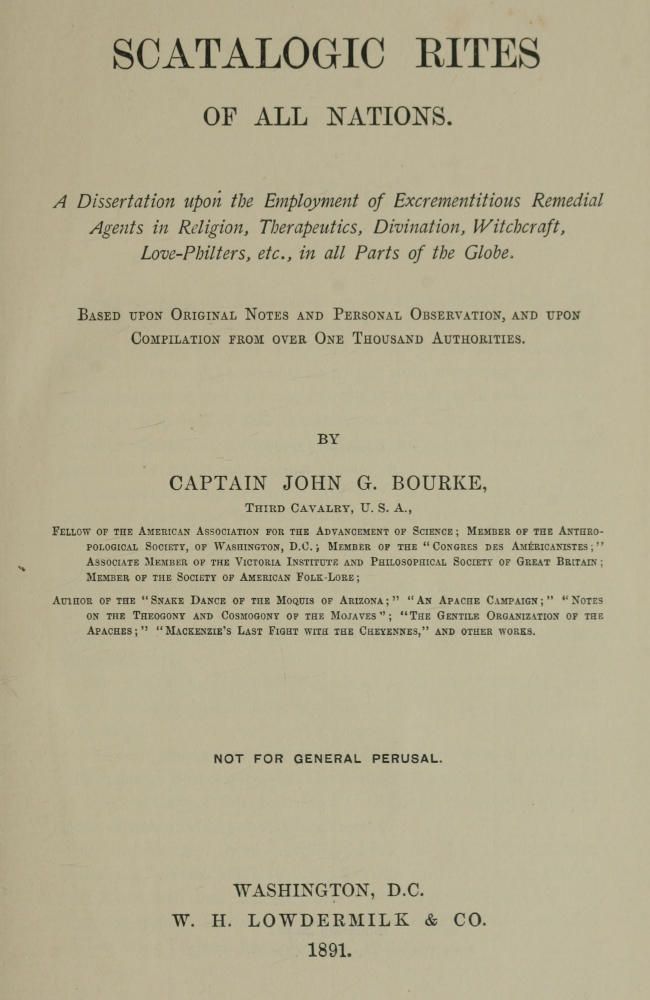
Scatalogic Rites of All Nations / A dissertation upon the employment of excrementitious remedial agents in religion, therapeutics, divination, witchcraft, love-philters, etc., in all parts of the globe
Explore more books like this:
About This Book
A global survey documents religious, medical, divinatory, and magical uses of human excrement and urine across cultures, drawing on the author's observations and a wide compilation of sources. It presents ethnographic case studies, such as ritual dances and festival practices, and compares phenomena like the European Feast of Fools and indigenous ceremonies to trace common origins. Chapters analyze therapeutic applications, food practices involving excrement, and associations with witchcraft, love-philters, and folk medicine, citing historical and contemporary authorities. The work aims to place these practices in religious and cultural context, juxtaposing evidence rather than imposing definitive interpretations.