
- A.
- Abaffi, a prince of Valachia, Pag. 89.
- Abydos, see Eski Natolia Hisar.
- Achmetleer, a village on the road from Smyrna to Sardis, 15.
- Achmet Gerai Sultan, a Tartar prince, 73.
- Achmet Sultan, his mosque at Constantinople described, 40, 45, 64.
- Adramyttian gulph, made by the two promontories of Cana and Lecton, 33.
- Adrastian plains, so called from the town Adrastia in Mysia Major, 52.
- Adrianople, by the Turks called Edrine, a city of Thrace on the river Hebrus, described, 63.
- Adultery, what proof it requires in Transylvania, 104.
- Aesepvs, now Simow, a river flowing into the Propontis, 52, 58.
- Aetna, a burning mountain in Sicily, described, 173.
- Aga, a name of respect among the Turks, which properly signifies lord or master; from the modern Greek word ἀγὰς, as some have thought, 9.
- It is also an additional title given to several officers, who attend the Grand Signior, 69
- ΑΓΙΑ ΠΥΛΗ, or the sacred curtain, which incloses the choir in the Greek churches, 42.
- Agria, a city in Hungary, 108.
- Aiasaluck, see Ephesus.
- Akhisar, see Thyatira.
- Alai chiaush, a messenger of ceremony, 76.
- Alai kiosk, a pleasure house of the Grand Signior in the great seraglio at Constantinople, described, 45.
- Alany, a village in Hungary, possessed chiefly by General Glychensberg, 108.
- Alba Julia, see Wissenburg.
- Alcyonivs, his book De exilio, said to be compiled out of Cicero’s treatise De gloria, 143.
- Alexander Sanctus, his bones carried in procession at Vienna, 124.
- Alckmair, a town in North Holland, 168.
- Allah, a name of God among the Turks, 71.
- See D’Herbelot.
- Allalmalee, a Christian village in Thrace, 62.
- Almasch, a river in Transylvania, 97.
- Almeloo, a town in Overissel, 161.
- Alonia, an island in the Propontis, famous for excellent wines, 37.
- Alsleber, a town in Upper Saxony, 146.
- Alster, a river, which runs into the Elbe at Hamburg, 152.
- Alt, a river in Transylvania, 89.
- Altena, a town near Hamburg, subject to the king of Denmark, 154, 156.
- Aluta, see Alt.
- Alyman, a mountain in Ionia betwixt Ephesus and the village Giamobasy, probably Mons Gallesius of the antients, 21.
- Amasia, see Ems.
- Amersford, a town in the province of Utrecht, 162, 169.
- Amman Dr. taught deaf and dumb persons to speak at Harlem, 167.
- Anatolia, see Natolia.
- Antiochvs King, where defeated by Scipio Asiaticus, 53.
- Antoninvs Marcus, the Emperor, died at Vindobona, 125.
- Apamea, see Montagnia.
- Apollonia ad Rhyndacum, see Ulubat.
- Apvlvm, see Wissenburg.
- Aqueducts of Constantinople described, 43.
- Arabic figures, their form, as expressed in a date 1477 at Clausenburg; and 1467 at Vienna, 97.
- Aranyas, antiently Chrysolas, a river in Transylvania, 96.
- Arcadivs the Emperor, his pillar at Constantinople described, 44.
- Archbishop of Vienna, his behaviour at a procession, 125.
- Arginvsae, see Musconisia.
- Argisch, a river of Bulgaria runing into the Danube, 77.
- Arguron, a Muscovian bird, 68.
- Arms of France, see Flies.
- Arnoutcui, a village in Bulgaria, 76.
- Arnswoldt, a wood in Lower Saxony, with a poor inn described there, 159.
- Arokszalles, a popish village in Hungary, 108.
- Aschersleben, a town in Upper Saxony, 146.
- Athos, a mountain in Macedonia, 33.
- Atmeidan, the Turkish name for the hippodromus, or cirque, at Constantinople, 44.
- Augustines, their convent at Vienna, 117.
- Auratbasar, a place at Constantinople, which signifies the market of women, where stands an antient historical pillar, with a Greek inscription upon it, 44.
- Austria, divided from Hungary by the river Leyta, 114.
- And from Moravia by the Teya, 131.
- B.
- Baba, the name of a cape, formerly called Lecton, in the Aegean sea, 33.
- Babitz, a town in Austria, 132.
- Babo, Count of Abensberg, his numerous ofspring, 125.
- Baden, a town near Vienna, celebrated for its baths, 126.
- Their manner of making wine, enclosing vineyards, and drawing carriages, 128.
- Their custom upon the death of any animal, ib.
- Bajazet Sultan, his mosque at Constantinople, 40.
- And at Adrianople, 64.
- Bain, a small Saxon brass coin, somewhat more than our farthing, current in Valachia, 85.
- Balasfalva, a town in Transylvania, 94.
- Balashaza, a town in Transylvania, 97.
- Balihisar, a town of Mysia Minor, 52.
- Bandiera, a banner or standard, 81.
- Banti Count, governor of Wissenburg, 93.
- His present to L. Paget, 96.
- Baricle, a village on the road from Smyrna to Sardis, 15.
- Barrows, or hillocks, in Ionia, between Durguthli and Sardis, remarkable for their number and figure, 14.
- Barut aga, a Turkish officer, who has the charge of the gunpowder, 32.
- His treatment of captain Winter, 38.
- Basha, an additional title given to such officers, as attend the Grand Signior, 45, 66, 67.
- Basire Doctor, prebendary of Durham, professed divinity at Wissenburg during the troubles in England, 95.
- Left his Itinerary there in manuscript, ib.
- Bassarabas Joannes Constantinus, prince of Valachia, his character and family, 78.
- His palace at Bucurest, 79.
- He entertains L. Paget, ib.
- His palace at Tergovist, 82.
- Baths at Prusia described, 50.
- Near Buda, 111.
- At Baden, 126.
- In the island Milo, 177.
- Batkan, a river flowing from mount Haemus in Thrace, 75.
- Beaver, one at Neugebac described, 118.
- Beemster, a place in North Holland, 168.
- Bees, see Flies.
- Behemerwalt, see Sylva Hercynia.
- Behemish language, a dialect of the Sclavonian, 133.
- Belgrade, a village in Thrace near Constantinople, 43.
- ΒΗΜΑ, the chancel in Greek churches, 81.
- Benedictines, their convent at Vienna, 117.
- Bey, a Turkish word, signifying lord, 60.
- Bible, a ms. in the German language, with a remarkable picture, in the Imperial library at Vienna, 119.
- Another in old English; a third of St. Jerome’s, written by Abbas Gaufridus Vitulus; with a Greek Testament, and two printed copies, which all want the remarkable passage in the first Epistle of St. John; an Aethiopic Testament ms; a roll of the Pentateuch, as now used by the Jews; and a vulgate Latin Bible, printed by Aldus, with a remarkable reading: all in the Duke’s library at Wolfembutel, 148.
- Bieske, a village in Hungary, 111.
- Birghee, a town near mount Tmolus in Ionia, 18.
- Bitin, a town in Bohemia, the estate of Prince Lobcowitz, 138.
- Blankeness, a village in Lower Saxony, 159.
- Blanyan or Branyan, a town in Bohemia, 133, 134.
- Blew kiosk, a pleasure house of the Grand Signior, in the great seraglio at Constantinople, 45.
- Boclew, a river in Mysia minor, 59.
- Boet C., a famous painter in enamel at Vienna, 130.
- Bogaz, a strait, or narrow sea, between two lands. Also an isthmus, or neck of land, between two seas, 33.
- Bohaimtsbrodt, a town in Bohemia, 134.
- Bohemia, separated from Moravia by the river Iglaw, 132.
- From Saxony near the town Peterswaldt, 139.
- Boiak Dervent, a town in Thrace, 73.
- Boiukdere, a town near Constantinople, signifying the great vale, 47.
- Boklar, a Turkish village in Bulgaria, 75.
- Bonpournickel, a sort of black bread used in Lower Saxony, 160.
- Borosnyai Joannes Nagy, an Hungarian divine, 92, 93.
- Bosphorvs, by the Turks called Bogas, flows constantly into the Propontis, 38, 42.
- Bostangi basha, the Grand Signior’s chief gardiner, and keeper of the palace at Constantinople, 45.
- Both, a river in Hungary, 108.
- Bourg, a palace in Vienna so called, 117.
- Boy born at Rigetsch in Austria without legs or thighs, but healthy and lively, 129.
- Bozacgee, a village in the Adrastian plains, 59.
- Bozok, a Turkish drink, described, 62.
- Bozza, a river, which rises between Valachia and Transylvania, 86.
- Bran, a castle on the borders of Transylvania, described, 86.
- Bremen, the chief city of the Dutchy so called, and a Hanse town, in Lower Saxony, 156, 157.
- Described, 160.
- Brevicvlvs de nationibus Transylvanicis, the title of a book so called, 91.
- Bridges, one of stone at Uzunkuprée described, 62.
- A wooden one of four hundred paces over the Danube between Vienna and Entzersdorff, 131.
- A stone one at Prague described, 134, 137.
- In Bohemia usually covered with a penthouse, 138.
- One at Dresden, 139.
- Another at Misten, cross the Elbe, 140.
- Brunswick, the chief city of that dutchy, described, 149.
- Their way of making mum, ib.
- Bucurest, a town in Valachia, 81.
- Its streets floored with plank, 82.
- Buda, the metropolis of Hungary, described, 109, 110.
- Its government, 111.
- Budwitz, a town in Austria, on the borders of Bohemia, 132.
- Bulgaria, antiently Moesia Inferior, divided from Thrace by mount Haemus, 75.
- The soil rich, but the people poor, 76.
- Separated from Valachia by the Danube, 77.
- Buxtchude, a town in Lower Saxony, in the dominion of Sweden, 159.
- C.
- Cadi, a Turkish officer, properly a justice, 6.
- Cadilesker, a lord chief justice among the Turks; of which there are two, one for Europe, and the other for Asia, 66.
- Cadiz, in Spain, described, 170.
- Remarkable instances of superstition there, 171.
- Caftan, a vest or garment of honour among the Turks, 65.
- Caicvs, a river of Mysia Major, described, 52, 57.
- Caimekam, a Turkish officer, who acts as deputy to the prime vizír in his absence, 66, 69.
- Callipolis, see Gallipoli.
- Calvinists, their worship in Transylvania, 102.
- Camelostrvthi, see Ostriches.
- Cana, a promontory of the Adramyttian gulph, 33.
- Canon, see Eski Natolia Hisar.
- Cantacuzeno Thomaso, his reception of L. Paget, 77.
- Cantacuzenvs Constantinus Stolnichus, uncle to the Prince of Valachia, his character, 79.
- Capigees, messengers extraordinary from the Grand Signior, into whose presence they conduct ambassadors, 67.
- Capuchins, their convent at Vienna, in which are buried the imperial family, 117.
- Their cloister at Prague described, 135.
- Their convent at Cadiz, 172.
- Caravan, a company of pilgrims, or other persons, who travel together in Turkey, with a guard for their security, 51.
- See Dr. Pococke, V. ii. par. i. p. 30.
- Cardia, or Sinus Melas, a gulph on the west side the isthmus of the Chersonésus, 62.
- Carnvntvm, see Petronel.
- Cassaware, a sort of bird without wings, 118.
- Catergee, a Turkish word signifying a mule driver, 62.
- Catharine Saint, her church at Hamburg described, 153.
- Catrochan, a convent near Bucurest in Valachia described, 81.
- Cattle of Hungary, fair, white, and large, 107.
- Cayster, a river in Ionia, 19, 21.
- Caystrian, plain in Ionia described, 19.
- Cetivs, a mountain in Austria, 131.
- Chalcedon, a town in Bithynia opposite to Constantinople, some account of it, 43.
- Challikcavak, a town on the borders of Bulgaria; the ornaments of the women, and their manner of dismissing strangers, 74.
- Charybdis, see Scylla.
- Chateaurenault, the French admiral, his whole squadron sunk or taken at Vigo by the English, 138.
- Chersonesvs, the peninsula of Thrace, 61.
- Chiaush, a pursevant or messenger of the Turkish court, 69.
- Chiaush basha, the chief officer of the Turkish chiaushes, or messengers, who carries a silver staff, 65.
- Christianvs Avgvstvs Duke of Brunswick, founded the library at Wolfembutel, and wrote the catalogues himself, 147.
- Chroniques d’Angleterre, XIII volumes ms. in the Duke’s library at Wolfembutel, 148.
- Chrysolas, see Aranyas.
- Chrysopolis, see Scutari.
- Chrytshulest, a village in Valachia, 82.
- Churbegee, a captain of the janisaries, 66.
- Cianvs sinus, a bay in Bithynia, in which was the famous fountain, where Hylas was drowned, 49.
- Cibin, a river of Transylvania, from which the city Cibinium (or Hermanstadt) receives its name, 92.
- Cibinivm, see Hermanstadt.
- Cicero’s Orations ms. in the Imperial library at Vienna, 120.
- Civs, or Prusa ad Arganthonium, now a small village of Bithynia, 50.
- Clamston, a town in Bohemia, 138.
- Clavdiopolis, see Clausenburg.
- Clausenbvrg, a city in Transylvania described, 96.
- Inscriptions there, 97.
- Cloyster Newburg, a town in Austria, 131.
- Cokuck Derocut, a town in Upper Saxony, 138.
- Colonicza Cardinal, archbishop of Strigonium, 107.
- Colvmella, a curious manuscript of him in the possession of Dr. Goetze at Leipsick, 143.
- Comnenvs Theodorus, built a castle at Prusia, 51.
- Comorwa, a village in Thrace, between which and Adrianople drummers are placed in the road, like watchmen, for security, 74.
- Conack, a resting place or lodging, 2.
- Confraternity of the dead, persons who attend the public executions at Vienna, 123.
- Confucian philosophy, published in the Sinese language by the Jesuits at Vienna, 120.
- Constantine the Great, defeated Licinnius near Hadrianople, 63.
- Constantinople, by the Turks called Istambol, from a corruption of the Greek εἰς τὴν πόλιν, as some have conjectured. See Cantem. p. 51.
- The mosques there described, 40.
- The antient cirque, ib.
- Inscriptions there, 41, 46, 48, 49.
- The aqueducts, 43.
- The great seraglio, 45.
- Its figure towards the sea, 48.
- Cordag, see Ida.
- Cordilieu, a hill near Smyrna, 2.
- Corn, in Hungary buried under ground, 109.
- Cornibat, a Turkish town in Thrace, famous for dying purple and yellow leather, 74.
- Cosson Daniel, his inscriptions, 163.
- Cotonest, a village Valachia, 84.
- Cotton wool, how managed in Turkey, 13.
- Cresset Mr. envoy to the court of Hanover, his character, 151.
- Cronstad, a city in Transylvania, described, 87.
- The religion, civil government, and language there used, 88.
- Cross Saint, a rich convent of Cistercian monks near Baden, 127.
- A church so called at Dresden, 139.
- Crucifix, in a chapel of the Premonstratensians at Prague, said to have been illuminated in the night, 136.
- Another on the bridge at Dresden, bearing an inscription, that disavows all superstitious worship, 140.
- One laid under foot at Cadiz, by the stratagem of a Jew shoemaker, 172.
- Cryptographia, a book written by Christianus Augustus Duke of Brunswick, 148.
- Csat, a village in Hungary, 107.
- Csege, a town in Hungary, having a pass over the Tibiscus, 107.
- Cvma, see Sotalea.
- Cvpervs Gisbertus, his library and museum, 162.
- Curiosities, at Vienna, 129.
- At Leipsick, 144.
- Curuchesmee, a village on the Thracian Bosphorus, which signifies a dry fountain, 39.
- Cushcui, a palace of the Grand Signior, very near Constantinople. The word signifies the Bird village, 49.
- Cyprianus Dr. rector of the university at Leipsick, 144.
- Cyrillian Sclavonic character described, 85.
- Cyzicvs, a city of Mysia minor, 59.
- Czaslaw, a town in Bohemia, where general Zeiska lies buried, 133.
- D.
- Dacia Mediterranea, now Transylvania, 85.
- Dacia Ripensis, now Moldavia and Valachia, ib.
- De Barias Didacus, his house at Cadiz esteemed a sanctuary, for sheltering the host from a storm of rain, 172.
- Debrecyn, a free city in Hungary, described, 105, 106.
- Delft, a city in Holland, 162.
- A monument there in memory of William I. Prince of Orange, 163.
- Delmenhorst, a town in Westphalia subject to the King of Denmark, 160.
- Dembowitza, a river in Valachia runing into the Danube, 77, 83, 84.
- Deplitz, a town in Bohemia, the estate and seat of Count Clery, 138.
- Derricui, a Christian village in Thrace, 62.
- Dervises, Turkish monks of several orders. Their college at Magnesia, 7.
- The ceremonies of those called Meulevi, 49, 70.
- Desk for books, a wheeling one at Prague, 136.
- At Wolfembutel, 148.
- Deventer, the chief town in Overissel, 161.
- De Wild Mr., an account of his cabinet, 166.
- Diana’s temple at Ephesus, its remains, 27.
- Dimotico, a market town in Mysia Minor, corruptly so called from the ancient Didymotichos, 60.
- Divan, the grand council room, or court of justice, among the Turks, 45, 66.
- Dobozi Stephanus, a learned gentleman of Debrecyn in Hungary, who is publishing a new version of the Bible in that language, for the use of the Reformed churches there, 106.
- Dobral, a town in Thrace, 74.
- Domuzdere, a place near Constantinople, signifying the vale of hogs, 47.
- Don John of Austria, his statue at Messina in memory of the victory at Lepanto, 174.
- Dragoman, a Turkish word signifying an interpreter, from the modern Greek δραγούμανος, or δραγώμανος, 2.
- Dragoslave, a village in Valachia, 84.
- Dresden, a royal city of Upper Saxony, described, 139.
- Drumna, a town in Austria, 132.
- Drummers, placed as watchmen in several parts of Thrace, 74.
- Durguthli, a Turkish town in Ionia, where cotton wool is manufactured, 13.
- An Armenian church newly founded there, ib.
- A Greek inscription there, 14.
- E.
- Earthquake, a remarkable effect of one at Messina, 176.
- Eberstorff near Vienna, in which there is a palace of the Emperor, 117.
- Effendi, from a corruption of the Greek word αὐθέντης, is a title of respect given to persons among the Turks; used sometimes by itself, and at other times subjoined either to their name, or the office which they bear, 6.
- Efficke Dr. professor of divinity at Leipsick, 142.
- Egra, a river in Bohemia, 138.
- Eironeia Gaufridi, an antient Satyr in ms. on the pope and court of Rome, in the possession of Dr. Goëtze at Leipsick, 143.
- Eisleben, a town in Upper Saxony, famous for the birth of Luther, 146.
- Elbe, a river in Bohemia described, 133, 152.
- Elchilee, a town in Thrace, 63.
- Elk, at the Emperor’s palace at Schonbran, described, 119.
- Emperor of Germany, his treasury, 121.
- Present family, ib.
- Character, 122, 127.
- Manner of hunting, 123.
- Investing the princes of the empire, 124.
- Pictures and rarities, 129, 130.
- Palace at Prague, 135.
- Ems, or Amasia, a river in Westphalia, 161.
- Engedi Stephanus, professor of divinity at Enyed, 95.
- Entzersdorff, a town in Austria, 131.
- Enyed, a town in Transylvania, where the Calvinists have the most flourishing school and college in that country, 95.
- Ephesvs, now called Aiasaluck, its situation, 23.
- Its ruins described, ib.
- The castle, and St. John’s church, 24.
- Remains of the old citadel, and Diana’s temple, with other reliques of antiquity, 26, 27, 28.
- Erdicurestur, a town in Transylvania, 97.
- Erzerum, a city of Armenia, 69.
- So called from erz land, and Rum Roman, Cantem. p. 75.
- Eskijami, a mosque at Adrianople, so called from its antiquity; eskí signifying old, and jamí a temple, 64.
- Eski Natolia Hisar, or, the Old Asian Castle. It is the antient Abydos in Mysia, 36.
- Brass guns in the castle with a bore three quarters of a yard diameter, ib.
- Eski Stambol, a city of Bulgaria, possibly the Oescus Triballorum of the antients, 75.
- Estzerhazi Count, Palatin of Hungary, 112.
- Evphormio of Barclay, a comment upon it by Mr. Wagner of Leipsick, 141.
- F.
- Fabricivs Jo. Albertus, his character, 157.
- Falling sickness, the blood of persons executed esteemed a remedy for it at Vienna, 124.
- Faro of Messina described, 173.
- Favorite, a palace of the Emperor at Vienna so called, 117.
- Feketeholm, a town in Transylvania, with a church fortified like a garrison, 88.
- Ferdinand II Emperor, made Vienna the Imperial seat, 117.
- Destroyed the town Sloney in Bohemia, 138.
- Flies or BEES, the emblem of them supposed to be the real arms of France, 130.
- Fochia Vecchia, antiently Phocaea, a harbour near Smyrna, 32.
- Foetus human, double in all its parts as far down as the navel, kept dry and stuffed, in the bibliotheca Windhagiana at Vienna, 119.
- Fogeras, a town in Transylvania, with a castle, which was never taken by force, 89.
- Foris Debreezeni Stephannus, chief pastor at Zilak a Calvinist village in Transylvania, 97.
- Fortshausen, a village in Gelderland, 162.
- Fountain, in the town house at Prague, described, 135.
- In the Duke of Brunswick’s palace at Hesden, 146.
- At Messina, 174.
- Franciscans Minorite, their convent at Vienna, 117.
- Franckivs, a professor in the university of Hall, his scheme for an ample charity, 145.
- Friburg, a town in Misnia, subject to the Elector of Saxony, 138.
- Fritsel Thomas, a noted bookseller at Leipsick, 143.
- G.
- Gala days, so called at Vienna, on which the court appears in its greatest splendor, 122.
- Galata Greater and Less, two villages in Thrace near Callipoli, 37.
- Galata, a town and port near Constantinople, 39.
- Gallesivs mons, see Alyman.
- Gallipoli, antiently called Callipolis, a city in Thrace near the Hellespont, 37.
- Gelemba, a town of Mysia Major, upon the river Caicus, 52, 57.
- Gemmae salis, pellucid like crystal, 93.
- George Saint, an island near Smyrna, 32.
- George Saint, a village near Smyrna, with an antient Greek church, 3.
- Gerhardvs Abbot, otherwise Molanus, his coins and medals, 150.
- Income and authority, 151.
- Geysa, see Saxons.
- Ghika, a prince of Valachia, who formed an insurrection against the Turks, 83.
- Giamobasy, a village in Ionia near mount Alymán, 21, 31.
- Glychensberg General, governor of the forces at Cronstadt, 87.
- Goetze Dr. his manuscripts, etc., 143.
- Gold, remarkable accounts of its lodging in vines and grapes in some parts of Transylvania, and upon mount Tokaí in Hungary, 103.
- Golden bull, containing the constitutions of the empire by Charles the fourth, 119.
- Gothic character, an account of it, 143.
- Gouda, a town in Holland, 166.
- Grabe Ern. Mr. Le Clerc’s complaint of him, 167.
- Graevivs Mr. keeper of the public library at Leipsick, 141.
- Grand Signior, his manner of receiving ambassadors, 66.
- His person described, and manner of riding to a mosque, 69.
- His titles, 70.
- Grand Vizír, chief counsellor or representative of the Grand Signior, his manner of giving audience to ambassadors, 65.
- His person described, ib.
- Entertains the L. Paget, 70.
- As to the inferior visírs, his assistants, see Wilson’s Seraglio, p. 610, 611.
- Granicvs, see Boclew.
- Graven Lieut. Col., 87.
- Receives a present of a diamond ring from L. Paget, 91.
- Greeks, their church at St. George’s, 3.
- Their devotion, 4.
- Manner of celebrating the Eucharist, ib.
- Churches at Tyria, 20.
- They abhor all imagery in releivo, 20, 61.
- Their funerals, 39.
- Famous convent called Maurómolos, 42.
- Numerous chapels about the town Milo, 176.
- Guns, see Eski Natolia Hisar.
- Gygaean lake, near Sardis, 17.
- Gyongyossi, a city in Hungary taken from the Protestants by the Jesuits, 108.
- Gyongyossi Paul, a Hungarian divine, who formerly resided at Oxford, 106.
- H.
- Habern, a wood in Bohemia, 133.
- Hadgelar, a village near Smyrna, so called from its being the first rendevous of the hadjées or pilgrims in their annual journey from Smyrna to Mecca, 55.
- Inscriptions there, ib.
- Haemvs, a mountain in Thrace, 74.
- Hague, a town in Holland, 162.
- Prince of Orange’s house in the adjacent wood, 164.
- Halberstadt, a town in Saxony, 146.
- Halesvs, a river in Ionia, discharging itself into the sea at Colophon, 31.
- Hall, a city of Suabia described, with the university, 145.
- Hamal, a Turkish name for a boatman or porter. In the modern Greek χαμάλ, 39.
- Hamburg, a free Imperial city, and chief of the Hanse towns, seated on the north side of the Elbe, 152.
- Besieged in 1686 by the king of Denmark, 153.
- The religion, government, dress, funerals, and trade of the inhabitants, with the English company of merchants there, ibid.
- Famous for Rhenish wine and fine loaf sugar, 156.
- An account of the opera house, and a model of Solomon’s temple, 157.
- The language and manners of the inhabitants, 158.
- The detestable practice of melancholy persons, and infamous character of a monstrous virago there, ib.
- Hanover, the chief city of that electorate, described, 151.
- An account of the Electoral family, ib.
- Harach, a pole tax laid upon Christians by the Turks, 42.
- Harburg, a town in Lunenburg, 152.
- Harda, a river running into the Hebrus at Adrianople, 63.
- Harem, a Turkish word for women, or the womens apartment, 32, 38.
- In the Arabic language it signifies things forbidden.
- Harlem, a town in Holland, which claims the invention of printing, 167.
- Hasanogli, the mosque at Magnesia, where he was buried, held in great veneration by the Turks, 11.
- Hase, a river in Westphalia. 161.
- Haselun, a town in Westphalia, ib.
- Hatwan, a town in Hungary, 109.
- Hebrvs, a famous river of Thrace, 62.
- Hellespont, now called the Dardanells, flows perpetually into the Aegean sea, 35.
- Its breadth, 61.
- Hens of Grand Cairo described, 46.
- Heraclea, a city of Thrace, 38.
- Hermannvs, founder of Hermanstadt, his statue there, 92.
- Hermanstadt, a city in Transylvania, L. Paget’s entertainment there, 90.
- Inscriptions there, 91.
- Its government, 92.
- Hermvs, a famous river in Ionia described, 5, 56.
- Hessen, a small village in Saxony, the Duke of Brunswick’s house there, 146.
- Heusler, General, defeated and taken by Count Tekely near Rosnaw in Transylvania, 87.
- Hildesheim, a city of Lower Saxony, 146.
- Hippivs, a river near the city Prusia, 51.
- Hogia, a Turkish word signifying a learned man, an instructor, or teacher, 69.
- Holibrun, a town in Austria, 131.
- Holthenvs Edvardus, a learned divine of Utrecht, who was then publishing the new edition of Gruter, 169.
- Holy Sepulcher, certain rents at Bucurest in Valachia consigned for the use of it, 80.
- Homer, an old manuscript of him in the university library at Leipsick, 143.
- Honslardyke, a palace of K. William near the Hague, 166.
- Horse tails, two allowed by the Turks to be carried before the prince of Valachia, 81.
- Host, see De Barias Didacus.
- Hound slayer, his office at Baden, 128.
- Hour in traveling, about three English miles, 5.
- See Dr. Shaw’s Preface to his Travels, p. ix.
- Houses in Hungary made under ground, 108.
- Hu, Hu, that is, he be, or he who is; with the Turks meaning God, 71.
- See D’Herbelot, and Wilson’s Seraglio, p. 764, 786.
- Humumlee, a village in Mysia Minor near the lake Minyás, 59.
- Hungari, a people of Transylvania, 99.
- Their government, 100.
- Religion, 101.
- Customs, 104.
- Hungars, a gold coin in Turkey, worth about ten shillings sterling, 39.
- Hungary, divided from Transylvania near the village Zilak, 98.
- Its soil rich and abounding with lakes, 111.
- Divided from Austria by the river Leyta, 114.
- Hungrisch Altenburg, a town in Hungary, situated on the river Leyta, 114.
- Hvnni, a colony of Scythians, now settled in Transylvania, 99, 100.
- Hyaena, one at Neugebac in Austria described, 118.
- Hyllvs, a river near Thyatira, 52.
- I.
- Jacacui, a village near Smyrna, 2.
- Jalomitza, a river in Valachia, 83.
- Janikaw, a town in Bohemia, memorable for the battle in 1645 between the Swedes and Imperialists, 133.
- Janisaries, a body of the Turkish infantry. The word signifies new soldiers, as they were the last order introduced. They make the Grand Signior’s foot guard, and the spaheés the horse, 2.
- The manner of their dismission from duty, 68.
- Ichoglans, youth born of Christian parents, and educated by the Turks in the seraglio for public offices of the state, 46.
- Ida, now Cordág, a mountain near Troy, 33, 58, 59, 60.
- Jenicui, a town in Thrace, 73.
- Jerdack, a village in Mysia Minor near Lampsacus, 60.
- Two inscriptions there, ib.
- Jesuits, their convents at Vienna, 117.
- And colleges at Prague, 135.
- Where they have the direction of the university and public schools, 137.
- Pictures in St. Nicholas’s college at Messina in honour of those five, who were executed in England for the popish plot, 174.
- Jews at Pernitz, their mark of distinction, 132.
- and at Prague, 137.
- Iglaw, a city in Moravia, 132.
- Houses there with false fronts, ib.
- Iglaw, a river in Moravia, 132.
- Igmand, a town in Hungary, 112.
- Iirid, a Turkish javelin. The modern Greeks write it τζιρήδ. 46.
- Ilfof, a small river in Valachia, 82.
- Ilivm, see Troy.
- Images, see Statues.
- Imam, a Turkish priest, who daily says public prayers. From the Greek word ἐφημέριος, by the modern Greeks corrupted into ἡμάμ, 60.
- Imbros, an island in the Aegean sea, near the Chersonésos, 33.
- Inn, see Arnswoldt.
- Inscriptions Greek, one at Magnesia, 11.
- At Durguthli, 14.
- At Tyria, 20.
- Three at Ephesus, 28, 29.
- One at Constantinople, 41.
- At the convent Maurómolos, 42.
- Upon Aurátbasar’s pillar at Constantinople, 44.
- On a tower near Porto Janicula, 48.
- Others near the seraglio, 49.
- One at Prusia, 51.
- Others at Thyatira, 53, 56, 57.
- At Hadgelar, 55.
- And at Jerdáck, 60.
- One at Komora, 112.
- Another belonging to Mr. Neufville at Leyden, 165.
- And another to Mr. Uilenbroek at Amsterdam, 168.
- Inscriptions Latin, one at Ephesus, 25.
- At Constantinople, 41.
- Upon one of the Symplegades, 42.
- Two in the great seraglio at Constantinople, 46.
- Others at Hadgelar, 55.
- And at Thyatira, 57.
- Three at Hermanstadt, 91.
- And at Wissenburg, 95.
- One at Therda, 96.
- Two at Clausenburg, 97.
- And at Komora, 112.
- One at Petronel, 125.
- Another belonging to Mr. Cuper at Deventer, 162.
- Others to Mr. Neufville at Leyden, 164.
- And one to Mr. Uilenbroek at Amsterdam, 168.
- John Saint, his church at Ephesus, 24.
- And hospital at Cadiz, 171.
- Irongate, a place so called in Mysia Minor, 52.
- Ishmaelja, a village in Ionia near Durguthli, 14.
- Isvora, a pleasant place incompassed with woods in Valachia, near the river Dembowitza, 83.
- Jvstvs Sanctus, his bones carried in procession at Vienna, 124.
- K.
- Kanes, public places in Turkey, both on the road and in towns, with a mosque usually in the middle, enclosed for the lodging of travellers, 8, 13, 80.
- See Maundrell, pag. 1.
- These buildings seem to have been very antient in the East, and alluded to Jerem. ix. 2. where by the Septuagint they are called σταθμοί.
- Kaposi Samuel, professor of the Schola Albensis at Wissenburg, teaches the English language to the students, 94.
- ΚΑΣΤΡΙΩΤΗΣ Κῦρ Γεώργιος, a Grecian at Bucurest in Valachia, 80.
- Kaya, a deputy of the grand vizír, 65.
- Kerepes, a town in Hungary, 109.
- Kible, or Kiblah, that part in a Turkish mosque, whose prospect is towards Mecca, to which they always turn, when they pray, 8.
- See Dr. Shaw’s Travels, p. 284.
- Kief, a Turkish word, signifying delight or pleasure, 10.
- King of France, an epigram upon him by the Emperor, 120.
- King of Poland, his dexterity in shooting, 125.
- Kiosk, a Turkish pleasure house, 6.
- Kirkingecui, a Christian village near Ephesus, 21, 22.
- Klopperburg, a town in the bishopric of Munster, 161.
- Koendern, a town in Upper Saxony, 146.
- Koes Johannes, professor of divinity at Debrecyn in Hungary, 106.
- Koes, a town in Hungary remarkable for the many curious trees, herbs, and flowers, which grow near it, 111.
- Koloseri Samuel, inspector general of the emperor’s mines in Transylvania, 93.
- Kolosvari Stephanus, professor of philosophy at Enyed, 95.
- Komora, a city in Hungary, 112.
- Inscriptions in the castle, ib.
- Koningsmark Count, brass statues of the twelve Apostles at Prague converted by him into canon, 136.
- Koolaert Mr. merchant of Harlem an account of his daughter, who was born deaf, being taught to speak, 167.
- Kottin, a town in Bohemia, 133.
- Krasna, a river in Hungary, 98.
- Kremnytz, a town in Hungary, famous for mines of gold and other metals, 109.
- Kunstcammer, or arts chamber, the Elector of Saxony’s repository of rarities at Dresden so called, 140.
- ΚΥΡΙΑΚΟΔΡΟΜΙΟΝ, see Maximus Hieromonac.
- Kurugelchick, or the dried lake a village on mount Temnus in Mysia Major, 57.
- Kutali, a small island in the Propontis near Marmora, 37.
- Kuttenberg, a city in Bohemia, 133.
- Kysler aga, the chief eunuch so called by the Turks, 69.
- L.
- Lambecivs, keeper of the Imperial library at Vienna, turned Papist in order to qualify himself for that imployment, 121.
- Lampsacvs, a town in Mysia Minor, 37, 60.
- Landaw, a city of Alsace, 122.
- Langerman Mr. a druggist at Hamburg, his curiosities, 157.
- Lapis Lydivs, so called from Lydia, a country in Asia Minor, 10.
- Latin Letters in ms. writen by the present emperor to Lambecius, in the Imperial library at Vienna, 120.
- Launa, a town in Bohemia, 138.
- Lectionarivm of the four Evangelists at Kirkingécui near Ephesus, 22.
- Lecton, see Baba.
- Leewenhoek Mr. his curious discoveries upon insects, etc., 165.
- Leibnitz Mr. librarian to the Duke of Brunswick at Wolfembutel, 147.
- Leichtenstein Prince, purchased the bones of three Hungarian Saints in Italy, and conveyed them to Vienna, 124.
- Leine, a river in the Electorate of Hanover, 151.
- Leipsick, a city in Upper Saxony described, 140.
- Its government, 141.
- Commodities, university, etc., 142, 144.
- The habit of the ecclesiastics, 145.
- Lemnos, an island in the Aegean sea, 33.
- Leo the Emperor, his superstition, 45.
- Leopards at the palace of Neugebac, near Vienna, described, 118.
- Leopold Saint, a castle on the Danube, near Cloyster Newburg in Austria, 131.
- Lepelar, a sort of stork, 166.
- Lesbos, see Mitylene.
- Leyden, a city in Holland, 162.
- Leyta, a river in Hungary, 114.
- Libraries.
- Windhagiana and Imperial at Vienna, 119.
- Premonstratensian at Prague, 136.
- The Duke of Brunswick’s at Wolfembutel, 147.
- Those at Leipsick, 143.
- And Hamburg, 157.
- Licinnivs, see Constantine.
- ΛΙΜΝΗ ΔΑΣΚΥΛΙΤΙΣ, a lake in Mysia Minor, now called Minyás, 58.
- Lingen, a town in Westphalia, described, 161.
- Lion dollars, coins current in Valachia, 85.
- Livy, an account of an antient manuscript, which seems to have contained more books of that author, than the present copies, 119.
- Loaf sugar, see Hamburg.
- Loo in Gelderland, K. William’s house and gardens there, 162, 169.
- Lubeck, an Hanse town in Lower Saxony, 157.
- Luther, a picture of him at Leipsick taken after his death, 143.
- Reliques of his in the Duke’s library at Wolfembutel, 148.
- Lutherans, their churches and manner of worship in Transylvania described, 101, 102.
- Their manner of communicating, 144, 147.
- Luxemburg near Vienna, an Imperial palace there, 117.
- The castle described, with a remarkable instance of thunder, which happened in it, 126.
- Lynces, at the palace of Neugebac near Vienna described, 118.
- M.
- Mackshusen, a town in Overissel, 162.
- Madonna, see Mary.
- Magnesia ad Sipylum, city of Lydia, 5, 56.
- Its manufacture, 6.
- A seraglio, madhouse, college of dervíses, and royal mosques there described, 7, 8.
- Gave name to the magnet, 9.
- Inscriptions there, 11.
- Magnet, see Magnesia.
- Mahomet effendi, his courtesy to the travelers at Magnesia, 6.
- Mahomet IV. Sultan, a stone bridge built by him near Dimotico in Mysia Minor, 60.
- Maitos, antiently Madytos, a town in the Chersonésus, described, 37.
- Makren, see Moravia.
- Malgara, a town in Thrace, described, 62.
- Mamot, an East Indian animal, like a stag, with twisted horns, 166.
- Mandahora, a village on the river Aesépus in Mysia Minor, described, 52, 58.
- Marcomanni, see Moravia.
- Margaret, Countess of Henneberg, said to have had 165 children at a birth, 165.
- Margarita, a town in Hungary, 98.
- Mark, see Morawa.
- Marmora, an island in the Propontis described, 37.
- Marvs, see Morawa.
- Mary Virgin, her pillar at Vienna described, 115.
- Her picture said to have shed tears, 116.
- A miraculous image of her, ib.
- A new sort of Gloria Patri inscribed to her, 131.
- Her statue at Prague, 134.
- Picture pretended to be done by St. Luke, 135.
- Numerous titles, 136, 173.
- A stone sculpture of her and our Savior at Messina, beleived to have been taken from the life, 174.
- Her letter to the Messanians, 175.
- Mauromolos, a Greek convent on the European side of the Bosphorus, described, 42.
- Mavrvsivs, a river near Wissenburg in Transylvania, 93.
- Maximvs Hieromonachus, a famous Greek monk, author of a book called Κυριακοδρόμιον, 80.
- Meander, a river in Ionia, 5.
- Medoslanivm, see Znaim.
- Melancholy persons, their method to get rid of their lives at Hamburg, 158.
- Melancthon, a celebrated picture of him at Leipsick, taken after his death, 143.
- Melas, a river in Thrace, flowing into the gulph Cardia, 62.
- Melos, see Milo.
- Menchenivs Dr. Otto, professor of moral philosophy at Leipsick, and editor of the Acta Eruditorum, 142.
- Menchenivs Junior, doctor of law at Leipsick, 143.
- Menologion, a Greek manuscript in the possession of Dr. Goëtze at Leipsick, 143.
- Mepomienvs, or Nepomenenvs Sanctus Joannes, a new saint at Vienna, 117.
- A brazen statue and inscription erected there to his memory, 137.
- Mercy, a convent at Cadiz, founded for the redemption of Christian slaves, 171.
- ΜΕΣΟΓΕΙΟΤΗΣ, or Midland hills, in the Caystrian plain, 19.
- Messina, a city on the coast of Sicily, described, 173.
- The cathedral, monasteries, etc., 174, 175, 176.
- Ceres and Proserpina antiently worshiped there, 176.
- Metropolis, an antient city of Lydia, whose ruins are described, 30.
- Meulevi, an order of Turkish monks, whose ceremonies are described, 49, 70.
- Meyer Dr., a turbulent divine of Hamburg, 155.
- Michael Saint, his church at Vienna, 117.
- A remarkable picture of him at Cadiz, 171.
- Mihalick, a town in Mysia Minor, where the river Aesépus discharges itself into the sea, 58.
- Mikes, Count Michael, received L. Paget on the borders of Transylvania, 86.
- Mile Hungarian, equal to six Italian, 87.
- Milo, antiently Melos, one of the Cyclades, with a city of the same name, described, 176.
- The birth place of Socrates and Aristophanes, ib.
- Hot baths there, 177.
- Minaree, a steeple, or tower, joining to a Turkish mosque, from which the muezin, or chanter, calls the people to prayers, 7.
- Mindera, a Turkish mattress, filled with cotton or wool, 67.
- Ministers of the diván, their habit, 68.
- Minyas, a village and castle so called in Mysia Minor, 58.
- Misseltoe, its manner of growing about Thyatira, 56.
- Misten, a town in Upper Saxony, 140.
- Mitylene or Lesbos, an island in the Aegean sea, 32, 33.
- Moesia Inferior, see Bulgaria.
- Molanvs, see Gerhardvs Abbot.
- Moldavia, by submitting to the Turks was taxed lower than the neighbouring countries, 85.
- Moneta bracteata, lately found in Saxony, described, 143.
- Monnikedam, a town in North Holland, 168.
- Montagnia, a Turkish town in Bithynia, which seems to be the Apaméa of the antients, 50.
- Monte Argentato, see Batkan.
- Morat I. Emperor of the Turks, converted a Christian church at Adrianople into a mosque, now called Eskijamí, or the Old mosque, which yet retains the antient form, 64.
- Morat Sultan, his strength and activity, 46.
- Moravia, now called Makren, 131.
- Antiently the seat of the Marcomanni and Quadi, 123.
- The country fertile, but the people slaves, ib.
- Speak the Behemish language, ib.
- Morawa, antiently the Marus, a river in Austria, 131.
- Called Mark by the Germans, 133.
- Muezin, or chanter, who calls the Turks to their prayers, 47.
- Mosques, buildings for the publick worship of the Turks, in the form of our churches, 7.
- See Dr. Shaw’s Travels, p. 283.
- Mufti, the primate, or chief ecclesiastic, and of greatest authority among the Turks; whom they are bound to consult in all causes of importance, whether ecclesiastical, civil, or military, 69.
- Mugevezee, a sort of turbant worn by the officers of the diván, 68.
- Muldaw, a river, which runs thro Prague, 134.
- Mulvetelee, a river near the village Minyás in Mysia Minor, 58.
- Mum, see Brunswick.
- Musconisia isles, situated between the continent of Aeolia and the island of Mitylene, 33.
- Muyden, a town in Holland, 169.
- N.
- Naerden, a town in Holland, 169.
- Nakeib effendi, the chief of the sheriffs or descendants of Mahoment, 70.
- Sheriff in Cantemir, p. 216, signifies an holy person.
- Namaz, the common and daily prayers, which the Turks are injoined to repeat five times in twenty four hours, 47.
- ΝΑΟΣ, the body of a Greek church, 81.
- ΝΑΡΘΗΞ, the porch of a Greek church, 81.
- Natolia, or Anatolia, antiently Asia minor, 34, 35.
- Nemethi M. B. professor of philosophy at Clausenburg, 97.
- Neimethi Sam. professor of divinity at Clausenburg, 97.
- Nepomenenvs, see Mepomienvs.
- Neptune, see Statues.
- Nesselivs, keeper of the Imperial library at Vienna, turned Papist in order to qualify himself for that imployment, 121.
- Nestorivs, the place where his heresy was condemned, 25.
- Neufville Mr. his character, and curiosities, 164.
- Neugebac, an imperial palace near Vienna, 118.
- Nicholas Saint, his church at Leipsick described, 141.
- And college at Messina, 174.
- Niphti, or Nymphe, a river near Magnesia, some account of it, 12.
- Nishangee basha, an officer, who sets the Grand Signior’s tura, or name, to all orders sent from the Porte, 66.
- See Wilson’s Seraglio, p. 610.
- Nomades Scythae, see Turcmen.
- Norbert Saint, patron of Bohemia, 134.
- His tomb in the church of the Premonstratensians at Prague, 136.
- Norlicui, a village near Smyrna, signifying the pomegranate village, 2.
- The word gui, is a dissyllable, and denotes a village. Leunclav. Hist. Turc. p. 406.
- Northern, a town of the United Provinces, at the confines of Westphalia and Overissel, 161.
- Nymphe, a plain near Smyrna, 3.
- O.
- Ocker, a river in Lower Saxony, 147.
- Oescvs Triballorvm, see Eski Stambol.
- Oetingh Count, a christian church built at Challikcavák in Thrace by his interest, 74.
- Offensey, a village in Lower Saxony, 159.
- Oke, a Turkish weight of about two pounds three quarters avoir de pois, 6.
- See Rycaut, V. iii. p. 12.
- Olearius Mr. junior, professor of humanity at Leipsick, 143.
- Olympvs Mysenvs, a mountain near the city Prusia, described, 50.
- Opera house, see Hamburg.
- Operas, an account of those at Vienna, 122.
- Orangery, see Honslardyke.
- Organ, a remarkable one at Hamburg described, 154.
- Orphanotrophivm at Hall, founded by Mr. Frank, 145.
- Osman, see Ottoman.
- Osmanogli, that is, Osman’s son, or descendant, 9.
- See Leunclav. Hist. Turc. p. 418.
- Ostriches, at Schonbran described, 118.
- Otmarsh, a town in Overissel, 161.
- Ottoman, made Prusia the first capital of the Turkish empire, 51.
- Oval, a town in Bohemia, 134.
- Ovid’s Metamorphoses, ms. 120.
- Ovid’s Tower, a ruinous stone building not far from the Bosphorus, on the European side, 47.
- P.
- Pactolvs, a river near Sart or Sardis, described, 15.
- Paget Lord, ambassador from K. William to the Porte, the manner of his audience of leave at Adrianople, 69, 70.
- Entertained by the grand vizír, 70.
- Presents given and received by him, 70, 71, 72, 80, 92, 96, 107,131.
- His equipage and retinue, 72, 77, 78, 90, 106.
- Entertained by the Prince of Valachia, 79.
- His reception upon entering Transylvania, 86, 87.
- At Rab, 113.
- At Vienna, 115.
- Audience of the King and Queen of the Romans, 131.
- Paidleburg, a town in Saxony, 146.
- Palaces, those of the Prince of Valachia at Bucurest and Tergovist described, 79, 82.
- Of the Emperor at or near Vienna and Prague, 117, 118, 126, 135.
- Count Traun’s at Petronel, 125.
- King of Poland’s at Dresden, 140.
- Duke of Brunswick’s at Hessen and Wolfembutel, 146, 147.
- That of the Elector of Hanover, 151.
- Of the Prince of Orange in the wood near the Hague, 164.
- And at Honslardyke, 166.
- Palamutcui, a village near Smyrna described, 2.
- Palvs Artynia, a lake fed from mount Olympus, described, 51.
- ΠΑΝΑΓΙΑ, or Virgin Mother, her image described, 75.
- Pannonian Alps, near Baden, in Austria, 126.
- Paper, a fine sort made of silk, 69.
- Curious work cut in it by a woman at Rotterdam, 165.
- Pariz Papa Fr. professor of Greek at Enyed in Transylvania, 95.
- Paschal colours, described, 81.
- Pasha, the governor of a Turkish province, 76.
- Pashacui, a village in Thrace, 73, 74.
- Patriarch of Jerusalem, his residence at Bucurest in Valachia, 80.
- Paul Saint, his prison, a tower at Ephesus so called, 25.
- Paulins, an order of monks, who never eat flesh nor fish, 132.
- Peine, a town in the dutchy of Brunswick, 149.
- Pelorvs, a promontory of Sicily, 175.
- Pentateuch, see Bible.
- Pera, a town near Constantinople, 47.
- Pergamvs, a city in Mysia Major, 52.
- Pernitz, a town in Moravia, 132.
- Pest, a city in Hungary, described, 109.
- Peterswaldt, a town in Bohemia, 138.
- Petronel, a village on the Danube, 125.
- Remains of antiquity, and Count Traun’s palace there described, 125, 126.
- Phocaea, see Fochia Vecchia.
- Phrygivs, or Hyllvs, a river near Thyatira, 56.
- Phyrites, a river between Ephesus and Smyrna, 30.
- Pictures, fine ones in Luxemburg castle, 126.
- At Vienna, 129, 130.
- Piedra de Puerco, an account of it, 157.
- Pietists in Germany, 146.
- Pirn, a town in Upper Saxony, 139.
- Pismetlee, a town in Mysia Minor, 60.
- Plat Dutch, the language of Hamburg, a medium betwixt that of Germany and Holland, 158.
- Plebanvs, the title of the chief pastor of the Unitarians at Clausenburg in Transylvania, 97.
- Pleiss, a river in Misnia, 141.
- Plica Polonica, on the head of a man at Alány in Hungary; the effects of cutting it off, 108.
- Po George, born at Prague, his strange voracity, 157.
- ΠΟΔΑ νείατον Ἴδης, a tract of mountains near Susegierlíck, described, 58.
- Pompey’s column, see Symplegades.
- Ponte d’Erchiene, see Uzunkupree.
- Ponte Grande and Piccolo, two bridges near Constantinople, 38.
- Popest, or Priest town, a town in Valachia, 77.
- Porphyry pillars, at Mandahóra, 58.
- Porta Janicvla, see Seven Towers.
- Porumback, a village in Transylvania, described, 89.
- Pozzo P. a Jesuit at Vienna, famous for painting, 117.
- Prague, the metropolis of Bohemia, described, 134.
- The town house, a church and college of Jesuits, Emperor’s palace, Capuchin cloister, cloister of Premonstratensians (called the Shawhoff) and university, described, 134, 135, 136, 137.
- Premonstratensians, see Prague.
- Priest town, see Popest.
- Procession at Vienna described, 124.
- Prochorvs, a manuscript of the Evangelists said to be written by him, 22.
- Proconesvs, see Marmora.
- ΠΡΟΝΑΟΣ, the outward chapel of a Greek church, 81.
- Proserpina, see Messina.
- Proszlo, a village in Hungary, 107.
- Pruck, a town in Austria, described, 114.
- Prvsa ad Arganthonium, see Civs.
- Prusia, a city at the foot of mount Olympus, antiently called Prusa ad Olympum, to distinguish it from Prusa ad Arganthonium, 50.
- The manner of spinning silk there, ib.
- Its baths, ib.
- A Greek inscription there, 51.
- Psalms, a copy of them in the characters called Ciceroniani and Cyprianici, 148.
- Purse, a summ of money in Turkey equal to an hundred pounds sterling, 82.
- Q.
- Qvadi, see Moravia.
- Quarts, coins current in Valachia, 85, 103.
- R.
- Rab, a town and river in Hungary, 113.
- Rabnitz, a river in Hungary, ib.
- Rabutin General, his character, 92.
- Rasgrad, a palace belonging to the pashá of Nicopoli, 76.
- Reis effendi, the high chancellor in Turkey, 65.
- Reisner George, senator of Helmanstadt, 90, 91.
- Rhegivm, a town on the coast of Naples, 175.
- Rhenish wine, see Hamburg.
- Rhoetevm, near Troy, described, 34.
- Rhyndacvs, a river in Phrygia, 51.
- Robbers, how treated in Turkey, 70.
- Rodolphvs Avgvstvs, Duke of Brunswick, his house at Hessen, 146.
- His government and character, 148, 149.
- Rodope, a mountain in Thrace, 62.
- Romanvs, consul of Leipsick, 141.
- Rosnaw, a town in Transylvania, 87.
- Rotterdam, a city in Holland, 163.
- Rukar, a village in Valachia, described, 84.
- Rumeli Hisar, or the Roman Castle, the antient Sestos in Thrace, 36.
- So called from Rum-yli, the part of the Romans (the later Greeks taking on them the name of Ῥωμαῖοι) and hisar a castle. See Cantem. p. 75.
- Ryswick, a village in Holland, 162.
- S.
- Sacred curtain, see ΑΓΙΑ ΠΥΛΗ.
- Sala, a river in Suabia, 145.
- Salt Pits, at Saltzburg, 92.
- Therda, 96.
- And Hall, 145.
- Saltzburg, a town in Transylvania, so called from the salt pits there, 92.
- Samos, a river in Transylvania, 96.
- Samothracia, an island opposite to the mouth of the Hebrus in Thrace, 34.
- Sardam, a town in Holland, some account of it, 166.
- Sardis, a city in Lydia, now called Sart, 15.
- Its ruins described, 16.
- Sart, see Sardis.
- Saxons, settled in Transylvania under Geysa the second king of Hungary, 99.
- Their government, 100.
- And religion, 101.
- Saxony, the manner of the Duke’s investiture by the Emperor, 124.
- Sazawa, a river in Bohemia, 133.
- Scacchia ludus, a book written upon that subject by Christianus Augustus, Duke of Brunswick, 148.
- Scala sancta, twenty eight stairs, up which our Savior was led to Pilate’s house, which were sent to Constantine the Great from Jerusalem by his mother Helen, and are now kept at the church of St. John Lateran in Rome, 117.
- See Lassel’s Travels, Par. i. p. 113.
- Scale, or port, for passing the Hellespont at Jerdáck, 60.
- Scamander, a river near Troy, runing into the Hellespont, 34.
- Described, 35.
- Schaurtzenburg Count, his stratagem in taking the town Rab, 113.
- Schonbran, near Vienna, the Emperor’s palace there, and menagerie, 118.
- Schutz, an island in the Danube, 112.
- Schweka, a village and river in Austria, 114.
- Scipio Asiaticvs, see Antiochvs.
- Sclavonic language, 85.
- Scutari, antiently Chrysopolis, a city in Bithynia opposite to Constantinople, described, 43.
- Scylla and Charybdis described, 173, 174.
- Sea compass, its effects on the castle hill at Magnesia, 10.
- Seau Count, 89.
- His castle at Wissenburg described, 94.
- Sedicui, a village near Smyrna, 31.
- Selickar aga, the chief sword bearer to the Grand Signior, 69.
- Selim Sultan, his mosque at Adrianople described 64.
- Selimee turbant described, 66.
- Selymbria, a city of Thrace, not far from Heracléa, 38.
- Senigee, a village in Thrace, 73.
- Seraglio, a Turkish palace, an old one of the Grand Signior at Magnesia, 7.
- That at Constantinople described, 45.
- And at Adrianople, 63, 66, 67.
- Sestos, see Rumeli Hisar.
- Seven Towers, a castle at Constantinople, 38.
- Described, 48.
- Sharkan, a town in Transylvania, described, 88.
- Sharshees, porticos at Adrianople for the reception of particular trades, 65.
- Sheep of Hungary, their horns long, straight, and twisted; and their wool exceeding course, 107.
- Shepherd Scythians, see Turcmen.
- Sheriff, see Three Sheriffs.
- Sherradin Count, his dexterity in shooting, 125.
- Sicambria, see Buda.
- Sigevm, a promontory near Troy, 34.
- Sigrivm, see Siguri.
- Siguri, a cape in the island Lesbos, 33.
- Silk, see Prusia.
- Simow, see Aesepvs.
- Sinan pashá, his sepulcher at Gallipoli, 61.
- Sinvs Cianvs, 49.
- Sinvs Melas, see Cardia.
- Sipylvs, a mountain near Magnesia, 5.
- Described, 12.
- Sloney, a town in Bohemia, 138.
- Solacks, the Grand Signior’s body guard, 69.
- Solomon’s temple, see Hamburg.
- Solyman effendi, his account of Roman arms reserved in Magnesia castle, 9.
- His civility to the travelers, 10.
- Solyman Sultan, his mosque at Constantinople, called the Solymanjá, described, 40.
- Solymanjá, see Solyman Sultan.
- Somlyo, formerly a seat of the kings of Hungary, 98.
- Sopha, a Turkish room, having the floor covered with a carpet, and a mattress on both sides, and at the upper end, about a yard broad and a foot high, over which cloth is laid, or other rich stuff, and cusheons next the wall to lean upon, 3, 39.
- Sophia, princess dowager of Hanover, 150.
- Her character, 151.
- Sophia Saint, her church at Constantinople, now turned into a Turkish mosque, described, 47.
- Sorndorf, a village in Lunenburg, 152.
- Sorricui, a village on the river Bocléw in Mysia Minor, 59.
- Sotalea, antiently Cuma, a bay in Aetolia, 32.
- Stagnvm Pegasevm communicates with the river Cayster, 21.
- Stambol, or Istambal, the Turkish name for Constantinople, 47.
- Stanizlo Stephanus, professor of philosophy at Clausenburg in Transylvania, 97.
- Staon, a Bulgarian Christian, aged 120 years, who had three times changed his teeth, 73.
- Statues, one of our Savior in the cloister of the Premonstratensians at Prague, affirmed to have sweated blood, 136.
- A brass one of an old German idol described, 143.
- One of Neptune at Messina described, 174.
- Another of our Savior and the Virgin, believed to have been taken from the life, ib.
- Steken, a village in Bohemia, 132.
- Stephen Saint, his church at Vienna described, 116.
- A stone preferred there, as one of those, with which he was martyred, 117.
- Sternfort, a small castle near Hamburg, 153.
- Stifer Allah, in the Turkish language, God forbid, 60.
- Stockeran, a town in Austria, 131.
- Stolnicho, a Valachian word, signifying a steward, 78.
- Strada Jacobus, his manuscript of antient medals in the Imperial library at Vienna, 120.
- Stromboli, a burning island near Sicily, an account of it, 173.
- Strychivs, a learned professor at Hall, 145.
- Susegierlick, a village on the river Aesépus in Mysia Minor. The word signifies the Water ox, or Buffalo town, 52, 58.
- Sutton Sir Robert, ambassador to the Porte, his manner of audience of the grand vizír, and grand signior, 65, 66.
- His present to the grand signior, 68.
- Sylva Hercynia, now called Behemerwaldt in Bohemia, 132.
- Symplegades, islands near the entrance of the Thracian Bosphorus, 42.
- A pillar on one of them falsely called Pompey’s column, ib.
- An inscription on the basis of it, ib.
- Szekeli, a people of Transylvania, 99, 104.
- Their religion, 101.
- Szekhelyhid, a town in Hungary, 105.
- T.
- Tain, a Valachian word for an allowance, 77.
- Tartalecui, a village in Lydia between Magnesia and Thyatira, signifying the board village, from the trees, which are there sawed into boards, 56.
- Tartalee, a hill not far from Smyrna, 2.
- Tartar Han, his letter to the Emperor, 120.
- Tarza, antiently Tarsius, a river running thro the plains of Zelia, in Mysia Minor, described, 58, 59.
- Tefterdar, or Defterdar, from the Greek διφθέρα, the skin or vellum on which they write, 66.
- This officer has the whole management of the external revenue among the Turks. Cantem. p. 146.
- Tekely Count, defeated general Heusler, 87,
- but was slain in that defeat, 89.
- Temnvs, a mountain in Aeolia described, 52, 57.
- Tenedos, an island, with a town of that name in the Aegean sea, opposite to Mysia, 33.
- Tergovist, a city in Valachia, and a convent near it described, 83.
- Teskergée Basha, secretary to the Grand Signior, 67.
- Teya, a river in Austria, 131.
- Theocritvs, a manuscript of him in the senators library at Leipsick, 144.
- Therda, a town in Transylvania, remarkable for its salt pits, 96.
- An inscription there, ib.
- Thesavrvs lingvae Latinae of R. Stephanus, with ms. notes of his own writing, in the possession of Mr. le Clerc, 167.
- Thomasivs, a professor in the university of Hall, 145.
- Thrace, its shore described, 38, 41.
- Thracian Bosphorus described, 41, 42.
- Three Sheriffs, a mosque at Adrianople so called, 63, 64.
- These sheriffs are galleries, from whence the ezan, or sacred hymn, is sung; and are so called from the word sheriff, which signifies holy. Cantem., p. 215, 216.
- ΘΥΣΙΑΣΤΗΡΙΟΝ, the altar of a Greek church, 81.
- Thyatira, a city of Lydia described, 53.
- Greek inscriptions there, ib.
- Tibiscvs, a river in Hungary, 107.
- Tivan, a Turkish word for a ceiling, 7.
- Tmolvs, a mountain in Lydia, 15.
- Described, 17, 18.
- Tokai, a mountain in Hungary, famous for its generous wine, 107.
- Tophana, a town near Constantinople, opposite to Scutari, at the entrance of the Bosphorus, 41.
- It is so called from tope, or the foundery of canon. Dr. Pococke, vol. ii. par. ii. p. 135.
- Tragoe, a Christian village in Bulgaria, 75.
- Transylvania, its former state, 98.
- Taxes exacted by the Emperor, 99.
- Its inhabitants, government, and religion, ib.
- Soil, minerals, and coin, 103.
- The disposition, habit, and customs of the people described, 104, 105.
- Traun Count, his descent, and palace at Petronel, 125.
- An inscription there, 126.
- Trebisond, a city of Capadocia, 69.
- Trianta, a village between Ephesus and Smyrna, 31.
- Trinity, represented in stone at Pest in Hungary, 109.
- On a pillar at Pruck in Austria, 114.
- In brass at Vienna, 115.
- Troas, a country in Asia minor, 33.
- Trogilivm, a cape near Ephesus, 23.
- Troy, its antient situation uncertain, 35.
- The ruins of new Ilium mistaken for it, ib.
- Tsanad, a town in Transylvania, 93.
- Tunsa, a river running into the Hebrus at Adrianople, 63.
- Turcmen, or Turcomen, who, and their way of living, 30.
- Turks, their genius, 6, 13.
- Leave their shoes at the entrance of their mosques, 8.
- Permit no new Christian churches to be built, 13.
- Their manner of cuting inscriptions on stones, 24.
- Use no chairs, 31.
- Liquors used by them, 57, 62.
- Their ceremonies at giving audience to an ambassador, 65.
- Their custom of treating robbers, 70.
- Extravagant devotion of one of their sects, ib.
- Tutracan, a town in Bulgaria on the Danube, 76.
- Tuytschenbrodt, a fortification on the river Sazawa in Bohemia, where the Emperor Sigismund was defeated by General Zeiska, 133.
- Two Brothers, hills near Smyrna, 2.
- Tyria, a city in Ionia described, 19.
- With the Greek churches there, 20.
- V.
- Vaari Michael, professor of philosophy at Debrecyn in Hungary, 106.
- Valachi in Transylvania, their condition and way of life, 101.
- Valachia, the country described, 77, 82.
- Courtesy of the nobility, 79.
- The prince nominated by the Turk, 85.
- Its former state, ib.
- Taxes imposed by the Turks, ib.
- The current coin, ib.
- Administration of justice, ib.
- The language, religion, churches, and dress of the inhabitants, 86.
- Validee, a mosque at Constantinople so called, 40.
- Vandale Antony, a physician, his character, 167.
- Ucha, a village in Transylvania, 89.
- Veledin, a village in Transylvania, 88.
- Vespreni Stephanus, bishop of the Reformed church in Transylvania, 94.
- Victoria Sancta, an account of carrying her bones in procession, 124.
- Vienna, the capital city of Austria, described, 115.
- The cathedral church, 116.
- Other churches and convents, 117.
- Palaces and libraries, ib.
- University and academy, 121.
- A remarkable execution of a woman there, 123.
- The investiture of the Duke of Saxony, 124.
- A pompous procession, ib.
- Vigo, an account of the victory obtained there by the English fleet, 138.
- A Latin poem on the same, 159.
- Vincent Mr. of Amsterdam, his cabinet, 166.
- Vineyards, how inclosed at Baden, 128.
- Virgin, see Mary.
- Virgin fort, at Komora in Hungary, so called because never taken by the enemy, 112.
- Visakna, see Saltzburg.
- Visvrgis, see Weser.
- Ujvaros, a town in Hungary, 107.
- Vizír, see Grand Vizír.
- Vizír kaya, see Kaya.
- Ulricvs Antonius, Duke of Brunswick and Lunenburg, his government and character, 148, 149.
- Ulubat, a village in Mysia, formerly Apollonia ad Rhyndacum, 52.
- Unitarians, their worship in Transylvania, 102.
- Uppeer, a town in Bulgaria, 76.
- Urganlui, a village between Durguthli and Sardis, 14.
- Uri, three at Schonbran in Austria described, 119.
- Utrecht, the chief city of the province so called, 162.
- Uzungée Alon, a town in Bulgaria, 76.
- Uzunkupree, a town in Thrace, so called from its long bridge, cuprée signifying a bridge, 62.
- W.
- Walcowitz, a town in Bohemia, 138.
- Waltheim, a town in Bohemia, 138.
- Wasser Cratz, a small hamlet in Bohemia, 133.
- Way, a branch of the Danube, 112.
- Wenceslavs Emperor, a remarkable story of him, 119.
- Weser, or Visvrgis, a river between Lower Saxony and Westphalia, described, 160.
- Westphalia, a country in Germany, some account of it, 161.
- Wildeshusen, a town in Westphalia, subject to the Elector of Hanover, 160.
- William George, Duke of Zell, his age, 152.
- Wine, an excellent sort about Adrianople, 71.
- How made at Baden, 128.
- Wissenburg, a city in Transylvania, the Calvinist church there described, 94.
- Latin inscriptions there, 95.
- Witchcraft, how tried in Transylvania and Hungary, 105.
- Wolfembutel, a town in Lower Saxony, described, 147.
- The cathedral, new church, and castle, ib.
- Famous for excellent beer, 149.
- Wurzen, a town in Upper Saxony, 140.
- Z.
- Zabanius Isaacus, divine of Hermanstadt, who published an answer to Campiani Rationes decem, 91.
- Zagywa, a river in Hungary, 109.
- Zechin, or Chequin, a gold coin in Transylvania, about 9s. 6d., in value, 103.
- Zeiska General, see Tuytschenbrodt and Czaslaw.
- Zelia, plains in Mysia minor, now called Minyás, 58.
- Zell, a city of Lunenburg, 152.
- Zericle, a village in Lydia on the road from Smyrna to Sardis, 15.
- Zevgma, see Clausenburg.
- Zilak, a Calvinist village in Transylvania, 97.
- Zingans, or gypsies, 93.
- Find gold dust in the river Aranyas, 96.
- Znaim, antiently Medoslanium, a town in Moravia, in which is a pillar inscribed with a new kind of Gloria Patri, 131.
About This Book
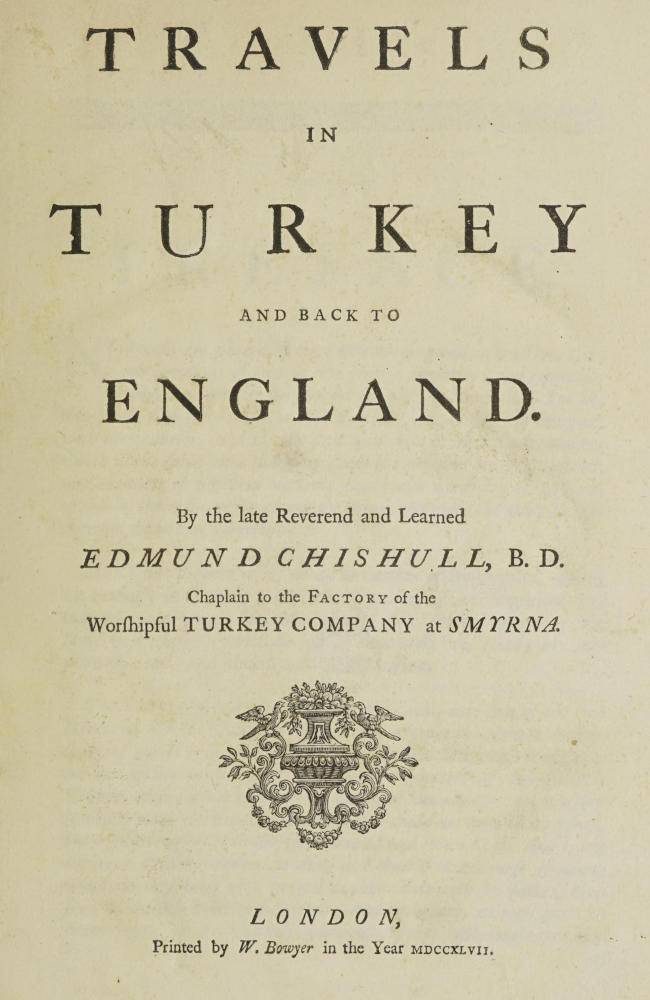
A travel journal recounts a voyage to Smyrna and a circuit through ancient Ionia, recording visits to coastal towns, inland ruins, and notable sites such as temples, theatres, and mosaic pavements. Entries combine daily travel detail with ethnographic observations on local manners and administration, while emphasizing antiquarian description of inscriptions, stonework, and architectural remnants. The editor supplements raw notes with classical citations and transcriptions, producing a careful field study that links on‑site observations to ancient authors and interprets material remains for readers interested in history and archaeology.