
- A.
- Abacus (for arithmetic), 60.
- Actors, 127, 154.
- Administration, imperial, 119 ff.
- Aesop, fables of, 73.
- Afrikaans in South African schools, 255.
- Age for beginning school, (pagan), 106;
- (Christian), 181.
- Agrimensores, 89.
- Agroecius, text-book of, 64.
- Alexandria, Christian schools at, 176.
- doctors of, 89.
- Alimenta, 138.
- Ambrose, hymns of, 237, 238.
- Analogists, 62.
- Annonae, 113.
- Anomalists, 62.
- Antecessores, 85.
- ἀντιθέσεις (rhetorical), 78.
- Antioch, school-life at, 52.
- Sophists of, 72.
- school-exercises at, 72 ff.
- Antiquities, 64, 65.
- ἄπαξ εὶρημένα and provincialisms, preserved by Marcellus, 88.
- Appointment of teachers, 113, 149.
- Aquitaine, connexion with Greece of, 220.
- distinction of, 46 ff.
- first to be Romanized, 27.
- morals of, 199.
- peacefulness of, 39.
- Archaism, prevalent in our period, 254.
- effect on education, 255.
- Archiatri, 88.
- Architecture at Trèves and Autun, 102, 234.
- Christian, 234.
- Arena, 154.
- Arithmetic, in Christian schools, 186.
- in pagan schools, 59.
- Art, in Catacombs, 235.
- natural to Gauls, 231.
- how modified in Gaul, 31, 232.
- Martin and Cassiodorus on, 234, 235.
- naturalistic in choice of subject, 31.
- possible school of, at Martres, 233.
- paintings, 236.
- produced by foreigners, 233.
- references in Ausonius, 231, 232.
- remains of in Gaul, 30.
- tendency to artificiality of, 232, 233.
- vases, ivories, &c., 235, 236.
- Artificiality, 160, 251-4.
- Astronomy, needed for poetry, 41, 67, 68.
- Authority, educational, of Quintilian, 57 ff., 183, 184.
- Autun (Augustodunum, Flavia Aeduorum), 28, 37, 38 ff., 102 ff., 136.
- eclipsed by Trèves, 48.
- soon Romanized, 38.
- B.
- Bagaudae, 37, 246, 249 and n.
- Barbarians, imperial attitude towards, 25, 26, 32.
- imperial policy towards, 31.
- invasions of, 142, 143, 243 ff.
- Bards among the Celts, 12.
- Bede on finger-computation, 59.
- Bible as text-book, 189, 229.
- influence on history, 218.
- Bishops, growth of power of, 153.
- Book-copying, (pagan), 58;
- (Christian), 186.
- Bordeaux, educational importance of, 46 ff.
- fortunes of, 47.
- Greek teachers of, 222.
- intellectual capital of Gaul, 46.
- Breves (reports on work of students), 107.
- Buildings, Roman, in Gaul, 30.
- at Autun, 102, 234.
- C.
- Capella, Martianus, seven acts of, 60.
- in Christian schools, 188.
- Cassiodorus, conception of art of, 235.
- Catacombs, art in, 235.
- Catechumen schools, 176, 178.
- Cathedra, 103.
- Celtic, survival of, 10 ff., 161.
- plant-names in, 88.
- Celts, boorishness of, 49 ff.
- character of, 12 ff., 199.
- worship Mercury, 11, 12.
- oratorical gift of, 12.
- priests of, 13.
- exclusive educational system of, 13, 14.
- Censure, ψόγος (rhetoric), 77.
- Centralization, effect of, on education, 144, 145.
- Charities, 155.
- Chreia (rhetoric), 73.
- kinds of, 74.
- Chronography, 210, 217.
- Church, adornment of, 232, 234, 235.
- contains aristocrats and intellectuals of the time, 156, 157.
- art in, described by Paulinus of Nola, 236.
- enthusiasm for education of, 40, 42, 54, 177 ff., 197.
- government of, 175.
- does not create new education, 162.
- gains individuality, 155.
- influence of, 153, 256.
- music in, 237.
- political significance of, 152 ff.
- reaction in, against paganism, 195.
- does not transform Roman Empire, 157.
- sincerity of, 257, 258.
- Church schools, rise of, 175 ff.
- scattered and indefinite, 181.
- not exclusively moral, 188.
- methods of, 193 ff.
- Citizenship, 128, 148, 218.
- Civil power, growth of, 119.
- Class distinction in society, 124 ff.
- Jullian’s statement concerning, 125 ff.
- Mommsen’s, 128.
- effect on education, 131.
- Class-rooms, 102, 182.
- Collegia, 127 ff.
- Coloni, 129.
- Comparison, σίγκρισις (rhetoric), 77.
- Confirmation, κατασκευή (rhetoric) 76.
- Conplatonicorum collegium, 80.
- Controversia de loco (surveying), 89.
- Controversiae, 69.
- Contubernium, 111, 112.
- Convictus, 111.
- Corporati, 127 ff.
- Cosmographia, of Aethicus Hister, 66.
- Courses, length of, 106.
- Courts, ecclesiastical, 152.
- Criticism, literary, 62.
- Curiales, 121, 126, 131.
- D.
- Description, ἔκφρασις (rhetoric), 78.
- Dictionaries, 65.
- Dictiones Ethicae, 69.
- of Ennodius, 69, 163 n.
- Discipline, (pagan), 53, 93 ff.;
- (Christian), 241.
- Quintilian on, 96.
- Disticha Catonis, 188.
- Doctors, exempt from military service, 88.
- State-paid, 88.
- teachers of their profession, 88, 89.
- chiefly provincials, 89.
- wealthy, 89.
- Donatus = grammar of Donatus, 63.
- Dress, academic, 107.
- Druids, philosophy of, 12, 82.
- Caesar’s account of, 13.
- learning of, derived from Britain, 13.
- use of writing among, 13.
- Cicero on science of, 13.
- exclusive nature of learning of, 13, 14.
- political influence of, 14.
- imperial policy towards, 15.
- persistence of, 15, 16.
- female, 15, 16.
- E.
- Education, abroad, of Gallic students, 240 ff.
- affected by art, 234, 237.
- authorities on, Quintilian supreme, 57 ff., 183, 184.
- effect of centralization on, 144.
- effect of class distinction on, 124 ff.
- Christian, in Gaul, 175 ff.
- control of, 93.
- decline of, 243.
- earlier Roman, 33 ff.
- elasticity in, advocated by Christians, 168.
- elementary, (pagan), 58;
- support given by Emperors to, 138, 139;
- (Christian), 175.
- epitome of, (pagan), 53.
- extent of, (pagan), 34 ff., 41 ff., 131 ff.;
- (Christian), 175, 178, 181, 190.
- female, 205.
- practised by Gallic Celts, 11 ff.
- general scope of, (pagan), 55, 56, 57.
- given by grammaticus, 60 ff.
- higher, (pagan), 68 ff.;
- (Christian), 191.
- history in, 205.
- ideals in, 249 ff.;
- of Isocrates and Cicero in, 158, 159;
- of Panegyrici Latini in, 160.
- imperial protection of, 36, 84, 85, 113, 135 ff.
- invaders’ influence on, 37, 47, 243 ff.
- Julian’s encouragement of, 2, 40, 113, 137.
- language question in, 223 ff.
- upheld by Massilia, 7 ff.
- place of memory in ancient, 90.
- monopolized by emperors, 113, 144, 145.
- moral, 198.
- organization of, (pagan), 102;
- (Christian), 182 ff.
- practice of, (pagan), 52 ff.;
- (Christian), 180 ff.;
- in Rhetores Graeci, 172 ff.
- private, 55, 103, 145, 182.
- prosperity of, in Gaul, 39 ff.
- public, growth of, 135.
- remuneration of, 112 ff.
- given by rhetor, 68 ff.
- based on rhetoric, 71 ff., 157 ff., 249.
- affected by roads, 29, 30, 248.
- stages of, 53, 55, 56, 103 ff.
- Ἐγκύκλιος παιδεία, 71.
- Ἑλληνισμός (purity of style), 73.
- Elocution, 61, 250, 251.
- Ἠθοποιία, characterization (rhetoric), 77.
- Eversores, 242.
- Examinations, 107.
- Exposition (enarratio), 61.
- F.
- Fables, in schools at Antioch, 72 ff., 187.
- forced interpretation of, 73.
- Fathers, Church, interest in education of, 178 ff.
- fondness for Rhetoric, 162 ff.
- reaction of, against rhetoric, 166 ff. (rusticitas).
- attitude to art, 234, 235, 237.
- harsh methods of, 194.
- manual labour of, 195.
- enthusiasm of, 40, 41, 177 ff.
- aim at simplicity, 166.
- nature of work of, 197.
- attitude to women, 206 ff.
- Fees, 115.
- Finger-computation, 59, 186.
- Flaccus, M. Verrius (see Dictionaries).
- Flavia Aeduorum (Autun), 28 ff.
- Flavius Caper (see Text-books).
- Floralia at Toulouse, 108.
- Florus (see Gauls, character of).
- Formula, magic, for medicine, 88.
- G.
- Gallic Latin, 21.
- Games, 97 ff.
- in home of Gallic aristocrat, 54.
- gladiatorial, 154, 155.
- Gaul, imperial status of, 42, 240.
- prosperity of schools of, 39 ff.
- Romanization of, 26 ff.
- students of, abroad, 240 ff.;
- how treated at Rome, 241, 242.
- Gauls, capacity for art, 231.
- supposed boorishness of, 49 ff., 221.
- character of, 11, 12, 199.
- capacity for eloquence, 11, 12, 141, 160.
- lively spirit of, 231.
- cultivate the panegyric, 141.
- Geography, supposed weakness of Romans in, 66.
- writers on, 66.
- in Ausonius, 67.
- function of, 66, 67, 215.
- Germans, forbidden to intermarry, 21.
- influence of, on Gaul, 20 ff.
- influence of, on Latin, 20, 21.
- influence of, on Romans, 19, 20.
- Gladiators, action concerning, 154, 155.
- Gnomê, γνώμη (rhetoric), 74.
- Goths, attitude of aristocrats towards, 25, 26.
- code of laws of, 24, 200.
- entertainments of, 23, 237.
- intellect of, 23.
- moral influence of, 199.
- not unpopular in Roman Gaul, 54.
- Grammar (modern sense), 64.
- Grammatikê, first treatise on, by Dionysius Thrax, 61.
- how regarded by Ennodius, 163.
- function of, 61.
- compared with Rhetoric, 68.
- criticized as non-ethical, 202.
- regarded as incentive to virtue, 203, 204.
- general scope of, 56.
- Greek, neglected by Ausonius, 222.
- in Church, 9, 44, 222, 223.
- decline of, 221 ff.
- in Gaul (second century), 35.
- influences gymnastics, 101.
- inscriptions in, 221.
- influence of Massilia in favour of, 4 ff., 161, 220.
- identified with paganism, 220.
- Quintilian on, 229.
- found difficult by schoolboys, 55, 222, 223, 224.
- why found difficult, 225 ff.
- Guilds, 127 ff.
- Gymnastics, regarded with disfavour by Romans, 99.
- due to Greek influence, 101.
- Quintilian on place of, 100.
- H.
- Head masters, 116, 182, 184.
- Heiresses, married by Bordeaux teachers, 133.
- History, 57, 209 ff.
- Constitutional, 65.
- ancient conception of, 211 ff.
- Christian influence on, 217.
- directed by imperial policy, 66, 210, 215, 216.
- logical and psychological value of, 219.
- moral value of, 219.
- ruled by rhetoric, 214, 215.
- treated as side issue, 210, 211.
- haphazard study of, 213.
- Holidays, increase of Christian, 109.
- attitude of Church to pagan, 110.
- Floralia at Toulouse, 108.
- easily produced, 110, 111.
- less splendid in provinces than at Rome, 108.
- Home, literary atmosphere of, 54.
- education, 103, 145, 182.
- Hours, school, 107.
- Hymns, antiphonal, 238.
- influence of Augustine, 237.
- contribution of Gaul, 239.
- importance of, for modern metres, 239.
- origin of, 237, 238.
- used in schools, 237, 238.
- I.
- Ideals, Pagan and Christian, 249 ff.
- of Isocrates and Cicero, 158, 159.
- of Panegyrici Latini, 160.
- Imperial interest in schools, 36, 84, 85, 113, 135 ff., 146.
- Inscriptions, 4, 15, 45, 46, 99, 161, 182, 203, 221, 242.
- Intermarriage, between Roman and barbarian, 21 (ff. 248, 249)
- between different classes in society, 127.
- Invasions, 37, 47, 243 ff.
- affect education through slaughter of children, 248.
- J.
- Jurisdiction, civil, passes over to Church, 152.
- K.
- Κατηγορία (rhetoric), 78.
- Knowledge, low general standard of, 124 ff., 175, 181, 190.
- widespread among Christians, 40, 42, 43, 54, 177, 178, 179, 196.
- made a matter of class by Celts, 13, 14.
- affected by imperial protection, advantageously, 135 ff.;
- disadvantageously, 144 ff.
- Κοινόβιοι, original idea of monastery, 177.
- Κοινὸς τόπος (rhetoric), 76.
- L.
- Labour, manual, 155, 195.
- La Tène Civilization, 14.
- Law, Arles a centre of, 83.
- connexion with imperial policy, 84.
- increased interest in, during fifth century, 82.
- Justinian on teaching of, 84, 85.
- Civil magistrates drawn from profession of, 85.
- Roman, passes into Church, 153.
- students of, go to Rome, 83, 84, 241.
- few teachers of, 82.
- Lawyers, as lecturers (antecessores), of Massilia, 82.
- bad reputation of, 86, 87.
- Lector, 181, 183.
- ordination and qualifications of, 184.
- Lérins, education at, 177, 179, 180, 187, 190, 195.
- Lesson, method of conducting in pagan schools, 60.
- Literature, enthusiasm for, 43, 131, 140.
- pagan, banned by Christians, 169 ff., 206, 260;
- reason for exclusive attitude toward, 170, 171;
- partially accepted by wiser Christians, 172, 173, 188;
- form of, used by Christians, 189.
- Litterae formatae, 223.
- Litterator (elementary teacher), 105.
- Locus communis, κοινὸς τόπος, 76.
- Vergilianus, 69.
- Ludi Florales, 108.
- λύσεις (rhetoric), 78.
- M.
- Maeniana, meaning of, 38.
- school at Autun, 38, 41, 100, 102.
- Magic, in medicine, 88.
- Manumissions, in Church, 152.
- Maps, 66, 67.
- imperial use of, 66, 215, 216.
- Martyrum, Acta, 9, 185, 210.
- Masses, ignorance of, 130, 131, 175, 190.
- Massilia, art of, 5.
- coins of, 4.
- culture of, 6.
- Christian place of refuge, 10, 177, 178, 200 note.
- doctors of, 87.
- educational centre, 6, 7.
- lawyers of, 82.
- languages of, 8, 9.
- part placed by, 9.
- friendship with Rome, 5.
- teachers of, 8.
- contrasted with surrounding tribes, 7.
- effect on surrounding tribes, 7, 8.
- St. Victor, monastery of, at, 10, 177, 178.
- Mathematics, of primary school, 60.
- came to Rome from Egypt, 89.
- Medicine, studied by Ausonius’s aunt, 41.
- influence of Massilia on, 87.
- a lucrative profession, 89.
- prominence of provincials in, 89.
- no separate school of, 87.
- superstition in, 88.
- Memory, place of, in ancient education, 91, 92.
- Mendicancy, law against, 155.
- Merces (fees), 115.
- Mercury, worshipped in early Gaul, 11 ff.
- Metres, modern, developed by Christian hymns, 239.
- Military power, decreases in later Empire, 119.
- Minerval (fees), 115.
- Mnemonics, 90.
- Monasticism, rise of, in Gaul, 177.
- widespread educational influence of, 178.
- not yet organized by St. Benedict, 166, 181.
- Monks, trained in Arts of Capella, 188.
- appreciation of their work, 197.
- harsh discipline of, 193, 194.
- efficiency of, as teachers, 196.
- educated chiefly at Lérins and Marseilles in fifth century, 179.
- manual labour of, 193, 194.
- attitude of, to Rhetoric, 162 ff.
- Music, work of Augustine on, 237.
- ecclesiastical, 237.
- among the Goths, 23.
- mentioned in school exercises, 73.
- frivolous nature of, at Rome, 237.
- N.
- Narration, διήγημα (rhetoric), 73.
- Nationalism in Roman Empire, 18, 19, 219.
- Neoplatonism, 192.
- Newspapers, professors used instead of, 140.
- Notarii, (pagan), 59;
- (Christian), 185.
- Number of pupils at Bordeaux, 105.
- O.
- Oblati, 181.
- Organization, of pagan schools, 102;
- of Christian schools, 182.
- Oxford, compared with Bordeaux University, 135.
- P.
- Paedagogus, 52.
- protects child from evil influences, 53.
- Paganism, artificiality of, 160, 251-4.
- Paganism, attitude of Christians towards, 42 ff., 169 ff.
- bitterness of, 170 ff.
- neglects elementary education, 175.
- neglects education of lower classes, 124 ff.
- persists in holidays, 110.
- persists in rhetorical tradition, 162 ff.
- how Christianity supplemented, 175, 191, 195.
- Palladia, name for Toulouse, 34.
- Panegyric, archaism of, 254.
- one of teacher’s duties, 141.
- historical value of, 33 note.
- imperial use of, 146.
- merits of, 251.
- servility of, 146 ff.
- Panegyrists, genuinely grateful to Emperor, 142.
- hysterically loud in his praise, 146 ff.
- Greek learning of, 221.
- Patriotism, inculcated by history, 218.
- Pelagianism, 192.
- Philology, 62, 189.
- Philosophy, of Ausonius, 81.
- Christian, 191 ff.
- of Claudianus Mamertus, 192, 193.
- of history, 217.
- in grammarian’s school, 79, 203.
- among litterati of Gaul, 79 ff.
- connected with natural sciences, 80.
- neglect of, 81.
- Jung’s theory to account for neglect of, 81, 82.
- influence of Pythagoras on, 193.
- Physicians, State-paid, 88.
- Πιθανότης (rhetoric), 73.
- Plato, how regarded by Christians, 80, 193.
- Platonic club, 80, 112.
- Play, 97 ff.
- Poetry, in pagan schools, 56, 57, 68, 69.
- in Christian schools, 169, 188, 206.
- Poor scholars, support of, 138.
- Pottery, 31.
- Praefectus Galliarum, Ausonius becomes, 119.
- Praise, ἐγκώμιον (rhetoric), 76.
- Prescriptions, book of, by Marcellus Empiricus, 88.
- Primus magister (litterator), 104, 105.
- Progymnasmata, 72 ff.
- Proscholus, 105.
- Provinces, exposed to attacks of barbarians, 47, 48, 244.
- divisions of society in, 121.
- advantages of imperial protection of, 122, 141 ff.
- disadvantages of imperial protection of, 123, 144 ff., 215.
- government of, 18, 24, 29, 31, 119 ff., 249.
- status of, 32, 240.
- Salvian on misgovernment of, 249 note.
- Q.
- Qualifications of teacher, 137 (Julian’s decree); 138 (decree of Valentinian and Valens).
- Querolus, fourth-century comedy, 171, 200.
- R.
- Reader, Church, see Lector.
- Reading, in Christian schools, 183.
- in pagan schools, 59.
- clearness and intonation aimed at, 61.
- Quintilian on, 59, 61 n., 183.
- Refutation, ἀνασκευή (rhetoric), 74.
- perverse method of, 75.
- Research, attitude towards, 212, 213.
- Restrictions, local, due to imperial protection, 127.
- Rhetores Graeci, 71.
- Rhetoric, advantages of, 249-51.
- disadvantages of, 251-6.
- natural to Gauls, 11, 12, 16.
- persistence of, 157 ff.
- power of, 160.
- how regarded by Ennodius, 163.
- of Hilary of Arles, 165.
- of Hilary of Poitiers, 164, 167.
- ideal of Isocrates in, 158, 159.
- ideal of Cicero in, 159.
- ideal of Panegyrists in, 160.
- increasing futility of, 158.
- why a failure, 256.
- predominant in schools, 162.
- prominent in Gaul, 11, 39, 50, 51, 160, 161.
- general scope of, in schools, 68.
- stages of, in schools, 69.
- universality of, 70.
- Roads, influence of, on education, 29, 30, 248.
- Romanization, 26 ff.
- causes of, in Gaul, 31.
- not quite complete, 27, 29.
- proved by archaeological remains, 30.
- Rusticitas, 166 ff.
- S.
- Salaries of teachers, amount of, 114.
- enactments of Vespasian and Gratian concerning, 113.
- gifts of Emperor supplement, 115.
- paid at one time by parents, 115.
- paid sometimes by individual towns, 114.
- paid by State first in Gaul, 112.
- unequal, 112.
- Schola, meaning of, in fourth century, 103.
- Schoolboy, picture of, in Libanius, 52.
- Schoolroom, nature of, (pagan), 102;
- (Christian), 182.
- Schools (see Education), grades of, 103 ff.
- private adventure, discouraged, 113.
- Sculpture (see Art).
- Semi-Pelagianism, 192.
- Sententia, γνώμη (rhetoric), 74.
- Shorthand, (pagan), 59;
- (Christian), 185, 186.
- Slaves, education of, 128, 129.
- new attitude to, 153.
- decrease of, reasons for, 154.
- Social life of Bordeaux teacher, 132 ff.
- Stage, action of Church against, 154.
- unhealthy state of Gallic, 199.
- State, relation of, to Church, 151 ff.
- overshadowed by Church, 152, 153.
- flouted by Church, 156.
- as the champion of the Church, 156.
- passes on its law and organization to Church, 153.
- pays teaching doctors, 88.
- pays teaching lawyers, 85.
- pays school-teachers, 112 ff.
- protects education materially and spiritually, 135 ff.
- Stationes (of lecturing lawyers), 85.
- Strenae, gifts of Emperor, 115 and note.
- Studies, decline of, 243.
- primary, (pagan), 58 ff.;
- (Christian), 175 ff.
- secondary, (pagan), 68 ff.;
- (Christian), 191.
- Subdoctor (proscholus), 105.
- συνηγορία (rhetoric), 78.
- superstition, in Astronomy, 67, 68.
- in Medicine, 88.
- T.
- Teachers, appointed by Emperor, 136, 139.
- to be approved of by Emperors, 113, 137, 138.
- at Antioch, 72 ff.
- benefits bestowed by Emperor, 136 ff.
- conviviality of, at Bordeaux, 133 ff.
- encouraged by Julian, 2, 40, 113, 137.
- Gratitude of, to Emperor, 142.
- Greek, at Rome, 135, 136.
- harshness of, (pagan), 53, 93 ff.;
- (Christian), 193 ff.
- intellect of, (pagan), 134;
- (Christian), 193.
- methods of, (pagan), 52 ff., 90 ff., 93 ff.;
- (Christian), 180 ff., 193 ff.
- of morals, 203.
- number appointed at Bordeaux, 115, 116.
- public, gradually recognized at Rome, 136.
- remuneration of, 112 ff.
- social status of, 134, 135.
- State, forbidden to teach privately, 145.
- unhappiness of, 132.
- whether they followed pupils from class to class, 116 ff.
- Teaching, private, (pagan), 55, 103, 145;
- (Christian), 182.
- public (see Education).
- Text-books, 63, 189, 193.
- of Donatus, 63.
- of Sinnius Capito, 64 ff.
- epitomes of Varro, 65.
- Vergil, in pagan schools, 55, 56, 62, 69 et passim;
- in Christian schools, 162, 169, 174, 187, 197.
- Theatres, Gallic, Salvian’s condemnation of, 199.
- Theodosian Code, 82, 88, 90, 129, 133, 137, 152 n., 153, 200, 201 et passim.
- Thesis (rhetoric), 78.
- Trèves, eclipses Autun in importance, 48.
- buildings of, 30.
- imperial capital, 30, 34, 48.
- predominantly military, 48.
- U.
- Universalism of Christianity, 217.
- University, residential, germ of, 111.
- V.
- Vates (οὐάτεις) among Celts, 12.
- Victor St., monastery of, 10, 177, 178.
- W.
- Women, attitude of Christians towards, 155, 205 ff.
- education of, influenced by Christianity, 205, 207;
- at Rome, 206;
- objected to by Claudius Victor, 206;
- in Sidonius, 207;
- small on the whole, 209.
- friends of Jerome, 208.
- intellect of, praised by Sedulius, 208;
- by Ennodius, 209.
- Writing, in Christian schools, 184.
- in pagan schools, 58.
- among Druids, 13.
- Quintilian on, 58, 184.
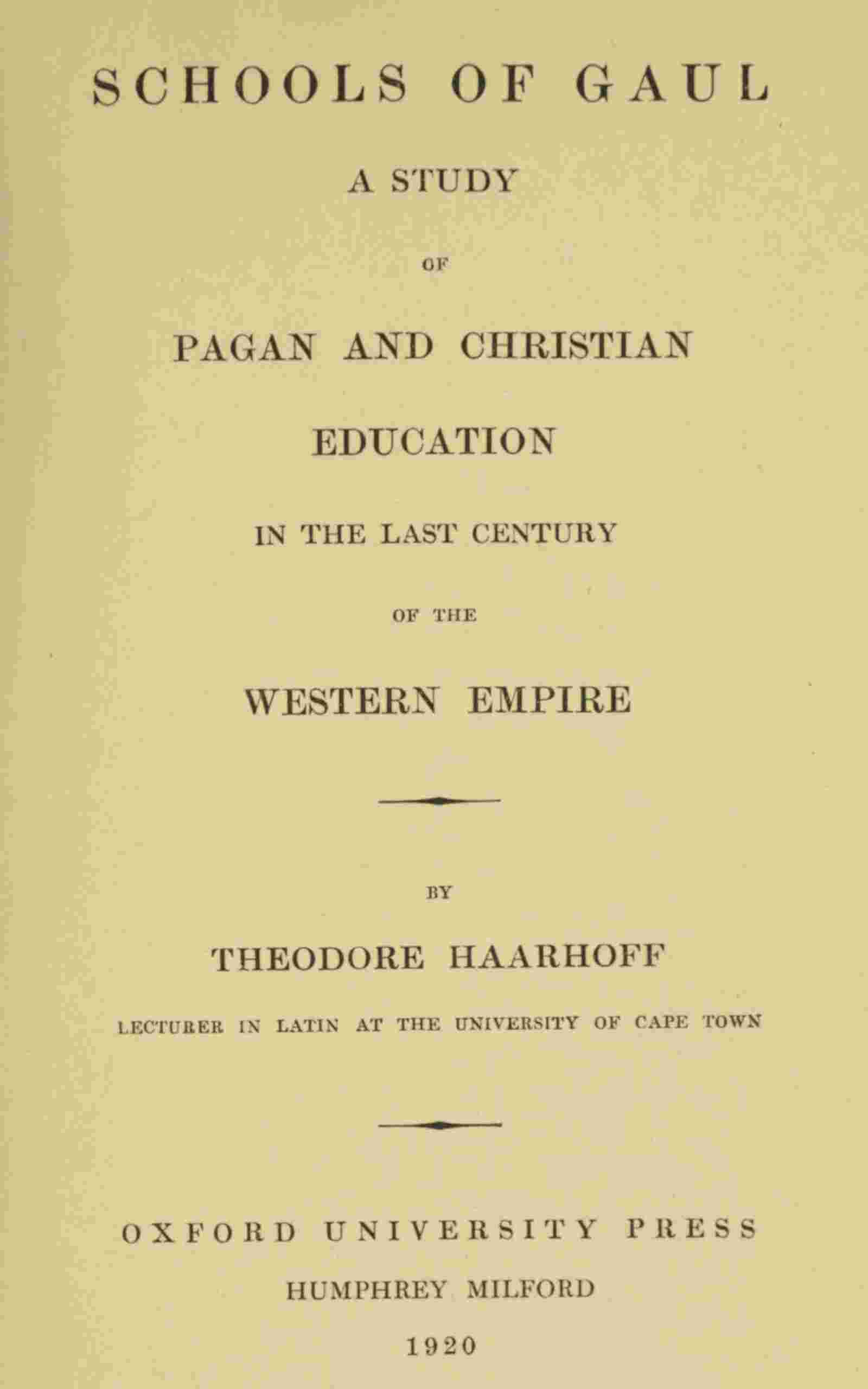
Schools of Gaul in the last century of the Western Empire
Explore more books like this:
About This Book
The study examines education in late Roman Gaul during its transition from pagan public schooling to Christian instruction, showing how Roman rhetorical and legal frameworks kept Latin uniform even as social change, ethnic mixing, and the decline of Greek reshaped curricula. It surveys methods of teaching language and history, the clergy's shift to simpler idiom to reach vernacular audiences, and the transmission of Roman pedagogy into medieval institutions. The work also considers the effects of political disorder on schools and revisits contemporary sources to correct misconceptions and illuminate the period's educational dynamics.