
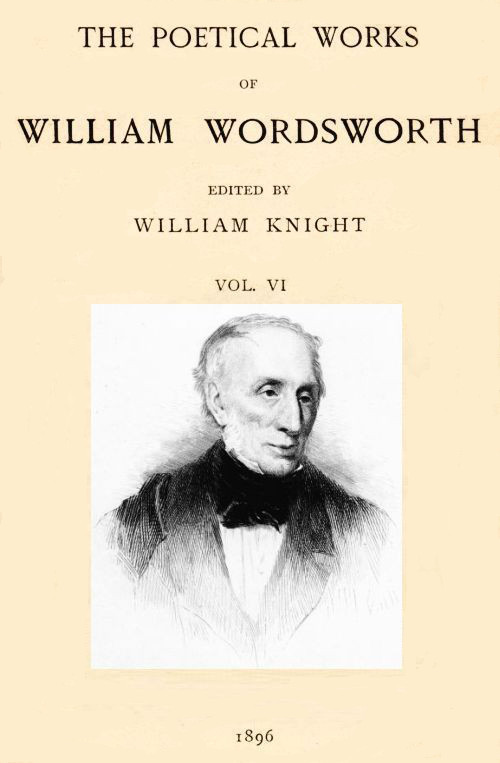
The Project Gutenberg eBook of The Poetical Works of William Wordsworth — Volume 6 (of 8)
Title: The Poetical Works of William Wordsworth — Volume 6 (of 8)
Author: William Wordsworth
Editor: William Angus Knight
Release date: December 13, 2014 [eBook #47651]
Most recently updated: October 24, 2024
Language: English
Credits: Produced by Jonathan Ingram, Jane Robins and the Online
Distributed Proofreading Team at http://www.pgdp.net
THE POETICAL WORKS
OF
WILLIAM WORDSWORTH
VOL. VI
THE POETICAL WORKS
OF
WILLIAM WORDSWORTH
EDITED BY
WILLIAM KNIGHT
VOL. VI
London
MACMILLAN AND CO., Ltd.
NEW YORK: MACMILLAN & CO.
1896
CONTENTS
1814
| PAGE | |
| Laodamia | 1 |
| Memorials of a Tour in Scotland— | |
| The Brownie's Cell | 16 |
| Composed at Cora Linn, in sight of Wallace's Tower | 26 |
| Effusion, in the Pleasure-Ground on the Banks of the | |
| Bran, near Dunkeld | 28 |
| "From the dark chambers of dejection freed" | 33 |
| Yarrow Visited | 35 |
| Lines written on a blank leaf in a copy of the author's poem | |
| The Excursion, upon hearing of the death of the late Vicar of Kendal | 40 |
1815
| PAGE | |
| Dedication to the White Doe of Rylstone | 42 |
| Artegal and Elidure | 45 |
| To B.R. Haydon | 61 |
| November 1 | 63 |
| September, 1815 | 64 |
| "The fairest, brightest, hues of ether fade" | 65 |
| "Weak is the will of Man, his judgment blind" | 67 |
| "Hail, Twilight, sovereign of one peaceful hour!" | 67 |
| "The Shepherd, looking eastward, softly said" | 68 |
| "Even as a dragon's eye that feels the stress" | 69 |
| "Mark the concentred hazels that enclose" | 71 |
| "Surprised by joy—impatient as the Wind" | 72 |
1816
| PAGE | |
| Ode. The Morning of the Day appointed for a General Thanksgiving. | |
| January 18, 1816 | 74 |
| Ode | 88 |
| Invocation to the Earth | 95 |
| Ode | 96 |
| Ode | 104 |
| The French Army in Russia, 1812-13 | 107 |
| On the Same Occasion | 109 |
| Siege of Vienna raised by John Sobieski | 110 |
| Occasioned by the Battle of Waterloo | 111 |
| Occasioned by the Battle of Waterloo | 112 |
| "Emperors and Kings, how oft have temples rung" | 113 |
| Feelings of a French Royalist, on the Disinterment of the | |
| Remains of the Duke D'Enghien | 114 |
| Dion | 116 |
| A Fact, and an Imagination; or, Canute and Alfred, on the | |
| Sea-shore | 130 |
| "A little onward lend thy guiding hand" | 132 |
| To ——-, on her first Ascent to the Summit of Helvellyn | 135 |
1817
| PAGE | |
| Vernal Ode | 138 |
| Ode to Lycoris | 145 |
| To the Same | 149 |
| The Longest Day | 153 |
| Hint from the Mountains, for certain Political Pretenders | 156 |
| The Pass of Kirkstone | 158 |
| Lament of Mary Queen of Scots | 162 |
1818
| PAGE | |
| The Pilgrim's Dream; or, the Star and the Glow-worm | 167 |
| Inscriptions supposed to be found in and near a Hermit's Cell | 170 |
| Composed upon an Evening of Extraordinary Splendour and Beauty | 176 |
1819
| PAGE | |
| This, and the two following, were suggested by Mr. W. Westall's Views | |
| of the Caves, etc., in Yorkshire | 183 |
| Malham Cove | 184 |
| Gordale | 185 |
| Composed during a Storm | 187 |
| "Aerial Rock—whose solitary brow" | 187 |
| The Wild Duck's Nest | 189 |
| Written upon a blank leaf in "The Complete Angler" | 190 |
| Captivity—Mary Queen of Scots | 191 |
| To a Snow-Drop | 191 |
| "When haughty expectations prostrate lie" | 192 |
| To the River Derwent | 193 |
| Composed in one of the Valleys of Westmoreland, on Easter Sunday | 194 |
| "Grief, thou hast lost an ever ready friend" | 195 |
| "I watch, and long have watched, with calm regret" | 197 |
| "I heard (alas! 'twas only in a dream)" | 198 |
| The Haunted Tree | 199 |
| September, 1819 | 201 |
| Upon the Same Occasion | 202 |
1820
| PAGE | |
| Composed on the Banks of a Rocky Stream | 208 |
| On the Death of His Majesty (George the Third) | 209 |
| "The stars are mansions built by Nature's hand" | 210 |
| To the Lady Mary Lowther | 211 |
| On the Detraction which followed the Publication of a certain Poem | 212 |
| Oxford, May 30, 1820 | 213 |
| Oxford, May 30, 1820 | 214 |
| June, 1820 | 214 |
| The Germans on the Heights of Hock Heim | 216 |
| A Parsonage in Oxfordshire | 217 |
| To Enterprise | 218 |
| The River Duddon— | |
| To the Rev. Dr. Wordsworth | 227 |
| "Not envying Latian shades—if yet they throw" | 230 |
| "Child of the clouds! remote from every taint" | 231 |
| "How shall I paint thee?—Be this naked stone" | 232 |
| "Take, cradled Nursling of the mountain, take" | 233 |
| "Sole listener, Duddon! to the breeze that played" | 234 |
| Flowers | 235 |
| "Change me, some God, into that breathing rose!" | 237 |
| "What aspect bore the Man who roved or fled" | 237 |
| The Stepping-Stones | 239 |
| The Same Subject | 240 |
| The Faëry Chasm | 241 |
| Hints for the Fancy | 242 |
| Open Prospect | 243 |
| "O mountain Stream! the Shepherd and his Cot" | 245 |
| "From this deep chasm, where quivering sunbeams play" | 245 |
| American Tradition | 246 |
| Return | 248 |
| Seathwaite Chapel | 249 |
| Tributary Stream | 250 |
| The Plain of Donnerdale | 251 |
| "Whence that low voice?—A whisper from the heart" | 252 |
| Tradition | 253 |
| Sheep-Washing | 253 |
| The Resting-Place | 254 |
| "Methinks 'twere no unprecedented feat" | 255 |
| "Return, Content! for fondly I pursued" | 255 |
| "Fallen, and diffused into a shapeless heap" | 256 |
| Journey Renewed | 257 |
| "No record tells of lance opposed to lance" | 258 |
| "Who swerves from innocence, who makes divorce" | 260 |
| "The Kirk of Ulpha to the pilgrim's eye" | 260 |
| "Not hurled precipitous from steep to steep" | 261 |
| Conclusion | 262 |
| After-Thought | 263 |
| Postscript | 264 |
| Note to Sonnets XVII. and XVIII. | 267 |
| Memoir of the Rev. Robert Walker | 270 |
| Memorials of a Tour on the Continent— | |
| Dedication | 285 |
| Fish-women—on Landing at Calais | 286 |
| Brugès | 288 |
| Brugès | 290 |
| After visiting the Field of Waterloo | 292 |
| Between Namur and Liege | 293 |
| Aix-la-Chapelle | 295 |
| In the Cathedral at Cologne | 297 |
| In a Carriage, upon the Banks of the Rhine | 299 |
| Hymn, for the Boatmen, as they approach the Rapids under the | |
| Castle of Heidelberg | 301 |
| The Source of the Danube | 303 |
| On approaching the Staubbach, Lauterbrunnen | 306 |
| The Fall of the Aar—Handec | 308 |
| Memorial, near the Outlet of the Lake of Thun | 310 |
| Composed in one of the Catholic Cantons | 312 |
| After-Thought | 315 |
| Scene on the Lake of Brientz | 315 |
| Engelberg, the Hill of Angels | 316 |
| Our Lady of the Snow | 318 |
| Effusion, in Presence of the Painted Tower of Tell, at Altorf | 321 |
| The Town of Schwytz | 324 |
| On hearing the "Ranz des Vaches" on the Top of | |
| the Pass of St. Gothard | 326 |
| Fort Fuentes | 328 |
| The Church of San Salvador, seen from the Lake of Lugano | 332 |
| The Italian Itinerant, and the Swiss Goatherd | 338 |
| The Last Supper, by Leonardo da Vinci, in the Refectory of the | |
| Convent of Maria della Grazia—Milan | 343 |
| The Eclipse of the Sun, 1820 | 345 |
| The Three Cottage Girls | 351 |
| The Column intended by Buonaparte for a Triumphal | |
| Edifice in Milan, now lying by the wayside in the Simplon Pass | 356 |
| Stanzas composed in the Simplon Pass | 357 |
| Echo, upon the Gemmi | 360 |
| Processions. Suggested on a Sabbath Morning in the | |
| Vale of Chamouny | 363 |
| Elegiac Stanzas | 371 |
| Sky-Prospect—From the Plain of France | 377 |
| On being Stranded near the Harbour of Boulogne | 378 |
| After Landing—the Valley of Dover, Nov. 1820 | 380 |
| At Dover | 381 |
| Desultory Stanzas, upon receiving the preceding Sheets from the Press | 382 |
| Appendix— | |
| Note A | 387 |
| Note B | 389 |
| Addendum | 396 |
WORDSWORTH'S POETICAL WORKS
1814
The Excursion—to which the fifth volume of this edition is devoted—has been assigned to the year 1814; since it was finished, and first published, in that year,—although commenced in 1795. During the earlier stages of its composition, this poem was known, in the Wordsworth household, as "The Pedlar"; and Dorothy Wordsworth tells us in one of her letters to the Beaumonts, preserved amongst the Coleorton MSS., that "The Pedlar" was finished at Christmas 1804. See also the Memoirs of Wordsworth, by his nephew (vol. i. p. 304, etc.), and Dorothy's Grasmere Journal, passim. But The Excursion, as we have it now, was finished for press in 1814. The poems more immediately belonging to that year are Laodamia, the Memorials of a Tour in Scotland, Dion, and two Sonnets.—Ed.
LAODAMIA
Composed 1814.—Published 1815.
[Written at Rydal Mount. The incident of the trees growing and withering put the subject into my thoughts, and I wrote with the hope of giving it a loftier tone than, so far as I know, has been given to it by any of the Ancients who have treated of it. It cost me more trouble than almost anything of equal length I have ever written.—I.F.]
In 1815 and 1820 this poem was one of those "founded on the Affections"; afterwards it was classed among the "Poems of the Imagination."—Ed.
After meeting the Wordsworths at Charles Lamb's, on the 9th May 1815, Henry Crabb Robinson wrote in his Diary: "It is the mere power which he is conscious of exerting in which he delights, not the production of a work in which men rejoice on account of the sympathies and sensibilities it excites in them. Hence, he does not much esteem his Laodamia, as it belongs to the inferior class of poems founded on the affections." (See Diary, Reminiscences, and Correspondence, vol. i. p. 482.)
Wordsworth wrote thus to Walter Savage Landor, from Rydal Mount, on the 21st of January 1824:—
"You have condescended to minute criticism upon the Laodamia.[D] I concur with you in the first stanza, and had several times attempted to alter it upon your grounds. I cannot, however, accede to your objection to the 'second birth,' merely because the expression has been degraded by Conventiclers.[E] I certainly meant nothing more by it than the eadem cura, and the largior æther, etc., of Virgil's Sixth Æneid. All religions owe their origin or acceptation to the wish of the human heart to supply in another state of existence the deficiencies of this, and to carry still nearer to perfection what we admire in our present condition, so that there must be many modes of expression arising out of this coincidence, or rather identity of feeling common to all Mythologies; and under this observation I should shelter the phrase from your censure—but I may be wrong in the particular case, though certainly not in the general principle. This leads to a remark in your last—'that you are disgusted with all books that treat of religion.' I am afraid it is a bad sign in me, that I have little relish for any other. Even in poetry it is the imaginative only, viz., that which is conversant with or turns upon Infinity, that powerfully affects me. Perhaps I ought to explain: I mean to say that except in those passages, where things are lost in each other, and limits vanish, and aspirations are raised, I read with something too like indifference; but all great Poets are in this view powerful Religionists."
In 1815 Charles Lamb wrote to Wordsworth, "Laodamia is a very original poem; I mean original with reference to your own manner. You have nothing like it. I should have seen it in a strange place, and greatly admired it, but not suspected its derivation." (The Letters of Charles Lamb, edited by Alfred Ainger, vol. i. p. 284.)
Mr. Hazlitt wrote of Laodamia: "It breathes the pure spirit of the finest fragments of antiquity—the sweetness, the gravity, the strength, the beauty, and the languor of Death. Its glossy brilliancy arises from the perfection of the finishing, like that of careful sculpture, not from gaudy colouring—the texture of the thoughts has the smoothness and solidity of marble. It is a poem that might be read aloud in Elysium, and the spirits of departed heroes and sages would gather round to listen to it."
I am indebted to the Headmaster of Fettes College, Edinburgh, the Rev. W. A. Heard, for the following illustrative notes on Laodamia:—
"This poem illustrates more completely than any other the sympathy of the poet with the spirit of antiquity in its purest and most exalted forms. The idea that underlies the poem is the same conception of 'pietas' which Virgil has embodied in the Æneid, and with which he has associated, especially in the sixth book, which Wordsworth in many passages recalls, great ethical and religious conceptions, derived in the main from the philosophy of Plato. 'Pietas' embraces all the duties of life that are based upon the affections—love of home and parents and children, love of the Gods of our Fathers, and a reverence for that great order of things in which man finds himself a part. The pious man believes in a destiny, or order transcending his own will: to exalt any passion, however innocent, above this, is a rebellion; to intensify any passion, so as to disturb the appropriate calm of resignation, is to act irreverently against the gods. Lesser duties must give way to greater: love of wife must give way to love of country, and the sorrow of bereavement must not obscure the larger issues of life. Thus, not only did Laodamia's yearning for the restoration of her husband to life show a failure to recognise the fixity of eternal laws, but her death was 'ὑπὲρ μόρον' and in reason's spite; it was, after all, self-will, and could not win the favour of heaven.
Blending with this notion of 'pietas,' we find the Platonic repudiation of sensuous and material life. This life is only a discipline under imperfect conditions, and to be set free from the passion and fretfulness of existence is the choice and longing of the wise.
The poem is thus notable, not so much for the assimilation of details, as for natural affinity to the spirituality of antiquity, of which Virgil is the purest exponent. Virgil's seriousness, his tenderness, his conception of the inevitable, and yet moral, order of the world, his desire for purification, his sadness, and yet complete freedom from unmanliness, his love of nature and belief in the sympathy of nature with man—all these are points of contact between the ancient and modern poet.